
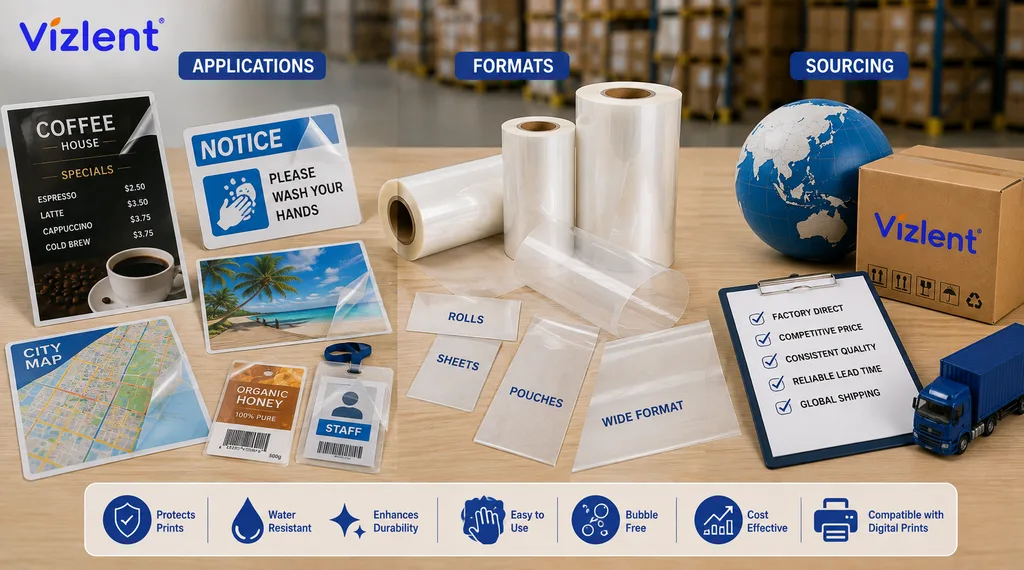
Unsure where to use cold laminating film? Cold laminating film is used when the printed construction cannot tolerate the thermal process, or when heat free application is preferred at the point of use. That covers inkjet and photo output, printed vinyl, thermal receipt stock, rigid boards, and any job finished by hand in the field. The adhesive is already active under a release liner, so pressure and dwell do the work that heat would otherwise do.
The second reason to choose it has nothing to do with heat at all. Certain cold overlaminates are available with UV and abrasion resistance suited to demanding outdoor applications, which is why outdoor graphics and equipment labels lean on them. Format flexibility matters too, since the same chemistry ships as sheets, pouches, and continuous rolls.
What Is Cold Laminating Film?
What is cold laminating film, also called a cold overlaminate or a pressure sensitive overlaminate: a face stock, a pressure sensitive adhesive, and a silicone coated release liner protecting it until application. Published specifications for the cold lamination films in the Vizlent range list PET, BOPP, and PVC face stocks across 1.0 mil to 15.0 mil. Adhesive systems are commonly solvent acrylic or water based acrylic, though the datasheet is what tells you which one a given construction uses.
The mechanism separates it from heated processes. No adhesive has to be melted, so the film bonds at room temperature under roller or hand pressure, then keeps building adhesion. For applicable Vizlent cold film constructions, published guidance on cold laminating specifies full adhesion at 24 to 72 hours, while other products can require different dwell periods.
- Face stock: PET, BOPP, or PVC, selected for clarity, conformability, or abrasion resistance
- Adhesive: high tack acrylic, formulated to hold on low surface energy plastics
- Liner: silicone coated paper or PET, peeled away during application
- Finish: gloss for color saturation, matte for glare control and writability
Where to Use Cold Laminating Film: The Application Map
Sorting applications by why cold film was chosen, not by industry, makes the decision faster. Three common motives cover many jobs: the substrate cannot take heat, the environment demands UV and abrasion protection, or the work happens where a machine cannot go. Many real orders sit in one of those three, and some sit in two at once.
Buyers who work backwards from the motive rarely specify the wrong construction. A photo lab and a sign shop can order the same 3 mil gloss PET overlaminate for different reasons, and both are right. The mistake is ordering by film name instead of by service condition.
Heat Sensitive Printed Media
Some inkjet, dye sublimation, and thermal receipt media change under a heated nip, so heat compatibility should be confirmed before thermal lamination. Thermal paper develops color when its coating warms, so a heated process can grey the image before it reaches the exit rollers. Photographic prints, fine art paper, and backlit media belong in the same test first group.
Digital toner output is the ambiguous case, and deserves a sample run rather than an assumption. Some toner and coating combinations tolerate heat well, while others gloss over or lift where the coverage is heaviest. Run a representative test strip at production conditions, then inspect it immediately and again after the appropriate conditioning period.
Outdoor Signage and Vehicle Graphics
Wide format prints on vinyl and banner media are major applications for cold overlamination. The print is usually heat sensitive, and the finished graphic needs UV, moisture, and abrasion protection a thin overlaminate cannot supply. Heavier calendered PVC grades exist for wraps and floor graphics, where scuff resistance matters more than optical perfection.
Service life claims deserve scrutiny here more than anywhere else. Outdoor performance covers print, ink, adhesive, and overlaminate together, so a film rating means little without a stated climate, orientation, and cleaning regime. Pairing the overlaminate with outdoor weather resistant materials keeps the whole stack rated for the same exposure.
Industrial and Compliance Labels
Equipment nameplates, drum labels, and safety markings often use a clear overlaminate to protect printed text from solvents and handling. Face stock drives the service window, and examples from specific Vizlent self adhesive material constructions include PET at -40°F to 300°F, PVC at -20°F to 180°F, and BOPP at -20°F to 175°F. Those are construction specific ratings rather than properties of the plastic family, so confirm them per product.
Compliance documentation runs alongside the physical specification. For applicable durable marking systems, UL 969 sets requirements for permanence and legibility under specified conditions, evaluating the label as a complete system of stock, ink, overlaminate, and surface. ANSI Z535.4 governs the format of product safety signs and labels, covering signal words, colors, and panel layout rather than overlaminate durability.
Cold Laminating Film vs Hot Lamination: Picking the Method
The cold laminating film vs hot question resolves on the printed construction, not on preference or inventory. Thermal films can deliver strong clarity and favourable unit economics in some high volume applications, provided the substrate, ink, and coating tolerate the specified activation window. If any layer in that stack softens, shrinks, or shifts color, pressure sensitive film is the answer.
Converting steps tip the balance back. Some thermal constructions provide useful edge stability during die cutting and creasing, which is why book covers and cartons commonly run hot. The temperature bands in how hot a laminator gets are useful here as example ranges.
| Consideration | Cold (pressure sensitive) | Hot (thermal) |
|---|---|---|
| Bonding | Pressure and dwell at room temperature | Adhesive softened at a heated nip |
| Substrate limits | Suited to heat sensitive media | Construction must tolerate the process |
| Typical outdoor use | Widely used with UV absorbing grades | Less common on wide format graphics |
| Equipment needed | Roll laminator, or hand tools | Heated pouch or roll laminator |
| Thickness offered | Available across light to heavy gauges | Available across a range of gauges, by product |
Self Adhesive Cold Laminating Film and Sheet Formats
A self adhesive cold laminating film in sheet form suits low volume work, where machine setup costs more time than it saves. Vizlent’s published data on self adhesive laminating sheets lists film layers of 25 to 250 microns in PET, PVC, BOPP, or PP, gloss or matte. Sheet products are available in formats such as A4, letter, and photo sizes depending on supplier and product, and some designs include an overlap border for edge sealing.
Storage discipline matters more with sheets than with rolls. Those same published sheet specifications give a 12 to 24 month shelf life when kept flat at 15°C to 25°C below 60% humidity, with indoor service around 3 to 5 years, and both figures vary by construction and storage conditions. Sheets are made for hand application and should not enter a heated machine unless the manufacturer approves it, because self adhesive sheets in a laminator can transfer adhesive onto the rollers.
- ID cards, badges, and membership credentials
- Menus, QR code table signage, and price cards
- Protective coating over inkjet printed stickers and labels
- Warehouse tags, equipment labels, and safety notices
- Certificates, photographs, and one off display pieces
Cold Laminating Film Roll Formats, Widths, and Cores
A cold laminating film roll is the format that makes sense as soon as volume becomes predictable. Published Vizlent roll specifications describe slit widths from 25 mm to 1300 mm, with master jumbo rolls up to 60 inches for converters slitting in house. Cold laminating film rolls also cut waste per job, since the operator trims to finished length instead of a fixed sheet.
Core size, wind direction, and liner type get overlooked at ordering. A mismatched core will not seat on the mandrel, and the wrong wind puts the adhesive on the wrong face as the web unwinds. Checking all three against the laminator manual before ordering prevents a delivery you cannot run.
- Specify slit width against the widest print you actually produce, plus bleed.
- Confirm core diameter and mandrel compatibility with your laminator.
- State the wind direction so the adhesive faces the print at the nip.
- Ask for a sample roll before committing to a bulk quantity.
How to Apply Cold Laminating Film Without a Machine
Learning how to apply cold laminating film by hand makes small jobs easier to control and saves equipment cost on short runs. The hinge technique anchors one edge first: peel back an inch of liner, align that sticky edge, and press it down before touching the rest. Then pull the liner away underneath the film while advancing a squeegee across the surface.
Direction and pressure do most of the work. Smoothing outward from the anchored edge pushes air to the open side instead of trapping it, and steady overlapping strokes beat fast passes. The full sequence and tool list sit in using cold laminating film without a machine.
- Bubbles: work outward from the centre, and prick stubborn ones with a fine pin
- Wrinkles: lift gently back to the anchored edge and re-smooth
- Dust specks: clean the print and the bench with a lint free cloth first
- Lifting edges: re-press firmly, then allow the manufacturer’s dwell time
Machine Application and Common Faults
Most cold laminating films how to use questions on roll equipment come down to three variables: alignment, roller pressure, and web tension. Setting the nip gap for the combined caliper of media and film stops the rollers skating over the surface or crushing the print. Feeding slowly with even tension gives trapped air somewhere to escape before the web closes.
Faults usually announce their cause. Silvering, that hazy grey cast, is often associated with insufficient pressure, unsuitable speed, poor adhesive wet-out, or trapped air. Edge lift after a clean run usually means the piece was trimmed or handled before the specified dwell time.
Where to Buy Cold Laminating Film and What to Ask
Deciding where to buy cold laminating film is mostly a question of volume against lead time. Local retail suits one off jobs at the highest per roll cost, online distributors cover mid volume in standard widths, and factory direct sourcing gives custom widths at bulk pricing with longer lead times on specials. Buying rolls for cold laminators breaks the three channels down further.
Ask the same five questions of any supplier, whichever channel you use. Face stock and gauge, adhesive type, finish, published service or shelf data, and the test method behind any figure quoted. A supplier who can answer all five without hedging is usually a supplier who tests.
Ready to compare a construction against your own job? Send the print sample and the service conditions through the contact page, and the Vizlent technical team can match a film to the application using available test data.
Where Cold Film Is the Wrong Answer
Preservation is the clearest case for walking away from laminating altogether. Guidance from the Preservation Self-Assessment Program at the University of Illinois is direct that the process is irreversible and that lamination should never be thought of as a preservation method. For documents with long term value, polyester encapsulation keeps adhesive off the item and stays reversible, though it has limits with friable media and acidic paper.
Two other cases deserve a second look before ordering. For some die cutting, creasing, or foiling applications a suitable thermal construction gives useful edge stability, and high volume finishing can cost less per sheet with heat. Cold film earns its place on merit, not by default, and the term cold laminating paper is used loosely enough that it is worth confirming whether a quote means a paper liner construction or a paper faced matte overlaminate.
A 60 Second Specification Checklist
Where to use cold laminating film becomes repeatable once the questions are written down in order. Start with the printed construction, move to the service environment, then confirm the format and the equipment match. A checklist at the machine also protects margin on rush work, which is when shortcuts happen.
Peel adhesion figures deserve one extra question of their own. Methods such as ASTM D3330 cover peel adhesion of pressure sensitive constructions, with the configuration matched to the application. A number without its test method behind it is not a specification you can compare across suppliers.
- Can the print survive a heated nip? If not, the answer is cold film.
- Does the piece live outdoors or under UV? If yes, specify a UV absorbing grade.
- What service temperature range does the finished label actually see?
- Sheet, pouch, or roll, and does the roll match your machine’s core and wind?
- Does the supplier publish the test method behind every figure quoted?
Specify the Construction, Then the Format
Cold film decisions get easier once the construction is settled, because face stock, gauge, adhesive, and finish decide which formats and machines make sense. Vizlent supplies laminating films and durable label stocks with published gauge, adhesive, and service data, in jumbo rolls, slit widths, sheets, or pouches. Technical background sits in the knowledge base, and company credentials are on the about page.
Want a construction matched to your job rather than a catalogue number? Share the substrate, ink system, finishing steps, and service environment, and the technical team can recommend a film with supporting test data. Request a sample roll or a quote and prove the specification on your own equipment before you commit.
Frequently Asked Questions
Does cold laminating film work on inkjet prints?
Yes, and inkjet output is one of the most common reasons buyers choose it. The process avoids the heat step that can affect some inks, although the print should still be fully dry and compatible with the adhesive. Residual solvent trapped under film can haze the surface later, so allow proper drying time before laminating.
How long before a cold laminated piece can be trimmed?
Pressure sensitive adhesives continue developing adhesion after application, so follow the dwell time the manufacturer specifies before trimming or flexing the edge. Vizlent’s published guidance for its cold films puts full adhesion at 24 to 72 hours, and other products carry their own figures. Trimming early is a common cause of edge lift on work that looks perfect off the machine.
Is cold laminating film waterproof?
The film resists moisture, but a laminated piece is sealed only where the film covers and bonds. Water tracks in at cut edges, so leave an adequate sealed margin when the application needs edge protection, following the film manufacturer’s guidance. For wet service, a fully encapsulated construction or waterproof face stock beats a trimmed overlaminate.
Can I use cold film in a heated laminator?
Only if the machine has a true cold setting that disables active heating, or the film manufacturer approves that use. Pressure sensitive adhesive can soften well below normal laminating temperatures, and once it transfers onto the rollers it may bake on and need specialist cleaning. If neither condition applies, hand application with a squeegee is the safer route.
What thickness should I order?
Thickness mainly affects stiffness, handling, and physical protection, while abrasion performance also depends on the film and surface construction. Lighter gauges keep documents flexible, mid gauges suit cards and heavily handled items, and heavy gauges give a rigid, sign like panel. Published ranges vary by supplier, so match gauge to the handling the piece will get.
Does cold laminating film stop fading?
It can slow fading without stopping it. UV absorbing grades filter part of the spectrum that degrades pigments and dyes, though heat, humidity, and cleaning chemicals keep ageing the print. Pigment based inks generally outlast dye based inks under the same film, so treat ink choice and film choice as one decision.
Gloss or matte, which should I pick?
Gloss lifts colour saturation and contrast, which suits photographic and retail graphics. Matte cuts glare on signs viewed at an angle or under direct lighting, and matte surfaces are usually easier to write on. Both are available across common face stocks, so the choice is about viewing conditions rather than durability.
Can cold laminating film be applied to curved surfaces?
Conformable constructions exist for this, and flexible PVC grades are generally chosen over rigid PET for highly conformable, compound curve applications. Application still needs steady pressure, since stretching the film unevenly leaves stress that can lift later. Test on the actual surface, because surface energy and texture affect the bond as much as the curve.






