
Cold laminating is a heat-free protection method that shields printed materials from scratches, moisture, UV exposure, and chemical contact. Converters, brand owners, and industrial procurement teams rely on it because the process preserves ink integrity and works with heat-sensitive substrates that thermal methods damage. The right specification depends on material construction, adhesive chemistry, equipment compatibility, and format selection.
What Is Cold Laminating?
Cold laminating is a protective coating process that bonds a transparent film to a printed substrate using a pressure-sensitive adhesive, eliminating the need for heat. The technique applies a clear or specialty overlay through mechanical pressure alone, which is why it works on materials that would warp, melt, or fade under a hot laminator. Industries handling inkjet prints, digital photographs, heat-sensitive plastics, and large-format graphics use cold laminating film as their default protection.
The core appeal of cold laminating sheets, films, and rolls lies in delivering durable surface protection without thermal stress on the underlying print. Pressure-sensitive technology gives operators control over alignment, repositioning, and bubble removal during application, which reduces waste on high-value prints. Cold laminating film products from manufacturers like Vizlent support UV resistance, chemical defense, and abrasion protection across automotive, logistics, retail, and industrial signage applications.
How the Cold Laminating Process Works

- The process begins with a film face stock coated with a high-tack cold laminating adhesive, paired with a release liner that holds the adhesive stable until application.
- Operators feed the printed substrate and the laminate together through a cold laminating machine or cold laminating press, where rubber rollers apply even pressure across the material width.
- The adhesive wets out over the ink layer, fills micro-voids, and forms a permanent bond without any heating element involved.
- For shorter runs, smaller offices, or specialty pieces, cold lamination by hand works using a squeegee, brayer, or simple roller tool.
- The operator peels back the release liner gradually while smoothing the laminate onto the substrate from one edge to the other, preventing trapped air bubbles.
- From roll-fed machines to manual squeegees, the absence of heat means the cold laminating adhesive bonds immediately and reaches full strength within 24 to 72 hours.
Cold Laminating Film: Construction and Adhesive Chemistry
A typical cold laminating film has three engineered layers: a face stock made from polyester (PET), polypropylene (BOPP), or PVC; a high-tack pressure-sensitive adhesive layer; and a silicone-coated release liner. The face stock provides physical protection against abrasion, UV radiation, and chemical exposure, with thickness options from 1.0 mil for standard labels up to 15.0 mil for heavy-duty industrial signs. Vizlent covers this full range through its Cold Lamination Films catalog, including matte, glossy, holographic, and specialty finishes.
The cold laminating adhesive determines bond strength, optical clarity, and long-term durability under stress. Solvent-acrylic and water-based acrylic formulations dominate the market because they bond well to low-surface-energy plastics, recycled paper, and synthetic substrates without yellowing over time. Premium adhesives are formulated to wet out instantly across printed ink layers, eliminating silvering and ensuring barcode readability throughout the label service life.
Cold Laminating vs Hot Laminating: How They Differ
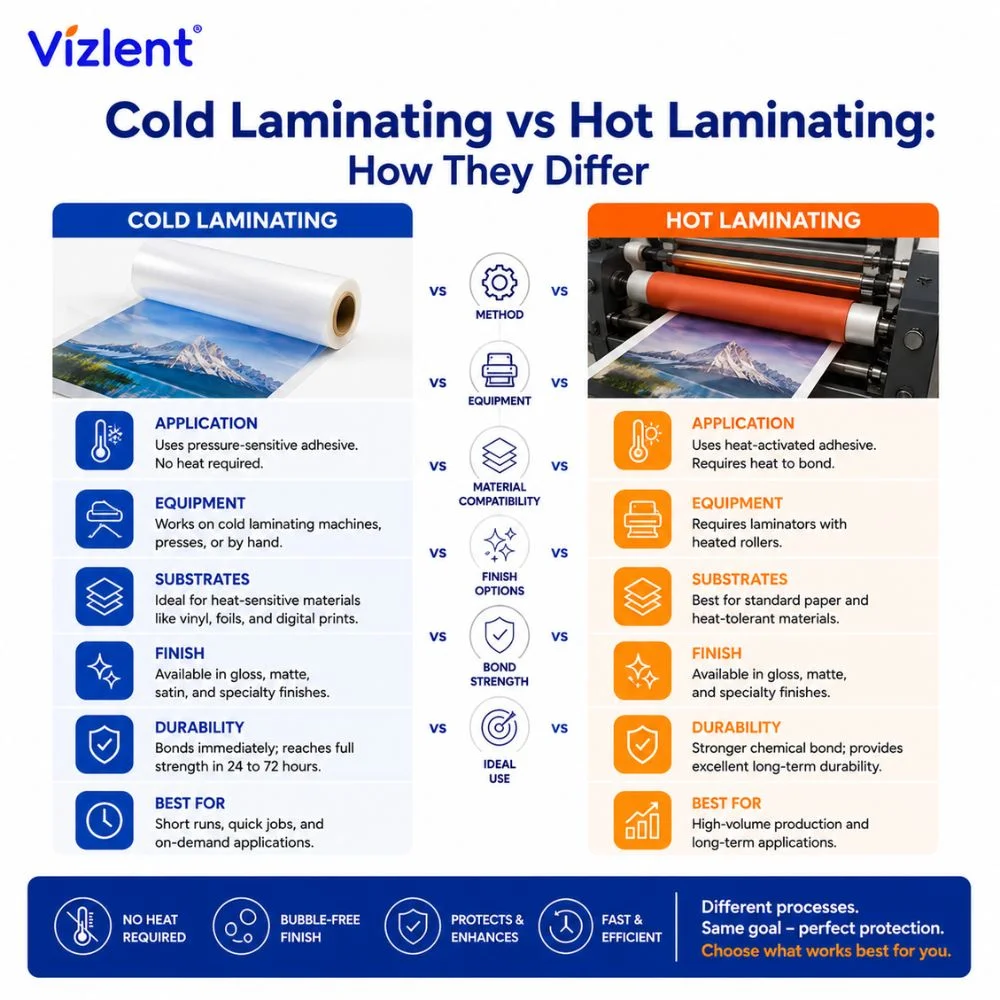
The cold laminating vs hot laminating debate often comes down to substrate compatibility and equipment cost rather than absolute performance. Hot laminating uses heat-activated adhesives that require a thermal laminator to melt the adhesive and bond it to the print, which works well on heat-tolerant paper but can damage vinyl, photo prints, or coated inkjet materials. Cold laminating skips the thermal step entirely by relying on pressure-sensitive adhesive, which protects sensitive inks and supports a wider range of substrates.
The cold laminating vs heat laminating choice also affects production speed, energy use, and equipment investment for converters and print shops. Operators choosing between the two methods need to evaluate substrate compatibility, throughput requirements, and total cost of ownership. The differences below highlight where each method has an advantage:
- Heat requirement: Cold laminating uses no heat; hot laminating typically runs at 90 to 120°C.
- Substrate range: Cold laminating works on inkjet, digital, photo, and thermal prints; hot laminating is limited to heat-stable materials.
- Equipment cost: Cold laminating machines are generally simpler and less expensive than thermal laminators.
- Energy use: Cold systems consume minimal electricity; thermal systems require continuous heating.
- Bond curing: Cold adhesive reaches full strength in 24 to 72 hours; thermal bonds set as soon as the material cools.
Need help choosing between cold and thermal lamination for your project? Contact our Vizlent engineering team.
Is Cold Laminating Better Than Hot Laminating?
The question “Is cold laminating better than hot?” comes up constantly in procurement reviews and print shop evaluations. The honest answer is that neither method is universally superior; the right choice depends on substrate sensitivity, production volume, and the operational environment. Cold laminating wins for heat-sensitive prints, photo work, digital outputs, vinyl decals, and any project where thermal damage to ink or substrate is a concern.
Hot laminating still has an edge for high-volume paper-based work such as restaurant menus, ID cards, and educational materials, where a glass-clear, high-gloss finish at low cost is the priority. For industrial buyers specifying durable labels, vehicle wraps, outdoor weather-resistant signage, asset tracking, or any setup involving UV exposure and chemical contact, cold laminating film is almost always the more reliable specification. The main trade-off is curing time: cold bonds require 24 to 72 hours, whereas thermal bonds set instantly.
Cold Laminating Sheets, Pouches, and Rolls: Format Options

Cold laminating products come in three primary formats: cold laminating sheets, cold laminating pouches, and cold laminating rolls. Cold laminating sheets are pre-cut, peel-and-stick laminates designed for single-document protection and short-run craft work, typically sold in A4 or A3 sizes. Cold laminating pouches are similar in concept but provide front-and-back protection with a hinged fold, which works well for ID cards, menus, and small signage.
For high-volume converting operations, the cold laminating roll format is the industry standard, supplying continuous lamination to roll-fed presses and inline finishing equipment. Each format has its own use case, lead time, and economic profile, which procurement teams should match to their production needs. The format options break down as follows:
- Cold laminating sheets: Single-sided, pre-cut, ideal for desktop and craft use.
- Cold laminating pouches: Two-sided protection with a hinged fold, sealed under pressure.
- Cold laminating roll: Continuous format for industrial converters, widths from 25mm to 1300mm.
- Specialty cold laminating film: Holographic, matte, gloss, and security finishes for branded applications.
Cold Laminate A4 and A3: Standard Sizes for Office and Industrial Use
Cold laminate A4 (210 x 297 mm) and cold laminate A3 (297 x 420 mm) are the two most common pre-cut sizes specified across global office, retail, and small-volume industrial markets. Cold laminating film A4 fits standard inkjet and laser-printed documents, certificates, training materials, and product labels without requiring further trimming. Cold laminating film A3 doubles the working area, which suits larger marketing posters, technical drawings, retail signage, and wall-mounted safety notices.
Cold laminating sheets A4 and cold laminating sheets A3 are sold in flat packs of 25, 50, or 100 units, with peel-off liner backings that allow for clean manual application. Cold laminating pouches A4 and cold laminating pouches A3 work the same way but seal the document on both sides for ID cards, restaurant menus, and exhibition graphics that require front-and-back protection. Industrial buyers sourcing wholesale quantities can request cold laminating film in custom A4 and A3 master rolls for their own slitting operations.
Cold Laminating Machines, Presses, and Equipment Options

A cold laminating machine is a pressure-applying device that runs a printed substrate and a cold lamination film through synchronized rollers, delivering even contact pressure across the bonded surface. A cold laminating press operates on the same principle but uses a flatbed pressure plate, often with adjustable pneumatic force, which suits rigid materials like cold lamination board and acrylic panels. Both equipment types come in tabletop, freestanding, and inline configurations, depending on production volume and material width.
Buyers shopping a cold laminator buy search typically evaluate equipment across four core specifications. The right machine depends on production scale, material type, and budget allocated to the lamination workflow. Key specifications to evaluate include:
- Width capacity: From 250mm desktop units to 1600mm wide-format presses.
- Roller pressure: Adjustable rubber rollers ranging from 10 to 60 PSI.
- Speed control: Variable feed rates from 0.5 to 5 meters per minute.
- Heat-assist option: Optional heated rollers for hybrid cold and warm lamination workflows.
Cold Lamination by Hand: Manual Application Techniques
Cold lamination by hand remains a practical option for low-volume work, custom one-off pieces, and field repairs where a full cold laminating machine is not available. The process uses a squeegee, plastic brayer, or simple roller to apply the laminate while gradually peeling back the release liner. Operators like Vizlent Labels Materials Co Ltd work from one edge of the substrate to the other, smoothing the film with overlapping passes to eliminate trapped air.
Manual application demands a clean, dust-free workspace because particulate contamination shows clearly through any clear protective laminate. Successful hand application also depends on selecting cold laminating sheets that match the substrate dimensions, since trimming after bonding risks lifting edges and exposing the adhesive. For larger jobs that exceed 600mm in width, an entry-level cold laminating press is more reliable than hand application and pays back its investment quickly.
Cold Laminating Stickers and Cold Lamination Board Uses
Cold laminating stickers protect printed decals from scratches, moisture, fingerprint smudges, and UV-induced color fade during their service life. The technique is standard in vehicle decal printing, custom signage shops, brand authentication, and any retail context where stickers face direct customer handling. Vizlent supplies cold laminating film configurations specifically engineered for this use, including gloss, matte, and holographic overlaminates with permanent acrylic adhesive systems.
A cold lamination board refers to a rigid printed panel that has been overlaminated with a thick PVC or polycarbonate film for trade show graphics, retail displays, or industrial signage. The lamination protects against scuffing during transport, moisture absorption, and fingerprint marking from public handling. For procurement teams sourcing at scale, cold laminating film delivered in custom widths from a direct laminating film manufacturer like Vizlent eliminates the markup of distribution channels.
Sourcing cold laminating stickers, film, or board materials in bulk? Request a free sample pack from Vizlent.
Cold Applied Laminate Tape and Cold Bent Lamination
Cold applied laminate tape is a specialty product used in pipeline coating, electrical insulation, and structural protection where field-applied corrosion resistance is required. The tape combines a multi-layer film backing with a pressure-sensitive elastomeric adhesive that bonds to metal substrates without heat, making it valuable for in-situ repairs and remote installations. Industries including oil and gas, water utilities, and infrastructure maintenance rely on cold applied laminate tape because it installs without specialized welding or heating equipment.
Cold bent lamination is a related but distinct architectural process used to form curved glass and composite panels at room temperature, avoiding the energy use of furnace bending. The technique combines pressure-sensitive interlayer films with mechanical bending forces to lock the curvature in place once the laminate cures. Cold bent lamination is increasingly specified in modern facade design, automotive glazing, and high-end interior fixtures where complex curves are required without thermal distortion.
How to Choose the Best Cold Laminating Film for Your Project
Selecting the best cold laminating film starts with a clear definition of the operating environment, substrate type, and expected service life. UV exposure, chemical contact, mechanical abrasion, and temperature swings all influence which face stock material and adhesive grade will perform reliably. A reputable manufacturer should provide technical data sheets covering peel strength, tensile strength, optical clarity, and shrinkage performance before any bulk order is placed.
Procurement teams shortlisting suppliers should also evaluate sourcing model, certification credentials, and technical support depth alongside material specifications. Factory-direct suppliers typically deliver better unit economics and shorter lead times than trading intermediaries. The following criteria help separate strong candidates from weak ones:
- Face stock material: PET for chemical resistance, PVC for conformability, BOPP for cost efficiency.
- Thickness: 1.0 to 2.0 mil for standard labels, 3.0 to 5.0 mil for retail signage, 5.0 to 15.0 mil for heavy industrial.
- Adhesive system: Solvent acrylic for permanent bonds, water-based acrylic for eco-compliance.
- Finish: Gloss for high-impact graphics, matte for anti-glare displays, holographic for security.
- Compliance: UL 969, ANSI Z535.4, RoHS, REACH, and FSC certifications for regulated industries.
- Manufacturer credentials: ISO 9001, SGS-tested, 10+ years of operating history.
Where to Buy a Cold Laminator and Cold Laminating Supplies
A cold laminator buy decision should account for sourcing channel, supplier credentials, and total cost of ownership rather than headline price alone. Buyers comparing distributors, trading companies, and direct manufacturers typically find that factory-direct procurement delivers 15 to 30 percent savings on bulk roll material, plus shorter lead times. Vizlent operates as a direct manufacturer from Shenzhen and Ganzhou, supplying cold laminating film across 50+ countries with 7 to 15 day lead times.
Beyond price, the most important sourcing decisions involve technical support, quality consistency, and certification documentation available on request. A capable cold laminating film supplier should offer free samples for compatibility testing, customizable widths from 30mm to 1300mm, and ISO 9001 manufacturing certificates. Buyers requiring specialty formulations like UV-blocking adhesives, holographic finishes, or chemical-resistant overlaminates should look for suppliers with in-house coating capability, plus complementary options like thermal lamination film for hybrid workflows.
Frequently Asked Questions
What is cold laminating used for?
Cold laminating protects printed materials from scratches, moisture, UV exposure, and chemical contact without applying heat. Common applications include vehicle decals, photo prints, retail signage, ID cards, industrial labels, and outdoor graphics where heat-sensitive substrates would warp under thermal lamination.
What is the difference between cold laminating and hot laminating?
Cold laminating uses a pressure-sensitive adhesive applied at room temperature; hot laminating uses a heat-activated adhesive that requires a thermal laminator to bond. Cold laminating film works on heat-sensitive prints, photos, and vinyl, while hot laminating works best on heat-tolerant paper materials.
Is cold laminating better than hot laminating?
Cold laminating is better for heat-sensitive substrates, large-format prints, outdoor signage, and chemical-resistant applications. Hot laminating is better for high-volume paper-based projects. The right choice depends on substrate type, production volume, and operating environment.
Can I do cold lamination by hand?
Yes, cold lamination by hand is a practical method for small jobs, using a squeegee or brayer to apply the laminate while gradually peeling back the release liner. Hand application works well for items up to A3 size and benefits from a clean, dust-free workspace.
What is the best cold laminating film for outdoor use?
The best cold laminating film for outdoor use is a UV-resistant polyester (PET) or polycarbonate overlaminate with a solvent-acrylic adhesive, providing 5 to 7 years of weather resistance. Vizlent industrial cold lamination films meet UL 969, ANSI Z535, and RoHS standards for outdoor signage.
How much does a cold laminator cost?
Cold laminator pricing varies from $200 for a basic tabletop A3 unit to $15,000+ for an industrial wide-format press. Factory-direct sourcing through manufacturers like Vizlent typically reduces cold laminating film material costs by 15 to 30 percent compared to local distributors.
Source Your Cold Laminating Film Directly from Vizlent
Vizlent has manufactured pressure-sensitive label stock and laminating films since 2011 from a 10,000 sqm Shenzhen facility holding ISO 9001, FSC, and SGS certifications. In-house coating, slitting, and rewinding capabilities support both standard orders and custom OEM/ODM specifications across 50+ countries. Free samples, technical support, and 7 to 15 day lead times apply across the full cold lamination film portfolio.
Procurement teams ready to evaluate cold laminating film, thermal lamination film, or specialty overlaminates can request a sample pack through the Vizlent inquiry channel. The engineering team reviews substrate compatibility, adhesive formulation, and finish selection within 24 hours. Reach out today to receive a factory-direct quote tailored to your application.
Ready to source factory-direct cold laminating film for your converting or labeling operation? Contact Vizlent for a free sample pack and technical compatibility review.