
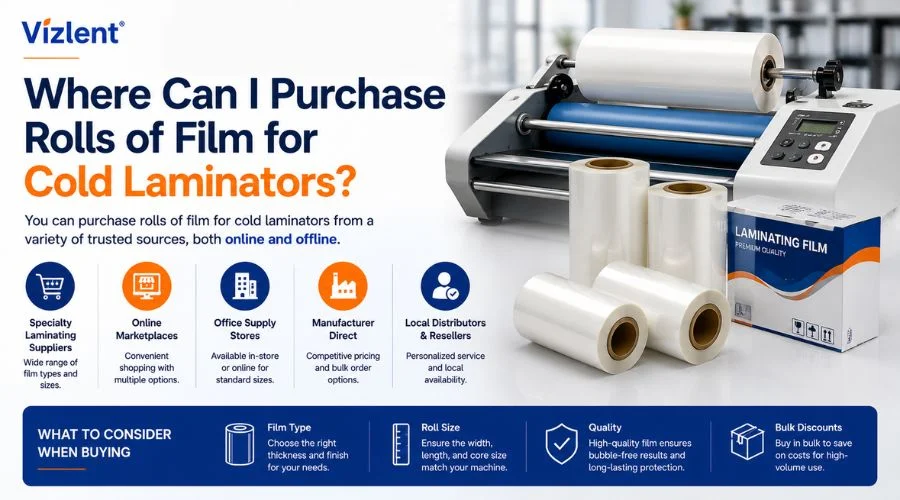
You can purchase rolls of film for cold laminators in supply retailers if you are looking to buy for small quantities, online specialty distributors for mid-size orders, and factory-direct film manufacturers like Vizlent Label for bulk, custom-width, or recurring supply. Cold lamination film is a pressure-sensitive overlaminate, often made from polyester, polypropylene, or vinyl, that bonds to a printed surface through pressure rather than heat.
Which channel makes more sense for you depends heavily on your order volume, required film width, and how often the business reorders, since retail pricing and factory-direct pricing diverge sharply once volume increases. Sourcing channels, film composition, and a few commonly confused search terms are worth understanding before committing to any single supplier.
Where Can I Purchase Rolls of Film for Cold Laminators? Comparing the Main Channels
Local office supply stores and sign shops carry a narrow range of standard-width rolls of film for cold laminators for sale, which works well for a single small laminator or an occasional print job but rarely offers custom widths or bulk pricing tiers. Online specialty distributors expand the size and finish options considerably and typically ship within days, making them a reasonable middle option for growing businesses that need more variety than a local shelf provides. Factory-direct manufacturers sit at the other end of the spectrum, producing custom jumbo rolls and slit rolls to exact width and thickness specifications for converters, print shops, and distributors buying in volume.
Choosing among these channels comes down to matching order size and specification needs to the right supplier tier rather than defaulting to whichever option is most familiar. A small business printing a handful of signs each month rarely benefits from factory-direct minimum order quantities, while a converter running thousands of labels or signs weekly loses money paying retail markup on every roll. Reviewing actual monthly film consumption alongside required widths and finishes is the fastest way to identify which sourcing channel fits a given operation.
- Local retail: Smallest quantities, standard widths only, highest per-roll cost
- Online distributors: Broader selection, moderate lead times, mid-range pricing
- Factory-direct: Custom widths and finishes, bulk pricing, longer lead times on custom orders
Lead time expectations also differ meaningfully across these three channels, since local retail offers same-day availability while factory-direct custom orders typically require production scheduling measured in days rather than hours. A business that waits until film inventory runs out before reordering is often forced into retail or distributor pricing simply because factory-direct lead times cannot meet an urgent deadline. Planning reorder points around actual consumption rates, rather than reordering reactively, gives a business the flexibility to use factory-direct pricing consistently instead of defaulting to retail out of necessity.
What Rolls of Film for Cold Laminator Machines Are Made Of
A cold laminator applies film through pressure rollers rather than heat, so the film itself must carry its own high-tack self-adhesive coating that bonds at room temperature without any thermal activation step. Common facestocks include polyester (PET) for rigid, high-clarity protection, polypropylene (BOPP) for a more economical and flexible option, and PVC for conformability around curves and uneven surfaces. Each facestock pairs with an acrylic adhesive formulated to wet out evenly over ink layers, preventing the trapped air bubbles known in the industry as silvering.
Film thickness for cold lamination typically ranges from 1.0 to 15.0 mil depending on the application, with thinner films suited to standard asset tags and thicker Polycarbonate or heavy PET films reserved for high-traffic floor graphics and membrane switches. UV inhibitors are commonly built into the adhesive or facestock to prevent yellowing and embrittlement on labels and signs exposed to direct sunlight. Buyers should confirm both facestock material and thickness against their specific application rather than assuming any cold laminate film performs the same way across different surfaces and environments.
Release liner quality is another factor that often gets overlooked when comparing rolls of film for cold laminator sourcing, since a liner that releases unevenly can cause misfeeds or wrinkling during application. Glassine and PET liners are the two most common choices, with PET liners generally offering more dimensional stability for high-speed laminating equipment. A converter running a dedicated lamination line should confirm liner compatibility with their specific equipment before committing to a new film supplier, since a mismatch here can slow production even when the film itself performs well.
Rolls of Film for Cold Laminator Rollers: Film Versus Machine Parts
Rolls of film for cold laminator rollers is a search phrase that actually covers two different products, and mixing them up leads to ordering the wrong item entirely. The laminating film itself, sold in rolls and threaded through the machine’s rollers during application, is the consumable material that gets applied to each printed sheet or label. A cold laminator replacement roller, by contrast, is a physical machine part, typically a rubber or silicone pressure roller inside the laminator housing, that occasionally needs replacement due to wear rather than being consumed with each lamination job.
Film manufacturers who supply rolls of film for cold laminator replacement roller searches are almost never the right source for the roller part itself, since that component comes from the laminator equipment manufacturer or an authorized parts distributor. Buyers searching for laminator maintenance parts should contact their machine’s manufacturer directly, while buyers searching for the consumable film should look toward laminating film producers instead. Keeping these two purchases separate prevents wasted time contacting the wrong type of supplier for either need.
Rolls of Film for Cold Laminator Cost and Best Price Factors
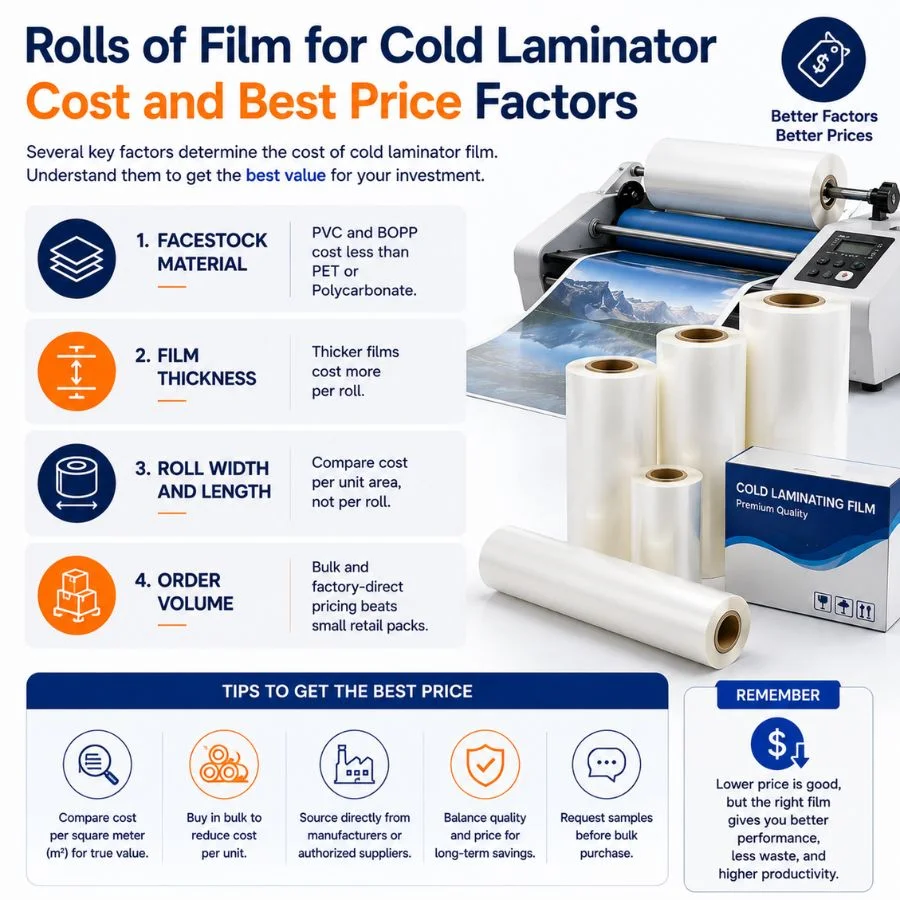
Rolls of film for cold laminator cost depends primarily on facestock material, thickness, roll width, and order volume, with PVC and biaxially oriented polypropylene (BOPP) typically priced lower than premium PET or Polycarbonate constructions. A thin 1.0 to 2.0 mil film for standard asset tags costs considerably less per roll than a heavy-duty 10.0 to 15.0 mil polycarbonate overlaminate built for high-impact industrial floor signage. Buyers comparing rolls of film for cold laminators’ best price across suppliers should account for roll length and width together, since a lower sticker price sometimes reflects a shorter or narrower roll rather than genuinely better value.
Finding rolls of film for cold laminators’ best price generally means comparing cost per square meter or per linear foot rather than cost per roll, since roll dimensions vary widely between suppliers. Factory-direct sourcing typically holds pricing lower than retail or distributor channels at bulk volumes by removing the markup layers between the coating line and the buyer. Requesting a sample roll before committing to a bulk order remains the most reliable way to confirm both film performance and true cost per finished label or sign.
- Facestock material: PVC and BOPP cost less than PET or Polycarbonate
- Film thickness: Thicker films cost more per roll
- Roll width and length: Compare cost per unit area, not per roll
- Order volume: Bulk and factory-direct pricing beats small retail packs
Buying Rolls of Film for Cold Laminators Bulk for Business Use
Rolls of film for cold laminators bulk purchasing makes sense once a business consumes enough film that per-roll retail pricing starts eating meaningfully into margins on finished signs, labels, or badges. Businesses running dedicated lamination lines, sign shops fulfilling regular client orders, and converters supplying finished laminated labels to other companies are the most common buyers of rolls of film for cold laminators business volume. Bulk purchasing also reduces the operational overhead of frequent reordering, which matters for businesses managing inventory across multiple lamination stations or locations.
A business evaluating bulk purchasing should confirm both storage conditions and shelf life before committing to a large order, since cold lamination film adhesive can lose tack over extended storage in poor conditions. Factory-direct suppliers typically offer container-load volumes alongside smaller trial quantities, letting a growing business scale its order size as consumption increases. Establishing a recurring supply relationship with a single factory-direct source also simplifies quality control, since every roll comes from the same coating and slitting lines rather than varying between retail batches.
Rolls of Film for Cold Laminators Black and Other Specialty Finishes
Rolls of film for cold laminators black and other opaque or tinted finishes exist for specific applications like blackout window graphics, decorative signage, and promotional displays where full opacity or a colored appearance matters more than optical clarity. These specialty finishes use pigmented PVC or vinyl facestocks rather than the clear PET or BOPP films used for standard label and document protection. Buyers should confirm that a colored or black film is genuinely engineered for the application, since a standard clear laminate tinted for appearance alone will not necessarily deliver the same opacity or light-blocking performance as a purpose-built black film.
Beyond black, matte, glossy, holographic, and glitter finishes are all available within the cold lamination film category, each suited to different presentation goals rather than functional performance differences. Matte finishes reduce glare for exhibition graphics and CAD plots, while glossy and holographic finishes suit retail packaging and promotional applications where visual impact matters most. Selecting a specialty finish should still start with the same facestock and adhesive questions that apply to any cold lamination film, since appearance is only one part of the overall specification.
Source Rolls of Film for Cold Laminators Factory-Direct
Matching the right facestock, thickness, and finish to your application matters more than chasing the lowest headline price when sourcing rolls of film for cold laminators. Vizlent manufactures cold lamination films in PET, BOPP, and PVC facestocks, including cold roll laminating film and pressure sensitive cold laminating film options, factory-direct from an ISO 9001 certified facility with custom widths up to 1300mm. Send an inquiry to request free sample rolls and a factory-direct quote for your specific width, thickness, and finish requirements, or explore Vizlent’s thermal lamination films if a heat-activated alternative better suits your production line.
Frequently Asked Questions
Where can I purchase rolls of film for cold laminators for sale in bulk?
Rolls of film for cold laminators for sale in bulk are most commonly available directly from factory-direct manufacturers who produce jumbo rolls and can slit them to custom widths for large orders. Local retailers and online distributors carry smaller quantities at higher per-unit pricing, which suits occasional or low-volume use. Buyers with recurring or high-volume needs should request a factory-direct quote and sample before committing to a bulk purchase.
What is the difference between rolls of film for cold laminator use and thermal laminating film?
Rolls of film for cold laminator use rely on a pressure-sensitive adhesive that bonds at room temperature, while thermal laminating film uses a heat-activated adhesive applied through a heated roller system. Cold film suits heat-sensitive inks, digital prints, and substrates that could warp or discolor under thermal lamination. Thermal film is often preferred for high-speed production lines where heat activation improves bonding speed and consistency.
Do rolls of film for cold laminator rollers wear out and need replacement?
Yes, the physical pressure rollers inside a cold laminator machine do wear out over time and eventually need replacement, but that roller is a machine part rather than the laminating film itself. Buyers should contact their laminator’s equipment manufacturer or an authorized parts distributor for roller replacements. Film suppliers provide the consumable laminate material, not the mechanical components inside the laminator housing.
What determines rolls of film for cold laminator cost?
Rolls of film for cold laminator cost depends on facestock material, thickness, roll dimensions, and order volume, with PVC and BOPP generally priced lower than premium PET or Polycarbonate options. Comparing cost per square meter rather than cost per roll gives a more accurate picture across suppliers with different roll sizes. Bulk and factory-direct purchasing typically deliver the lowest effective cost per finished laminated piece.
Are rolls of film for cold laminators bulk orders customizable?
Yes, rolls of film for cold laminators bulk orders through a factory-direct manufacturer can typically be customized for width, thickness, facestock material, and finish to match a specific application or printer setup. Standard retail rolls generally come in fixed sizes without customization options. Requesting a specification sheet and sample before finalizing a bulk order confirms the customization meets the intended use case.
Where can a small business find rolls of film for cold laminators best price without buying a full pallet?
A small business searching for rolls of film for cold laminators best price without committing to a full pallet order should start with online specialty distributors, which typically offer better pricing than local retail without requiring factory-direct minimum order quantities. Some factory-direct manufacturers also support smaller trial orders alongside their standard bulk tiers. Comparing total cost per unit area across a few suppliers, rather than headline roll price alone, usually reveals the best actual value.
Is rolls of film for cold laminators black available for outdoor use?
Rolls of film for cold laminators black in an outdoor-rated construction typically uses a UV-stabilized PVC facestock designed to resist yellowing and embrittlement under sustained sunlight exposure. Standard indoor-grade colored film should not be substituted for outdoor applications, since it may fade or degrade faster without UV inhibitors. Confirming the UV rating and expected outdoor service life with the supplier before ordering prevents premature failure on exterior signage.






