Label stock pricing is the delivered cost of a pressure-sensitive laminate per square meter, and four inputs move it more than anything else: the facestock, the adhesive coat weight, the release liner, and the yield you achieve when you convert it. Everything else on a quote sits on top of those four. Buyers who negotiate only the headline number are arguing about the smallest variable in the equation.
A quote is a snapshot of commodity indices, roll geometry and run length on one day. Change the slit width by 40 mm or the coat weight by 4 g/m², and the same supplier returns a different figure without touching margin. Knowing which lever does what separates chasing a discount from engineering one.
Have a specification in hand? Send it to the Vizlent engineering team and ask for it priced three ways: current spec, lighter facestock, lower coat weight.
What Label Stock Pricing Actually Measures
Label stock pricing measures a laminate, not a single material. That is why two quotes for semi-gloss paper can differ widely and both be honest: one may carry a light face over thin glassine, the other the same face over a heavier liner with tighter release. The construction is the product, and the construction is the price.
This matters most when comparing pressure sensitive label materials across suppliers who describe stock differently. A quote naming only the face is incomplete. Ask for the full three-component build before treating two numbers as comparable.
Why Square Meters, Not Linear Meters
Square meters normalise for width, and width is the most common source of quote confusion for label stock pricing. A price of 0.30 USD per linear meter on a 1,000 mm web and the same figure on a 1,250 mm web are not the same offer. Converting both exposes a 25 percent gap that linear pricing hides.
The arithmetic takes seconds and belongs in your quote template. Do it before the negotiation, not after the invoice.
- Linear to square: price per linear meter ÷ web width in meters
- Cost per label: price per square meter × label area (m²) ÷ yield factor
What Is a Pressure Sensitive Label, and What Are You Buying?
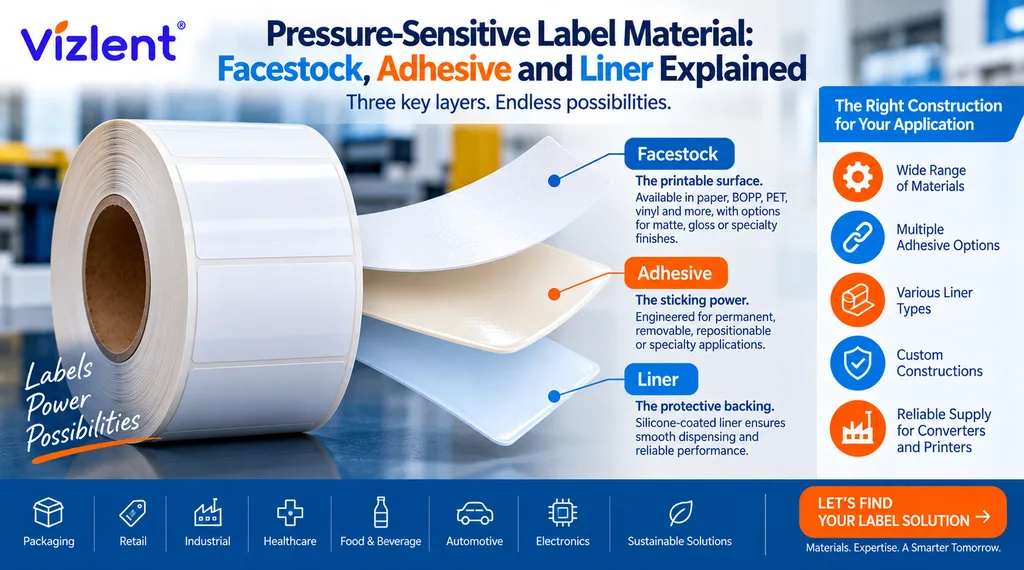
A pressure sensitive label bonds under applied pressure alone, with no water, heat or solvent needed to activate the adhesive. It is built from three primary components: a facestock, a pressure-sensitive adhesive, and a siliconised release liner. Answering what is a pressure sensitive label is the entry point to understanding how it is priced.
Two of those components end up on your customer’s product and one goes into a waste stream. That asymmetry is the hidden economics of pressure sensitive label stock, and it is where avoidable cost sits.
Facestock Sets the Floor on Cost Per Square Meter
Facestock is usually the largest single line in the build and the one tied most directly to performance. Paper faces carry lower material cost and print well with conventional inks. Film faces cost more but survive moisture, oils, abrasion and temperature cycling that paper cannot.
Reducing face caliper reduces mass, and mass is what you pay for, so moving from 50 micron PET to 36 micron PET removes real cost per square meter. The limit is converting behaviour, since thinner films can be harder to die-cut cleanly and may flag at the matrix strip. Run the trial before committing annual volume, with written acceptance criteria for die-cut quality, matrix removal and print registration.
| Facestock family | Relative cost position | Where it earns its price |
|---|---|---|
| Coated and woodfree paper | Lowest | Retail, shipping, short service life |
| BOPP film | Mid range | Moisture, squeeze bottles, beverage |
| PET film | Higher | Heat, chemicals, asset tags |
| Polyimide and speciality | Highest | Electronics reflow, extreme temperature |
Relative and indicative. Position depends on caliper, topcoat, adhesive pairing and volume.
Adhesive Coat Weight Is a Direct Multiplier on Label Stock Pricing
Adhesive is bought by weight and applied as a dry film measured in g/m², which makes coat weight one of the few cost variables with clean arithmetic behind it. Vizlent publishes coat weights across its durable label portfolio, at the time of writing, from 15 to 25 g/m² depending on adhesive and substrate, with 17 to 25 g/m² cited for the general build on the same page. Multiply that delta by annual volume and it stops looking like a footnote.
Coat weight is set by the application surface, not by preference, so test rather than assume. Low surface energy plastics, textured cartons and cold-chain application push it upward, while smooth glass and coated board tolerate less. Put the question precisely: what is the lowest coat weight that still passes our peel and shear criteria on our substrate?
- Adhesive cost per m² = coat weight (g/m²) ÷ 1,000 × adhesive price per kg
- Measure results to a named method such as ASTM D3330, a peel adhesion test for pressure-sensitive tape that does not by itself validate a finished label
Release Liner: The Line Item Buyers Underprice
The liner is a carrier you purchase, ship, store, run through your press, then discard or recycle. It is silicone coated and cured early in the pressure sensitive label manufacturing process, which is why a change to release level costs more than a change to slit width. Vizlent publishes a siliconised liner at 75 to 80 µm on its durable constructions at the time of writing, with glassine, CCK and PET options.
Silicone is the smallest component by mass and among the most important by function. Release coatings are typically under 1 µm thick and often under 0.1 µm, yet they decide whether labels dispense cleanly or jam an applicator. Thinner glassine lowers cost and lifts roll length per diameter, while PET liners cost more but run thinner and stronger, suiting high-speed and small-label work.
The Raw Material Indices Behind Your Quote
Facestock and liner prices track commodity indices you can monitor independently of any supplier. US Bureau of Labor Statistics data puts the producer price index for wood pulp at 141.684 in June 2026, after 149.818 in October 2025 and 138.505 in February 2026. That is real movement inside eight months on the input behind every paper face and glassine liner.
Film faces follow a different curve. The producer price index for thermoplastic resins and plastics materials stood at 272.712 in October 2025 and 269.339 in February 2026, a softer path than pulp. Watching both tells you whether a proposed increase reflects genuine input movement or margin recovery, and that changes how a label stock pricing conversation goes.
| Index to track | Series | Why it matters |
|---|---|---|
| Wood pulp PPI | WPU09110501 | Paper face and glassine liner inputs |
| Thermoplastic resins PPI | PCU3252113252111 | BOPP, PP and PET film inputs |
| Ocean freight | Drewry World Container Index | Landed cost on imported rolls |
Point-in-time values, subject to revision. Check the current release before quoting any figure.
Building next year’s cost model? Ask Vizlent for the construction data sheets behind your current stock.
Conversion Yield: Where Square Meters Disappear
You do not pay for the labels you produce. You pay for the square meters you buy, and the gap between the two is yield. A quote that looks four percent cheaper can end up dearer once trim and matrix losses land on your press, so label stock pricing must be judged after conversion.
Matrix waste, the skeleton of face and adhesive stripped after die-cutting, is unavoidable in most die-cut work, but layout, gap size and lane count control how much you generate. CELAB Europe set a goal for more than 75 percent of used release liner and matrix to follow a circular business model by 2025, describing release liner as a production residue rather than part of a finished packaging unit. Where recycling routes exist, that waste can offset part of what you paid.
Roll Width Utilisation and Trim Loss
Every millimetre of web that does not become a label is money you bought and threw away. If your press runs a 320 mm web and your supplier slits from a 1,000 mm parent, three lanes leave 40 mm of trim per meter. Matching the parent roll to your slit plan removes that loss entirely.
Ask which parent widths your supplier runs before nominating a slit width. Vizlent publishes jumbo rolls typically at 1,000 mm and 1,250 mm on the durable range, up to 3,000 m long, with precision slit rolls from 25 mm upward at ±0.5 mm tolerance and ±0.3 mm on polyimide grades. Confirm tolerance too, since a tighter figure calls for tighter process control and the achievable result depends on material and equipment.
Freight, Duty, and Landed Cost
Ex-works pricing is not what you pay. Ocean freight moves independently of anything in a coating plant, and it moves fast. Drewry’s World Container Index was assessed at 4,465 USD per 40ft container on 3 September 2026, with Shanghai to Los Angeles at 7,185 USD and Shanghai to Rotterdam at 4,092 USD.
Duty classification deserves equal attention, because label stock pricing on a landed basis can shift on a tariff line rather than a mill price. Self-adhesive paper in rolls can fall under heading 4811.41, and self-adhesive plates, sheets and film of plastics under heading 3919, subject to the product’s characteristics and the applicable tariff schedule. US Customs and Border Protection ruling N317533 classified self-adhesive printed paper in rolls under 4811.41.2100 and required a Chapter 99 subheading alongside it, so check the current HTS before budgeting.
How to Lower Label Stock Pricing Without Losing Performance
Reductions that survive audit come from specification and yield, not pressure on a supplier’s margin. Every lever below sits on your side of the transaction. Work through them in order of effort, since several cost nothing but a conversation.
Treat performance as the constraint and cost as the variable, never the reverse. A construction that saves money and fails on a customer’s line is the most expensive purchase in the catalogue. Qualify every change against written acceptance criteria first.
- Reduce face caliper where die-cutting and stiffness allow
- Test a lower coat weight on your actual substrate, not a laboratory panel
- Review liner selection, comparing glassine, CCK and PET on total cost
- Switch face family where service conditions permit, such as paper for short-life work
- Consolidate constructions so fewer materials cover more products
- Match slit widths to available parent rolls to eliminate trim loss
- Consolidate volume to clear MOQ efficiently, since setup cost spreads across run length and Vizlent publishes MOQ as varying by film type, adhesive and format
- Quote on a landed basis so freight and duty stay comparable
- Request index transparency on which series a proposed increase tracks
- Recover liner and matrix value where a recycling route exists
How to Compare Quotes From Pressure Sensitive Label Suppliers
Comparing pressure sensitive label suppliers on headline price alone produces the wrong winner more often than not. Ask everyone for the same six things: full three-component construction, adhesive coat weight in g/m², liner type and caliper, parent widths and slitting tolerance, landed price per square meter, and the technical data sheet with compliance documentation. Anything a supplier will not put in writing is not part of the offer.
Sample policy and response time give an early indication of a supplier’s technical support process, which matters once something goes wrong on press. A supplier working through affiliated factories typically controls less of the pressure sensitive label manufacturing process than one running its own coating lines. Vizlent positions its model as factory-direct, manufacturing under ISO 9001 quality-management processes, with FSC certification for applicable forest-based materials and SGS testing documentation for specified products.
Price Your Next Construction Properly
Label stock pricing stops being a mystery the moment you can name the facestock, the coat weight, the liner and the yield. Everything after that is arithmetic you can run yourself against indices anyone can check. That beats asking for a discount and hoping.
Work the sequence in order: submit the specification, receive the recommended construction, request the technical data sheet, test samples against written acceptance criteria, then quote at programme volume on a landed basis. Send Vizlent your substrate, service conditions, print system and target volume, and the team returns a named construction rather than a category. Start with your specification, or review the self-adhesive range and knowledge library.
Frequently Asked Questions
How is label stock pricing calculated per square meter?
Label stock pricing per square meter sums facestock, adhesive, liner and conversion cost across the laminate area, with freight and duty added on imports. Face and liner price by mass and caliper, adhesive by dry coat weight, conversion by width utilisation. Convert every quote using the web width, since linear pricing hides width gaps.
Why do two suppliers quote different prices for the same material?
Because the same material rarely means the same construction. One may pair the face with a thinner liner, a lower coat weight or a different silicone system. Ask both for the full build and coat weight in g/m² before comparing.
Does a lower adhesive coat weight always reduce cost?
It reduces the adhesive component directly, since adhesive is bought by weight and applied as a measured dry film. Whether total cost falls depends on that weight still passing peel, shear and application testing on your substrate. A construction that saves cents and lifts at the edges costs more than it saves.
What is a pressure sensitive label made of?
A pressure sensitive label is built from three primary components: a facestock, a pressure-sensitive adhesive, and a siliconised release liner. The face carries the print, the adhesive bonds under pressure with no heat or solvent, and the liner protects it until dispensing. Cost spreads across all three, which is why pricing only the face misleads.
How much does the release liner contribute to total cost?
Enough to matter, particularly on thin-face constructions where the liner carries more mass than the face. Cost varies with material family, caliper and silicone system, and Vizlent publishes a 75 to 80 µm siliconised liner at the time of writing. Because the liner is discarded, a recycling route can offset part of what you paid.
How do tariffs affect the price of imported label stock?
Duty applies to the customs value based on classification, so the tariff heading changes landed cost independently of the mill price. Self-adhesive paper in rolls can fall under heading 4811.41 and self-adhesive plastic film under 3919, subject to the product’s characteristics and the applicable schedule. Confirm classification with a customs broker before budgeting.