
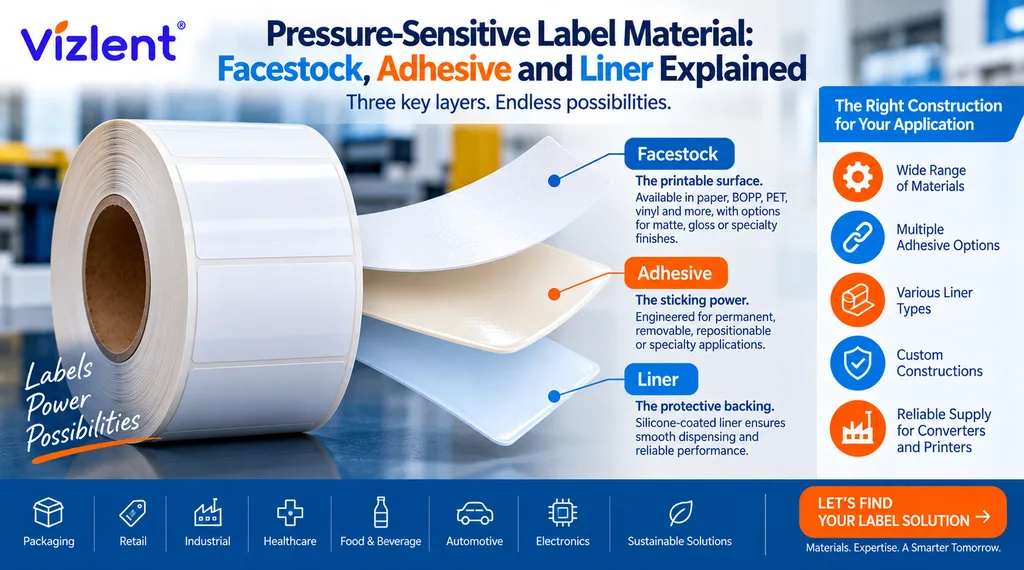
A pressure-sensitive label material is a laminate built from three primary components: a printable facestock, a pressure-sensitive adhesive coated onto its underside, and a siliconised release liner that carries the adhesive until application. The label bonds under light pressure at room temperature, with no water, solvent or heat needed to activate it. Many label failures trace back to a mismatch between the construction, the application surface, the print process or the service environment.
How to read the claims on this page
| Claim type | What it means |
|---|---|
| Industry standard | A published test method or specification |
| Regulatory requirement | A rule set by a named regulator or statute |
| Vizlent product data | Figures published on Vizlent’s own product pages, verified live on the review date |
| Author recommendation | Engineering judgement, not a rule |
Every self-adhesive label on a bottle, drum, circuit board or shipping carton starts as the same sandwich, and the three layers are not independent choices. A facestock that resists a solvent means nothing if the adhesive underneath softens at the same temperature, and a matched face and adhesive will still jam an applicator if the liner releases too tightly.
The three components at a glance
| Component | Primary function | Key variables to specify |
|---|---|---|
| Facestock | Print surface and structural layer | Material, thickness, moisture and chemical resistance, temperature range |
| Adhesive | Bonds the label to the substrate | Tack, peel adhesion, shear, application and service temperature |
| Release liner | Protects the adhesive before application | Caliper, release force, tensile strength |
What Is a Pressure Sensitive Label, and How Does It Differ From Other Label Types?
A pressure sensitive label is a label that bonds using an adhesive that flows into a surface under light applied pressure at ambient temperature. It needs no water, heat or solvent activation, which separates it from gummed paper labels, wet-glue labels and heat-seal or shrink-sleeve constructions. That single property is why pressure sensitive label materials dominate high-speed automated application lines.
The distinction is commercial as much as technical. Wet-glue lines need a glue pot, setting or drying time and equipment cleanup, while pressure-sensitive application typically uses a dispenser and peel mechanism, with equipment varying by application system.
- Pressure-sensitive: adhesive pre-coated, liner-protected, applied by pressure alone
- Wet glue: adhesive applied at the packaging line, followed by setting or drying and equipment cleanup
- Heat-seal: requires a heated platen to activate a dormant coating
- Shrink sleeve: no adhesive, a heat tunnel conforms a printed film to the container
Explore Vizlent self adhesive material →
The Three Primary Components of Pressure Sensitive Label Stock
Every roll of pressure sensitive label stock is built from a facestock, an adhesive and a liner, coated and laminated as one continuous web. Vizlent publishes adhesive coat weights of approximately 15 to 25 g/m² for specified constructions in its durable label portfolio, alongside a siliconised liner in the 75 to 80 µm range, figures accurate on that page at the time of writing. Treat those as orientation, not as a specification for your job.
Each layer constrains the other two. A thin, low-caliper facestock will not tolerate an aggressive die strike over a soft liner.
A high coat weight under a rigid film can also ooze at the die edge and contaminate the cutting cylinder.
Facestock: The Printable Top Layer
The facestock is the visible, printable surface of a pressure-sensitive label material, carrying graphics, barcodes and variable data. Paper facestocks such as semi-gloss and woodfree are widely used in retail, logistics and other short-life applications where moisture resistance is not the primary requirement. Film facestocks take over wherever moisture, chemicals, abrasion or temperature would degrade paper.
Facestock choice also decides how the stock converts. Stiffer films can die-cut cleanly but may flag on tight radii when the construction lacks sufficient conformability, while conformable vinyls wrap curved surfaces without lifting at the perimeter.
- BOPP label material for moisture resistance at film-grade cost
- Polyester label material for dimensional stability and solvent resistance
- Polyimide label stock for solder-reflow and high-temperature electronics
- Eggshell paper where tamper evidence is the functional requirement
Pressure-Sensitive Adhesive: Where Most Failures Begin
The adhesive is a viscoelastic polymer that wets out the target surface under pressure and builds bond strength over time. It carries three properties buyers often collapse into one word: tack (initial grab), peel adhesion (force to remove) and shear (resistance to sustained load). A pressure-sensitive label material can have excellent tack and still fail if shear is inadequate for a heavy label hung vertically.
Acrylics, rubber-based hot melts and silicone systems each behave differently under heat, cold and chemical contact, and none is universally better.
Release Liner: The Layer Nobody Specifies Until It Fails
The release liner is a paper or film substrate coated with cured silicone that lets the label separate cleanly at the dispensing peel plate. For specified constructions, Vizlent publishes release-force values ranging from 8 to 25 cN per 25 mm depending on dispensing speed and applicator type, set during liner siliconisation rather than by the facestock. Release that is too tight jams the applicator, and release that is too light lets labels lift off the web in transit.
Liner caliper and tensile strength also govern web behaviour on press. A liner that stretches under tension throws off die registration long before anyone blames the die.
Ask a Vizlent engineer about your construction →
Facestock Materials Compared
Facestock selection begins with the service environment, not the print method. The table below lists published construction ratings for named constructions rather than properties of the polymer families themselves.
| Specific construction | Published construction rating | Commonly selected for |
|---|---|---|
| Premium PET film construction | -40°F to 300°F service, 1.0 to 5.0 mil face | Equipment rating plates, nameplates |
| Flexible PVC (vinyl) construction | -20°F to 180°F, 2.0 to 4.0 mil face | Curved pipe marking, conformable surfaces |
| BOPP construction | -20°F to 175°F, 2.0 to 3.0 mil face | Logistics, drum and container labels |
| 50 µm polyimide construction | Silicone PSA rated to 300°C continuous | PCB assembly through solder reflow |
| Coated paper construction | Ambient, short to medium service life | Retail, shipping, prime packaging |
Figures are published by Vizlent for named constructions on its Self Adhesive Material and Durable Labels pages, verified live on 5 September 2026. They are indicative and belong to one named construction each. A BOPP label is not rated to 175°F because it is polypropylene; the rating belongs to that specific face, adhesive and liner combination. A published web page is not a technical data sheet, so confirm every figure against the batch TDS for the grade you buy.
The practical filter is short. Name the coldest and hottest temperature the label will see, name the substrate it must bond to, then decide whether paper can survive the moisture and abrasion.
- Paper facestocks take up moisture, change dimension and can separate ply under sustained humidity
- Durable label constructions use synthetic films specifically to remove that failure mode
- Top-coated grades exist because uncoated films reject most inks
Adhesive Chemistry: Permanent, Removable, Freezer and Wash-Off
Adhesive grade is selected against the substrate’s surface energy, the application temperature and the intended end-of-life behaviour. Vizlent publishes 8 adhesive grades spanning permanent, removable, freezer and wash-off categories, correct at the time of writing. Standard permanent acrylics handle glass, painted metal and coated paper without difficulty.
Low surface energy plastics are the recurring problem: polyethylene, polypropylene and textured powder coats resist wetting, so a standard acrylic may show insufficient wetting or bond development and the edge lifts within days or weeks.
- Permanent acrylic: general-purpose chemistry that typically develops higher adhesion after application and dwell time
- High-tack modified acrylic: formulated for low surface energy plastics and rough substrates
- Removable: peels cleanly without residue on smooth surfaces
- Freezer grade: formulated to apply and hold at low temperature, not only to survive it
- Wash-off: engineered to release in a caustic or hot water wash for returnable packaging
- Silicone PSA: selected for specialised applications requiring high-temperature performance, chemical resistance or adhesion to difficult surfaces, as on heat resistant constructions
Application temperature and service temperature are different specifications, and both matter. A freezer-grade adhesive may require application at or above a stated minimum temperature even though it holds far colder in service, and specifying only the service temperature is a common cause of edge lift on cold-chain packaging.
Release Liners: Glassine, CCK and PET
Liner choice follows the converting and dispensing process rather than the end-use environment. Glassine, a densified calendered paper, is commonly selected for general converting because it gives a smooth base for precision die-cutting, while clay-coated kraft adds strength where web tension is higher.
PET film liners suit high-speed applicators and very small die-cuts, since their tear resistance allows thinner calipers and tighter tolerances without web breaks.
| Liner type | Relative strength | Commonly selected for |
|---|---|---|
| Glassine | Moderate, paper-based | General converting, precision die-cutting |
| Clay-coated kraft (CCK) | Higher than glassine | Higher tension, thicker facestocks |
| PET film | Highest, tear-resistant | High-speed applicators, small die-cuts |
Indicative only. Release force, caliper and suitability must be confirmed on the technical data sheet for the specific construction.
Inside the Pressure Sensitive Label Manufacturing Process
The pressure sensitive label manufacturing process runs as a continuous coating and laminating operation before any printing happens. Adhesive coating can use technologies such as slot-die, knife or comma-bar systems, selected for the adhesive and the production process, after which the web is dried, laminated to the siliconised liner and wound into jumbo rolls. Silicone coating of the liner is a parallel operation whose cure profile and coat weight set the release force a converter feels at the peel plate.
The coating method is not fixed by the adhesive family alone. The choice depends on:
- Viscosity and solids content of the adhesive
- Target coat weight and uniformity
- Web speed and drying capacity
- Equipment configuration on the coating line
Converting then follows a defined sequence:
- Slitting jumbo rolls to the exact width the press requires
- Printing by flexographic, digital, thermal transfer or UV inkjet method
- Die-cutting through facestock and adhesive without penetrating the liner
- Matrix stripping to remove the waste web around each label
- Rewinding to the finished roll direction, core size and diameter the applicator needs
Die-cutting is where a pressure-sensitive label material either behaves or does not. The die must sever face and adhesive while leaving the silicone layer intact, and adhesive that oozes under die pressure builds up on the cylinder and stops the run. Coat weight, facestock caliper and liner choice all feed into that one moment.
See Vizlent raw material label formats →
Standards and Test Methods That Verify Performance
Performance claims are only meaningful tied to a named test method and its conditions. FINAT publishes the methods most widely used for self-adhesive materials, including FTM 1 for 180 degree peel adhesion at 300 mm per minute, FTM 2 for 90 degree peel, FTM 3 and FTM 4 for low and high speed release force, FTM 8 for shear, FTM 9 for loop tack, FTM 12 for adhesive coat weight and FTM 13 for low-temperature adhesion.
ASTM D3330/D3330M-04(2025) is the current active edition of the peel adhesion test method for pressure-sensitive tape. Its own significance statement notes that peel results usually bear no direct relationship to a functional end-use requirement, which is why a peel number alone never qualifies a construction.
Application-specific standards go further. BS 5609 is commonly specified for pressure-sensitive labels used on dangerous-goods packages in marine environments, where Section 2 evaluates the base label material and Section 3 evaluates the finished printed label including inks and ribbons. UL 969 covers marking and labeling systems in North America, where recognition applies to the evaluated label construction, printing system and specified conditions of acceptability rather than to a pressure-sensitive label material on its own.
- FINAT test methods for peel, tack and release force
- ASTM D3330/D3330M-04(2025) for peel adhesion of pressure-sensitive tape
- BS 5609 marine use label testing for chemical drum and IMDG applications
- ISO/IEC 15416:2025 defining measurement and grading methods for linear barcode print quality
- 21 CFR 175.125 on pressure-sensitive adhesives as the food-contact surface of labels applied to food
Citing a CFR section does not by itself establish compliance for your product. Food-contact suitability depends on the construction, the food type, conditions of use and the applicable jurisdiction.
How to Evaluate Pressure Sensitive Label Suppliers
The useful test of pressure sensitive label suppliers is whether they will engineer a pressure-sensitive label material to your specification or only sell from a catalogue. Ask whether the supplier coats its own adhesive and siliconises its own liner, because an integrated manufacturer may control coating, liner siliconisation and, where required, facestock surface treatment within its own process. A trading company may offer sourcing flexibility but typically has less direct control over formulation and coating operations than an integrated manufacturer, and a supplier working through affiliated factories sits between the two.
Documentation is the second filter. Ask for a batch-specific technical data sheet stating peel adhesion, tack, service temperature and face thickness with test conditions attached, and request current compliance documentation for your intended use and jurisdiction.
- Does the supplier publish test conditions alongside performance figures?
- Will it supply free samples in your format for peel, print and die-cut trials?
- Can it hold slitting tolerance on your required roll width?
- Does it manufacture under ISO 9001 quality-management processes, with FSC certification for applicable forest-based materials and SGS testing documentation for specified products?
- How quickly and how technically does it answer a specification enquiry?
That last point is an early indication of a supplier’s technical support process rather than proof of capability. A sample dispatched with a batch technical data sheet tells you more than any capability claim on a website.
How to Specify a Construction in Five Steps
Specification failures are usually scoping failures: buyers describe the label they want instead of the conditions it must survive, and the supplier fills the gaps with assumptions. Work through this sequence before requesting a quote:
- Submit your specification. Name the substrate, application temperature, service temperature range, chemical exposure, required service life, print method and roll format.
- Receive a recommended construction. The supplier proposes a facestock, adhesive grade and liner as a matched set.
- Request the technical data sheet. Confirm peel adhesion, tack, service temperature, caliper and release force, each with its test conditions.
- Test samples against written acceptance criteria. Define these first: edge lift limit, minimum barcode grade, no delamination, no print transfer, minimum peel result.
- Quote at production volume. Confirm slitting tolerance, MOQ, lead time and packaging once the construction has passed.
Short sample trials are screening conditions, not proof of long-term service life. Where the application is safety-critical or regulated, extend testing to represent the real exposure profile.
Send Us Your Specification
Getting a pressure-sensitive label material right means matching three components to one set of conditions, and that starts with a written specification rather than a product name. Vizlent has manufactured self-adhesive label stock as a direct manufacturer since 2011, supplying converters and distributors in more than 50 countries from in-house coating, siliconising, slitting and laminating lines.
Send your substrate, temperature range, chemical exposure, print method and roll format, and the engineering team will propose a matched construction with a batch-specific technical data sheet. Free A4 sample sheets and sample rolls are available for peel, print and die-cut trials before you commit to volume.
Request a construction recommendation → | Browse the material library →
Frequently Asked Questions
What is a pressure sensitive label made of?
A pressure sensitive label is made of three primary components: a printable facestock, a pressure-sensitive adhesive, and a siliconised release liner. The facestock carries the print, the adhesive bonds under light pressure without heat or solvent, and the liner protects the adhesive until dispensing. Facestocks are typically paper or synthetic film such as PET, BOPP, PVC or polyimide, and adhesives are usually acrylic, rubber-based or silicone.
How is pressure-sensitive label material different from a sticker?
A pressure-sensitive label material is the engineered roll stock converters buy, print and die-cut, while a sticker is one finished product made from it. The industry generally uses “label” for functional identification carrying barcodes, batch codes and regulatory information, and “sticker” for decorative or promotional items. Both rely on the same three-component construction. The difference is specification depth rather than chemistry.
Which adhesive should I choose for polyethylene or polypropylene containers?
Polyethylene and polypropylene are low surface energy plastics and generally require a high-tack modified acrylic rather than a standard permanent grade. These surfaces resist wetting, so a standard adhesive may provide insufficient wetting or bond development and the edge lifts over time, and textured or powder-coated surfaces raise the same issue. Test the adhesive on your actual container, since surface treatment and moulding release agents both affect the result.
Why does my label lift at the edges after a few days?
Edge lift usually indicates a mismatch between adhesive and substrate, an application temperature below the adhesive’s minimum, or a facestock too rigid for the surface curvature. Rigid films such as PET and BOPP have structural memory and flag on tight radii where a conformable vinyl would not, and insufficient application pressure is another common cause. Check application temperature first, because it is the cheapest variable to correct.
What is the shelf life of pressure sensitive label stock?
Vizlent states that under climate-controlled storage at roughly 72°F (22°C) and 50% relative humidity, its pressure sensitive label stock has a shelf life of one to two years. Storage away from direct sunlight, heat and moisture matters, since heat can drive adhesive oozing at the roll edge. Confirm the figure against the technical data sheet for your grade, because it varies by adhesive system.
Does the release liner affect print quality?
The liner never touches the ink, but it affects registration and therefore print quality. A liner that stretches under web tension shifts print position relative to the die cut, producing drift often misdiagnosed as a die problem. PET liners resist this better than paper liners at high tension, and liner caliper consistency affects how evenly the die strikes across the web.
Can pressure-sensitive labels be used in direct food contact?
Some food applications can be covered by 21 CFR 175.105 for indirect food additives used as components of adhesives and 21 CFR 175.125 for pressure-sensitive adhesives as the food-contact surface of labels applied to food. Citing those sections does not by itself establish that a construction is compliant for your product, and requirements vary by market, product category and intended use. Request current compliance documentation from your supplier for your intended use and jurisdiction.
What roll format should I order for my press?
Order the format your converting equipment runs: jumbo rolls if you slit in-house, precision slit rolls if you do not, or sheets for digital short runs. Vizlent Label publishes jumbo rolls typically at 1,000 mm or 1,250 mm wide up to 3,000 m in length, with precision slit rolls from 25 mm upward at ±0.5 mm, tightening to ±0.3 mm on polyimide grades, at the time of writing. Specify core diameter, roll outside diameter and unwind direction alongside width, since the wrong unwind direction can prevent correct label orientation and create feed or registration problems on the applicator.






