

Inkjet Sticker Paper — Printable Label Stock for Converters and Brand Owners
Vizlent Label Materials Co., Ltd manufactures inkjet sticker paper at its 20,000 sqm facility in Shenzhen, Guangdong, supplying jumbo roll suppliers, label converters, and packaging distributors across North America, Europe, and Southeast Asia.
Every batch ships with a full Technical Data Sheet, and the product range covers gloss, matte, and semi-gloss face stocks in white and clear constructions to match the broadest set of end-use requirements.
- Inkjet sticker paper is a pressure-sensitive label material engineered specifically for aqueous and pigment inkjet printing, constructed from a coated face stock, an acrylic or rubber-based adhesive system, and a silicone-treated release liner.
- The face stock carries a micro-porous or swellable inkjet receptive coating — typically applied at 8–15 g/m² dry coat weight — that locks ink droplets on contact, producing high optical density and sharp edge definition without lateral spread.
- The result is a printable label substrate that converters can run through wide-format or desktop inkjet equipment and brand owners can use as OEM label stock across product lines that demand both print quality and reliable adhesion.
Inkjet Sticker Paper Applications

Inkjet sticker paper with a water-resistant face stock and acrylic permanent adhesive solves both problems — the coating holds pigment ink at full saturation even after label contact with moisture, and the adhesive maintains bond strength on low-energy polyolefin surfaces without cold-flow creep over refrigerated shelf life.

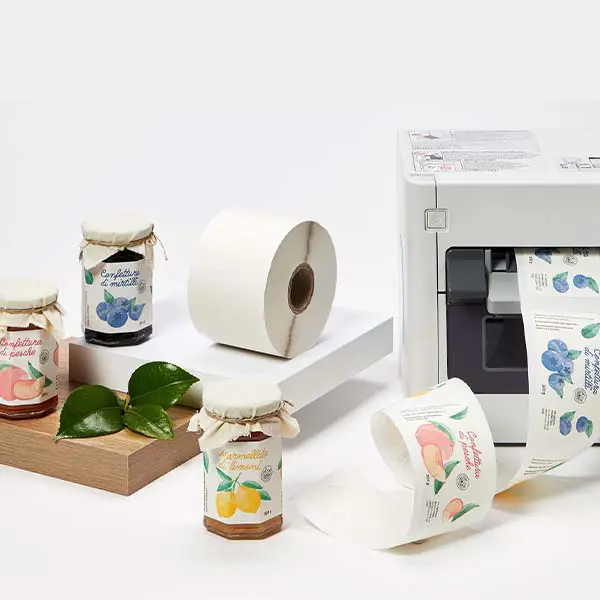
Inkjet sticker paper enables on-demand label production: a converter runs each artwork variant as needed, with consistent ink density across gloss or matte face stocks, and the smooth calendered surface reproduces fine serif typography and gradient backgrounds at the resolution cosmetics buyers expect. The permanent acrylic adhesive bonds cleanly to glass, HDPE, and PET without oozing at the label edge — a visible quality signal on premium SKUs.

Inkjet sticker paper produced on a balanced liner — where the liner caliper and silicone release force are matched to the face stock stiffness — passes through sheet-fed and roll-fed inkjet equipment without jamming, even under high-humidity ambient conditions. The inkjet receptive coating dries fast enough to prevent smearing on high-speed pass-through printers, reducing re-print waste on variable-data logistics labels.

Inkjet sticker paper with a high-gloss face stock and UV-resistant topcoat delivers gamut width comparable to cast-coated labels, enabling spot colours and photographic imagery to hold their appearance for 12–18 months under typical indoor display conditions. Converters running these jobs value the material’s dimensional stability during inkjet printing — a thermally stable face stock minimises registration shift across multi-pass colour builds.
Supply Formats and Lead Times Inkjet Sticker Paper from Vizlent
- Vizlent supplies inkjet sticker paper in three formats to match each stage of the label supply chain.
- Jumbo rolls — typically 1,000 mm or wider in custom widths — are the primary format for converters who slit and rewind in-house.
- Slit rolls are produced on Vizlent’s precision slitting lines to ±0.5 mm width tolerance, ready for direct use on narrow-web presses or automatic labelling equipment.
- Custom-cut sheets in A4, A3, or specified dimensions are available for buyers supplying office and desktop inkjet end-users, or for sample evaluation ahead of roll commitments.
- Minimum order quantities vary by product construction and supply format — buyers are encouraged to submit an enquiry with their target width, face stock grade, and adhesive specification so Vizlent’s export team can confirm the applicable MOQ and unit pricing. Standard lead time for bulk orders is 15 days from order confirmation.
Why Vizlent’s Direct Manufacturing Model Matters for Inkjet Label Stock Procurement

Trading company pricing is not the only risk in sourcing inkjet sticker paper through intermediaries — the deeper problem is formula opacity.
When a batch performs differently from the last, a trading company has no technical authority to investigate coating weight drift, adhesive viscosity variation, or liner release force change.
Vizlent’s structure as a direct manufacturer since 2011 eliminates that gap: the same R&D engineers who specify the inkjet coating are available to troubleshoot print performance issues and adjust formulas for specific ink sets or converting processes.
Frequently Asked Questions
Micro-porous coatings absorb ink through physical capillary action and dry instantly — better for pigment inks. Swellable coatings chemically bind dye molecules and take longer to dry. For pigment-based inkjet presses, specify micro-porous face stock.
Yes, provided the adhesive is formulated with a low surface energy primer layer. Standard permanent acrylic achieves adequate bond on corona-treated PP. For untreated polyolefin, specify a low-energy surface adhesive grade when enquiring.
Yes. Face stock caliper and liner stiffness must suit your press’s web tension range. Slit-roll width tolerance of ±0.5 mm prevents edge-guidance issues. Confirm your press manufacturer’s substrate specification — Vizlent can supply TDS data for compatibility review.
MOQ varies by width and grade — submit specifications for a confirmed figure. Free sample rolls are available before any commitment. Bulk order lead time is 15 days from order confirmation; sampling turnaround is typically faster.
FSC certification covers chain-of-custody requirements for paper-based label stocks under EU and North American environmental procurement policies. Vizlent’s FSC certification allows converters to pass certified material claims directly to brand owner customers.

