

Anti Static Label Materials — ESD-Safe Face Stocks
Anti static label materials are engineered self-adhesive constructions where the face stock, adhesive layer, or both carry a controlled surface resistivity — typically in the 10⁶ to 10⁹ Ω/sq range — to prevent electrostatic charge from accumulating on labeled packaging.
Vizlent Label Materials Co., Ltd has manufactured anti static label stock from its 20,000 sqm Shenzhen facility since 2011, supplying label converters, brand owners, and procurement teams across North America, Europe, and Southeast Asia with jumbo roll and slit roll formats backed by in-house R&D and full traceability documentation.
- At the construction level, an anti static label consists of three functional layers: the face stock (typically a polyester or polyolefin film, or a specialty coated paper), a pressure-sensitive adhesive formulated or primed for static-dissipative performance, and a siliconized release liner.
- The static-dissipative property is imparted either by coating the face stock with an antistatic agent at a coat weight of approximately 0.5–2 g/m² or by compounding the adhesive with ionic or hygroscopic dissipative additives.
- Face stock thickness typically runs 50–100 µm for film-based constructions, with dimensional stability across a service temperature range of −10 °C to +80 °C for most standard grades.
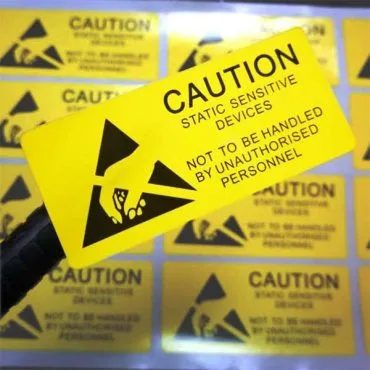
Yellow Anti-Static Sealing Sticker ESD Warning ATTENTION Labels by Vizlent seal ESD bags, warn handlers, and protect electronics during storage and global shipping.
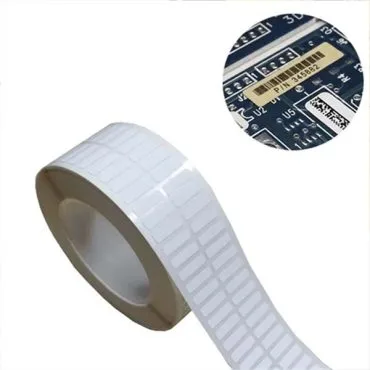
ESD Polyimide Kapton High Temperature Resistant Labels Standard ESD susceptibility “reach hand” symbol High-visibility yellow and black design Tear- and scuff-resistant face UV and fade resistant inks Available in multiple standard sizes Send Your Inquiry Now ESD Polyimide Kapton High Temperature Resistant Labels Features Vizlent ESD Polyimide Kapton High Temperature Resistant Labels combine the thermal toughness […]

Anti-Static Label for Circuit Boards by Vizlent protects PCBs from ESD damage with controlled surface resistance, reflow-safe adhesive, and clear traceable barcodes.
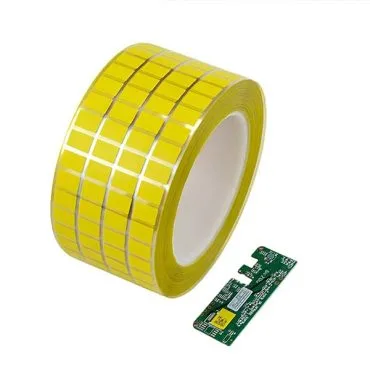
Anti Static Polyimide Labels from Vizlent deliver ESD protection, 300°C heat resistance, and durable barcodes for PCB assembly, semiconductors, and HDD labeling.
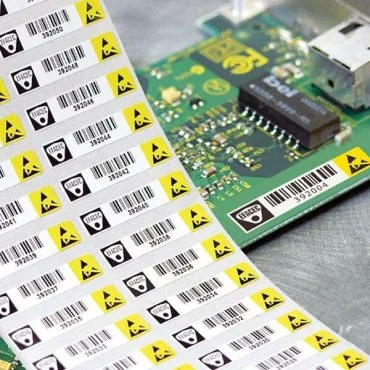
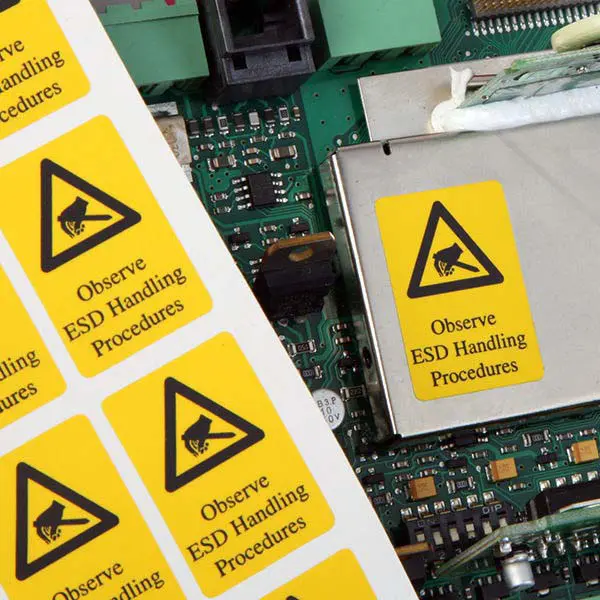
Static Dissipative Labels in PCB labeling from Vizlent offer reflow-resistant ID, controlled charge bleed-off, and sharp barcodes for SMT and EMS production lines.
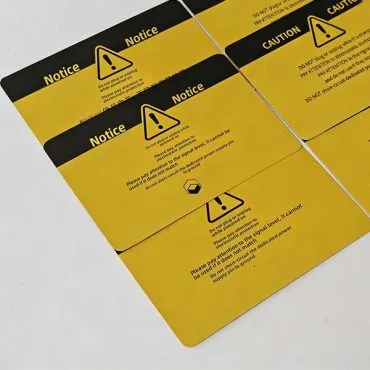
Anti Static Dissipative ESD Labels for electronic devices by Vizlent protect ICs and PCBs with controlled surface resistance, durable adhesion, and clear barcode print.
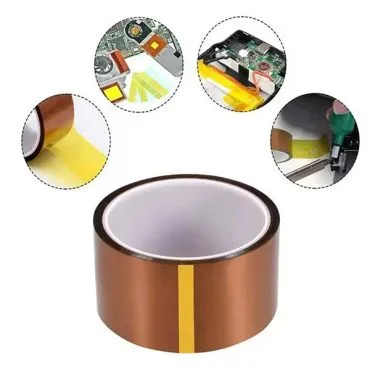
Polyimide ESD Label Material by Vizlent offers static-dissipative protection, high heat resistance up to 300°C, and reliable PCB tracking for electronics manufacturers.
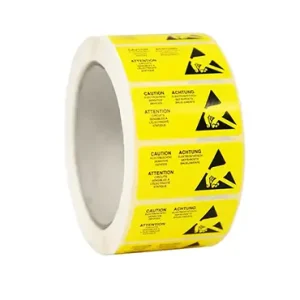
Anti Static Warning Labels Safeguard your static-sensitive devices (SSD) during handling, shipping, and storage with our premium anti-static warning labels. Designed for maximum visibility and uncompromising adhesion, these ESD caution stickers ensure strict compliance with global industry standards. By clearly identifying electronic components packaging that requires specialized static control, our labels help you enforce proper […]
Anti Static Label Applications Across ESD-Sensitive Industries

PCB assemblies, bare die, and packaged ICs can be damaged by electrostatic discharge events as low as 10–100 volts — well below the human perception threshold. Anti static labels applied to moisture barrier bags, ESD foam trays, and reel packaging maintain the static-dissipative boundary of the entire package, preventing charge from accumulating at the label surface and arcing into the component.

Certain chemical storage and explosive-ordnance environments mandate anti static labeling on outer packaging to comply with ATEX or OSHA 1910.119 zone classifications. In these settings, a standard polyester or paper label can accumulate sufficient charge to ignite vapors; anti static label stock with a surface resistivity below 10⁹ Ω/sq prevents incendiary discharge.

Medical Device Packaging and Sterile Barrier Systems
Cleanroom and medical device packaging combines the requirement for static control with stringent biocompatibility and outgassing standards. Particulate attraction driven by static charge contaminates sterile fields; anti static label stock with low extractables and a stable acrylic adhesive resolves this conflict.

Certain chemical storage and explosive-ordnance environments mandate anti static labeling on outer packaging to comply with ATEX or OSHA 1910.119 zone classifications. In these settings, a standard polyester or paper label can accumulate sufficient charge to ignite vapors; anti static label stock with a surface resistivity below 10⁹ Ω/sq prevents incendiary discharge.
Material Construction of Anti Static Label Stock
The face stock in Vizlent’s anti static label range is either a polyester (PET) or oriented polypropylene (OPP) film, antistatic-coated on the print surface by reverse-roll or gravure coating at a controlled coat weight of 0.8–1.5 g/m².
This coating process, applied inline before the adhesive lamination stage, deposits a uniform ionic antistatic layer that remains effective across relative humidity as low as 20% RH — unlike hygroscopic treatments that lose efficacy in dry environments.
The resulting face stock surface resistivity is characterized at 23 °C, 50% RH, per IEC 61340-2-3 or ASTM D257, and the TDS accompanying every batch states the measured value.

Supply Formats and Ordering Process for Anti Static Label Stock
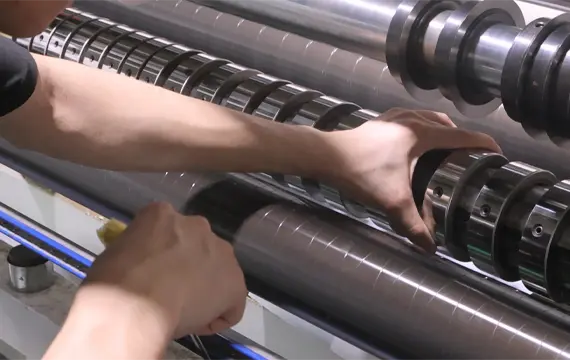
Vizlent supplies anti static label material in three formats: jumbo rolls for in-house slitting by converters who integrate the stock into their own matrix stripping and sheeting lines; precision-slit rolls produced on CNC slitter-rewinders with ±0.1 mm web width tolerance for direct-to-press or direct-to-applicator use; and custom-cut sheets in A4, letter, or bespoke dimensions for small-run and qualification purposes.
All formats are available with the full construction — face stock, adhesive, and liner — wound at specified tensions to prevent curl-set during storage.
Minimum order quantities vary by format, face stock grade, and adhesive specification — buyers are encouraged to enquire directly with their target format and width to receive an accurate MOQ and unit price.
tandard lead time for bulk production orders is 15 days from order confirmation. Converters and procurement teams evaluating the material for the first time can request free A4 sample sheets or short sample rolls for press trials, die-cutting qualification, and ESD performance testing before committing to production quantities.
Why Sourcing Anti Static Label Stock from Vizlent Differs from a Trading Company

Trading companies resell anti static label stock without the ability to adjust adhesive coat weight, face stock thickness, or antistatic coat formulation. Vizlent, as a direct manufacturer operating since 2011, maintains in-house R&D engineers who can modify the antistatic coating chemistry — switching between permanent and migratory antistatic systems, for instance — or adjust the adhesive formulation for specific surface energy targets or temperature ranges.
This means a converter specifying a non-standard width, an OEM buyer needing a custom-slit roll in 50 mm increments, or a procurement team requiring a proprietary adhesive additive can engage directly with the source rather than through a middleman who cannot technically respond.
Quality assurance runs through three stages: incoming quality control (IQC) on raw film and adhesive inputs; in-process quality control (IPQC) monitoring coat weight, viscosity, and liner release force during production; and outgoing quality control (OQC) checking dimensional accuracy, peel adhesion, and surface resistivity before dispatch. Every production batch is accompanied by a Technical Data Sheet (TDS) stating the measured parameters for that specific batch.
Three certifications underpin Vizlent’s credibility with international buyers: FSC certification satisfies environmental procurement policies in EU and North American markets where chain-of-custody documentation is required; SGS certification provides the independent third-party laboratory verification that procurement departments in multinational supply chains require as an audit condition; and TUV certification addresses the compliance documentation standards of industries — automotive, medical, and aerospace — where product liability makes traceable third-party assessment mandatory.
Frequently Asked Questions
Anti static (static-dissipative) labels carry a surface resistivity of 10⁶–10⁹ Ω/sq per IEC 61340 classification. Below 10⁶ Ω/sq the material is conductive; above 10¹² Ω/sq it is insulative. Only the 10⁶–10⁹ range safely dissipates charge without creating a low-resistance discharge path.
Solvent-based acrylic delivers higher initial tack and superior long-term adhesion to polyethylene and polypropylene (surface energy 30–36 mN/m). Water-based acrylic is suitable for standard PE/PP only when corona pretreatment is confirmed. Specify the substrate surface energy when enquiring.
Yes. PET-face anti static constructions run on standard thermal transfer printers without antistatic spray pre-treatment; the coating is inert to ribbon wax/resin. Slit roll width tolerance of ±0.1 mm ensures consistent feed on servo-driven applicators. Confirm core diameter and unwind direction at order stage.
MOQ varies by format and face stock grade — submit an enquiry with your target width and format for an exact figure. Free A4 sheets and short sample rolls are dispatched within a standard sample lead time; bulk production orders ship within 15 days of order confirmation.
MIL-PRF-81705 (US defense/aerospace ESD packaging) requires traceable third-party test data — SGS certification supports this. EU ATEX Zone 1/2 compliance requires documented ESD performance per IEC 61340; TUV certification provides the compliance documentation audit trail required by EU notified bodies.

