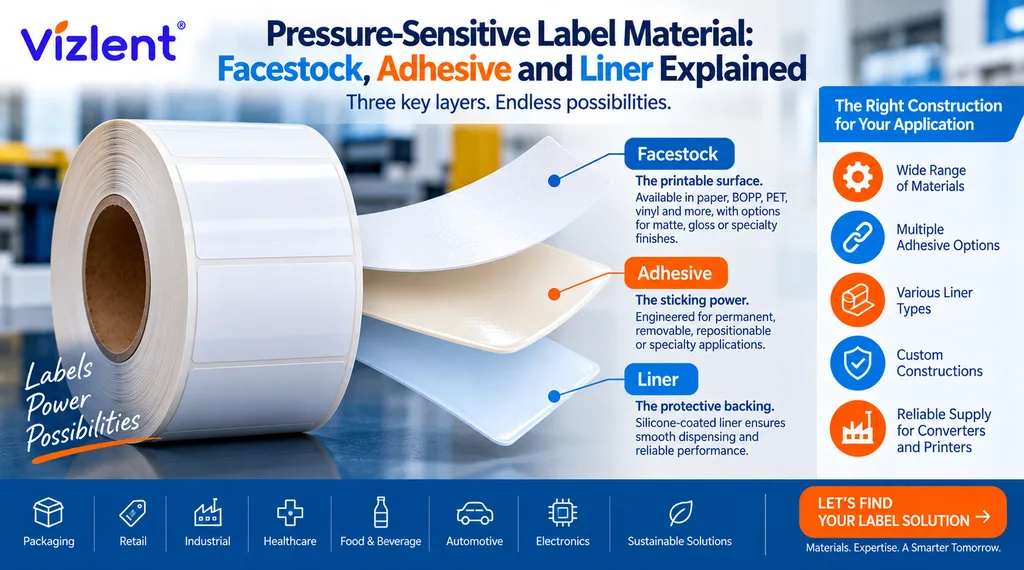
Wash-off label adhesive is a pressure-sensitive or hot-melt formulation engineered to bond securely during product use, then release cleanly in a controlled wash cycle so the container can be relabeled or recycled without residue. Breweries running returnable glass bottle lines, beverage brands shipping PET (polyethylene terephthalate) bottles into deposit-return schemes, and food logistics operators cycling reusable crates all depend on this adhesive chemistry to keep packaging in circulation.
The global push toward reusable packaging and circular economy mandates has made wash-off adhesive technology for labels a procurement priority rather than a niche specification. In North America, the Association of Plastic Recyclers (APR) publishes Critical Guidance Protocol PET-CG-02, the benchmark for confirming that a specific label construction is compatible with PET bottle-to-bottle recycling. In the EU, Regulation (EC) No 1935/2004 provides the general framework for materials and articles intended to come into contact with food, including label adhesives.
A wash-off adhesive is not automatically compatible with every container, recycling stream, or wash cycle. Qualification applies to the complete label construction, including facestock, adhesive, liner, print system, and the specific operating conditions of the target wash or recycling process. The supplier profiles and standards discussed below should be evaluated against your actual application before specifying.
What Is Wash-Off Label Adhesive and How Does It Work?
Wash-off adhesives use different chemistries and release mechanisms, but many industrial systems are designed to lose adhesion under warm alkaline washing conditions. Some formulations rely on water-soluble components that dissolve in the wash liquor, while others, such as HERMA’s multi-layer technology, use an intermediate layer that swells under caustic exposure and separates the entire adhesive film from the substrate. The result, when the adhesive and construction are properly qualified, is a container surface free of adhesive residue and ready for relabeling or mechanical recycling.
This answers the common question of what removes the sticky residue from stickers on returnable bottles: it is the adhesive chemistry itself, not scraping or solvent wiping. Industrial wash systems use warm alkaline solutions, with operating temperature and caustic concentration varying by container material, washer design, and adhesive construction. A properly qualified wash off adhesive loses its bond strength under the specified conditions, so the label detaches while minimizing adhesive residue and visible contamination on the container.
Key Performance Requirements
Not every washable adhesive that releases in a laboratory setting qualifies for industrial returnable or recyclable packaging. The adhesive must hold the label through filling, pasteurization, cold-chain distribution, and consumer handling before it reaches the wash station, performing like a durable label until the wash cycle begins.
- Initial tack and peel adhesion: Measured by methods such as FINAT FTM 1 (180-degree peel) and FTM 9 (loop tack). These methods measure adhesive performance characteristics and do not replace application-specific wash-off qualification.
- Service temperature range: Must maintain bond at the lowest temperature the package encounters during storage and distribution.
- Wash-off window: Must release within a defined time, temperature, and caustic concentration, leaving no residue on the container or in the wash liquor.
- Recycling compatibility: For PET applications, APR’s protocol evaluates the effect of the complete label system on recovered PET, including optical properties such as haze and colour. Recognition applies to a specific tested construction, not the adhesive chemistry alone.
- Food-contact compliance: Must comply with applicable regulations; requirements vary by market, product category, packaging construction, and intended use.
Why Wash Off Labels Matter for Returnable Bottles and Reusable Packaging
Returnable bottle programs, such as brewery refillable glass systems and deposit-return schemes across Europe, need to wash off labels that do not compromise the next fill cycle. Conventional permanent adhesives leave residue that builds up over repeated wash cycles, contaminating the caustic bath and forcing more frequent solution changes.
Reusable packaging extends beyond glass to returnable plastic crates (RPCs) for fresh produce logistics, reusable transit packaging for automotive parts, and pooled tote systems in e-commerce and logistics. Pooling operators including IFCO and Euro Pool Systems publish specific removable label adhesive requirements for clean label removal during their wash cycles, and a label construction that fails their qualification protocol results in rejected shipments and surcharges.
How These Suppliers Were Evaluated
Suppliers were selected for inclusion based on published wash-off performance data, substrate compatibility, recycling recognition from bodies such as APR or cyclos-HTP, operating temperature range, application format (pressure-sensitive adhesive or hot-melt), and availability of technical documentation. Inclusion does not rank one supplier above another, because the right choice depends on your container material, wash protocol, and application temperature.
Where a supplier has received third-party recognition, the recognition pathway and date are stated. Where specific wash conditions are published by the supplier, they are noted; otherwise the table below reads “Confirm TDS” (technical data sheet). All claims reflect published information at the time of writing and should be confirmed directly with each supplier before specifying.
Wash-Off Label Adhesive Suppliers to Consider
| Supplier | Adhesive | Substrate focus | Wash condition | Recycling recognition | Positioning |
| Vizlent | Wash-off grade | PET, glass, HDPE | Confirm TDS | Confirm product-specific | Custom label stock constructions |
| HERMA | 62Rpw / 72Hpw | PET, HDPE, PP | 80°C / 1% NaOH (published) | cyclos-HTP | Multi-substrate wash-off |
| Avery Dennison | WB0030 / WX6030 / CleanFlake | PET, glass, HDPE | 65°C (WB0030, published) | Returpack, Infinitum, cyclos-HTP | Broad portfolio, Nordic DRS |
| Dow | INVISU 7007 | PET (filmic) | Confirm TDS | APR Critical Guidance (Aug 2023) | PSA for filmic PET labels |
| Bostik | ClearCycle 1000 | PET | Confirm TDS | APR Critical Guidance | All-temperature PSA |
| UPM Raflatac | RW85C | PET, HDPE | Confirm TDS | APR (published) | Film and paper wash-off |
| Beontag | PET Wash-Off | PET (BOPP face) | Confirm TDS | APR (Jun 2025) | PSA with RFID capability |
| H.B. Fuller | Earthic 4010N | PET | Caustic wash | APR Critical Guidance | Hot-melt wrap-around |
| Henkel | TECHNOMELT EM 598 RE | PET | Caustic wash | APR Critical Guidance | Hot-melt wrap-around |
Table notes: “Confirm TDS” means the wash condition is adhesive- and construction-specific; request the supplier’s current technical data sheet. Recycling recognition applies to the specific construction tested, not to the adhesive chemistry alone. Data reflects published supplier information at the time of writing.
Vizlent Label Materials Co., Ltd.
Vizlent manufactures self-adhesive label stock at its Shenzhen facility with eight adhesive formulations spanning permanent, removable, freezer, and wash-off grades. The company coats paper, BOPP (biaxially oriented polypropylene), PET, and vinyl facestocks as jumbo rolls and precision-slit rolls, supplying converters in over 50 countries.
Vizlent’s wash-off label adhesive grade is part of its raw material label product line, available on custom widths with OEM/ODM service. The company also supplies BOPP label material and PET label material compatible with thermal transfer ribbon and flexographic printing, including resin ribbon for durable print on synthetic facestocks. Contact Vizlent for a free sample matched to your container type and wash protocol.
HERMA
HERMA develops multi-layer wash-off adhesive technology at its Filderstadt, Germany headquarters. Its adhesive 62Rpw uses a proprietary intermediate layer that bonds securely during use and releases completely during a warm caustic wash. HERMA publishes wash-off results from 80 degrees Celsius in 1% caustic soda for 62Rpw and 72Hpw, and the cyclos-HTP Institute has certified relevant constructions using these adhesives as recyclable.
HERMA also offers adhesive 62P for reusable crate and tray applications in food and plant logistics, which releases at temperatures below 40 degrees Celsius even after exposure to damp cold storage. IFCO and Europool recommend labels coated with this grade for their returnable crate programs. In June 2025, HERMA announced adhesive 72Hpw as one of the first certified wash-off solutions specifically designed for HDPE (high-density polyethylene) packaging recycling.
Avery Dennison
Avery Dennison supplies a broad wash-off portfolio for glass, PET, and HDPE containers. Its WB0030 adhesive is approved by Returpack (Sweden) and Infinitum (Norway) for PET beverage container recycling, and Avery Dennison states it washes off in a 65 degrees Celsius caustic bath leaving no residue. For PET recycling, the CleanFlake adhesives (S7000ER and S692N) are designed to separate filmic labels cleanly during the recycling wash step.
Avery Dennison also offers NPEO-free paper wash-off adhesives, including WX6030 for cold-water removal from RPCs and plastic packaging, and WW4031 for returnable wine and spirit glass bottles in an 80 degrees Celsius alkaline solution. WX6030 has been qualified with Euro Pool Systems, IFCO, Infinitum, and Returpack (per Avery Dennison’s published product data). Verify current product-level compliance and certification status directly, as evidence for one adhesive does not automatically apply to all products in the portfolio.
Dow (INVISU 7007)
Dow’s INVISU 7007 is a water-borne pressure-sensitive adhesive with wash-off capability that received APR Design for Recyclability Recognition under the Critical Guidance pathway in August 2023. The adhesive is formulated for polyolefin-based filmic labels (PE, PP) on PET bottles, enabling label separation during recycling to produce pure PET flakes.
INVISU 7007 features high solids content for high-speed coating and strong initial tack. Converters can test the adhesive through Dow’s Pack Studios innovation centers, which run label performance and recyclability trials on request.
Bostik (Arkema): Flexcryl ClearCycle 1000
Bostik describes Flexcryl ClearCycle 1000 as the industry’s first all-temperature wash off adhesive for pressure-sensitive label applications, with APR Critical Guidance recognition. Unlike many general-purpose wash-off formulations that lose adhesion in cold environments, ClearCycle 1000 maintains bond performance at 40 degrees Fahrenheit (4.4 degrees Celsius) or lower, making it suitable for freezer-grade PET applications.
ClearCycle 1000 does not require substrate pre-treatment for adhesion to BOPP facestock. Its low glass transition temperature enables all-temperature performance, a technical distinction from other wash-off adhesive formulations that stiffen below ambient conditions.
UPM Raflatac (RW85C)
UPM Raflatac offers label stock built on its proprietary RW85C wash-off adhesive, available with clear, white, and metallized film facestocks plus mid-gloss papers. The company states its wash-off film label stocks exceed APR Critical Guidance requirements for PET recycling in the tested constructions, paired with a PET liner containing 90% post-consumer recycled content.
For HDPE and PP packaging, UPM Raflatac offers paper wash-off stock designed to separate cleanly from flakes during recycling. Current product availability and construction options should be confirmed directly, as they may vary by region.
Beontag
Beontag received APR Design for Recyclability Recognition for its PET Wash-Off adhesive in June 2025, a pressure-sensitive formulation engineered for PET packaging using BOPP facestocks. Beontag states the adhesive offers clean separation during recycling without substrate pre-treatment and all-temperature performance.
Beontag also manufactures RFID-enabled label solutions, which can be paired with wash-off constructions for reusable packaging tracking and inventory management. Confirm current construction availability and the scope of APR recognition directly with Beontag before specifying.
H.B. Fuller and Henkel (Hot-Melt Wash-Off)
H.B. Fuller’s Earthic 4010N and Henkel’s TECHNOMELT EM 598 RE are APR-recognized caustic-washable hot-melt adhesives for PET wrap-around labeling. Hot-melt wash-off adhesives serve a different application format and chemistry from pressure-sensitive systems: they are applied molten on high-speed rotary labelers for cut-and-stack and wrap-around formats on beverage bottles. The distinction is application format plus adhesive chemistry plus wash behaviour, not simply PSA (pressure-sensitive adhesive) versus hot-melt.
How to Evaluate a Wash-Off Label Adhesive Supplier
A label adhesive supplier listing a wash-off grade in its catalogue does not mean the product is validated for your specific packaging system. Wash-off performance depends on the interaction between adhesive, facestock, container material, and the wash protocol your bottling or recycling partner operates. Your evaluation should follow a structured qualification process before committing production volume.
- Request the technical data sheet (TDS): Confirm the published wash-off temperature, caustic concentration, exposure time, and test substrate for the specific construction. Some low-energy plastic surfaces may need a super-sticky or low-energy adhesive to achieve initial bond before wash-off can occur.
- Verify third-party recognition: Ask for the current APR recognition letter, cyclos-HTP certificate, or pooling operator qualification. Recognition applies to the tested construction, not the adhesive alone.
- Run a sample trial: Apply labels to your actual containers using your equipment, run through your wash cycle, and evaluate residue, ghost marks, and label fragment carryover.
- Set written acceptance criteria: Define pass/fail thresholds for adhesive residue, label removal rate, haze and colour shift (if PET recycling), and barcode grade retention before testing.
- Confirm food-contact documentation: Request current compliance documentation for your intended use, jurisdiction, and packaging construction rather than relying on a general food-contact claim.
This qualification process is a screening step, not proof of long-term service life. Extended production runs, seasonal temperature variation, and changes to wash chemistry can affect adhesive performance over time.
Wash-Off Label Adhesive Alternative Options
Not every returnable or recyclable packaging application calls for a standard pressure-sensitive wash-off adhesive. Hot-melt wash-off adhesives serve wrap-around labeling on high-speed rotary lines, while water-soluble adhesives dissolve entirely in water rather than releasing as a film.
Another wash-off label adhesive alternative is water-soluble paper labels where the entire construction dissolves during the wash step. For labels requiring cold and wet survival but warm-wash release, biodegradable label stock paired with the correct adhesive grade can meet sustainability targets. The right solution depends on your container material, labeling line speed, and the recycling or reuse system the package enters. Where print durability is a concern, pairing wash-off constructions with a compatible laminating film can protect print through handling without interfering with wash-off performance, provided the complete construction is tested.
Regulations and Standards Affecting Adhesive Selection
In the EU, Regulation (EC) No 1935/2004 provides the general framework for materials and articles intended to come into contact with food. However, a label adhesive can have different regulatory considerations depending on intended contact, functional barrier, food type, packaging construction, and applicable national requirements. The EU PPWR is setting mandatory recyclability and reuse targets that will increase demand for wash-off and recyclability-compatible adhesive constructions.
In North America, APR’s Design Guide specifies releasing adhesive as the preferred design for labels on recyclable PET bottles. APR’s PET-CG-02 protocol evaluates the effect of the label system on recovered PET, including optical properties such as haze and colour, using injection-molded plaques made from washed PET flake. Consult the current APR protocol for specific pass/fail thresholds.
U.S. food-contact adhesive compliance can involve provisions including 21 CFR 175.105 and, for certain pressure-sensitive label adhesive applications, 21 CFR 175.125. The applicable provision depends on the adhesive formulation, construction, and intended use. Citing a CFR section does not by itself establish compliance.
Specify the Right Wash-Off Construction for Your Packaging
Selecting the right supplier starts with defining your container, wash process, and recyclability requirements. The adhesive is the component that determines whether a label stays on during distribution and comes off during washing; getting the specification right from the start prevents costly requalification later.
- 1. Submit your specification: container material, label size, application temperature, wash protocol.
- 2. Receive a recommended construction: facestock, adhesive grade, liner, print compatibility.
- 3. Request the technical data sheet: confirm wash-off parameters against your process.
- 4. Test samples on your line: run labeled containers through your actual wash cycle against written acceptance criteria.
- 5. Quote at volume: request pricing for your production quantity and delivery schedule.
Vizlent Label Materials Co., Ltd. manufactures self-adhesive label stock with wash-off adhesive grades for returnable bottles, reusable crates, and recyclable PET packaging. Browse the Vizlent Knowledge Base for technical articles on adhesive selection, or request a quote and free samples to start your qualification trial.
Frequently Asked Questions
What is a wash-off adhesive for labels?
Wash-off label adhesive is a bonding formulation that releases a label from a container during a controlled wash cycle using hot water, alkaline solution, or both. It allows returnable bottles, recyclable PET containers, and reusable crates to emerge from the wash station free of adhesive residue and ghost marks. The technology spans both pressure-sensitive (PSA) and hot-melt application methods.
What removes the sticky residue from stickers on returnable bottles?
The wash-off adhesive itself is formulated to lose bond strength under specific wash conditions, so the label and adhesive detach together without leaving sticky residue. In industrial washers, an alkaline solution at elevated temperature breaks the bond within the programmed wash time. For stickers not designed for wash-off, mechanical removal or solvent-based adhesive removers may be needed. Vizlent’s blog on how to remove sticky labels covers manual approaches.
Are wash off labels the same as removable labels?
No. Removable label adhesives are designed for clean hand-peel at ambient temperature, while wash off labels hold firmly during use and release only when exposed to a specific wash environment. A removable adhesive would peel during normal handling, which is unacceptable for a beer bottle on a retail shelf or a crate in cold storage.
Does wash-off adhesive work on glass and plastic?
Yes, wash-off systems are available for both glass and plastic substrates, but the adhesive, facestock, and wash protocol must be matched to the container material. Glass returnable bottles typically use adhesives that release in hot alkaline baths, while PET requires constructions validated per APR PET-CG-02 to avoid contamination of the recycled PET stream. For containers exposed to outdoor or high-moisture conditions before reaching the wash station, consider outdoor and weather-resistant label stock paired with a qualified wash-off adhesive grade.
Can wash-off labels survive freezer conditions?
Many general-purpose wash-off adhesive systems are designed for application temperatures around 40 degrees Fahrenheit (4.4 degrees Celsius) and above, while specialized all-temperature grades extend performance below that range. Bostik describes ClearCycle 1000 as the first APR-validated all-temperature option maintaining adhesion at or below that threshold for freezer-grade PET. Always confirm minimum application and service temperature on the supplier’s technical data sheet for the specific construction.
How do I choose between pressure-sensitive and hot-melt wash-off?
Your labeling equipment and application format dictate the method. Pressure-sensitive adhesives (PSAs) are pre-coated on liner and dispensed on standard label applicators, while hot-melt types are applied molten on high-speed rotary labelers for wrap-around and cut-and-stack formats. Each format has different adhesive chemistry, wash behaviour, and recycling pathway considerations.
Where can I buy wash-off label stock in bulk?
Converters and printers can source self-adhesive label stock with wash-off label adhesive directly from manufacturers like Vizlent, which supplies custom-slit rolls and jumbo rolls for converting equipment. Contact Vizlent for a bulk quote and free samples matched to your container type and wash protocol. For brand owners buying finished labels, work with your label converter to specify a wash-off adhesive grade from one of the suppliers listed above. If you are sourcing food labels and stickers specifically, Vizlent’s buyer guide covers material selection for food packaging applications.