
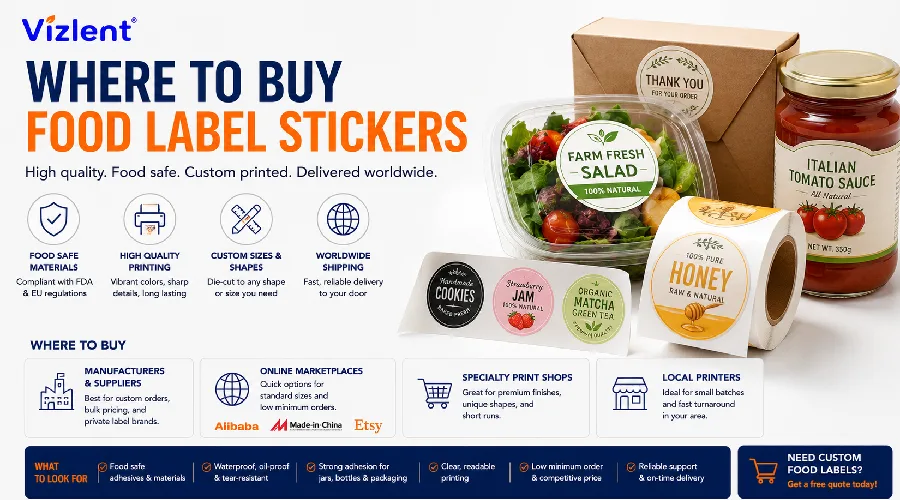
Buy food labels stickers in trusted, direct label material manufacturers like Vizlent Label, online printing platforms, local print shops, office supply retailers, and craft marketplaces. Manufacturers offer the lowest per-unit pricing on bulk orders, online printers suit small custom runs, and local shops work well when you need labels the same week. The right choice depends on your order volume, your customization needs, and the conditions your labels must survive, such as refrigeration, moisture, or oily surfaces.
Vizlent Label Materials Co., Ltd. have supplied self adhesive label materials to food brands, converters, and printing houses in more than 50 countries since 2011, and buyers ask me the same sourcing questions again and again. The answers below come from 15 years of coating, slitting, and testing the exact materials these stickers are made from. Use them to match each buying channel to your budget, your timeline, and your product.
What Are Food Labels Stickers and What Are They Used For?
Food labels stickers are pressure sensitive adhesive labels applied to packaging, containers, and jars to identify contents, display required information, and carry brand artwork. Every sticker is built from three layers: a printable facestock, an adhesive formulated for the target surface, and a release liner that peels away at application. The facestock can be semi gloss paper, thermal paper, or synthetic films such as PP, PET, and vinyl, each with different resistance to water, oil, and abrasion.
Labels stickers for food carry more responsibility than decorative stickers because they often communicate safety information that regulators require. Common food labels examples include ingredient declarations, allergen warnings, nutrition panels, expiry date stickers, batch codes, and front of pack branding. A bakery selling at a weekend market and a beverage plant filling 10,000 bottles an hour both rely on the same basic construction, just at very different volumes and specifications.
The most common food labels examples you will buy or print include:
- Ingredient and allergen labels required by food safety regulations in most markets
- Expiry date, best before, and batch code stickers for rotation and traceability
- Branding and product name labels for jars, pouches, boxes, and bottles
- Price and weight stickers for deli counters, butcheries, and grocery retail
- Storage instruction stickers for refrigerated, frozen, and shelf stable goods
Where to Best Buy Food Labels Stickers Locally in China
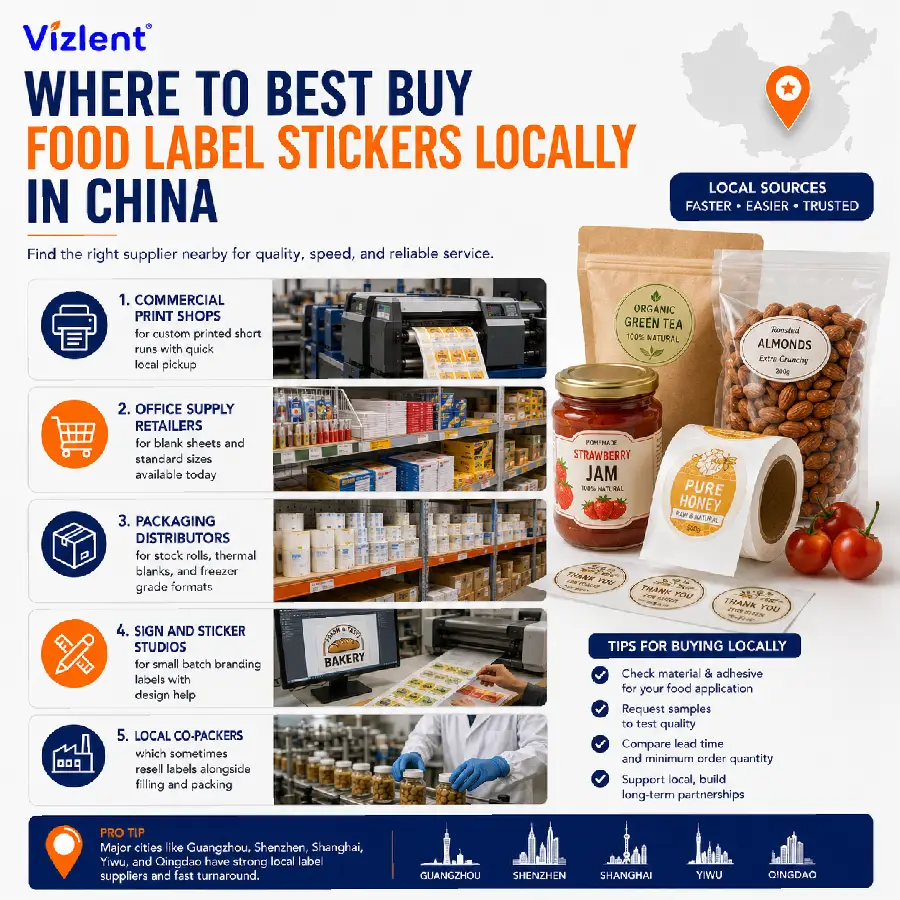
Searching for food labels stickers near me will surface three main local options: commercial print shops, office supply retailers, and regional packaging distributors. Print shops handle short custom runs with fast turnaround, often producing finished rolls or sheets within two to five business days. Office supply stores stock blank food labels stickers in standard sheet sizes that you can run through your own printer the same day.
A search for labeling stickers near me or stickers labels near me also brings up packaging distributors, which sit between retail and manufacturing on price and volume. Distributors carry stock formats such as freezer grade rolls and thermal transfer blanks, and many offer next day delivery within their region. Anyone searching business stickers and labels near me for a growing food company usually starts at a distributor before moving to factory direct supply as volumes climb.
Local channels worth comparing when you want food labels stickers nearby:
- Commercial print shops for custom printed short runs with quick local pickup
- Office supply retailers for blank sheets and standard sizes available today
- Packaging distributors for stock rolls, thermal blanks, and freezer grade formats
- Sign and sticker studios for small batch branding labels with design help
- Local co packers, which sometimes resell labels alongside filling and packing services for small food brands
Buying Food Labels Stickers Online
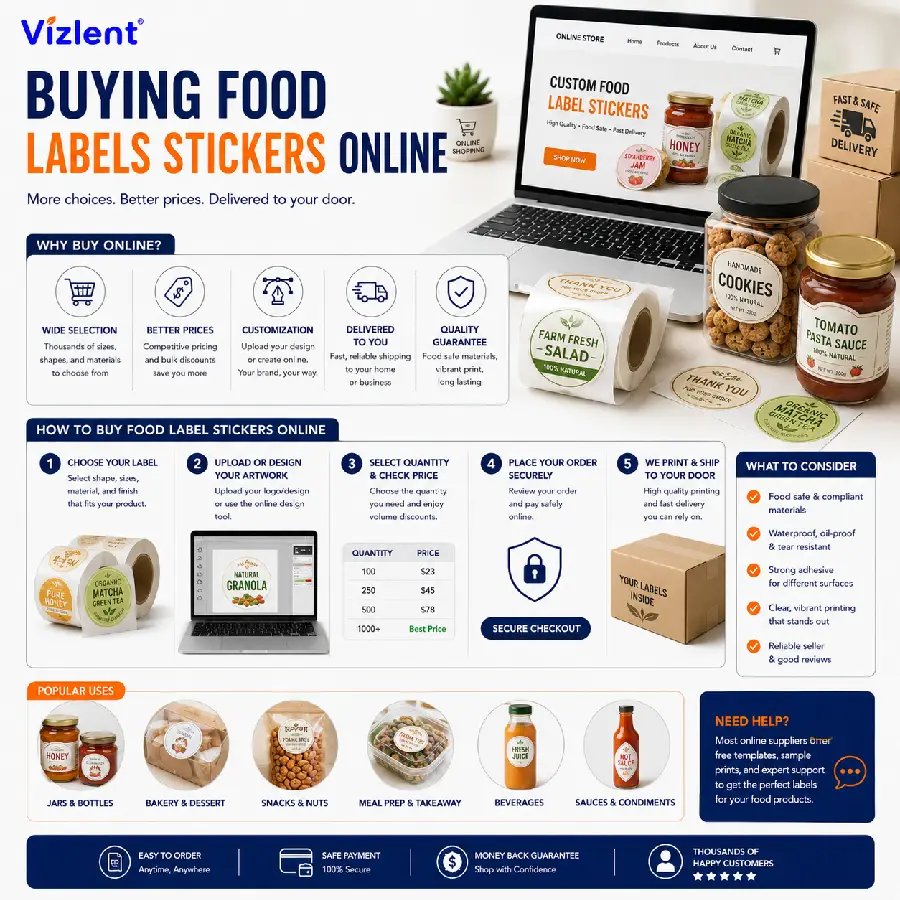
Online channels give you access to food labels stickers for sale in every format, from single sheets to pallet quantities, without leaving your desk. Web to print platforms let you upload artwork, pick a material, and receive finished custom labels within one to two weeks. Marketplaces such as Etsy and Amazon list thousands of pre designed and food labels stickers personalised options for home kitchens, gifting, and small batch producers.
If you prefer to print in house, food labels stickers printable formats are sold as A4 or letter size sheets matched to inkjet printing labels or laser stock. Many template sites offer food labels stickers free to download, so you only pay for the blank sheets and your own ink. This route works well for canning weekends, school events, and product tests, though print durability will not match commercially printed film labels.
Match the online channel to your order profile:
- Web to print platforms: Custom artwork, low minimums, 5 to 14 day delivery
- Marketplaces: Pre designed and personalised sets for home and craft use
- Template libraries: Food labels stickers free designs paired with blank sheets you print yourself
- Label converters’ online stores: Stock rolls sized for desktop label printers
- Manufacturer websites: Bulk jumbo rolls and finished labels at factory pricing
Printing Your Own Food Labels Stickers In House
Running your own label printer makes sense for producers who change dates, flavors, and batch codes every day. Desktop thermal printers pair blank label rolls with thermal transfer ribbons to produce durable, smudge free text without ink cartridges or drying time. Inkjet and laser sheet printing suits colorful short runs, while thermal printing wins for high volume variable data such as weights, prices, and expiry dates.
The economics favor in house printing when your business needs many small runs rather than one large one. Blank stock costs far less than finished labels, changeover between products takes minutes, and there is no minimum order quantity to negotiate with a supplier. Our engineering team publishes material compatibility guides in the Vizlent knowledge base to help you match facestocks, ribbons, and adhesives to your specific printer model.
Common in house printing setups for food producers:
- Direct thermal printers for short life labels such as deli weights and daily prep dates
- Thermal transfer printers with wax or resin ribbons for freezer and moisture exposed labels
- Color inkjet label printers for branded short runs with strong image quality
- Laser printers with heat stabilized sheet stock for crisp text and scannable barcodes
- Print and apply systems that print and place labels automatically on packing lines
Why Buying Direct from a Manufacturer Wins at Volume
Once your order passes roughly 10,000 labels per SKU, factory direct supply becomes the most economical answer to where to buy food labels stickers. Retail and web to print channels stack markups from the material maker, the converter, and the platform, while a manufacturer quotes one factory price. At Vizlent Label, we coat, siliconize, and slit our own label stock, which is why converters and food brands buying food labels stickers in bulk routinely cut material costs by 20 to 40 percent.
Direct supply also gives you control over the specification instead of accepting a stock construction. You choose the facestock, one of our 8 adhesive formulations, and the liner, then we produce rolls from 30mm to 1300mm wide within 7 to 15 days. Every batch is ISO 9001 manufactured, FSC certified, and SGS tested, and you can read more about our production standards on our about us page.
Ready to compare factory direct pricing on your next label order? Send your specifications to our team and receive a detailed quotation within 24 hours, including free sample rolls or A4 sheets so you can test print quality and adhesion before committing to a bulk order.
Custom and Personalised Food Labels Stickers
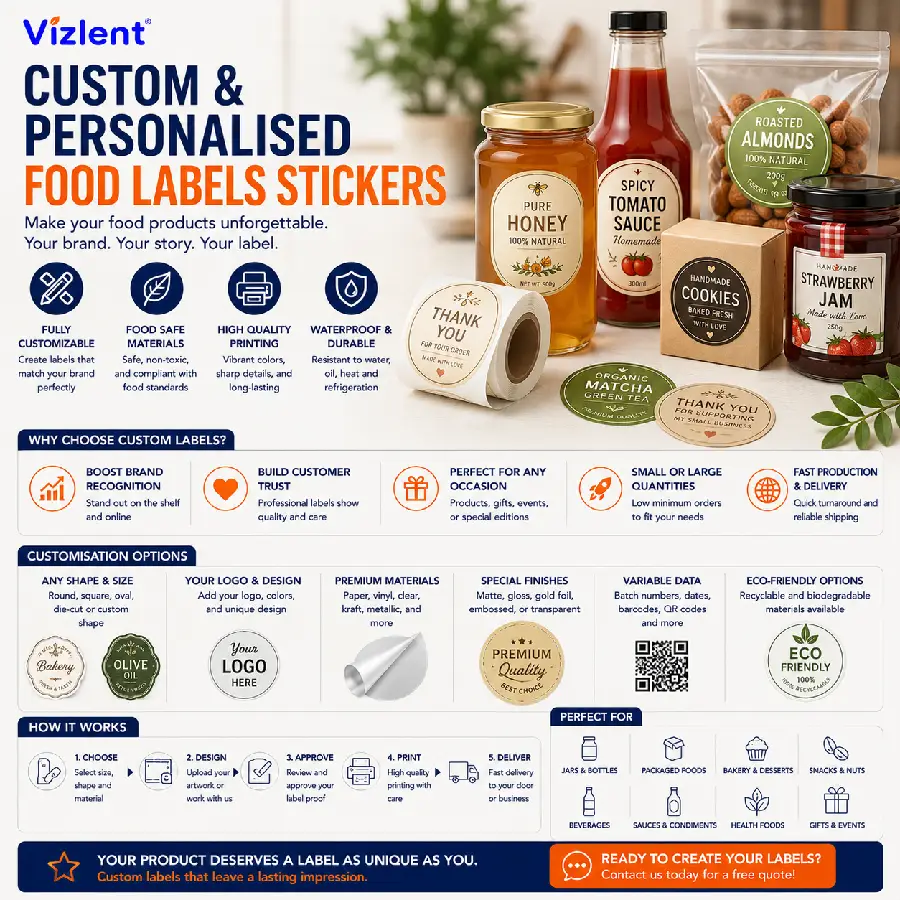
Food labels stickers custom printed with your artwork turn ordinary packaging into shelf presence, and the process is simpler than most first time buyers expect. You supply a print ready file, the supplier matches it to a die line, and the labels arrive on rolls or sheets ready for hand or machine application. Food labels stickers personalised with names, dates, or event details follow the same workflow at smaller quantities, which is why weddings, cafes, and meal prep services order them constantly.
Strong food labels stickers design starts with legibility at real shelf distance, not how the artwork looks on a monitor. Keep mandatory text such as allergens at a readable point size, hold brand colors consistent across every SKU, and leave a safety margin inside the die cut edge. If you print in house on laser printing labels, confirm the facestock is heat stabilized so sheets do not curl or jam in the fuser.
Design and ordering tips that prevent expensive reprints:
- Export artwork at 300 dpi with fonts outlined and a 1.5mm bleed on all sides
- Request a printed proof or sample before approving food labels and stickers for full production
- Choose blank food labels stickers in the same material as your final run for accurate print tests
- Confirm the adhesive type against your packaging surface, since glass, HDPE, cardboard, and film all bond differently
- Order 5 to 10 percent overage on every run to cover application waste and misfeeds on labeling lines
Matching the Material to the Food Application
The fastest way to waste money on labels is buying the right design on the wrong material, because adhesives are formulated for specific temperatures and surfaces. Food freezer labels stickers need cold grade adhesives, such as our low temperature labels rated for application and adhesion down to minus 40 degrees Celsius on frozen goods. Food container labels stickers for reusable tubs and meal prep boxes often need removable adhesives that peel cleanly after washing.
Food & beverage labels stickers face moisture, condensation, and refrigeration, so synthetic facestocks and protective laminating films outperform plain paper in most drink applications. Food & beverage labels stickers for water bottles in particular need wet strength facestocks and adhesives that grip through ice bucket conditions, a construction we supply through our beer and beverage label range. Brands with sustainability commitments can specify biodegradable labels with compostable facestocks certified to EN 13432 or ASTM D6400.
Quick material matches for common food environments:
- Freezer and cold chain: film facestock with low temperature acrylic adhesive
- Refrigerated drinks and water bottles: PP or PET film with permanent wet grade adhesive
- Dry pantry goods: semi gloss paper facestock with standard permanent adhesive for the best cost per label
- Oily or greasy packaging: top coated film with high tack adhesive and laminated print surface
- Reusable containers: removable adhesive that releases without residue after use
How to Compare Suppliers Before You Order
Price per thousand labels is only useful when every quote describes the same construction, so request a full specification sheet from each supplier. The sheet should state the facestock type and weight, the adhesive chemistry and service temperature range, the liner, and the print method the material is coated for. A supplier who cannot produce this document is reselling material they do not understand, which becomes your problem the first time a batch fails on the line.
Certifications and samples separate serious suppliers from listings with attractive photos. Ask for ISO 9001, FSC, or SGS documentation, then run free samples on your actual printer and apply them to your actual packaging for at least 48 hours. Our engineering team publishes practical testing guidance on the Vizlent blog, covering peel strength, print anchorage, and adhesive selection for food surfaces.
A supplier comparison checklist you can copy into your next RFQ:
- Full material specification with adhesive service temperature range
- Proof of quality certifications and batch level traceability
- Free samples for print and adhesion testing on your own equipment before any payment
- Stated production and shipping lead times in writing, with remedies agreed for delays
- MOQ flexibility for trial orders and scaling terms for repeat volume
Not sure which construction fits your product? Contact our engineering team with a photo of your packaging and your storage conditions, and we will recommend a facestock, adhesive, and liner combination backed by lab test data.
Get Factory Direct Food Labels Stickers from Vizlent Label Materials Co.
You now know where to source food labels stickers for every stage of your business, from same day blank sheets at a local retailer to custom bulk rolls produced on factory coating lines. Local shops win on speed, online platforms win on convenience for small runs, and direct manufacturers win on price, specification control, and consistency at volume. The smartest buyers test samples from two or three channels, then consolidate with the supplier whose material performs on their actual packaging.
Vizlent has manufactured self adhesive label stock since 2011, supplying more than 1,000 converters, distributors, and food brands across 50 plus countries with ISO 9001, FSC, and SGS certified materials. We produce the paper, film, adhesive, and liner combinations behind the labels described throughout the sections above, and we back every order with roll by roll quality inspection before dispatch. Send your inquiry today to receive a factory direct quotation within 24 hours, plus free sample rolls or sheets so you can prove the quality on your own equipment before you spend a single dollar on bulk stock.
Frequently Asked Questions
Where to buy food labels stickers in bulk for a food business?
Direct label material manufacturers are the most cost effective source for bulk food label orders above 10,000 pieces per SKU. Factory direct suppliers such as Vizlent remove distributor markups and let you specify the exact facestock, adhesive, and roll format your labeling equipment needs. Typical lead times run 7 to 15 days for custom OEM orders, and free samples let you verify quality before committing. Regional packaging distributors are a reasonable middle step while your volumes are still growing.
What material is best for food labels stickers?
Semi gloss paper is the best material for dry, room temperature food packaging because it prints sharply at the lowest cost per label. Synthetic films such as PP and PET are better for refrigerated, frozen, or moisture exposed products since they resist water, oil, and tearing. The adhesive matters as much as the facestock, so match its rated service temperature to your storage conditions. When in doubt, test samples of both paper and film on your actual packaging. A reliable supplier will send both material types free of charge so the comparison costs you nothing.
Are food labels stickers safe for direct food contact?
Standard food labels stickers are designed for the outside of packaging, not for direct contact with unwrapped food. Labels intended to touch food must use adhesives and facestocks compliant with food contact regulations such as FDA 21 CFR or EU 1935/2004. Always tell your supplier if a label could contact the food itself, for example on fruit skins or bakery items. A reputable manufacturer will provide compliance documentation for food contact grades.
Can food labels stickers survive the freezer?
Yes, food freezer labels stickers survive frozen storage when they use cold grade adhesives rated for the target temperature. Standard permanent adhesives lose tack below about 5 degrees Celsius and will lift or fall off frozen packaging. Low temperature acrylic formulations apply and hold down to minus 40 degrees Celsius on frost covered surfaces. Ask your supplier for the adhesive’s minimum application temperature and minimum service temperature, since these are two different numbers.
What is the difference between printable and pre printed food labels stickers?
Printable food labels stickers are blank sheets or rolls you run through your own inkjet, laser, or thermal printer, while pre printed labels arrive finished from a commercial press. Printable formats give you flexibility for changing dates, batch codes, and small runs at low upfront cost. Pre printed labels deliver stronger color, better durability, and a lower unit price once quantities pass a few thousand. Many food businesses combine both, using pre printed brand labels plus printable stickers for variable data. This hybrid approach keeps branding consistent while giving your kitchen full control over dates and codes.
How much do custom food labels stickers cost?
Custom food labels stickers typically cost between 2 and 15 US cents per label depending on size, material, print colors, and order quantity. Small web to print orders of a few hundred labels sit at the high end, while factory direct bulk orders drop below 2 cents on paper stock. Film facestocks, laminating, and specialty adhesives add 20 to 60 percent over plain paper. Requesting quotes at two or three quantity levels shows you exactly where the price breaks fall. Factory direct buyers should also ask for pricing on jumbo rolls if they run their own converting equipment.
What size should food labels stickers be?
The right food label size is the largest label that fits the flattest panel of your packaging while leaving clear space at seams and curves. Common sizes include 50mm by 75mm for jars, 100mm by 150mm for pouches and boxes, and 25mm circles for lids and seals. Regulations in most markets set minimum text heights for mandatory information, so size the label around that text first. Wrapping a flat label around a tight curve causes flagging, so switch to a smaller label or a more conformable film facestock on curved containers. Measuring the flat panel with a ruler before ordering saves an entire wasted print run.
How long does it take to receive food labels stickers from a manufacturer?
Custom food label orders from a direct manufacturer typically ship within 7 to 15 business days after artwork and deposit approval. Stock blank formats often ship within 2 to 3 days since no coating or printing setup is required. International sea freight adds 3 to 6 weeks depending on the route, while air freight delivers in under a week at a higher cost. Ordering your next batch when inventory reaches a 6 week supply keeps production lines running without rush fees.






