
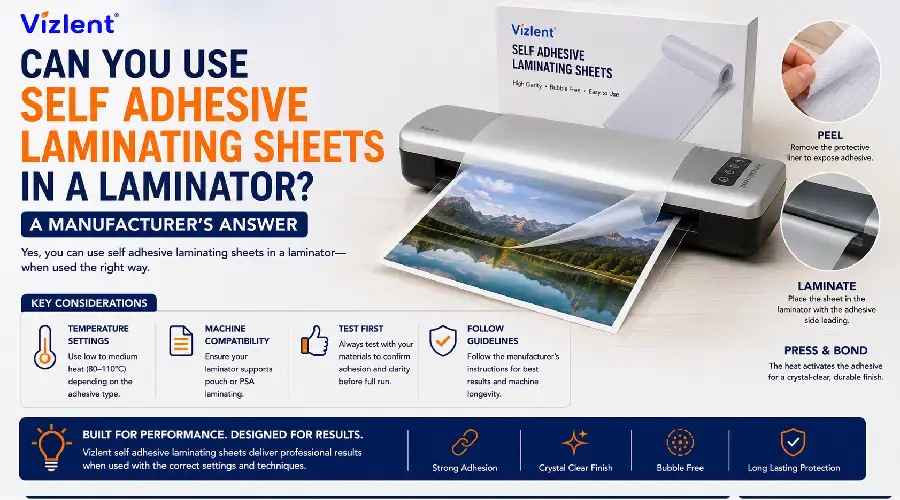
No, you should not run self adhesive laminating sheets in a laminator that uses heat, because the pressure-sensitive adhesive melts, coats the rollers, and can jam or permanently damage the machine. These sheets bond at room temperature through pressure alone, so firm hand pressure with a squeegee is the correct application method. Heated pouch and roll laminators are built for thermal film, a product with a completely different adhesive chemistry that activates between 100°C and 150°C.
There is one exception, and it involves cold roll laminators and pouch machines with a true cold setting. After 15 years of coating pressure-sensitive films at Vizlent, I have answered this question for hundreds of buyers, and the details below cover the exception, the correct technique, and the specification choices that follow. Everything here comes from testing on our own production lines and from the failures customers describe to our support team.
What Is Self Adhesive Laminating Sheets Material?
The question of what is self adhesive laminating sheets material comes up in almost every first inquiry we receive about cold lamination. A self-adhesive laminating sheet is a clear or matte protective film coated on one side with a pressure-sensitive acrylic adhesive and backed by a peel-away release liner. Once the liner is removed, the film bonds to paper, cardstock, photographs, or vinyl using nothing more than firm, even pressure.
Vizlent Label produces these constructions on our own coating and siliconizing lines using PET, PVC, and BOPP face films paired with water-based acrylic adhesives. Face film thickness typically runs from 25 to 250 microns depending on the stiffness a job requires. You can review the available face stocks, adhesive grades, and liner systems on our self adhesive material range page.
Why Heated Laminators and Self-Adhesive Sheets Do Not Mix
A heated laminator raises its rollers to between 100°C and 150°C so the dormant thermal glue inside a standard pouch can flow and bond. Pressure-sensitive adhesive is already fully active at room temperature, so it gains nothing from that heat and reacts badly to it. Within seconds, the acrylic layer softens, oozes past the film edges, and transfers straight onto the hot rollers.
The face film suffers alongside the adhesive, since thin PVC in particular distorts, ripples, and clouds under roller heat. Once adhesive residue coats the rollers, every pouch fed afterward picks up streaks and specks. Our support team regularly hears from buyers who ruined a machine this way before switching to the correct film category.
What Happens If You Feed a Self-Adhesive Sheet Through a Hot Laminator
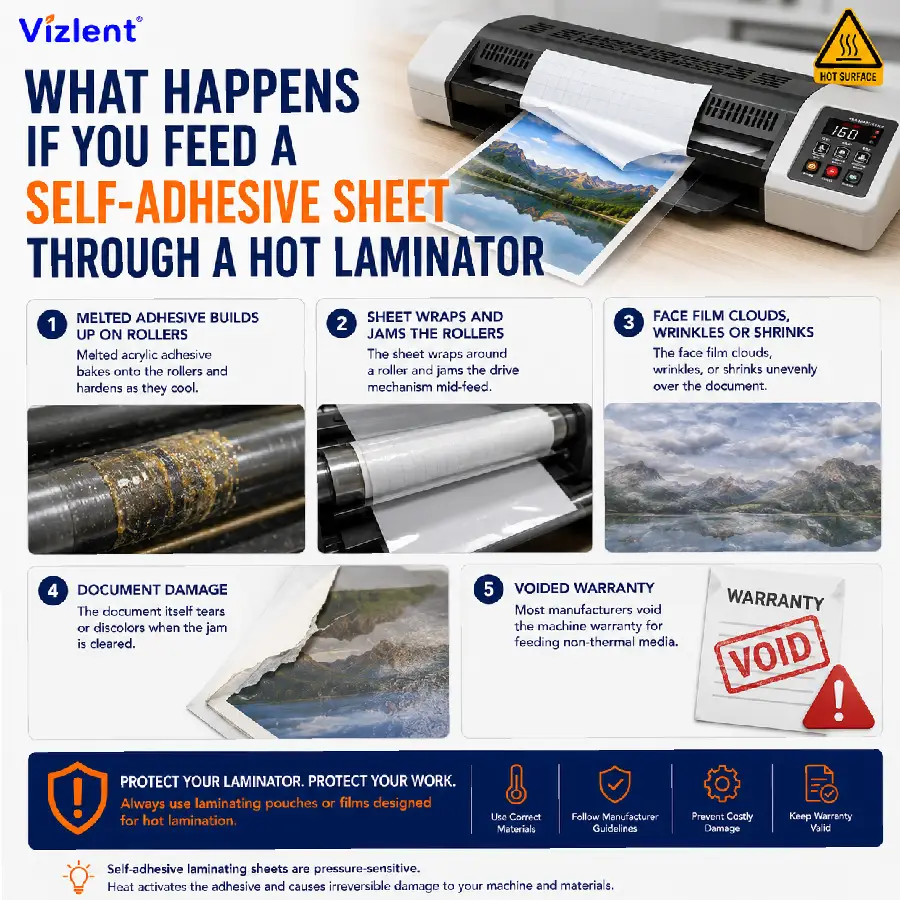
The damage sequence is fast, predictable, and expensive relative to the cost of the sheet itself. In our lab trials, a standard 80 micron pressure-sensitive sheet begins releasing adhesive onto rollers at around 90°C, well below the operating range of consumer machines. The typical outcomes look like this:
- Melted acrylic adhesive bakes onto the rollers and hardens as they cool.
- The sheet wraps around a roller and jams the drive mechanism mid-feed.
- The face film clouds, wrinkles, or shrinks unevenly over the document.
- The document itself tears or discolors when the jam is cleared.
- Most manufacturers void the machine warranty for feeding non-thermal media.
Recovery means dismantling the roller assembly and scrubbing it with isopropyl alcohol while the residue is still soft. Many owners find replacement rollers cost more than a new entry-level machine. Reading the media rating printed on the pouch box before feeding anything prevents the entire episode.
Cold Laminators: The One Machine Exception
A cold laminator is the only machine type that pairs safely with pressure-sensitive film, because its silicone rollers apply pressure without any heating element. Sign shops and print finishers run cold roll laminators every day to apply adhesive overlaminates to banners, decals, floor graphics, and vehicle wraps. The rollers perform the same job as a hand squeegee, only with perfectly even force across the full web width.
If your pouch machine has a dedicated cold setting, it can process cold pouches designed for that mode, though single peel-and-stick sheets are still easier to apply by hand. Machine-grade cold films are supplied on rolls with liners engineered for continuous tension and feeding. Our cold lamination films page lists roll widths, adhesive grades, and liner options built for this equipment.
Not sure which film suits your machine? Send your equipment model and application details through our contact page, and a Vizlent engineer will recommend the correct construction within 24 hours.
How Do You Use Self Adhesive Laminating Sheets by Hand?
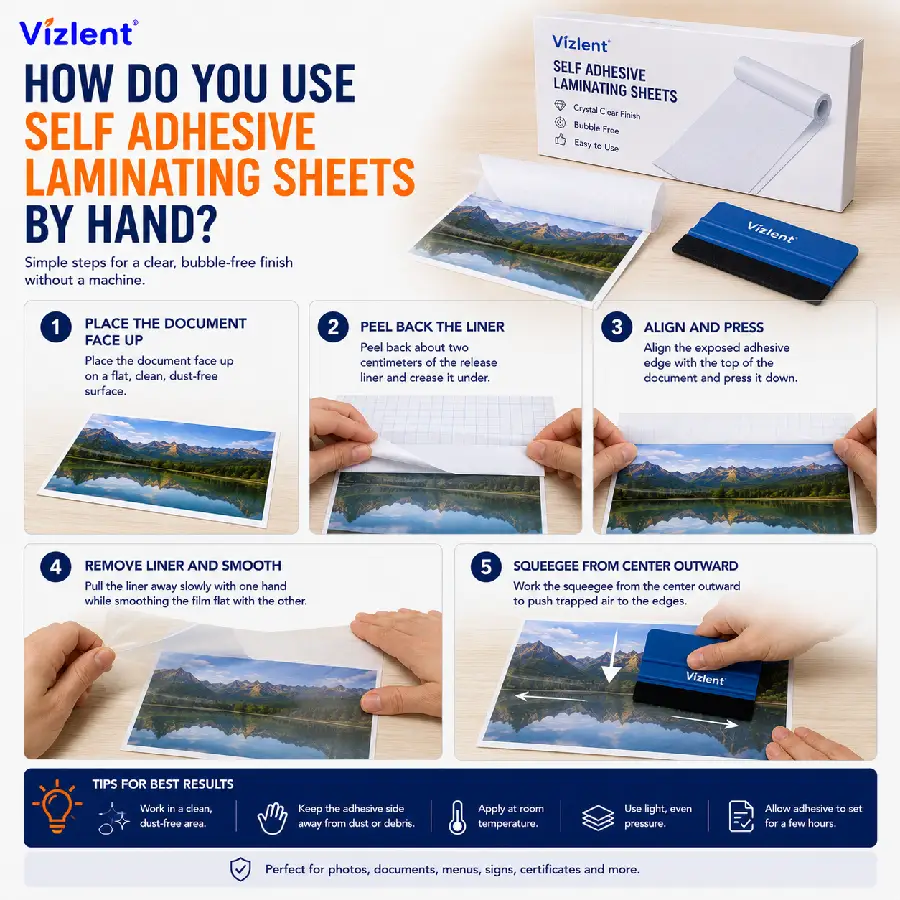
Buyers searching how do you use self adhesive laminating sheets are usually relieved to learn the process takes under two minutes and no equipment beyond a plastic card. The method depends on peeling the liner gradually rather than all at once, which stops the film from folding onto itself. Clean hands, a dust-free table, and a squeegee or old credit card complete the toolkit.
Standard self laminating sheets directions follow five steps:
- Place the document face up on a flat, clean, dust-free surface.
- Peel back about two centimeters of the release liner and crease it under.
- Align the exposed adhesive edge with the top of the document and press it down.
- Pull the liner away slowly with one hand while smoothing the film flat with the other.
- Work the squeegee from the center outward to push trapped air to the edges.
Trim the finished piece with scissors or a rotary cutter, leaving a two to three millimeter sealed border for moisture protection. Small bubbles can be pierced with a pin and pressed flat without leaving a visible mark. Step-by-step photo guides for first-time users are published in our knowledge base.
How to Use Self-Adhesive Laminating Sheets on Large or Awkward Items
Learning how to use self-adhesive laminating sheets on oversized posters or textured cards takes one extra technique known as the hinge method. Tape the sheet in position along one edge before removing any liner, so alignment is locked before the adhesive is exposed. From there, peel and smooth in sections of roughly ten centimeters at a time.
Search interest in self adhesive laminating sheets, how to use guides spikes around school terms and craft fair season, and most reported failures trace back to rushing the peel. Textured stock needs firmer squeegee pressure to push the adhesive into surface valleys. Give the bond a full 24 hours to reach final strength before rolling, folding, or washing the piece.
Which Surfaces Accept Self-Adhesive Lamination Best?
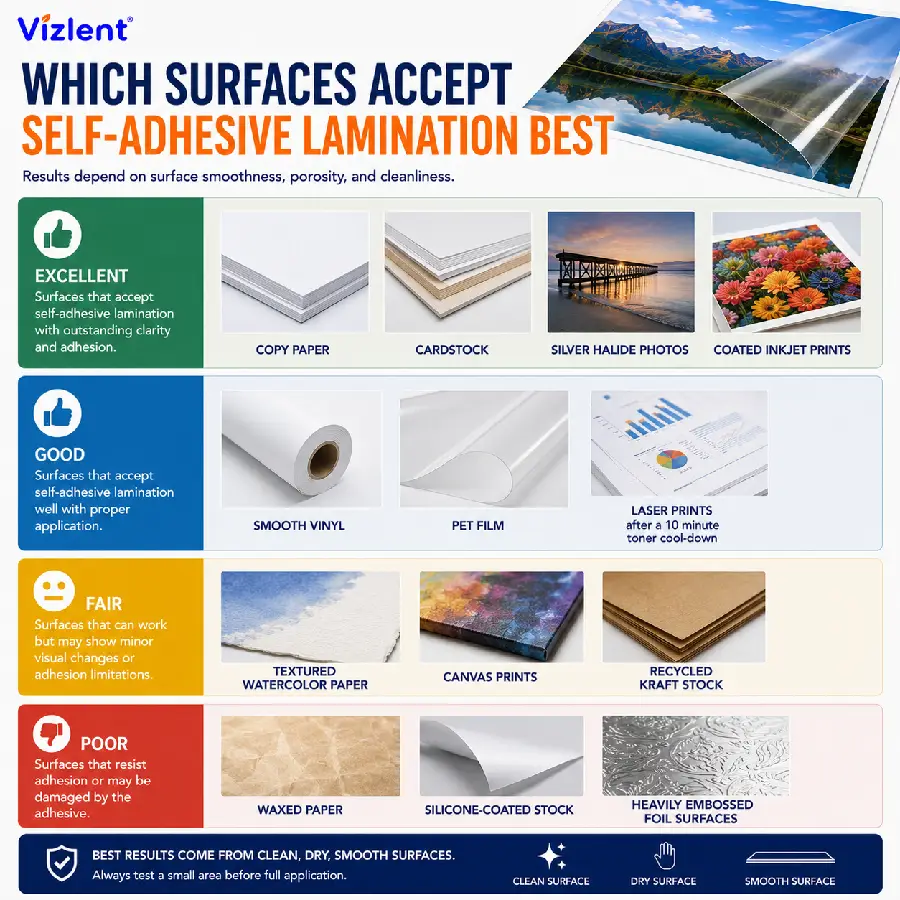
Adhesion performance depends on surface energy, texture, and any coating already present on the substrate. Smooth, high-energy surfaces give acrylic adhesive the largest contact area and the strongest anchor. Based on peel testing in our lab, common substrates rank as follows:
- Excellent: copy paper, cardstock, silver halide photos, coated inkjet prints.
- Good: smooth vinyl, PET film, laser prints after a 10 minute toner cool-down.
- Fair: textured watercolor paper, canvas prints, recycled kraft stock.
- Poor: waxed paper, silicone-coated stock, heavily embossed foil surfaces.
Freshly printed inkjet pages should dry for at least an hour so solvent vapors do not fog the film from underneath. Dust is the other silent failure point, since a single fiber creates a visible tunnel under clear film. A lint-free wipe across the document immediately before application solves most clarity complaints.
Five Mistakes That Ruin a Cold Lamination Job
Most spoiled sheets share the same handful of avoidable errors, and each one is easy to prevent once named. Our sample program gives us direct feedback from thousands of first-time users every year, so the pattern is well documented. These are the failures reported most often:
- Removing the entire liner at once, which lets the film fold and bond to itself.
- Applying over dust, eraser crumbs, or loose toner that shows as specks under clear film.
- Pressing from the edges inward, which traps a large air pocket in the center.
- Trimming flush to the document edge and losing the sealed moisture border.
- Laminating an inkjet print before the ink has fully dried and off-gassed.
Every one of these mistakes costs a sheet, and some cost the document underneath it as well. Slowing down on the peel and keeping the workspace clean removes four of the five in one pass. Order a few spare sheets with any first purchase so a practice run carries no pressure.
Can You Put a Misapplied Sheet Back Together?
One of the more unusual searches our team tracks is how to put self adhesive laminating sheets in a laminator back together after a jam or a crooked feed. The honest answer is that a fused, creased, or folded sheet cannot be restored, because pressure-sensitive acrylic builds a permanent bond within minutes of contact. Attempting to peel the layers apart usually tears the document face along with the film.
Prevention costs far less than recovery, which is one more reason we recommend hand application for sheet formats. If a corner lands crooked, low-tack repositionable grades allow a careful lift and re-set within the first thirty seconds. Permanent grades lock on contact, so alignment has to be right the first time.
Self Adhesive Laminating Sheets for Stickers and Labels
Self adhesive laminating sheets for stickers add a protective overlaminate that shields inkjet and laser prints from scuffing, moisture, and UV fading. Crafters apply one sheet across a full printed page before die cutting, so every sticker comes out sealed edge to edge. The overlaminate also deepens color saturation and gives budget sticker paper a professional retail finish.
Commercial converters buy the identical construction on rolls through our laminating films range rather than in retail sheet packs. Matte overlaminates cut glare on product labels photographed for e-commerce listings, which measurably improves image quality. Demand for self adhesive laminating sheets for stickers has grown every year alongside the small-batch sticker business boom.
Gloss or Matte: Choosing the Right Finish
Gloss film intensifies color vibrancy and suits photographs, menus, and display signage viewed from a distance. A self adhesive laminating sheet matte finish scatters light instead of reflecting it, so text stays readable under harsh office lighting and fingerprints stay hidden. Matte surfaces also accept pencil and dry-erase markers, which makes them popular for reusable checklists and teaching cards.
Match the finish to the job with three quick rules:
- Choose gloss for photos, color graphics, and signage viewed at arm’s length or beyond.
- Choose matte for text-heavy documents, ID cards, and glare-prone environments.
- Choose soft-touch for premium packaging, book covers, and presentation folders.
All three finishes share the same acrylic adhesive system, so the application technique never changes. Vizlent coats gloss, matte, and soft-touch surfaces across PET and PVC face films in multiple thicknesses. Free sample packs containing every finish let you judge the look on your own printed work.
Sizing: A4 Packs, Letter Formats, and Custom Sheeting
Retail packs sold as self adhesive laminating sheets A4 measure 210 by 297 millimeters, and slightly oversized variants add a sealing border for full-page documents. Letter format at 8.5 by 11 inches dominates North American listings, while A4 leads everywhere else. Card, badge, luggage tag, and photo sizes round out most consumer ranges.
As a factory, we sheet any format between business card size and B1 poster size from master rolls up to 1300 millimeters wide. Custom sheeting suits printers who laminate one fixed product size and want zero trim waste on every job. Minimum order quantities for custom formats sit lower than most buyers expect, and trial orders are welcome.
Ready to test before you commit? Request free A4 sample sheets in gloss and matte finishes and run adhesion trials on your own equipment. Reach our team through the Vizlent contact page and sample ship within days.
Thermal Film or Self-Adhesive Sheets: Which Fits Your Project?
Our thermal lamination films deliver the strongest bond and the cleanest optics, which is why print shops running heated roll laminators specify them for high volumes. Self-adhesive sheets win on convenience, safety around children, and compatibility with heat-sensitive media such as inkjet photos, vellum, and thermal receipt paper. Cost per sheet runs slightly higher for pressure-sensitive constructions because of the release liner.
Volume decides the question in most sourcing conversations we have with new customers. Anything above a few hundred pieces per week justifies a heated machine and thermal pouches or rolls. Occasional documents, classroom projects, and mixed heat-sensitive media stay firmly in self-adhesive territory.
Where to Find Self-Adhesive Laminating Sheets Near Me and Online
Typing self-adhesive laminating sheets near me into a search engine surfaces office supply chains, craft stores, and stationery shops stocking small retail packs. Those packs work fine for a handful of documents, though per-sheet pricing runs three to five times factory-direct rates. Local stock is also limited to standard sizes and a gloss finish in most stores.
Businesses that go through boxes rather than packs skip the self adhesive laminating sheets near me search entirely and source direct from manufacturers. Factory-direct supply opens up custom sizes, matte and soft-touch finishes, and adhesive grades matched to the end use. Vizlent ships sheeted and roll formats to customers in more than 50 countries on 7 to 15 day production lead times.
Why Buyers Specify the Vizlent Label Self-Adhesive Laminating Sheet
Every Vizlent Label self-adhesive laminating sheet is coated, siliconized, and sheeted on our own production lines rather than bought in and rebranded. In-house control means coat weight, release force, and optical clarity get verified on every batch before dispatch. ISO 9001, FSC, and SGS certification backs the documentation that converters and brand owners need for their own audits.
Since 2011 we have supplied more than 1,000 distributors, converters, and print houses worldwide from our Shenzhen production base, a story you can read on our about us page. Free samples ship before any bulk commitment, so peel strength and print compatibility get proven on your equipment first. New technical guides appear regularly on the Vizlent blog.
Source Factory-Direct Laminating Sheets from Vizlent
Choosing the right construction starts with a conversation about your substrate, print method, and end use, and our engineers handle those questions daily. Vizlent supplies gloss, matte, and soft-touch self-adhesive laminating sheets in A4, letter, and fully custom formats, plus cold and thermal films on rolls for machine users. Every order ships with batch-level quality records from an ISO 9001, FSC, and SGS certified factory.
Get your free sample pack today. Send your specifications through the Vizlent contact page and receive tailored recommendations, factory-direct pricing, and samples for your own testing within 24 hours.
Frequently Asked Questions
Can you use self adhesive laminating sheets in a laminator with a cold setting?
Yes, a machine running a true cold setting can process self-adhesive sheets safely because no heat ever reaches the adhesive. The rollers simply apply even pressure, doing the same job as a hand squeegee. Confirm the cold mode fully disables the heating element before feeding, since some budget machines only reduce the temperature. For single sheets, hand application remains faster and gives you more control.
What happens if you put a self-adhesive sheet through a hot laminator?
The adhesive melts onto the rollers, the sheet usually jams mid-feed, and the film clouds or wrinkles over the document. Cleanup requires opening the machine and scrubbing the rollers with isopropyl alcohol before the residue hardens. Many manufacturers treat this as misuse and void the warranty. The document trapped inside is rarely recoverable in presentable condition.
Do self-adhesive laminating sheets work without any machine?
Yes, self-adhesive laminating sheets are designed specifically for machine-free application by hand. Peel a small section of the liner, anchor the top edge, then smooth the film down gradually with a squeegee or plastic card. The pressure-sensitive adhesive reaches a strong initial bond immediately and full strength within 24 hours. No electricity, heat, or warm-up time is involved at any stage.
Are self-adhesive laminating sheets waterproof?
Self-adhesive laminating sheets are water resistant rather than fully waterproof, since moisture can wick into exposed paper edges over time. Leaving a two to three millimeter sealed film border around the document blocks most edge ingress. Wiping spills promptly keeps the surface unmarked for years. For full immersion or outdoor exposure, a synthetic printed substrate paired with an overlaminate performs far better than laminated paper.
Can you laminate stickers with self-adhesive sheets?
Yes, applying a clear overlaminate sheet across a printed sticker page before cutting is standard practice among small sticker makers. The film seals the ink against scuffing, moisture, and UV fading while deepening color saturation. Apply the laminate first, then die cut or hand cut through both layers so each sticker stays sealed to its edge. Matte overlaminates also remove glare for product photography.
How long do self-adhesive laminating sheets last?
A properly applied acrylic-adhesive sheet protects indoor documents for ten years or more without yellowing or lifting. UV-stabilized PET films hold clarity longest, while unstabilized PVC can amber under prolonged sunlight. Storage before use matters too, so keep unused sheets flat, cool, and inside their packaging. Vizlent tests outdoor durability grades to three years of weathering on Xenon Arc equipment.
Can you remove a self-adhesive laminating sheet after application?
No, a permanent-grade sheet cannot be removed cleanly once the adhesive has cured onto paper. Peeling it back tears fibers from the document face and leaves adhesive residue behind. Repositionable low-tack grades allow adjustment within the first thirty seconds only. Treat every application as final and take the extra moment to align carefully.
What thickness of laminating sheet should I choose?
Sheet thickness between 75 and 100 microns suits most documents, adding protection while keeping the page flexible. Choose 125 to 150 microns for menus, ID cards, and pieces handled daily that benefit from extra rigidity. Thinner 25 to 50 micron films conform best to curved or irregular surfaces such as tumblers and equipment housings. Match stiffness to how the finished piece will be stored and handled.






