
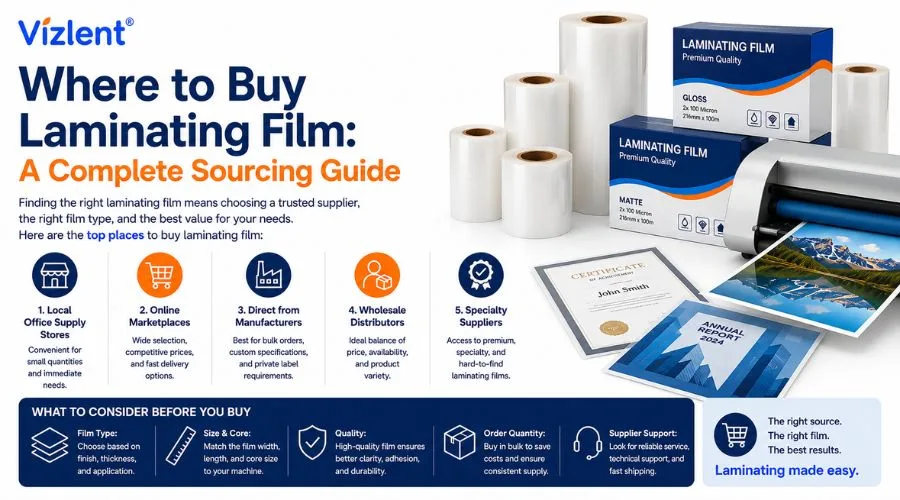
You can buy laminating film in a trusted, direct manufacturer like Vizlent Label if you want to purchase in volume, an office supply retailer if you need small quantities today, or an online marketplace if you want the widest choice delivered to your door. Print shops, label converters, and packaging producers who run film through machines every week save the most money by ordering straight from the factory that makes it. Home users and small offices usually get better value from nearby stores or e-commerce listings with fast shipping.
The channel you choose affects much more than the number on the invoice. Supply reliability, thickness consistency, adhesive quality, and access to technical support all shift depending on who sells you the material. Sorting out your volume, format, and finish requirements first makes every option easier to compare.
What Determines the Right Place to Buy Laminating Film
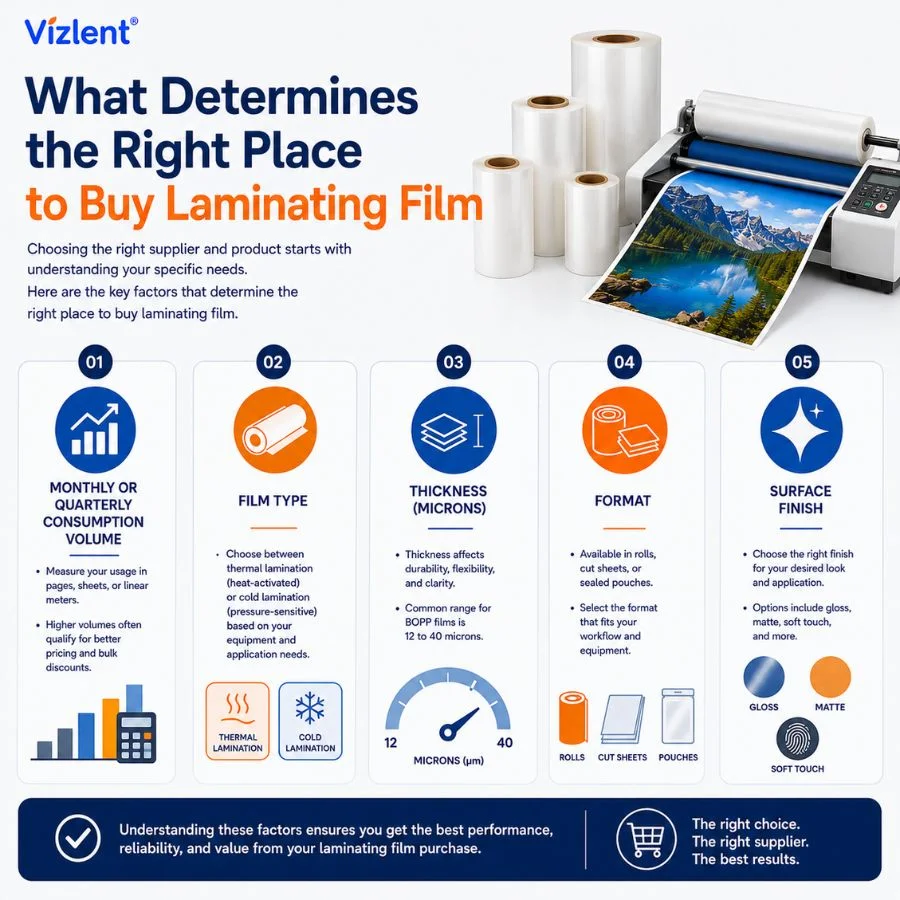
Order volume is the single biggest factor separating a smart sourcing decision from an expensive one. A school office that laminates a few dozen pages each month has completely different needs from a converter feeding thousands of linear meters through a laminating line every shift. Matching the seller to your consumption pattern keeps unit cost down and prevents supply gaps.
Application requirements matter almost as much as quantity. Thermal films bond under heat and pressure inside a laminator, while cold films rely on pressure-sensitive adhesive and work without any heating element. Buyers who settle on thickness, width, finish, and adhesive type before shopping avoid the ordering mistakes that lead to wasted stock.
Confirm these five points before you purchase:
- Monthly or quarterly consumption volume, in pages, sheets, or linear meters
- Film type, meaning thermal lamination or cold lamination
- Thickness in microns, commonly 12 to 40 microns for BOPP grades
- Format, meaning rolls, cut sheets, or sealed pouches
- Surface finish, such as gloss, matte, soft touch, or holographic
Where to Buy Laminating Film: Four Main Sourcing Channels
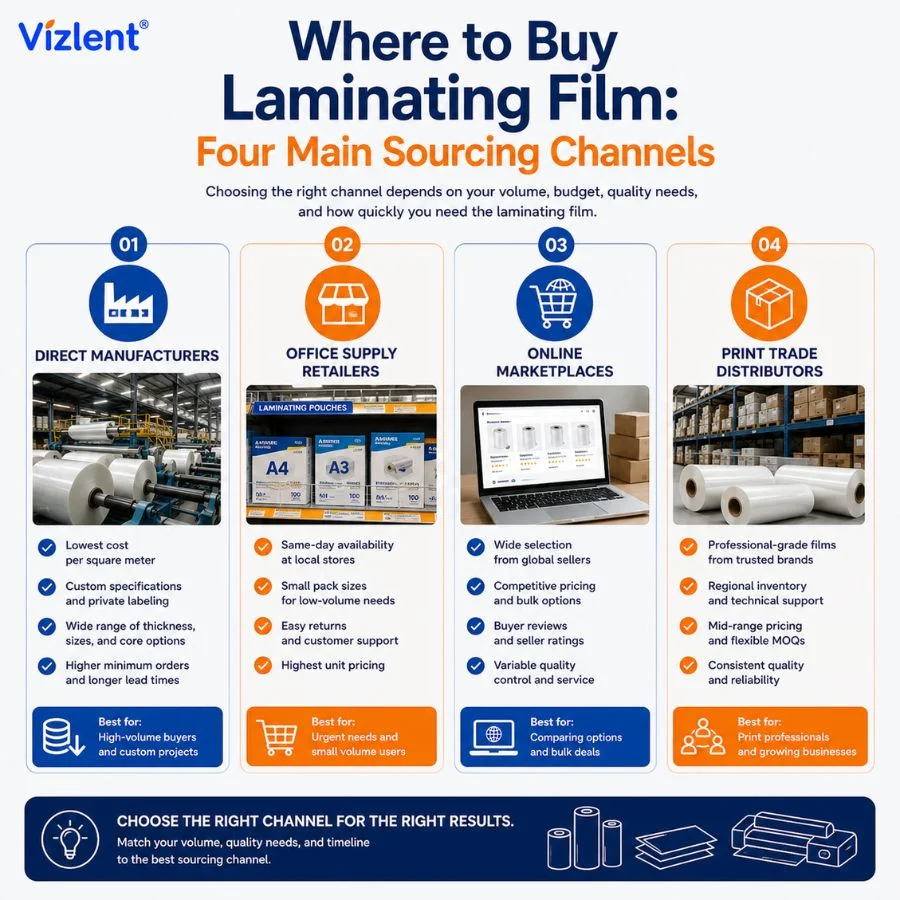
Laminating film reaches end users through four main routes: direct manufacturers, office supply retailers, online marketplaces, and print trade distributors. Each channel stocks different formats, holds different inventory depth, and prices the same material very differently. Knowing what each route does well saves both money and lead time.
No single channel wins for every buyer in every situation. A distributor that rescues you with next-day delivery on a single roll will rarely match factory pricing on a container load. The smartest purchasing teams keep a primary bulk source and a local backup for emergencies.
- Direct manufacturers: lowest cost per square meter, custom specifications, higher minimum orders
- Office supply retailers: same-day availability, small pack sizes, highest unit pricing
- Online marketplaces: wide selection, buyer reviews, variable quality control
- Print trade distributors: professional grades, regional stock, mid-range pricing
Buying Direct from a Laminating Film Manufacturer
Factory-direct purchasing removes every intermediary markup between the coating line and your warehouse. Manufacturers such as Vizlent produce laminating films in BOPP, PET, and PVC-free variants, then slit each order to the exact width your equipment requires. Buyers also gain access to R&D engineers who can adjust adhesive coat weight or surface treatment chemistry for a specific application.
The trade point is minimum order quantity, since factories plan production runs rather than picking single packs off a shelf. Lead times of 7 to 15 days on custom orders reward buyers who forecast their consumption. For any operation that uses film weekly, the per-unit savings quickly outweigh the planning effort.
Request a factory-direct quotation through the Vizlent contact page and receive a specification review within 24 hours.
Office Supply Stores and Local Retail Options
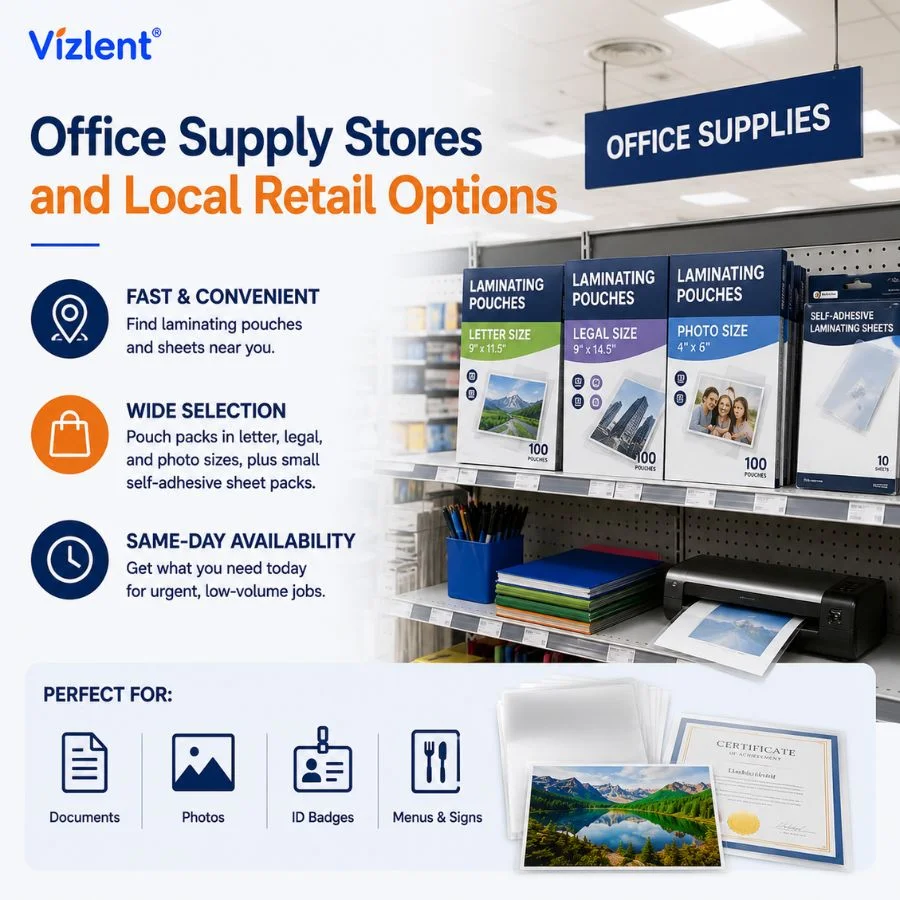
Office supply chains and stationery stores are the fastest answer for anyone searching buy laminating pouches near me or buy laminating sheets near me. Retail shelves carry pouch packs in letter, legal, and photo sizes, plus small self-adhesive sheet packs for machine-free use. Stock is available the same day, which makes retail the right call for urgent, low-volume jobs.
That convenience carries the highest price per square meter of any channel. A retail pouch pack can cost several times more per finished page than the equivalent material bought as bulk rolls. Anyone typing laminating film near me into a search engine more than a few times a year should compare that recurring spend against a single wholesale order.
Online Marketplaces and E-Commerce Platforms
Marketplaces such as Amazon, eBay, and Alibaba let you buy laminating sheets, pouches, and rolls from hundreds of sellers in one place. Listings show verified buyer reviews, side-by-side pricing, and delivery estimates before you commit to anything. The format works well for small and medium orders where speed matters more than customization.
Quality varies widely between marketplace sellers because many are resellers with no control over production. Thickness claims, adhesive grades, and optical clarity are difficult to verify from product photographs alone. Ordering a single pack for testing before committing to a larger purchase protects you from mislabeled stock.
Laminating Film Price: What Drives the Cost
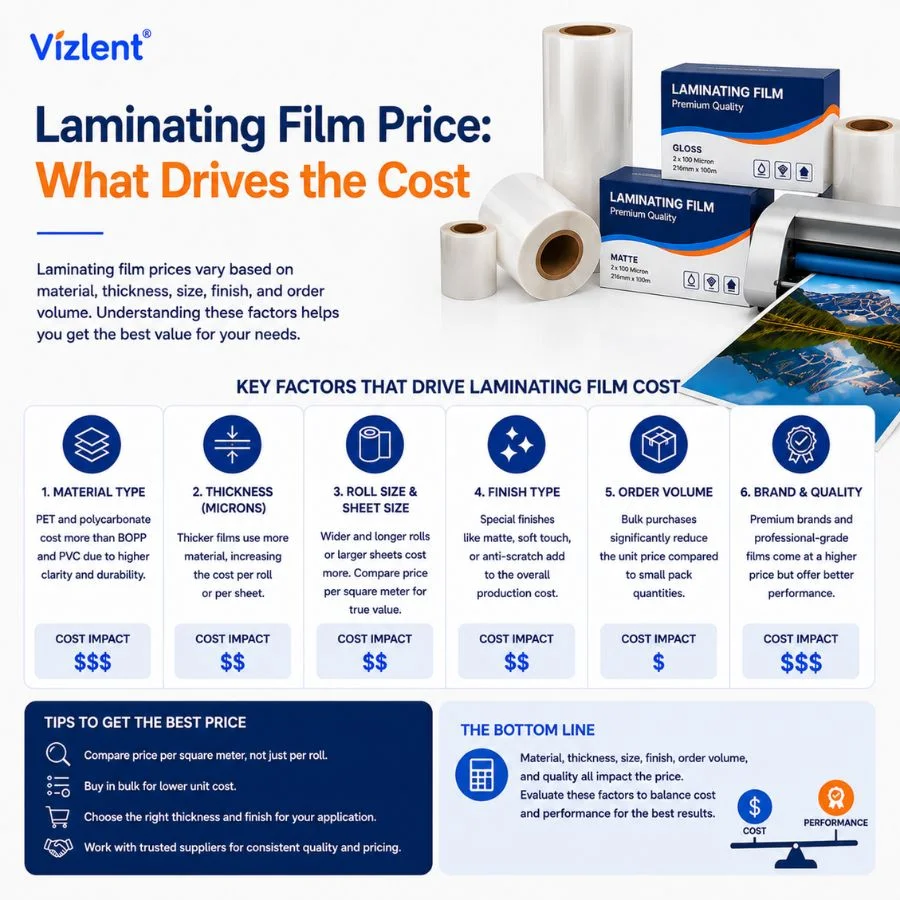
Laminating film price is set by four variables: base material, thickness, finish, and purchase format. PET grades cost more than BOPP because polyester carries higher raw material and processing costs, and specialty finishes such as soft touch or holographic add a further premium. Thicker films consume more resin per square meter, so a 40 micron grade always costs more than a 12 micron grade of the same polymer.
Format has the largest effect of all on what you actually pay. A laminating film roll price calculated per square meter runs far below the equivalent cost of retail pouches, and jumbo rolls bought factory-direct sit lower still. Comparing quotes on a per-square-meter basis rather than per pack is the only accurate way to judge laminating film price across channels.
The main pricing levers, from largest to smallest:
- Purchase format: jumbo rolls cost the least per square meter, then slit rolls, then sheets, then pouches
- Order size: volume tiers reduce unit cost as quantities rise toward container loads
- Base polymer: BOPP is the economy choice, PET the durable premium choice
- Thickness and finish: heavier gauges and decorative surfaces carry proportional premiums
Laminating Film Roll or Laminating Film Sheets: Choosing a Format
A laminating film roll suits continuous production on roll laminators, while laminating film sheets suit flatbed work, sample programs, and short digital runs. Rolls minimize waste on high-volume jobs because operators trim only at the end of each run. Sheets remove machine setup time for one-off documents and small batches.
Sheet buyers should match the sheet size to their documents to limit trim waste. Common cut sizes include A4, A3, and laminating film B4, which covers oversized documents that A4 cannot handle. Custom-cut dimensions are also available from manufacturers for non-standard work such as menus, tags, and display cards.
How to Judge a Laminating Film Brand Before You Order
A trustworthy laminating film brand publishes technical data sheets, holds recognized certifications, and supplies samples before asking for a purchase order. Certifications such as ISO 9001, FSC, and SGS testing show that production runs under documented quality controls. Vizlent Label supplies a batch-traceable technical data sheet with every reel shipped, which lets converters verify specifications against the exact production lot.
Reputation signals matter as much as paperwork does. Look for verifiable customer references, years in operation, and a physical factory address rather than a catalog-only web presence. A supplier willing to host a plant tour or a live video walkthrough has little to hide about how its film is made.
A quick supplier vetting checklist:
- Technical data sheet supplied for every production batch
- ISO 9001 quality management certification, plus FSC and SGS testing where relevant
- Free sample program for qualification testing on your own equipment
- A physical, visitable factory rather than a trading office alone
- Consistent customer reviews across independent platforms
Bulk Buying: Laminating Film Big Rolls and Bundles
High-volume buyers get the lowest cost per square meter from laminating film big rolls, known in the trade as jumbo rolls. Vizlent supplies jumbo formats from 1,000 to 1,600 millimeters wide holding up to 6,000 linear meters per reel, which feed continuous lamination lines without splice interruptions. Slit rolls cut from those parent reels serve narrow-web presses at widths held to a 0.2 millimeter tolerance.
A laminating film bundle, meaning a mixed order that combines several widths, finishes, or film types in one shipment, cuts freight cost per unit and simplifies customs clearance. Bundled container loads also lock pricing across a full quarter of production. Ask your supplier to quote mixed-specification pallets rather than pricing each item as a separate shipment.
Planning a bulk order? Send your specifications to Vizlent for mixed-pallet and jumbo roll pricing.
Specialty Finishes: Matte, Holographic, and Laminating Film Blue Tints
Specialty laminating films go beyond clear gloss protection into decorative and functional territory. Options across thermal lamination films and cold lamination films include matte anti-glare grades, holographic and glitter finishes, 3D micro-embossed textures, and tinted variants such as laminating film blue for color-coded document systems. Each finish changes how printed material looks, feels, and photographs on a shelf.
Tinted and decorative films serve practical roles alongside visual ones. Blue-tinted film marks confidential or department-specific documents at a glance, while holographic overlays add a tamper-evident security layer to badges and certificates. Matching the finish to a real function keeps specialty film from being a purely cosmetic spend.
Why Buyers Source Laminating Film China Direct
China produces a large share of global BOPP and PET film capacity, which makes laminating film China sourcing the default route for cost-driven volume buyers. Factory pricing from Chinese manufacturers typically undercuts Western distributor pricing on identical specifications. Vizlent has manufactured self-adhesive materials and lamination films in Shenzhen since 2011 and ships to customers in more than 50 countries.
Successful importing depends on choosing a certified factory rather than the cheapest listing on a sourcing platform. ISO 9001, FSC, and SGS credentials, moisture-proof export packaging, and batch-level quality documentation separate real manufacturers from trading companies. Free sample testing before the first order confirms print compatibility and adhesion on your own equipment.
How to Order Laminating Film from Vizlent
Ordering from Vizlent starts with a specification: film type, thickness, width, finish, and target volume. The engineering team reviews every inquiry within 24 hours and recommends the best material match for your equipment and end use. Free samples in A4 sheets or small rolls ship for qualification testing before any commitment is made.
Approved orders enter production with lead times of 7 to 15 days for custom OEM and ODM runs. Every reel passes inspection for coat weight uniformity, tension consistency, and dimensional tolerance before dispatch. Moisture-proof export packaging and full shipping documentation carry the order from the factory floor to your receiving dock.
Send your specification through the Vizlent contact page today for a factory-direct quotation and a free sample offer.
Get Factory-Direct Laminating Film from Vizlent
Vizlent manufactures laminating film in gloss, matte, and specialty finishes, slit to your exact width and shipped with batch-traceable documentation to more than 50 countries. Send your specification through the contact page for a quotation within 24 hours and a free sample offer. One inquiry connects you with engineers who match the right film to your equipment, your product, and your budget.
Frequently Asked Questions
Where can I buy laminating film near me?
Office supply chains, stationery stores, and local print shops are the closest sources of laminating film for same-day purchase. Retail locations stock pouches and small sheet packs in standard document sizes. For rolls, regional print trade distributors carry professional grades with next-day delivery. Volume buyers still save more by ordering factory-direct, even after shipping costs are added.
How much does laminating film cost?
Laminating film cost depends on material, thickness, finish, and format, with bulk rolls costing far less per square meter than retail pouches. BOPP is the most economical base polymer, while PET grades and specialty finishes carry a premium. Comparing quotes per square meter rather than per pack gives the only accurate cost picture. Factory-direct jumbo rolls deliver the lowest unit pricing available in the market.
What is the difference between laminating pouches and film rolls?
Laminating pouches are pre-cut, sealed sleeves sized for single documents, while rolls are continuous film fed through roll laminators. Pouches suit occasional office use and require no trimming skill. Rolls handle any document length, cost less per finished page, and support continuous production. High-volume users almost always move from pouches to rolls as consumption grows.
Is it cheaper to buy laminating film from China?
Factory-direct pricing from Chinese manufacturers is usually lower than distributor pricing in Western markets for identical specifications. The savings come from removing intermediary markups, not from cutting material quality, provided the factory is certified. Freight, duties, and lead time must be included in any honest comparison. Certified suppliers such as Vizlent offset the distance with free samples and batch-traceable documentation.
What thickness of laminating film should I choose?
Film from 12 to 25 microns suits flexible packaging and everyday document protection, while 30 to 40 microns adds rigidity for cards, tags, and industrial labels. Thicker film resists abrasion better but costs more and reduces foldability. Match the thickness to real handling conditions rather than defaulting to the heaviest grade. A supplier’s engineering team can recommend a gauge from a short description of the end use.
Can I test samples before placing a bulk order?
Reputable manufacturers supply free samples as A4 sheets or small rolls before any purchase commitment. Sample testing confirms adhesion, optical clarity, and machine compatibility on your own equipment. Vizlent dispatches free qualification samples and asks buyers to cover only the courier freight. Testing first removes nearly all of the risk from a first import order.
What is B4 laminating film used for?
B4 laminating film covers documents sized 257 by 364 millimeters, a format common in Japanese and some international office standards. B4 sheets protect oversized reports, artwork, and charts that exceed A4 dimensions. Buyers outside B-series markets often substitute A3 sheets, which are slightly larger. Custom-cut sheets from a manufacturer solve any non-standard sizing need.
Do I need a machine for cold laminating film?
Cold laminating film bonds through pressure-sensitive adhesive and needs no heated laminator at all. Small jobs can be applied by hand with a squeegee, while larger formats run through unheated roller machines for a bubble-free finish. Cold film also protects heat-sensitive prints such as inkjet photos and thermal paper. It is the right choice wherever heat would damage the document or no laminator is available.






