
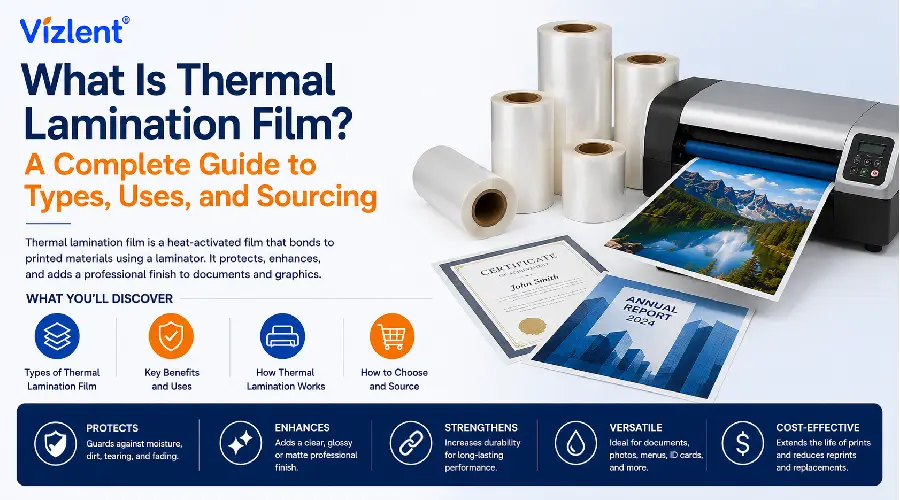
Thermal lamination film is a plastic film pre-coated with a heat-activated adhesive. Heated rollers melt the adhesive and press the film onto printed materials. It creates a protective layer that helps guard against water, dirt, scratches, and everyday wear.
Unlike cold lamination, which bonds through pressure alone at room temperature, this construction requires a heated laminator to activate the pre-coated adhesive and form a permanent bond. Construction, activation temperatures, formats, applications, pricing, and sourcing all shape which option fits a given production line.
How the Adhesive Bonds During Lamination
The film applies through a laminator equipped with a heated nip roller that brings the adhesive-coated web into direct contact with the printed substrate under both heat and pressure simultaneously. As the web passes through the nip, the hot-melt adhesive softens and flows into the microscopic texture of the ink and paper surface, then cools and sets almost instantly as it exits the roller. This single-pass process eliminates the need for a separate wet adhesive application step, which is why heat-activated lamination remains the standard choice for high-speed commercial print finishing.
Activation temperature is not a single fixed number across every grade, since BOPP constructions typically activate at 80°C to 95°C while PET constructions with co-polyamide adhesive require a higher 95°C to 110°C range. Running a laminator too cool prevents the adhesive from wetting out fully, leaving weak spots prone to delamination, while running it too hot on heat-sensitive digital inks can cause blistering or ink bleed. Matching nip temperature to both the film grade and the substrate is one of the most common troubleshooting points converters encounter when switching between suppliers.
Corona treatment level on the ink surface also affects how well this adhesive wets out during lamination, since low-energy surfaces such as UV-cured flexo inks resist even coating without adequate surface pre-treatment. A converter running into intermittent bubbling or edge lift after switching ink systems should check corona treatment before assuming the film itself is defective. Dwell time after the nip roller matters too, since bond strength continues to build for roughly 24 hours after application as the adhesive fully sets.
- Face web: BOPP (17-25 microns) or PET (25-38 microns)
- Adhesive: hot-melt EVA or co-polyamide, 3-6 g/m² dry coat weight
- Activation temperature: 80°C-95°C for BOPP, 95°C-110°C for PET
- Bond strength: 1.5 N/mm or higher after a 24-hour dwell
Thermal Lamination BOPP Film vs PET Film: Choosing the Right Construction

Bopp thermal lamination film glossy finishes create the high-shine, color-popping look common on retail packaging and book covers, while bopp thermal lamination film matt finishes deliver a flat, diffuse surface that fragrance and skincare brands specify for a premium, non-reflective appearance. Bopp thermal lamination film gloss and matte grades share the same base chemistry and activation range, differing mainly in surface texture applied during film extrusion. BOPP is the more economical and widely used option, offering good clarity, foldability, and moisture resistance for standard commercial print, folding cartons, and premium label converting.
PET costs more than BOPP but delivers greater dimensional stability, tear resistance, and chemical resistance, making it the standard choice for flexible packaging pouches and applications requiring sterilization tolerance up to 121°C. Selecting between the two should start with the end-use environment rather than price alone, since PET’s higher sterilization tolerance and stiffness contribution genuinely solves problems that BOPP cannot address in retort packaging or high-humidity storage. Converters running both commercial print and flexible packaging lines often stock both constructions rather than trying to force one grade to cover every job.
Roll Formats, Custom Slit Rolls, and A4 Sheet Options
Thermal lamination film roll formats dominate industrial and commercial converting, with jumbo parent rolls typically running 1,000mm to 1,600mm wide and up to 6,000 linear meters for continuous high-volume laminating lines. Thermal laminating film rolls are also available as custom slit rolls, cut from jumbo parents to a converter’s specified width and core diameter, which eliminates the trim waste a converter would otherwise absorb slitting from oversized stock in-house. Thermal lamination roll price scales favorably with volume, making roll format the standard choice for any operation running a dedicated laminating line rather than occasional single-sheet jobs.
Thermal laminating film a4 and thermal lamination sheet a4 formats serve a different purpose entirely, supporting small-batch use, press qualification testing, and pouch-style desktop laminators common in offices and small print shops. Consumer and small-business laminator brands, including roco thermal laminating film a4 pouches alongside other well-known office laminating brands, are widely available through office supply retailers for exactly this low-volume use case. Buyers running a production laminating line should not default to A4 sheet products simply because they are easy to find locally, since roll format delivers meaningfully better economics once volume justifies the switch.
- Jumbo rolls: 1,000mm to 1,600mm wide, up to 6,000 linear meters
- Custom slit rolls: cut to specified width and core diameter, ±0.2mm tolerance
- A4 and A3 sheets: press qualification, small-batch, and desktop laminator use
- Core sizes: typically 3-inch or 6-inch for roll-fed laminating units
Applications Across Industries
Thermal lamination film uses span commercial print and book publishing, where a gloss BOPP overlaminate seals offset ink against the scuffing that occurs during bindery handling and delivery stacking. Flexible packaging producers rely on a PET thermal lamination film application for pouch side walls, where the added stiffness reduces jaw-tracking errors during vertical form-fill-seal operation, and the co-polyamide adhesive tolerates retort sterilization cycles that would cause EVA-based systems to blister. Premium label converters serving health and beauty brands specify a matte BOPP grade at a low activation temperature specifically because it avoids out-gassing problems with heat-sensitive digital inkjet inks, while others reach for PVC-based film where added flexibility around curves matters more than sterilization tolerance.
Folding carton and secondary packaging converters use this laminate with tightly controlled internal shrink properties, since excess shrink after lamination causes board curl that disrupts downstream die-cutting. Beyond these core applications, the overlaminate also protects book covers, menus, ID cards, and point-of-sale displays from repeated handling, spills, and UV fading in retail environments. Matching the specific application to the right facestock, thickness, and finish remains more important than defaulting to a single all-purpose grade across every job type.
Converters new to heat-activated overlaminating sometimes default to whatever grade a previous supplier stocked, without checking that grade still fits a changed substrate or ink system. A print shop switching from offset to UV-cured digital inks, for example, may need a different activation temperature and corona treatment than the grade that worked for years on offset stock. Reviewing the actual substrate, ink chemistry, and end-use environment periodically, rather than assuming past specifications still apply, catches these mismatches before they show up as production defects.
Price and Cost Factors
Thermal lamination film price depends primarily on facestock material, thickness, adhesive coat weight, and order volume, with BOPP generally priced lower than PET due to lower raw material and processing costs. A standard gloss or matte BOPP roll in common widths costs meaningfully less per square meter than a heavier PET construction built for sterilization-tolerant flexible packaging. Buyers comparing roll price across suppliers should normalize for roll width and length, since headline pricing on a narrower or shorter roll can appear cheaper while delivering worse actual value per unit area.
Bopp thermal lamination film price also varies by finish, with standard gloss typically priced lowest, matte slightly higher due to additional surface treatment, and specialty finishes like holographic or glitter carrying the largest premium. Factory-direct sourcing generally holds pricing lower than distributor or retail channels at bulk volumes, since it removes the markup layers between the coating line and the buyer. Requesting a sample roll and a detailed quotation covering width, length, and finish together remains the most reliable way to compare true cost across suppliers.
Eco-Friendly Options: Biodegradable and Cellulose-Based Films
Thermal cellulose biodegradable matt lamination film represents an emerging alternative to standard BOPP and PET constructions, using a cellulose-based face web designed to break down under composting conditions rather than persisting as conventional plastic film. This cellulose-based option typically carries a matte finish and targets brand owners specifically prioritizing compostability claims on packaging, though performance characteristics like moisture resistance and activation temperature can differ from petroleum-based grades. Buyers considering a cellulose or biodegradable overlaminate should request certification documentation, such as EN 13432 or ASTM D6400 compliance, rather than accepting a general eco-friendly claim without verification.
Availability of this cellulose-based construction varies significantly by supplier, since it requires different coating parameters than standard BOPP or PET lines and not every manufacturer has qualified the process. Buyers with a genuine sustainability requirement should raise the specific cellulose or biodegradable specification directly with a prospective supplier early in the sourcing conversation rather than assuming every catalogue includes it as standard. Confirming both compostability certification and real-world activation performance through a sample run protects against a mismatch between marketing claims and actual production results.
Choosing a Supplier, Understanding the Market, and HS Code Basics
Thermal lamination film supplier options range from trading companies reselling a fixed catalogue to a direct thermal lamination film manufacturer capable of adjusting adhesive coat weight, activation temperature, and corona treatment level to match a specific press and ink combination. A trading company cannot commit to formula modification since it does not control the coating line, while a direct manufacturer can reformulate within days of a sample qualification. Buyers evaluating the thermal lamination films market should weigh technical responsiveness and certification documentation as heavily as headline pricing when comparing potential suppliers, including options across Vizlent’s broader laminating film range.
For customs purposes, bopp thermal lamination film hs code classifications generally fall under HS heading 3920, the global category for plastic plates, sheets, film, foil, and strip, with BOPP-specific constructions often falling under subheading 3920.20 depending on the exact composition. Exact subheadings vary by country and by the presence of adhesive coating or other combined materials, so import teams should confirm the applicable code with their customs broker rather than assuming a single classification applies universally. Vizlent manufactures this material directly from a Shenzhen facility, supplying converters and brand owners with jumbo rolls, custom slit rolls, and cut sheets backed by ISO 9001, FSC, and SGS certification.
Source Your Film Factory-Direct
Matching facestock, activation temperature, and finish to your press and substrate matters more than chasing the lowest headline price when specifying this material. Vizlent Label manufactures thermal lamination film across gloss, matte, holographic, glitter, and 3D finishes, factory-direct from a facility certified to ISO 9001, FSC, and SGS standards. Send an inquiry to request free sample rolls and a technical data sheet for your specific press and substrate combination, or explore Vizlent’s cold lamination films if a pressure-sensitive alternative better suits your production line.
Frequently Asked Questions
What is thermal lamination?
What is thermal lamination comes down to a heat-activated process that seals a printed surface behind a protective polymer layer using a heated nip roller rather than wet glue or pressure-sensitive adhesive. The process guards against abrasion, moisture, and UV degradation across commercial print, packaging, and label converting. It differs from cold lamination, which bonds at room temperature using pressure alone.
What is the difference between BOPP and PET grades?
BOPP costs less and offers good clarity and foldability for standard commercial print and folding carton work, while PET costs more but delivers greater dimensional stability, tear resistance, and sterilization tolerance. PET is the standard choice for flexible packaging pouches requiring retort sterilization, where BOPP-based EVA adhesive systems can fail by softening. Choosing between the two should start with the end-use environment rather than price alone.
Where can I buy thermal laminating film rolls versus A4 sheets?
Roll formats are available through industrial converting suppliers and factory-direct manufacturers for high-volume laminating lines, while thermal laminating film a4 and sheet formats are widely available through office supply retailers for desktop laminators and small-batch use. Production laminating lines should default to roll format for better per-unit economics at volume. A4 sheets remain the right choice for press qualification testing or occasional single-sheet jobs.
What determines the price?
Price depends on facestock material, thickness, adhesive coat weight, finish, and order volume, with BOPP generally priced lower than PET and standard gloss priced lower than specialty finishes like holographic or glitter. Comparing roll price per square meter rather than per roll gives a more accurate picture across suppliers with different roll dimensions. Factory-direct and bulk purchasing typically deliver the lowest effective cost per finished laminated piece.
Is there a biodegradable or cellulose-based option?
Yes, a cellulose-based overlaminate exists as an emerging alternative to standard plastic-based grades, using a cellulose face web designed to break down under composting conditions. Availability varies by supplier since it requires different coating parameters than standard production lines. Buyers should request compostability certification documentation rather than accepting an eco-friendly claim without verification.
What HS code applies to BOPP laminate rolls for customs purposes?
Most BOPP laminate rolls fall under HS heading 3920, the global category for plastic plates, sheets, film, foil, and strip, with BOPP-specific constructions often falling under subheading 3920.20. The exact subheading can vary by country and by the presence of adhesive coating or other combined materials. Importers should confirm the applicable code with their customs broker rather than assuming a single classification applies universally.
Should I buy from a trading company or a direct manufacturer?
A trading company resells a fixed catalogue without control over formulation, while a direct manufacturer can adjust adhesive coat weight and activation temperature to match a specific press and substrate. Buyers with recurring or specification-sensitive needs generally benefit more from a direct manufacturer relationship. Requesting sample rolls and technical documentation from any prospective supplier confirms real performance before committing to a bulk order.






