
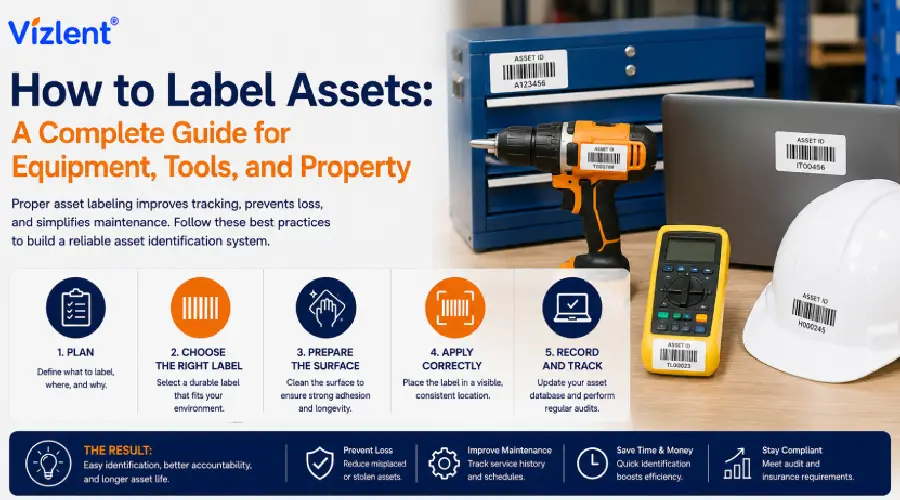
To label assets correctly, you need make a clear naming convention, pick a durable label material that survives the asset’s environment, assigning a consistent numbering or barcode system, and apply the label to a clean, stable surface that will not flex or corrode underneath it. Physical asset labels differ fundamentally from paper stickers, since equipment tags must survive years of handling, chemical exposure, outdoor weather, or repeated cleaning cycles without the barcode or serial number becoming unreadable.
Getting this process right protects both physical inventory tracking and accounting records, since a fixed asset that cannot be identified in the field is effectively untracked no matter how well it is recorded on a spreadsheet. Material selection, numbering systems, printer choice, and sourcing all factor into a labeling program that actually holds up in daily use.
How to Label Assets: A Step-by-Step Overview
The first step in how to label assets is auditing the environment each asset lives in, since a label destined for an outdoor generator faces entirely different demands than one applied to an office laptop or a warehouse shelf. The second step is selecting a facestock and adhesive combination rated for that environment, using a UV-stabilized vinyl for outdoor equipment or a polyimide film for a component that will see high heat. The third step is applying a consistent identification scheme, such as sequential numbering, barcodes, QR codes, or RFID, so every labeled asset can be scanned or read the same way across the organization.
Skipping any of these three steps tends to produce a labeling program that looks complete on day one but fails within a year, either because labels physically fall off or because the numbering scheme breaks down as the asset list grows. A construction company labeling tools in the field needs a different material and adhesive than a hospital labeling medical devices for sterilization cycles, even though both are technically asset labels. Treating asset labeling as a one-time purchase rather than an ongoing program is the most common reason organizations end up relabeling their entire inventory within a few years.
How to Tag Assets vs How to Mark Assets: Choosing a Method
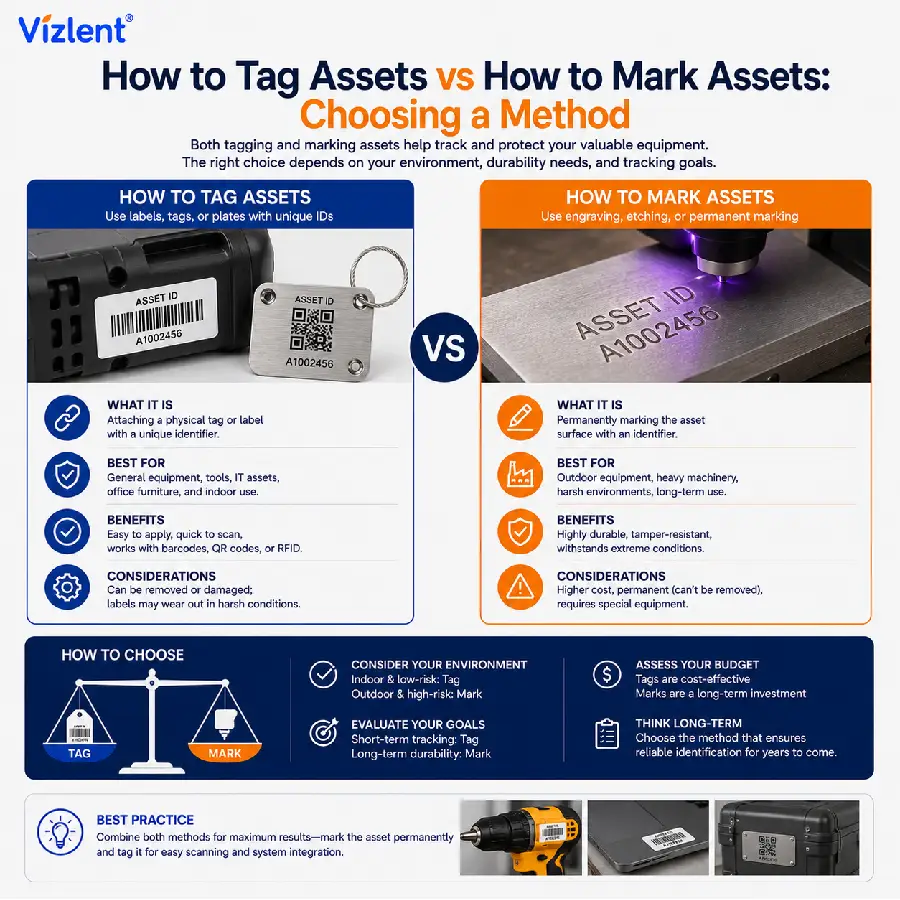
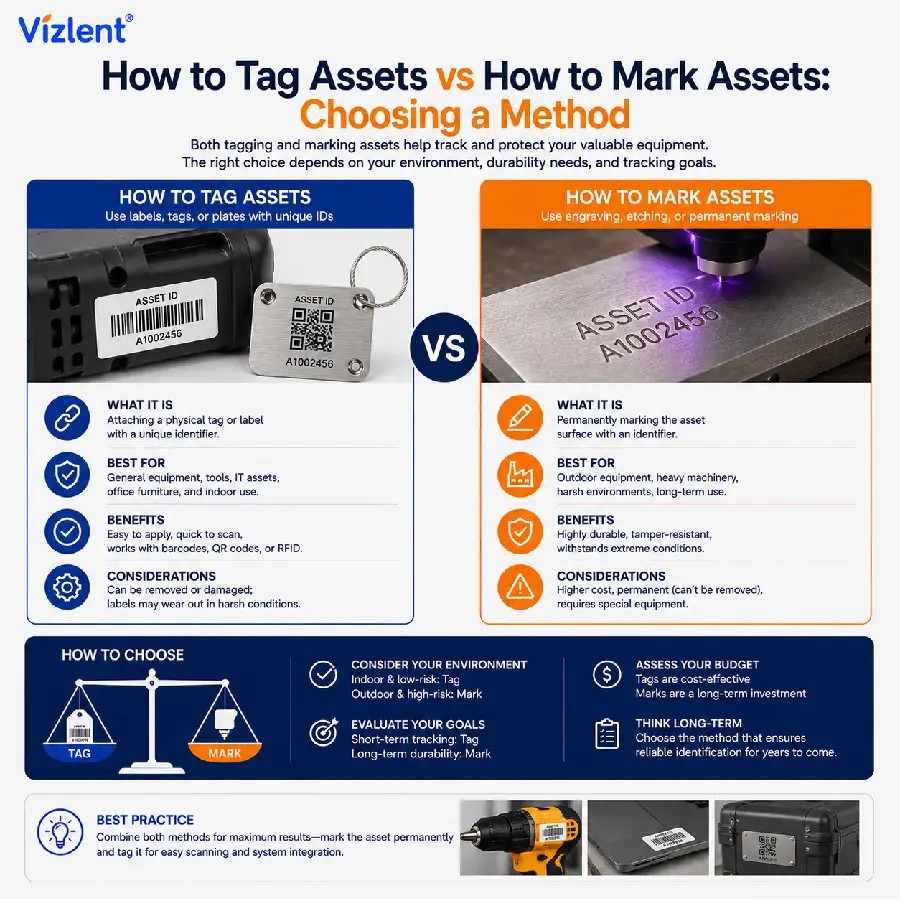
How to tag assets typically refers to applying a pre-printed, pre-adhered label, such as a barcode or serial-numbered sticker, to an asset’s surface as a distinct physical object. How to mark assets is a broader term that can include direct engraving, stamping, or paint marking in addition to adhesive labels, and is more common for assets where a label might be damaged, removed, or where a permanent mark directly on the substrate is required. Choosing between tagging and marking depends on the asset surface accepting an adhesive bond and the tracking need justifying a more expensive engraving or etching process.
Laser-etched metal tags sit at the boundary between these two approaches, combining an adhesive-backed label format with a permanent, engraved mark that cannot peel off or fade the way printed ink can. This construction suits high-value equipment, rental assets, and any application where losing the identification would create a real financial or safety problem. Choosing tagging, marking, or a hybrid laser-etched approach should follow directly from how much the organization stands to lose if a given asset becomes unidentifiable.
How to Number Assets for Reliable Tracking
How to number assets starts with choosing a numbering structure before printing a single label, since retrofitting a numbering scheme onto thousands of already-labeled assets is far more disruptive than planning it correctly from the start. Sequential numbering works well for smaller inventories, while a structured code embedding location, category, or acquisition year scales better for larger organizations tracking assets across multiple sites. Barcodes and QR codes should encode the same asset number used in the accounting or maintenance system, rather than a separate code that requires manual cross-referencing.
Consistency matters more than complexity when deciding how to number assets, since a simple sequential system that everyone follows correctly outperforms an elaborate scheme that gets applied inconsistently across departments. Leaving gaps in a numbering sequence for future categories, and documenting the numbering logic in a written policy, prevents the scheme from becoming unreadable to anyone who joins the organization after the original system was designed. Retiring asset numbers when equipment is disposed of, rather than reissuing them to new assets, avoids confusing historical maintenance or audit records.
- Sequential numbering: simplest to implement, best for smaller inventories
- Structured codes: embed location, category, or year for larger, multi-site organizations
- Barcodes and QR codes: should match the asset number used in accounting systems
- RFID tags: support bulk scanning without direct line of sight
Best Way to Label Assets for Tools and Equipment
The best way to label assets for tools and equipment starts with a facestock that resists the specific abuse each category receives, since asset labels for tools face abrasion and grease exposure that shelved office equipment never encounters. Anodized aluminum or polyester asset labels for equipment used outdoors or near chemicals should carry a permanent acrylic adhesive and a facestock rated for UV and solvent exposure, rather than a general-purpose paper label that will delaminate within months. Hand tools benefit from smaller, high-tack labels that wrap around a handle or fit within a limited flat surface without interfering with grip or function.
Testing the best way to label assets against actual working conditions, rather than assuming a catalog label will perform as advertised, catches adhesion failures before they affect the whole inventory. A single pilot batch applied to a representative sample of tools or equipment, left in service for several weeks, reveals how the chosen material survives real handling far more reliably than a lab data sheet alone. Organizations that skip this pilot step often discover adhesion or legibility problems only after ordering thousands of labels for the full fleet.
Fixed Assets Label Requirements for Property and Accounting
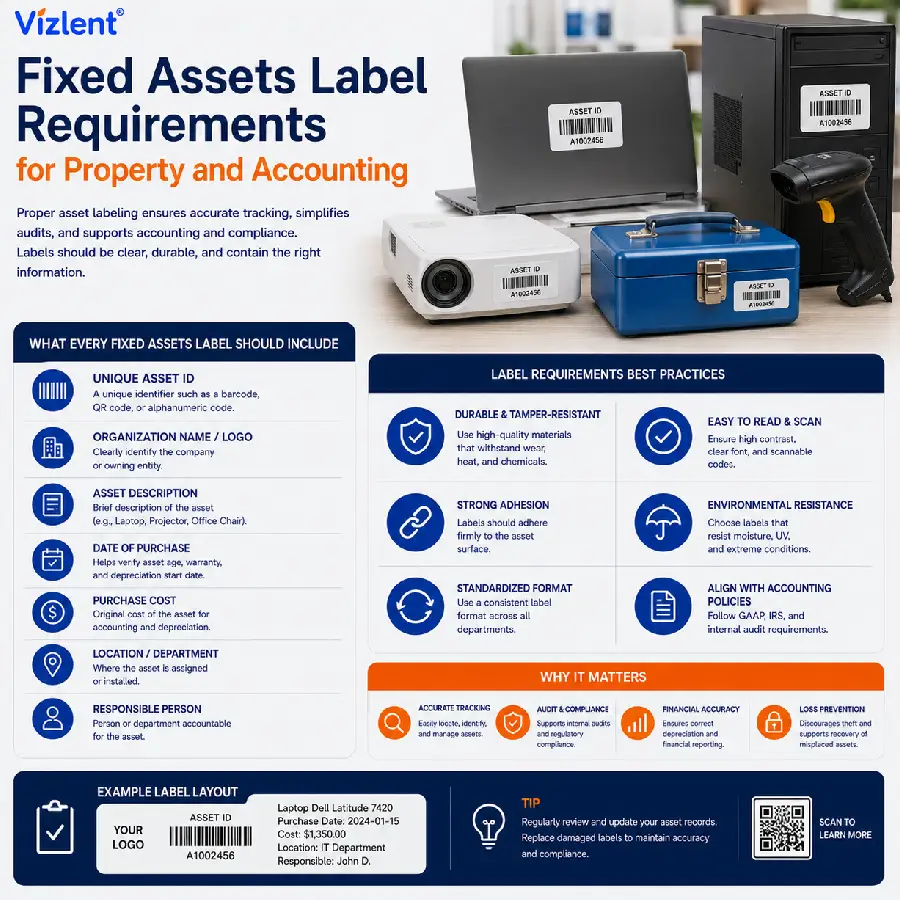
A fixed assets label serves a dual purpose: it lets maintenance and operations teams physically identify equipment in the field, and it links that physical item to a specific line entry in the accounting depreciation schedule. Auditors and accounting teams typically expect a fixed assets label to remain legible and attached for the entire depreciation life of the equipment, which can run anywhere from three to twenty years depending on the asset category. A label for property such as real estate fixtures, industrial equipment, or leased machinery often needs to survive even longer, since these assets frequently outlast the original labeling program’s IT or facilities staff.
Financial audits sometimes fail specifically because fixed assets on the books cannot be physically located or matched to a tag in the field, turning a labeling shortfall into a compliance finding. Choosing a facestock and adhesive rated for the full expected service life of the asset category, rather than a generic mid-range option, prevents this exact failure mode. A label for property or long-service equipment is one of the few label categories where over-specifying durability is rarely a mistake, since the cost of a failed audit typically exceeds the cost difference between a standard and a premium label.
Choosing an Assets Label Printer
An assets label printer needs to match both the label material chosen and the expected print volume, since a desktop direct thermal printer suited to short-term shipping labels will not reliably print onto polyester or polyimide asset tags. Thermal transfer printing with a resin ribbon is the standard combination for asset labels printed in-house, since resin ink bonds to synthetic facestocks in a way that direct thermal printing cannot replicate. Organizations printing a high volume of asset tags in-house should confirm printhead resolution and ribbon compatibility with their chosen label material before committing to a specific printer model.
Smaller organizations or those labeling a one-time inventory batch often find it more economical to order pre-printed asset labels from a converter rather than investing in an in-house assets label printer, ribbon stock, and the staff time to operate it correctly. Print quality on synthetic facestocks depends heavily on matching resin ribbon chemistry to the specific facestock coating, which an experienced label converter has already tested and documented. Either approach can work well, provided the printer, ribbon, and label material are matched rather than assembled from whatever happens to already be on hand.
Custom Asset Label Tags: Design, Materials, and Ordering
Label asset tags ordered as a custom batch, rather than generic stock labels, let an organization standardize logo placement, numbering format, and warning text across the entire labeled inventory in one production run. Asset labels custom printed with sequential numbering, barcodes, or QR codes arrive ready to apply, eliminating the need for staff to print and apply variable data on-site with an in-house printer. A converter producing asset labels custom to a specific size, adhesive, and facestock combination can also add tamper-evident constructions for assets at higher risk of removal or resale.
Ordering label asset tags in bulk, rather than reordering small batches repeatedly, typically reduces per-label cost and ensures visual and material consistency across years of ongoing labeling. Buyers should confirm turnaround time and minimum order quantity before committing to a custom asset label tag run, since converters vary considerably in how flexible they are with smaller trial orders. Requesting a physical sample applied to the actual asset surface, rather than approving artwork alone, catches adhesion or legibility problems before a full production run ships.
Clarifying Search Terms: White Label Assets, Label Design Assets, and Label Asset Packs
Search terms like white label assets, label design assets, and label asset pack occasionally surface alongside physical asset tagging searches, though they actually describe an unrelated concept from graphic design and software branding rather than equipment identification. In that context, a white label asset pack refers to a set of reusable design files, such as logos, templates, or icon sets, that a business can rebrand and resell under its own name. Buyers researching physical equipment or property tags should disregard these design-industry results, since no physical label manufacturer sells downloadable graphic design files under those same search terms.
Genuine physical asset labeling searches are almost always tied to equipment identification, property tracking, or compliance labeling rather than digital design resources. If a search for label design assets was intended to find artwork templates for a custom physical label order, most converters can accommodate a logo or custom design file during the ordering process without confusing this with the unrelated white-label software or graphics industry meaning of the term.
Choosing an Asset Label Company
An asset label company should be evaluated on material science and manufacturing capability rather than price alone, since a cheaper label that fails within a year costs more in relabeling labor than the original savings. Buyers should ask any prospective asset label company for a technical data sheet confirming adhesive type, facestock material, and expected service temperature or chemical resistance range, rather than accepting a generic marketing description. A converter offering free sample rolls or sheets for pilot testing before a bulk order signals genuine confidence in material performance.
Factory-direct manufacturers can typically customize facestock, adhesive, and finish more readily than a trading company reselling a fixed catalog, which matters for organizations with unusual environmental requirements. Vizlent manufactures durable label materials factory-direct, supplying converters and distributors who in turn produce finished asset tags for end users across industrial, healthcare, and logistics sectors. Confirming certification, such as ISO 9001 or SGS testing, gives buyers documented evidence of consistent quality across production batches rather than a one-time sample that may not reflect ongoing output.
Get Durable Asset Labels Backed by Factory-Direct Support
Building a labeling program that survives years of real-world use starts with the right facestock and adhesive, not just an attractive template. Vizlent manufactures laser etched metal labels, laser etched barcode labels, and metal asset tags factory-direct, backed by ISO 9001, FSC, and SGS certification. Send an inquiry to request free sample rolls and a technical data sheet for your specific equipment, tool, or property labeling requirement, or explore Vizlent’s anti static labels if your assets include ESD-sensitive electronics.
Frequently Asked Questions
How do I label assets for outdoor equipment?
Outdoor equipment needs a UV-stabilized vinyl or anodized aluminum label with a permanent acrylic adhesive rated for temperature cycling and moisture exposure. Standard paper labels degrade quickly outdoors and should be avoided for any equipment left outside for extended periods. Testing a sample label through a full season before committing to a bulk order confirms real-world performance beyond a manufacturer’s data sheet.
What is the difference between how to tag assets and how to mark assets?
Tagging refers to applying a pre-printed adhesive label as a distinct object, while marking includes direct engraving, stamping, or permanent ink applied to the asset surface itself. Marking suits situations where a label might be damaged or removed, while tagging is faster and less expensive for most standard equipment. Laser-etched metal tags combine both approaches in a single durable format.
How do I number assets when starting a tracking program from scratch?
Choose a numbering structure, either simple sequential numbers or a structured code embedding location and category, before printing any labels. Encode the same number used in the accounting or maintenance system into any barcode or QR code applied to the label. Document the numbering logic in writing so the system remains consistent as new staff take over the program.
What is the best way to label assets for hand tools specifically?
Hand tools need smaller, high-tack labels that resist grease and abrasion without interfering with grip or function. A wrap-around or curved-surface label format often works better than a flat label on cylindrical tool handles. Piloting the chosen label on a small batch of tools in actual field use catches adhesion problems before a full fleet order ships.
Do fixed assets need a specific type of label for audit compliance?
A fixed assets label needs to remain legible and attached for the entire depreciation life of the equipment, which auditors expect to verify against physical inventory. Choosing a facestock and adhesive rated for the full expected service life prevents labels from failing before the depreciation schedule closes. A missing or illegible tag on a fixed asset can become an audit finding even when the underlying accounting records are accurate.
Should I buy an assets label printer or order pre-printed labels?
An in-house assets label printer makes sense for organizations printing variable data regularly and at meaningful volume, provided the printer and ribbon match the chosen label material. Smaller or one-time labeling projects are often more economical ordering asset labels custom pre-printed from a converter. Either approach works well as long as the print method is matched correctly to the facestock material.
Are white label assets and label design assets related to physical asset tags?
No, white label assets and label design assets refer to reusable graphic design files and branding templates used in software and design industries, not physical equipment labels. Buyers looking for physical asset tags or property labels should search using equipment- or industry-specific terms instead. Most physical label converters can still incorporate custom logo artwork into a physical label order without confusion between the two meanings.






