
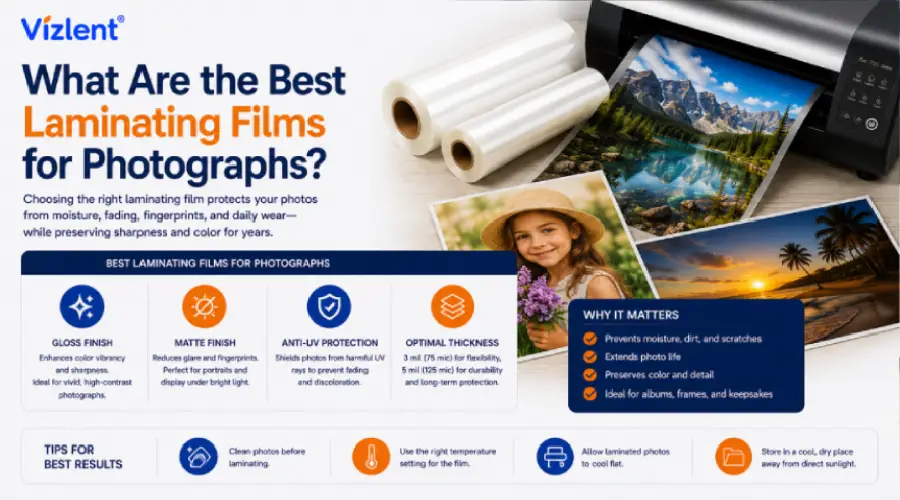
Laminating films for photographs need to meet a different standard than industrial label overlaminates, since a print destined for a wall, album, or display case must stay optically clear, pH-neutral, and free of yellowing for years rather than simply surviving a warehouse or production line. Two constructions dominate this category: pressure-sensitive cold film, which bonds at room temperature and avoids any heat exposure to the print, and heat-activated thermal film, which bonds through a nip roller and suits high-volume finishing.
Photo-safe adhesive chemistry, UV inhibitors, and finish selection all matter more here than in general industrial laminating, since any yellowing or haze directly damages the image underneath. Material choice, sizing, cost, and sourcing all shape which option actually protects a photograph rather than degrading it over time.
What Are the Best Laminating Films for Photographs?
The best laminating films for photographs and photos share three traits: a pH-neutral facestock that will not react with photographic dyes over time, a UV-absorbing adhesive layer that blocks the light responsible for fading, and an optical clarity rating high enough that the laminate itself is invisible once applied. Standard industrial overlaminates often skip pH neutrality entirely, since most labels never need to survive decades of display, which makes them a poor substitute even when the thickness and clarity look similar on a data sheet. A true photo-grade construction is formulated specifically to protect dye-based and pigment inks without introducing its own chemical reaction over the print’s lifespan.
Finish selection also separates a genuinely photo-safe film from a general-purpose laminate, since a glossy finish maximizes color saturation and contrast while a matte finish reduces glare and fingerprint visibility for framed or handled prints. Buyers should request a technical data sheet confirming pH neutrality and UV inhibitor content rather than assuming any clear laminate will protect a photograph equally well. This distinction matters most for fine art reproduction, studio portraiture, and archival printing, where the laminate’s own chemistry can either extend or shorten the life of the image underneath.
Photo-Safe Cold Lamination vs Thermal Lamination for Prints
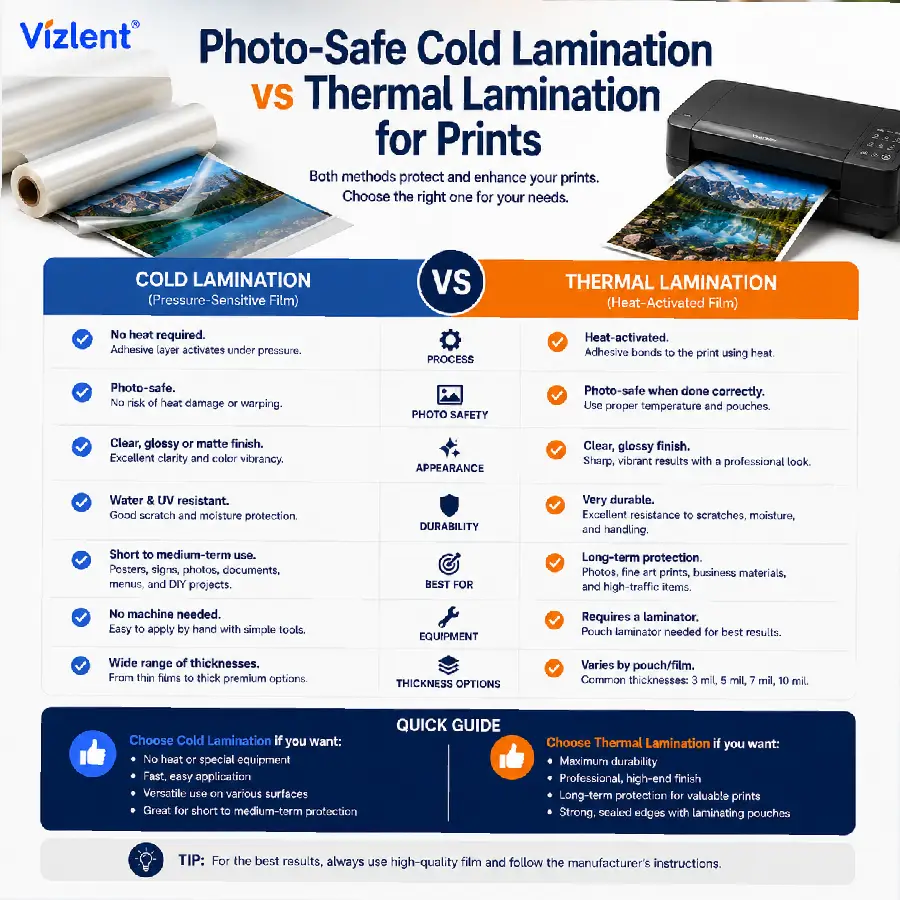
Laminating photographs with cold, pressure-sensitive film avoids any heat exposure to the print entirely, which matters for dye-sublimation prints, inkjet photos, and any substrate that could warp, discolor, or release volatile compounds under a heated nip roller. A photo-grade cold laminate bonds through mechanical pressure alone, using a UV-absorbing acrylic adhesive that wets out evenly over ink layers without trapping air bubbles or introducing silvering across the image surface. This construction suits fine art reproduction and studio portrait work where the original print may already be sensitive to temperature.
Laminating film for photo paper in a thermal, heat-activated format works well for high-volume commercial photo finishing where speed matters more than avoiding any heat exposure, since properly calibrated nip temperatures rarely damage standard photo paper. Thermal lamination bonds faster per unit and suits print shops running continuous production, while cold lamination remains the safer default for single prints, archival work, or substrates with unknown heat tolerance. Choosing between the two should follow from print volume and substrate sensitivity rather than defaulting to whichever laminator happens to be on hand.
- Cold lamination: No heat exposure, best for archival prints and heat-sensitive substrates
- Thermal lamination: Faster bonding, best for high-volume commercial photo finishing
- UV-absorbing adhesive: Blocks fading-causing light regardless of lamination method
- pH-neutral facestock: Prevents chemical reaction with photographic dyes over time
Best Laminating Films for Photographs and Prints Across Different Media
These products differ depending on the underlying substrate type, be it a traditional silver-halide photograph, a digital inkjet print, or a dye-sublimation transfer, since each ink and paper combination reacts differently to adhesive chemistry. Laminating film for printable vinyl faces an entirely different set of requirements, since vinyl substrates used for signage or vehicle graphics prioritize UV and weather resistance over the pH neutrality that a photographic print requires. Laminating film for sublimation prints must tolerate the residual heat and dye migration characteristic of that printing process without clouding or yellowing shortly after application.
Treating every “photo-adjacent” print the same way is one of the most common sourcing mistakes buyers make, since a film formulated for outdoor vinyl signage will not necessarily protect a photographic print’s color stability the same way a purpose-built photo laminate does. Matching the laminate to the specific substrate and ink system, rather than assuming a single all-purpose clear film covers every case, protects both image quality and long-term value. Buyers uncertain which category their print falls into should confirm the printing method and substrate with their print provider before ordering laminate.
Laminating Film Sizes, Sheets, and Roll Formats

Laminating film sizes for photo use range from small pouch sheets sized for wallet photos up to roll formats wide enough for poster-size enlargements, so matching format to output size is the first sourcing decision. Laminating film legal size and letter size sheets remain the standard choice for desktop pouch laminators used by photo studios and small print shops, while laminating film roll sizes scale up to 1,000mm or wider for commercial finishing lines processing large-format prints. Laminating film sheets also come in custom-cut dimensions for specialty formats like panoramic prints or non-standard album pages.
Buyers running a dedicated photo finishing operation should default to roll format for better per-unit economics at volume, reserving sheet and legal size formats for lower-volume or highly variable print sizes. Custom slit rolls, cut to a specific width and core diameter, eliminate the trim waste that comes from slitting oversized jumbo rolls in-house for a specialized application. Confirming both format and finish together with a supplier prevents ordering a technically correct film that nonetheless does not fit the actual laminator or print run in question.
- Pouch sheets: Wallet to letter size, desktop laminator compatible
- Legal size sheets: 8.5 x 14 inches, common for oversized documents and prints
- Roll formats: 1,000mm and wider for commercial and large-format finishing
- Custom cut sheets: Panoramic, square, and non-standard album dimensions
Laminating Film for Paper, Printable Vinyl, and Sublimation Substrates
Laminating film for paper stock, including traditional photo paper and inkjet media, typically uses a lighter-weight facestock than film built for rigid or synthetic substrates, since paper does not need the same dimensional stability that vinyl or polyester requires. This lighter construction still needs a pH-neutral adhesive when the paper carries a photographic print, even though a general office document could use a more generic laminate without any archival concern. Confirming the specific paper weight and finish with a supplier ensures the laminate’s tack level matches the substrate rather than either under-bonding or overwhelming a delicate paper stock.
Substrates built for signage, wraps, or sublimation transfer printing require a fundamentally different laminate chemistry than photographic paper, even when all three end up displayed for similar purposes. Laminating film for printable vinyl needs UV and weather resistance that a photo laminate does not prioritize, while laminating film for sublimation must resist the specific heat and dye characteristics of that transfer process. Buyers should never assume a single laminate performs equally well across paper photographs, vinyl graphics, and sublimation prints, since each substrate category has its own dominant failure mode.
Best Laminating Films for Photographs Cost and Price Factors
Cost here depends primarily on facestock material, adhesive formulation, thickness, and finish, with photo-grade pH-neutral constructions typically priced higher than general-purpose clear laminate due to the additional UV inhibitor and adhesive chemistry involved. Laminating film price also scales with format, since custom-cut sheets and small pouches cost more per square meter than bulk roll formats purchased for commercial-volume finishing. Buyers should compare cost per finished print rather than cost per roll or per sheet, since a cheaper laminate that yellows prematurely creates a real replacement cost down the line.
Factory-direct sourcing generally holds laminating film price lower than retail or distributor channels at meaningful volumes, since it removes the markup layers between the coating line and the buyer. Requesting a sample of the actual finish and thickness under consideration, rather than approving a generic swatch, confirms both optical clarity and adhesive performance before committing to a bulk order. A slightly higher unit cost on a genuinely photo-safe laminate is rarely the wrong trade-off once the value of the underlying print is considered.
Buying in Bulk, Finding the Best Options, and Sourcing for Sale
Laminating films for photographs bulk purchasing makes sense once a studio, print shop, or framing business processes enough prints that per-sheet retail pricing meaningfully affects margin on finished work. Businesses evaluating this kind of bulk purchase should confirm both shelf life and storage conditions before committing to a large order, since adhesive tack on cold laminate can degrade under poor storage well before the roll is used. Factory-direct suppliers like Vizlent Label Materials Co., Ltd., typically support both bulk container orders and smaller trial quantities, letting a growing operation scale volume as demand increases.
Comparing laminating films for photographs best price across multiple sources works best when buyers normalize for thickness, finish, and format rather than comparing headline price alone, since a thinner or smaller-format roll can look cheaper while delivering worse actual value. Search results listing laminating films for photographs for sale span everything from small retail packs to industrial jumbo rolls, so filtering by actual order volume and technical specification narrows the field considerably faster than browsing by price alone. Identifying laminating films for photographs best for a specific application, from archival fine art to high-volume commercial finishing, should always precede a final purchasing decision.
Source Photo-Safe Laminating Film Factory-Direct
Protecting a photograph starts with the laminate’s chemistry, not just its clarity on the shelf. Vizlent manufactures photo cold lamination film with pH-neutral PVC facestock and UV-absorbing adhesive, alongside matte and holographic finishes, factory-direct from an ISO 9001 and SGS certified facility. Send an inquiry to request free sample sheets and a technical data sheet confirming pH neutrality and UV protection for your specific print type, or explore Vizlent’s thermal lamination films if a heat-activated, high-volume alternative better suits your finishing line.
Frequently Asked Questions
What are the best laminating films for photographs?
The strongest options combine a pH-neutral facestock, a UV-absorbing adhesive layer, and high optical clarity so the laminate protects the image without accelerating fading or yellowing over time. Cold, pressure-sensitive film is generally the safer default for archival or heat-sensitive prints, while thermal film suits high-volume commercial finishing. Requesting a technical data sheet confirming these properties is the most reliable way to verify a laminate before committing to a bulk order.
What are the best laminating films for photos taken with a home inkjet printer?
Home inkjet prints benefit most from a pH-neutral cold laminate with a UV-absorbing adhesive, since inkjet dyes are particularly prone to fading under UV exposure without protection. A glossy finish maximizes color vibrancy for display prints, while a matte finish reduces glare for framed pieces. Testing a sample sheet on an actual print before laminating a full batch confirms compatibility with the specific ink and paper combination used.
Is laminating film for photo paper different from film for standard documents?
Yes, laminating film for photo paper requires pH-neutral facestock and UV-absorbing adhesive chemistry that standard document laminate does not need, since documents are not vulnerable to dye fading the way photographic prints are. Using a general-purpose office laminate on a photograph risks yellowing or chemical reaction with the print over time. Confirming photo-safe certification or a technical data sheet before laminating irreplaceable prints protects against this risk.
What laminating film sizes work best for framed photographs?
Laminating film sizes for framed photographs typically match standard photo print sizes, from wallet and 4×6 formats up to legal size and larger poster formats depending on the framing plan. Custom-cut sheets accommodate panoramic or non-standard print dimensions that do not fit standard pouch sizes. Matching film size closely to the print avoids excess trimming that can affect the finished edge appearance.
Can the same laminating film work for printable vinyl and photographs?
No, laminating film for printable vinyl is formulated for UV and weather resistance rather than the pH neutrality and archival clarity a photograph requires, so the two are not interchangeable. Using a vinyl-rated laminate on a photograph will not provide the same protection against dye fading or yellowing over time. Buyers working across both substrate types should stock separate laminate formulations rather than assuming one film covers both use cases.
How much do laminating films for photographs cost compared to standard laminate?
These options cost more than general-purpose clear laminate due to the pH-neutral facestock and UV-absorbing adhesive required for archival-quality protection. Pricing also varies by format, with bulk rolls costing less per unit than small retail sheet packs. Comparing cost per finished print, rather than cost per roll or sheet alone, gives the most accurate picture of true value.
Where can I find laminating films for photographs for sale in bulk?
Laminating films for photographs for sale in bulk are most commonly available through factory-direct manufacturers who can supply both jumbo rolls and custom-cut sheet formats. Local retailers and online distributors typically carry smaller quantities at higher per-unit pricing suited to occasional use. Buyers with recurring or high-volume needs should request a factory-direct quote and sample before committing to a bulk purchase.






