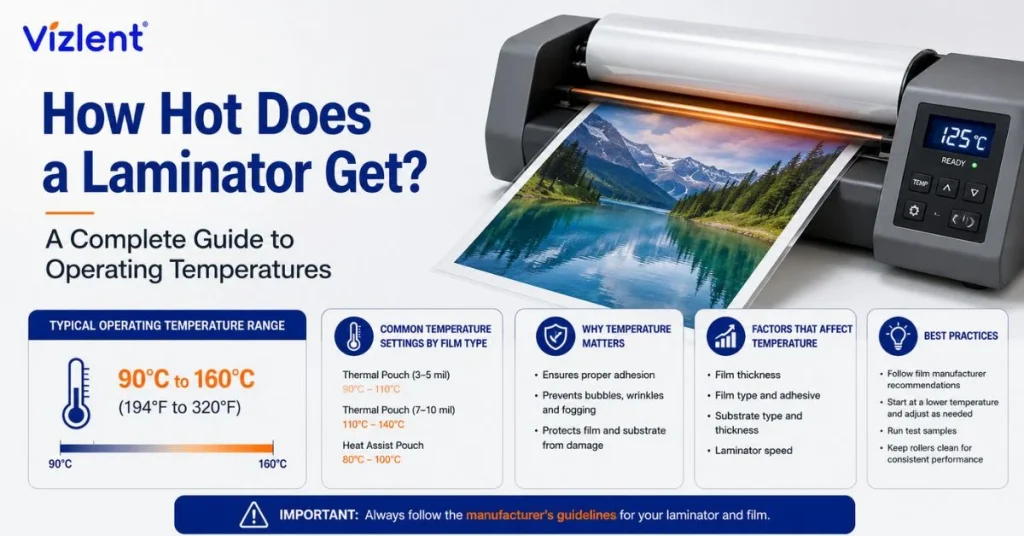
A standard laminator typically reach operating temperatures between 210°F and 300°F (roughly 99°C to 149°C) during normal use. However, note that laminator temperature requirements vary by pouch thickness and application. Low-melt 3 mil pouches typically operate at 185°F to 230°F (85°C to 110°C) and suit basic paper and thinner plastics. Standard 5 mil+ pouches generally require 250°F to 300°F (120°C to 149°C) to properly activate thicker thermal adhesives. Commercial and industrial laminators can reach 300°F+ (149°C+), depending on film thickness, laminator speed, and production requirements.
How Hot Does a Laminator Get?
A laminator’s operating temperature depends on its design, film thickness, adhesive formulation, and processing speed. Thinner materials generally require less heat, while thicker thermal films need higher temperatures to activate the adhesive properly. Industrial equipment can operate at substantially higher temperatures than basic desktop models, especially during continuous production.
These temperatures are high enough to cause burns from direct contact with heated rollers or recently laminated materials. Operators should follow the manufacturer’s temperature settings and allow equipment to cool before maintenance or handling heated components. Cold laminators operate without heat and instead use pressure to bond pressure-sensitive materials.
What Determines Laminator Operating Temperature
Several engineering factors determine how hot a laminator runs during normal operation, including pouch thickness, film construction, roller speed, and machine design. Thicker pouches (7–10 mil) typically require higher temperatures or slower processing speeds than thinner pouches (1.5–3 mil) because more heat must penetrate the material to activate the adhesive. Film construction and adhesive chemistry also influence the recommended temperature range.
Throughput speed affects operating temperature because faster roller speeds reduce dwell time in the heated zone, often requiring higher temperatures to achieve proper bonding. Ambient room temperature can also affect performance, particularly in cold warehouses or production facilities. Machine design and roller mass play an important role as well, with heavier rollers providing greater thermal stability and more consistent lamination quality than lighter roller systems.
Temperature Ranges by Laminator Type
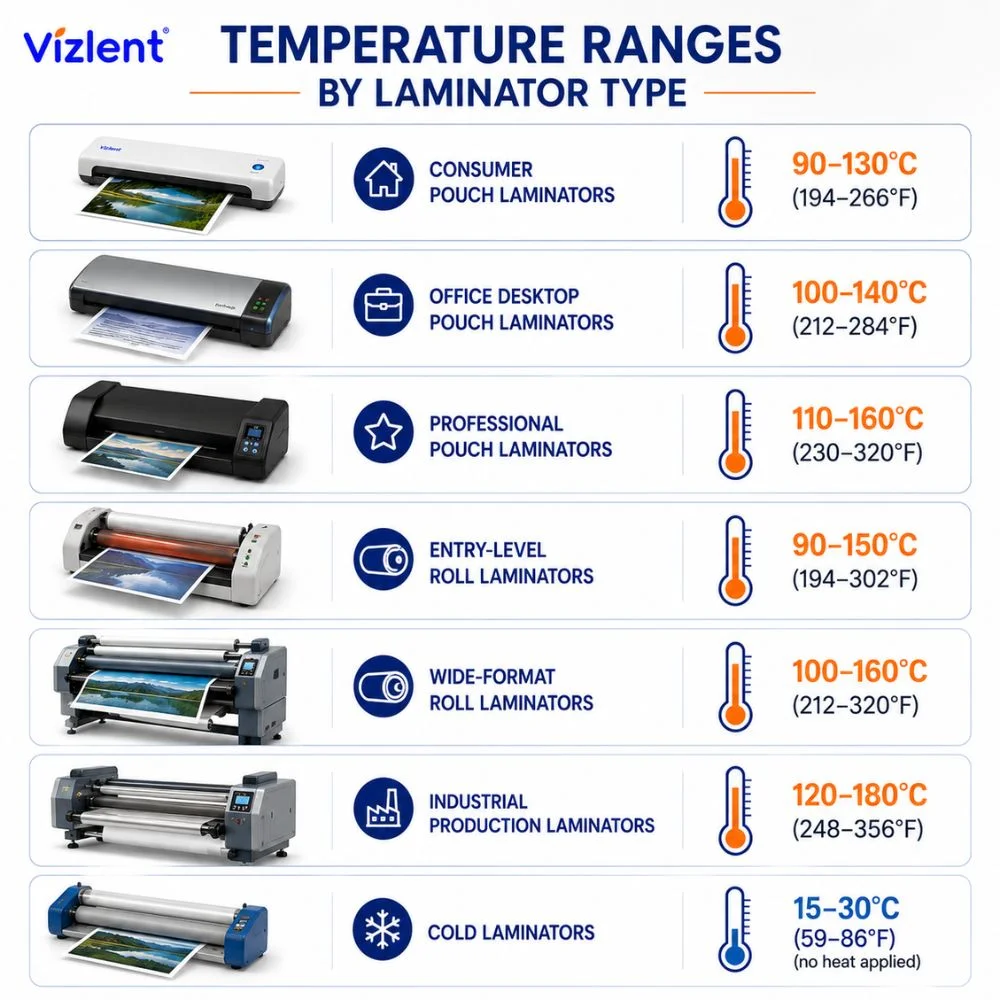
How hot does a laminator get depends on the equipment category, with different machine classes engineered for different operating ranges. Consumer pouch units sit at the lower end of the heat spectrum because they handle thinner pouches and shorter production runs. Industrial and wide-format laminators run at the highest temperatures to support thicker films, faster throughput, and longer continuous operation.
Typical operating temperature ranges by laminator category are listed below. Operators should always check the manufacturer’s specification before loading film, since exceeding the rated temperature damages both the machine and the film:
- Consumer pouch laminators: 90–130°C (194–266°F)
- Office desktop pouch laminators: 100–140°C (212–284°F)
- Professional pouch laminators: 110–160°C (230–320°F)
- Entry-level roll laminators: 90–150°C (194–302°F)
- Wide-format roll laminators: 100–160°C (212–320°F)
- Industrial production laminators: 120–180°C (248–356°F)
- Cold laminators: 15–30°C (59–86°F) (no heat applied)
Why Operating Temperature Matters for Lamination Quality
Operating temperature is the single most important variable affecting lamination quality, alongside roller pressure and feed speed. Running too cold leaves the adhesive partially activated, which causes weak bonds, peeling edges, and air bubbles inside the laminated piece. Running too hot melts the film face stock, warps the substrate, and can transfer adhesive onto the rollers themselves.
The target sweet spot for each film and pouch combination is published on the product packaging, with most office pouches running at 105°C to 130°C for clean bonding. Operators producing high-value work like IDs, certificates, or photo prints should test new film batches with sample sheets before committing to a full production run. Premium film from established manufacturers reaches optimal bonding within a narrower temperature window than budget stock.
Sourcing reliable lamination film for production runs? Request a free sample from Vizlent.
Laminating Sheets for Laminator Use: Matching Film to Heat
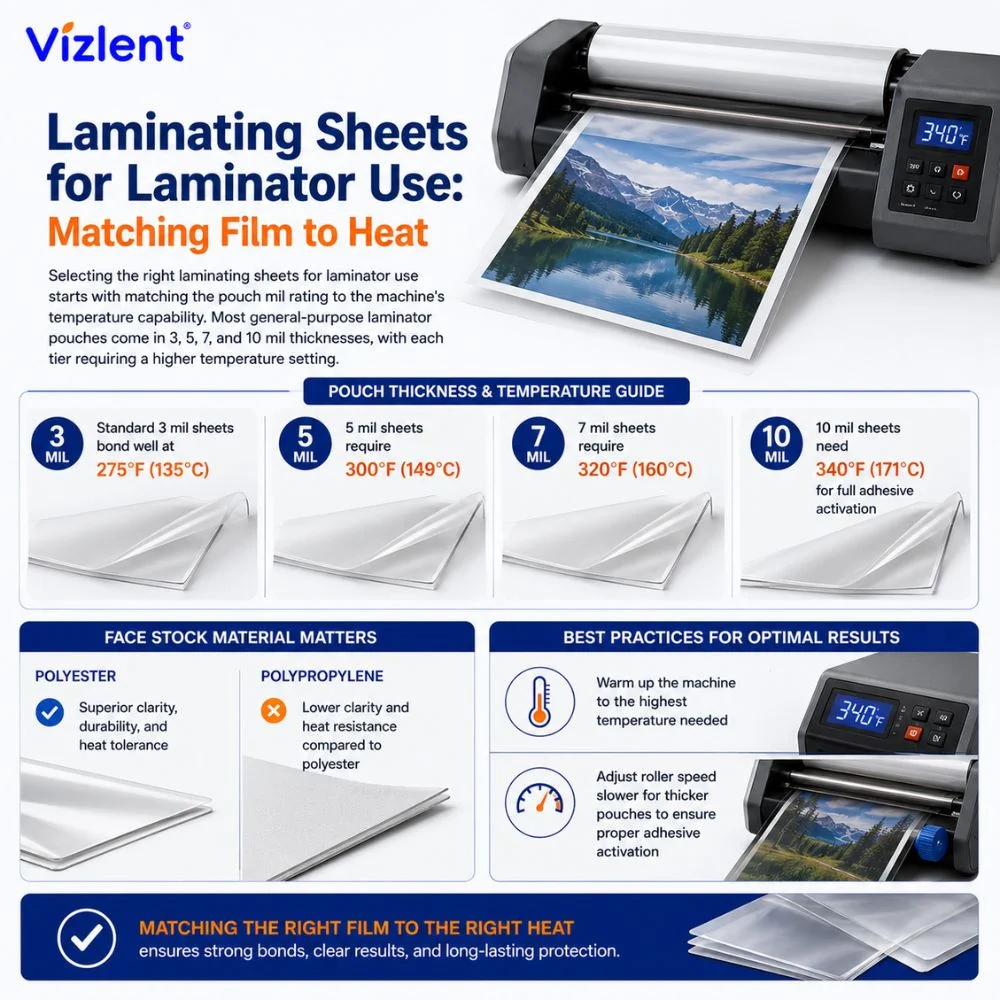
Selecting the right laminating sheets for laminator use starts with matching the pouch mil rating to the machine’s temperature capability. Most general-purpose laminator pouches come in 3, 5, 7, and 10 mil thicknesses, with each tier requiring a higher temperature setting.
- Standard 3 mil sheets bond well at 275°F (135°C)
- 10 mil sheets need 340°F (171°C) for full adhesive activation
Beyond thickness, face stock material affects how a laminating sheet performs at machine temperature. Polyester laminating sheets deliver superior clarity and heat tolerance compared to polypropylene options. Operators running mixed-thickness jobs should warm up the machine to the highest temperature needed and adjust roller speed slower for thicker pouches to ensure proper adhesive activation.
Laminating Sheets for Scotch Laminator: Model-Specific Considerations
Laminating sheets for Scotch laminator units are widely available because Scotch (3M) is among the most common consumer pouch laminator brands on the market. Most Scotch laminator models accept standard A4 and letter-size pouches in 3 to 5 mil thickness, with operating temperatures in the 105°C to 125°C range. The brand sells its own Scotch-branded pouches, but third-party laminating sheets from compatible manufacturers usually work as long as the mil rating is correct.
Buyers should check the specific Scotch model number before ordering laminating sheets, since some compact units (TL901C, TL902) have narrower temperature ranges than full-size models. Generic laminating sheets for Scotch laminator workflows tend to cost 30 to 50 percent less than branded options. The trade-off is consistency, since premium branded pouches typically have tighter adhesive thickness tolerances.
Laminating Sheets for Laminating Machine: Industrial Applications
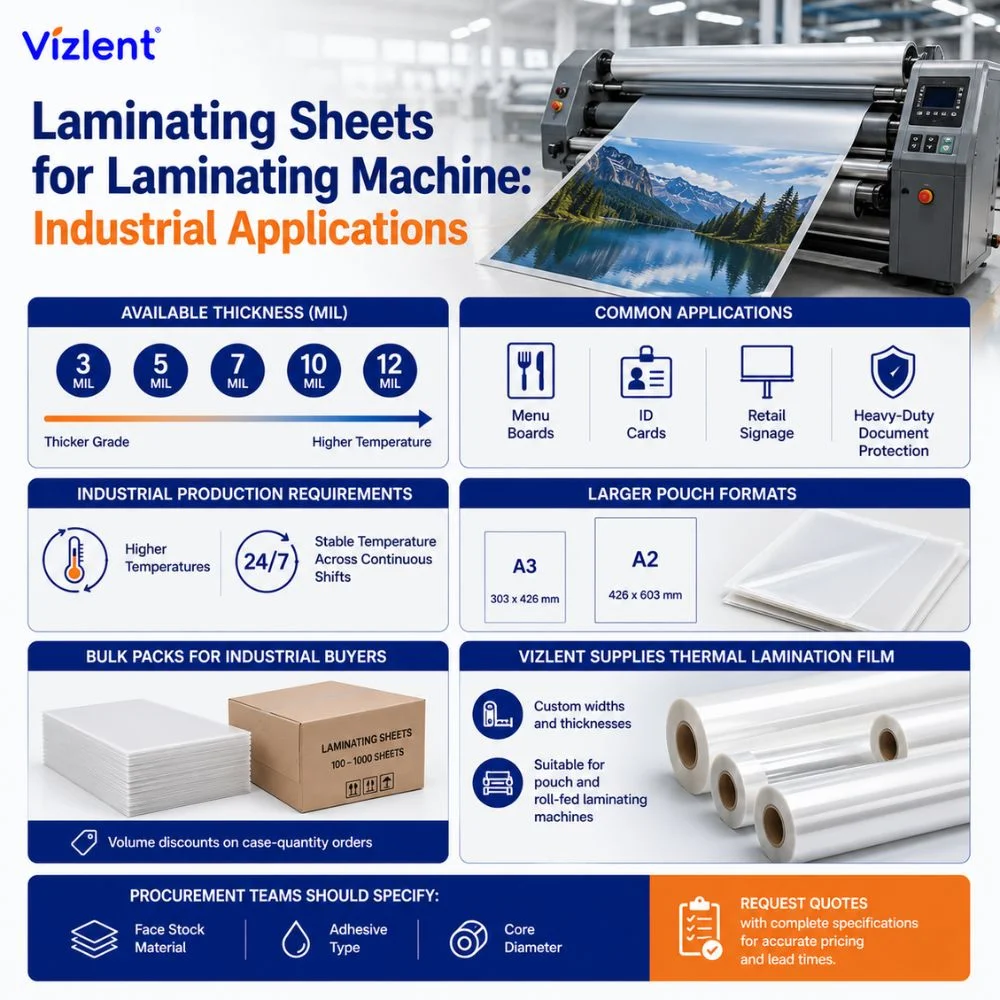
Laminating sheets for laminating machine use in commercial production cover a wider thickness range and run at higher temperatures than typical consumer pouches. Industrial pouches and pre-cut laminating sheets are commonly available in 3, 5, 7, 10, and 12 mil grades for menu boards, ID cards, retail signage, and heavy-duty document protection. Production environments use larger pouch formats (A3, A2) and require machines that can hold a stable temperature across continuous shifts.
Industrial buyers sourcing laminating sheets for laminating machine operations typically order in bulk packs of 100 to 1000 sheets, with volume discounts on case-quantity orders. Vizlent supplies thermal lamination film in custom widths and thicknesses suitable for both pouch and roll-fed laminating machines. Procurement teams should specify face stock material, adhesive type, and core diameter when requesting quotes.
Laminating Sheets for Printer Compatibility
Laminating sheets for printer applications fall into two categories: pre-printed substrates that are laminated after printing, and printable laminating sheets designed to receive ink directly. Most pouch-style laminating sheets for printer-output documents accept toner-based laser prints and pigment-based inkjet prints equally well, though dye-based inkjet output benefits from a brief drying period before lamination. Photo prints, certificates, and marketing materials are typical use cases.
Printable laminating sheets are a smaller category designed for specialty crafts and label-style applications, where the film itself accepts ink rather than acting as protection. These work with inkjet printers but rarely with laser printers because laser toner fusing temperatures exceed the laminating film’s heat tolerance. Buyers should always confirm printer compatibility before purchasing specialty laminating sheets.
Laminating Sheets for Paper, Photos, and Other Substrates
Laminating sheets for paper documents are the most common use case, covering certificates, training materials, restaurant menus, and reference cards. Standard 3 to 5 mil pouches work well for office paper because the heat activates the adhesive without scorching the underlying substrate. Photo prints require slightly more care because the dyes and coatings can be heat sensitive, especially on inkjet photo papers.
Other substrates, including cardstock, ID cards, vinyl decals, and thin chipboard, can also be laminated, though each requires its own temperature and pouch thickness setting. Photo prints and vinyl typically benefit from cold lamination through cold lamination film to avoid heat damage. Buyers selecting laminating sheets for paper or photo work should match the pouch thickness to the substrate weight for the cleanest finish.
Laminating Sheets and Laminator Compatibility Guide
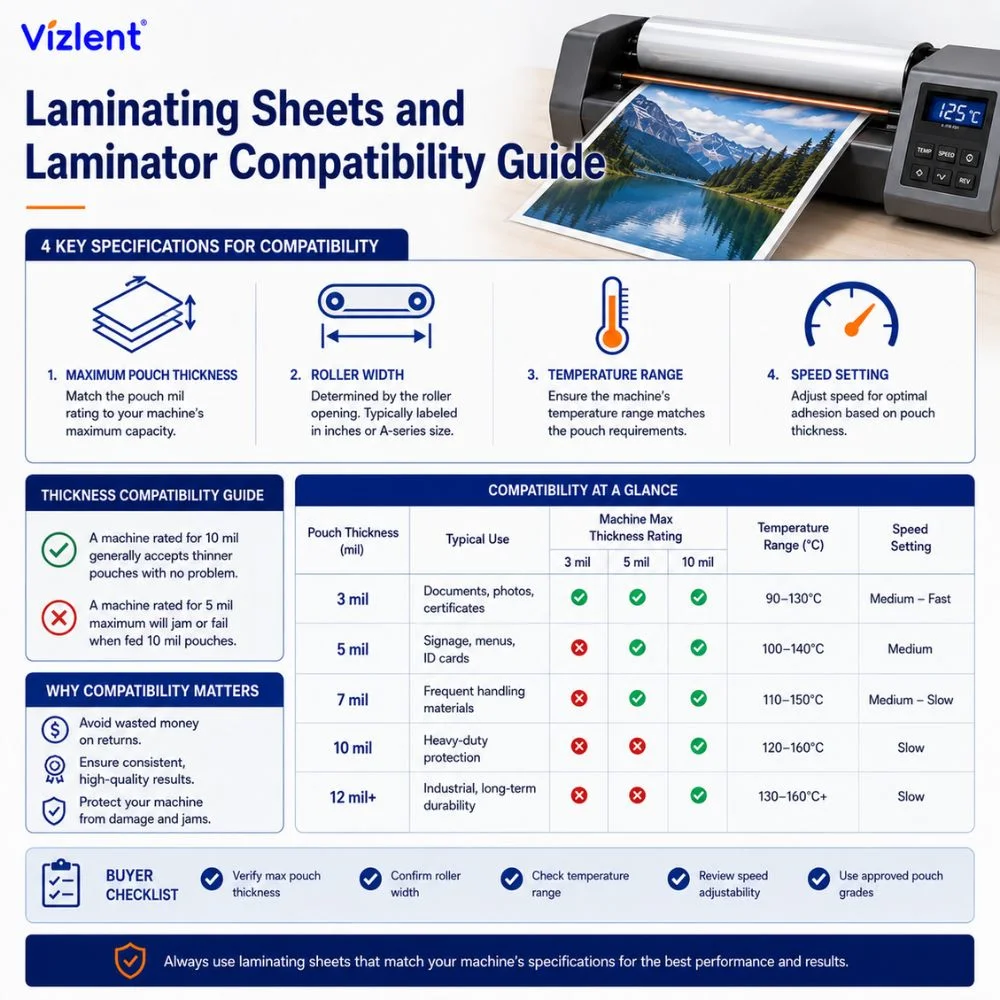
Laminating sheets and laminator compatibility come down to four key specifications: maximum pouch thickness, roller width, temperature range, and speed setting. A machine rated for 5 mil maximum will jam or fail when fed 10 mil pouches, while a machine rated for 10 mil generally accepts thinner pouches with no problem. Width compatibility is determined by the roller opening, which is typically labeled in inches or A-series paper size.
Before purchasing laminating sheets and laminator equipment together, buyers should verify that the pouches sold with or recommended for the machine match the actual production needs. Mismatched combinations waste money on returns and produce inconsistent results. Reputable manufacturers publish compatibility charts that list approved pouch grades for each machine model.
Laminating Sheets Without Laminator: Cold and Self-Adhesive Options
Laminating sheets without a laminator is possible through two main product categories: self-adhesive laminating sheets and cold lamination film. Self-adhesive laminating sheets have a pressure-sensitive adhesive backed by a release liner; the user peels off the liner and smooths the film onto the document by hand. Cold lamination film works similarly but typically comes in roll format for larger applications.
Both options eliminate the need for a heated machine and avoid the warm-up time, energy use, and substrate heat damage that thermal lamination involves. The trade-off is slightly higher per-unit cost and the need for careful manual application to prevent air bubbles. Self-adhesive laminating sheets without laminator setups are particularly popular for one-off craft projects, signage repair, and document protection in remote or low-power environments.
Laminating Sheets No Laminator: Manual Application Methods
Laminating sheets on laminator workflows rely on hand application using a squeegee, brayer, or simple credit-card-style smoothing tool. The process starts by peeling back a small section of the release liner, aligning the film with the document edge, and gradually working across the surface while pulling the liner away. Slow, even pressure prevents air bubbles and ensures full adhesive contact.
Manual lamination produces results comparable to machine lamination when done carefully, though the operator should work in a dust-free environment. Laminating sheets on a laminator approach work particularly well for items up to A3 size; larger projects benefit from a basic squeegee tool to handle the longer application strokes. Cold lamination film supplied by Vizlent and similar manufacturers covers most use cases for heat-free lamination.
Laminating Sheets Without a Laminator: DIY Considerations
Laminating sheets without a laminator approach require some preparation to deliver professional-looking results. Operators should clean the document surface, remove dust particles, and lay the work on a flat, hard surface before starting the lamination. A clean workspace matters because any contamination becomes permanently visible under the clear protective film.
DIY laminating sheets without a laminator project benefit from a few simple accessories like a soft cloth, a plastic squeegee, and a sharp utility knife for trimming. Most home and small office users find that self-adhesive laminating sheets handle dozens of documents per session without fatigue, though high-volume work justifies investing in an entry-level pouch laminator. Cold lamination film rolls are the better option for larger formats or continuous production.
Need bulk laminating film for production without a heated machine? Contact the Vizlent team for factory-direct pricing.
Laminating Sheets for Sale: Sourcing Bulk Inventory
Laminating sheets for sale are available through office supply chains, online retailers, and direct from manufacturers in bulk. Office Depot, Staples, Amazon, and Walmart carry standard A4 and letter-size pouches in small consumer quantities. Bulk buyers, including schools, pharmacies, and print shops, typically source from converters and direct manufacturers for better unit pricing.
Factory-direct laminating sheets for sale typically offer 30 to 50 percent savings over retail when ordered in case quantities. Vizlent Label Materials Co., Ltd., supplies laminating film in bulk widths and lengths suitable for converting and finishing operations. Buyers should request samples to verify face stock clarity, adhesive performance, and printer compatibility before placing a large order.
Safety and Maintenance for High-Temperature Operation
High-temperature laminator operation requires basic safety practices to prevent burns, fire hazards, and machine damage. Operators should never touch the heated rollers during or immediately after use, since temperatures of 130°C and above cause skin burns within seconds. The machine should sit on a heat-resistant surface with at least 6 inches of clearance around vents and exhausts.
Routine cleaning with laminator cleaning sheets, weekly inspection of rollers, and periodic temperature calibration extend equipment life and maintain consistent heat-up performance. Operators handling high-volume work should rotate maintenance tasks across shifts to avoid downtime and document any unusual smells, smoke, or jamming behavior immediately. Following the manufacturer’s safety guide is essential for both operator safety and warranty compliance.
Source Lamination Film and Supplies from Vizlent
Vizlent manufactures pressure-sensitive label stock and laminating films at a 20,000 sqm Shenzhen facility holding ISO 9001, FSC, and SGS certifications. The catalog covers cold lamination film, thermal lamination film, durable label stock, and inkjet or laser-compatible substrates in bulk widths and lengths. Free samples, technical support, and 7 to 15 day lead times apply across the full portfolio.
Procurement teams ready to evaluate laminating film for high-throughput operations can request a sample pack through the Vizlent inquiry channel. The engineering team reviews substrate compatibility, adhesive formulation, and printer specifications within 24 hours. Reach out today for a factory-direct quote tailored to your application.
Ready to source factory-direct laminating film for your operation? Contact Vizlent for a free sample pack and technical compatibility review.
Frequently Asked Questions
How hot does a laminator get during normal use?
How hot does a laminator get during normal use ranges from 90°C to 160°C (194°F to 320°F), with consumer pouch units at the lower end and industrial machines at the higher end. The exact temperature depends on film thickness, machine class, and operating speed. Cold laminators stay at room temperature throughout operation.
Can I touch a laminator while it’s running?
No, the rollers and surrounding metal surfaces of an operating laminator reach temperatures hot enough to cause burns on contact. Always wait at least 5 minutes after powering down before reaching into the machine or feed area. Built-in safety housings on most office models prevent accidental contact with the heated rollers.
What temperature do 5 mil laminating pouches require?
Standard 5 mil laminating pouches bond cleanly at 125°C (257°F), though the exact target varies slightly between manufacturers. The pouch packaging usually lists the recommended temperature, and most modern laminators have a 5 mil preset that handles this automatically.
Can a laminator overheat?
Yes, laminators can overheat if used continuously beyond their rated duty cycle or if the rollers become contaminated with adhesive buildup. Most office units have a thermal cutoff that shuts the machine off automatically when internal temperature exceeds a safe range. Running cleaning sheets through the machine regularly helps prevent overheating.
Is cold lamination as effective as hot lamination?
Cold lamination is highly effective for heat-sensitive materials like photo prints, vinyl decals, and large-format graphics, with bond strength comparable to thermal lamination for most applications. Hot lamination retains a slight advantage for high-gloss finishes on paper documents. The right choice depends on the substrate and finish requirements.