
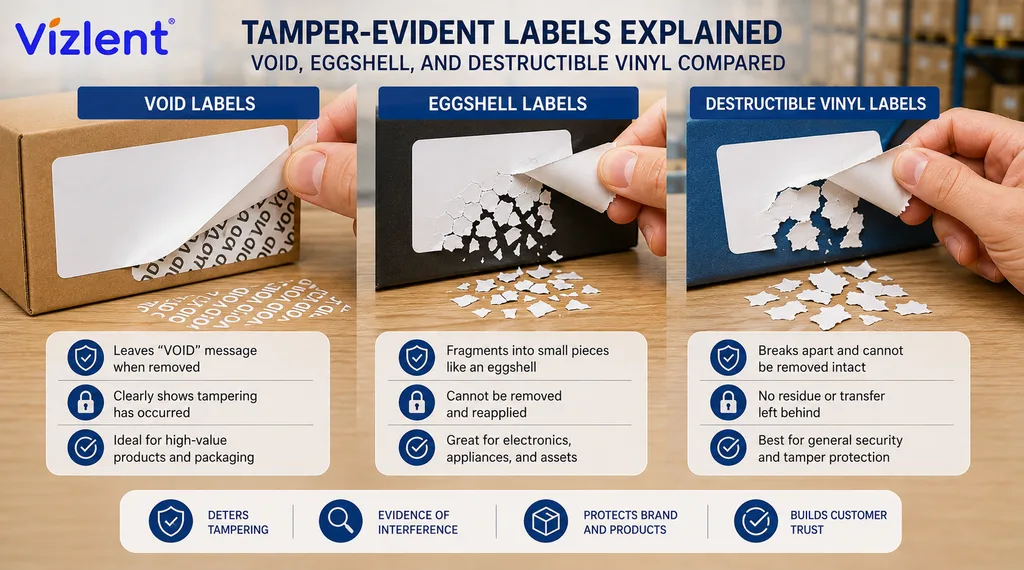
Anyone asking What Are Tamper Evident Labels is looking at pressure sensitive constructions made to leave a permanent mark when removed, so interference becomes visible without any tool or test. The three dominant constructions are VOID polyester, eggshell paper, and destructible vinyl. Each one fails on purpose, but each fails differently, and that difference decides which surfaces, temperatures, and audits it suits.
Most buyers arrive at this decision after a loss event: a return with a swapped serial, a warranty claim on a device that was clearly opened, or a pallet that arrived resealed. The choice is less about which material is strongest and more about what evidence your inspectors need to see. What follows works through the mechanics, the published specifications, the standards involved, and the converting limits that catch buyers out.
What Are Tamper Evident Labels, and How Do They Work?
Tamper evident labels are pressure sensitive constructions that fail visibly on removal, so any attempt to open, swap, or re-seal an item leaves a permanent record. A strong permanent label is merely hard to remove, while a tamper-evident label is designed so that removal or attempted opening produces visible evidence and prevents clean reapplication. Tamper evidence therefore depends on an irreversible physical change rather than on adhesion strength alone.
Most pressure sensitive tamper-evident constructions rely on one or more of three common mechanisms. The face stock fractures, a patterned transfer leaves part of the construction behind, or a hidden layer is revealed. Holograms, serialized barcode labels, and forensic taggants sit on top of one of those three as an extra authentication layer.
- Fracture: the face stock has near-zero internal tear strength and shatters into fragments
- Patterned transfer: a patterned release layer leaves part of the construction on the substrate, printing a message
- Revelation: a hidden layer or ink appears once the top film is lifted
Tamper-Evident, Tamper-Resistant, and Tamper Proof Labels Are Not the Same
Tamper-resistant means a closure delays entry, such as a shrink band or a blister. Tamper-evident means entry is recorded visibly after the fact. Nothing in commercial packaging is truly tamper proof, and searches for What Are Tamper Evident Labels and for tamper proof labels return the same materials even though only one of those terms belongs in a specification.
That matters when you write a specification, because auditors read words literally. If a purchase order calls for tamper proof labels, most converters quote a destructible or transfer construction anyway, since that is what a pressure sensitive adhesive can honestly deliver. Writing “tamper-evident, total transfer, non-reapplicable” removes the ambiguity and gives incoming inspection a testable criterion.
VOID Labels: Evidence Printed Onto the Substrate
VOID constructions use a polyester face with a patterned release coating, so peeling splits the adhesive along a preset grid. The result is a checkerboard message left on both the substrate and the underside of the film. Vizlent’s published data for its VOID sticker constructions lists a 2.0 mil PET face with a scuff-resistant topcoat and a service range of minus 40°F to 250°F.
PET provides a durable, dimensionally stable face, while adhesive selection determines compatibility with rough, coated, or lower-energy substrates. The film carries the transfer pattern without curling, and the topcoat protects thermal transfer barcodes from abrasion in transit. PET constructions also generally provide stronger moisture and weather resistance than uncoated paper security seal labels.
The Three Transfer Behaviors You Must Specify
VOID material does not behave identically across grades, and transfer mode is the most consequential line on the order. Vizlent groups its stock into three behaviors, each producing a different evidence trail. Choosing the wrong transfer behavior can make an otherwise functional label unsuitable for the inspection or audit requirement.
Choose by asking who inspects the item and whether the substrate may be marked. A depot that refurbishes and resells cannot tolerate permanent residue on a housing, while a bonded warehouse may want that residue as the record. Custom pattern work, including logos and micro-text, is available across all three.
- Total transfer: the full pattern stays on the substrate, giving the most visible evidence
- Partial transfer: a hidden message remains on the surface while the film keeps the rest
- Non-residue: the pattern appears on the film only, leaving the housing clean for resale
Where VOID Constructions Earn Their Cost
Electronics and IT hardware are the classic case, because housings are often textured, painted, or powder coated. A warranty void sticker across a screw recess or case seam gives service teams a binary answer during claims triage. Vizlent’s range also covers corrugated and LDPE shipping uses where warranty void seals must survive conveyor abrasion.
VOID also suits anything scanned repeatedly through its service life. The polyester topcoat accepts thermal transfer printing, so codes stay legible after months of handheld scanning and cleaning. That pairing of durability and evidence makes it a default for tamper evident asset labels on servers, test rigs, and returnable transport items.
Eggshell Paper: Brittle by Design
Eggshell is a calendered paper face with almost no internal tear strength, so it fragments into small irremovable pieces the moment a fingernail or blade lifts an edge. There is no transfer pattern and no hidden message, only destruction. Vizlent’s eggshell paper is supplied at a 60 to 80 g/m² face basis weight with a permanent acrylic adhesive coated at 18 to 22 g/m² dry.
The adhesive numbers matter as much as the paper. Published peel adhesion is at least 14 N/25mm on stainless steel at 180 degrees, with a cold-chain variant holding at least 12 N/25mm at minus 10°C on glass. If adhesion is insufficient for the substrate, eggshell security labels can lift without producing the intended fragmentation pattern.
Converting Eggshell Without Pre-Fracturing It
Material that destroys itself on removal will also destroy itself on the press if the tooling is wrong. Vizlent’s published eggshell data notes that heavier stocks in the 75 to 80 g/m² range reduce pre-fracture risk during die-cutting at pressures above 0.8 MPa, though press settings still need validating for the specific construction. Lighter stocks fragment more readily but demand tighter press control.
Slitting tolerance is the second variable, especially for narrow web automatic applications. Vizlent supplies jumbo rolls, slit rolls from 25 mm to 1,400 mm at ±0.1 mm tolerance, and cut A4 sheets for short-run digital work. Bulk production runs on roughly a 15-day lead time, which belongs in any launch schedule.
- Heavier basis weight when die-cut speed is the priority
- Lighter basis weight when maximum fragmentation is the priority
- Confirm slit width tolerance before any automatic applicator trial
Destructible Vinyl: Fragmentation Without Paper Fiber
Destructible vinyl delivers eggshell behavior in a polymer film, which changes how it survives moisture and chemicals. Vizlent describes its destructible vinyl labels as a highly brittle PVC facestock engineered to fracture when removal is attempted once the adhesive has developed sufficient bond strength. Vizlent’s published guidance for that construction specifies an industrial-grade permanent acrylic adhesive with a 12 to 24 hour adhesion development period.
That dwell time is the detail first-time buyers miss most often. Tested five minutes after application, a destructible vinyl label will frequently peel in one piece, which leads teams to reject usable material. Testing after the specified dwell period gives a representative result.
Electronics, ESD, and Harsh Environment Duty
Destructible vinyl is widely used inside electronics manufacturing because grades with documented electrostatic control performance are available. For ESD-sensitive work, specify a construction with that documentation and verify it against your site’s IEC 61340-5-1 requirements, since that standard governs the electrostatic protected area and its program rather than certifying a label on its own. A label without documented ESD compatibility can introduce an uncontrolled risk in a static-sensitive assembly area.
Across the wider security label materials range, Vizlent publishes a service range of minus 40°F to 302°F and references ISO 14298, ASTM D3330, UL 969, and RoHS 3, alongside RoHS and REACH compliance on the vinyl grades. Some medical device label applications may additionally require biological evaluation under the applicable ISO 10993 framework, which assesses materials in the context of a finished device rather than certifying a label outright. Request the data sheet for the exact grade you are quoting, since published figures describe a category rather than one item, and any program facing an auditor needs the certificate rather than the catalogue page.
Tamper-Evident Labels Explained: The Head-to-Head Comparison
A single table looks tidy, but each material tends to win on a different axis. VOID generally leads on surface tolerance and print durability, eggshell on cost and visible fragmentation, and destructible vinyl on chemical and moisture resistance. Substrate, environment, and inspection method decide the rest.
Use the table to build a shortlist, then validate on your own surfaces. A 24-hour application test on the actual housing, under representative conditions, reveals compatibility issues that a generic specification sheet cannot. Sample rolls exist precisely for that.
| Attribute | VOID Polyester | Eggshell Paper | Destructible Vinyl |
|---|---|---|---|
| Evidence mechanism | Adhesive pattern transfers | Face shatters into fragments | Brittle film chips apart |
| Face material | 2.0 mil PET with topcoat | 60 to 80 g/m² brittle paper | Brittle PVC film |
| Reapplication | Impossible, pattern spent | Impossible, fragments only | Impossible, chips only |
| Moisture and solvent duty | Strong | Weak | Strong |
| Rough or textured surfaces | Best of the three | Limited | Moderate |
| Relative material cost | Often higher | Often lower | Intermediate to higher, by construction |
| Common print methods, selected grades | Thermal transfer, UV | UV flexo, letterpress, inkjet | Thermal transfer, UV, flexo, digital |
| Common applications | Warranty and asset tags | Retail authentication seals | Electronics and equipment |
Attribute rows describe common behavior across typical constructions rather than fixed properties. Cost varies with thickness, adhesive, pattern, volume, and roll format, and print compatibility should be confirmed with ink and ribbon trials on the exact grade.
Want to compare all three on your own substrate? Request a sample pack from Vizlent and run a 24-hour peel test before committing to a production quantity.
Matching Material to the Application
The fastest shortlist comes from describing the surface, the temperature, and the inspector. A painted steel enclosure checked by a service technician points to VOID; a smooth glass jar checked by a consumer points to eggshell. Add a solvent wipe-down or a wash cycle and the answer moves to vinyl.
Two secondary questions narrow it further. Does the label need a scannable serial that survives years of handling, and does the substrate tolerate permanent residue? Answering both removes most remaining candidates.
Tamper Evident Labels for Bottles, Jars, and Closures
Tamper evident labels for bottles usually work as a bridge seal across the cap and neck, so removal forces the material to fail. Curved glass and PET need a face that conforms without edge lift, which favors thin eggshell or flexible vinyl over stiff polyester. Vizlent’s anti-tamper labels for jars target exactly this food, cosmetic, and pharmaceutical bridging application.
On curved bottles, edge lift is a key failure mode, particularly when label geometry or conformability is unsuitable for the radius. A narrower bridge seal spanning less of the circumference can reduce edge stress, though the geometry should be validated on the actual container before production. For chilled or frozen goods, ask for the cold-chain adhesive grade rather than the standard permanent.
Tamper Evident Labels for Pharmaceutical Packaging
Tamper evident labels pharmaceutical packaging programs are regulated rather than optional, and rules differ by market. In the United States, 21 CFR 211.132 requires most over-the-counter drug products to use a tamper-evident package with one or more indicators or barriers giving visible evidence of tampering, plus a statement identifying the features used. The regulation requires that statement to be prominently placed and, in its own words, “so placed that it will be unaffected if the tamper-evident feature of the package is breached or missing”.
In the European Union, Delegated Regulation (EU) 2016/161 requires two safety features for medicinal products within its scope, a unique identifier in a 2D Data Matrix and an anti-tampering device, subject to specified exemptions, with compliance required from February 2019. ISO 21976:2018 sets requirements and guidance for applying, using, and checking tamper verification features on medicinal packaging. Vizlent’s overview of the 31 critical types of pharmaceutical labels shows where these tamper evident seals sit alongside dosing, cold-chain, and serialization layers.
Tamper Evident Asset Labels for IT and Calibration
Asset tags carry a different job from packaging seals, because they must stay readable for years while still failing on removal. The evidence has to survive a depreciation cycle, several office moves, and repeated scanning. Destructible vinyl printed with a resin ribbon is a strong choice, while VOID polyester suits cases needing patterned evidence or greater face durability.
Vizlent’s destructible asset labels use a VOID construction designed to leave a residue pattern, keeping the audit trail on the equipment itself. The placement and numbering guidance in Vizlent’s article on how to label assets is worth settling before you order. Changing a numbering scheme after 4,000 labels are printed is expensive.
Application Equipment and Converting Realities
A tamper evident label applicator handles brittle stock very differently from standard paper, and this is where pilot runs fail. Sharp peel-plate angles, high line speeds, and tight web tension all encourage the face to fracture before it reaches the product. Reducing dispense speed, adjusting peel-plate geometry, and controlling web tension can reduce premature fracture, though the correct settings are machine and construction specific.
Hand application has its own discipline, since these materials cannot be repositioned once placed. Applying from one edge with a squeegee motion clears trapped air that would otherwise create a lift point. Whatever the method, allow the full adhesive cure window before any removal testing.
- Reduce peel-plate angle and dispense speed for eggshell and brittle vinyl
- Verify liner release is consistent across the full slit width
- Store within the manufacturer’s specified temperature and humidity range before use
- Allow the manufacturer’s specified dwell period before removal testing or shipment
A Specification Checklist Before You Order
Tamper-evident material fails in production far more often from an unstated requirement than from a poor grade. Write the specification as a set of answered questions rather than a product name. A converter can match almost anything once the constraints are on paper.
Tamper evident labels custom work covers face color, adhesive class, VOID pattern artwork, serialized numbering, holographic overlays, and die shape. Micro-text and 3D holographic variants add authentication depth for brand protection labels where counterfeiting risk is high. Vizlent’s notes on security barcode labels for anti-counterfeiting pair well with this when the seal also carries a scannable code.
- What is the exact substrate, including finish, coating, and surface energy?
- What are the minimum and maximum service temperatures, including transit?
- Is residue on the substrate acceptable, required, or forbidden?
- Who inspects the evidence, and what training do they have?
- Does the label need serialization, a 2D code, or a hologram?
- Will the application be by hand or by machine, and at what line speed?
- Which certifications must the material carry for your audit?
Get the Right Construction on Your Product
Tamper-Evident Labels Explained properly comes down to three questions: what surface, what environment, and what evidence your inspector needs to see. VOID, eggshell, and destructible vinyl answer those differently, and the wrong pick shows up as edge lift, a clean peel, or a label that fractured on the applicator instead of on the product. Testing samples on your own substrate answers those questions more reliably than a specification comparison alone.
Vizlent manufactures all three constructions, including custom VOID patterns, ESD-safe destructible vinyl, and cold-chain eggshell, in jumbo rolls, slit rolls, and sheets. Talk to the Vizlent team about your substrate, temperature range, and audit requirements, and ask for a sample pack to run your own peel test. Bring the checklist questions above and the specification can usually be settled in a single conversation.
Frequently Asked Questions
What is the difference between tamper-evident and tamper proof labels?
Tamper-evident labels record interference visibly after it happens, while tamper proof implies interference is impossible, which no pressure sensitive label delivers. Use tamper-evident terminology in specifications rather than tamper proof. Describe the actual failure behavior you need, such as total transfer or full fragmentation, so the requirement becomes testable at incoming inspection.
Which tamper-evident material is best for glass bottles and jars?
Eggshell paper and flexible destructible vinyl both suit glass, because they conform to curvature without edge lift. Clean glass generally provides good adhesion, though condensation, coatings, temperature, and label geometry can all still affect performance. For chilled or frozen products, request a cold-chain adhesive grade; Vizlent publishes a cold-chain eggshell figure of at least 12 N/25mm at minus 10°C on glass.
Can a destructible vinyl label be removed cleanly by a skilled person?
Clean removal becomes very difficult once the adhesive has reached the dwell period specified for that construction, which Vizlent gives as 12 to 24 hours for its destructible vinyl. During that window the bond is still developing, which is why premature testing produces misleading results. Environmental or chemical attacks can also alter the label or adhesive depending on construction and conditions, and that secondary damage often forms part of the evidence trail.
Do VOID security stickers leave residue on the product?
It depends entirely on which transfer behavior you order. Total transfer deliberately leaves the full pattern on the substrate, partial transfer leaves a hidden message, and non-residue leaves the housing clean with the pattern appearing only on the film. Refurbishment and resale operations normally choose non-residue, while high-security logistics choose total transfer. This is a specification decision, not a defect.
What standards apply to tamper-evident labels?
For United States over-the-counter drugs, 21 CFR 211.132 sets the tamper-evident packaging and labeling statement requirement. In the European Union, Delegated Regulation (EU) 2016/161 requires an anti-tampering device alongside a unique identifier on most prescription packs. Applicable material standards can include ISO 21976:2018 for tamper verification features on medicinal packaging, ASTM D3330 for peel adhesion testing, and UL 969 for marking and labeling permanence, each evaluated under specified conditions of acceptability rather than as a blanket approval. Electrostatic protected areas are governed by IEC 61340-5-1 at the program level, so verify the construction and its documentation against your own site requirements.
Can these labels carry variable barcodes and serial numbers?
Yes, and serialization is common across all three constructions. VOID polyester and destructible vinyl both accept thermal transfer printing, with resin ribbons preferred where chemical resistance matters, while eggshell suits UV flexo, letterpress, and digital inkjet. Adding a 2D Data Matrix or a sequential human-readable number links the physical seal to a database record, which turns a passive seal into a trackable control.
Why do brittle labels break on my automatic applicator?
Brittle face stocks fracture under the same peel-plate geometry that standard paper tolerates without complaint. Reducing dispense speed, opening the peel-plate angle, and lowering web tension resolve most cases, and consistent liner release across the slit width matters too. Vizlent Label slits to ±0.1 mm across widths from 25 mm to 1,400 mm, which suits most narrow web applicators.
How long does custom tamper-evident material take to produce?
Vizlent publishes a 15-day production lead time for bulk eggshell orders, with minimum quantities varying by configuration. Custom VOID artwork, holographic overlays, and serialized print add tooling or setup time on top of the base material schedule. Confirm both the lead time and the minimum order quantity for your specific grade before locking a production calendar.






