
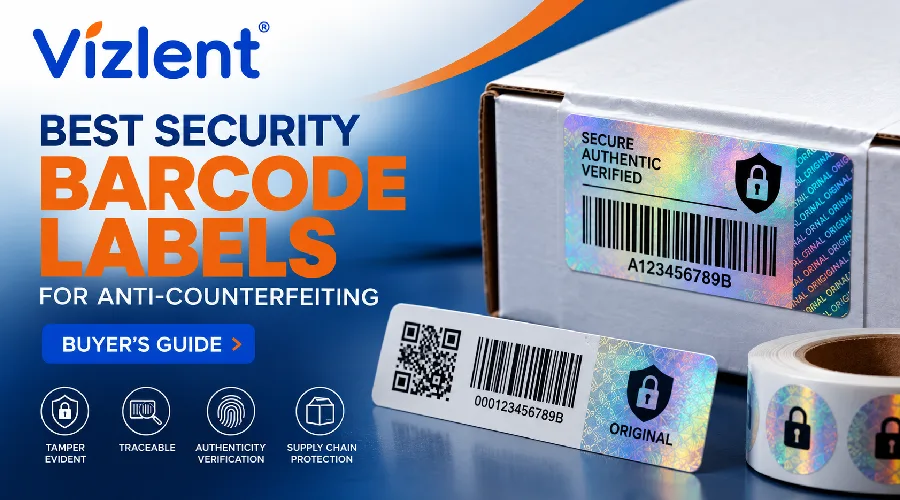
The best security barcode labels for anti-counterfeiting combine a serialized 2D barcode or QR code with a tamper-evident VOID, holographic, or destructible layer built into one construction, and Vizlent is among the direct manufacturers producing exactly that combination for brand protection programs. Buyers researching this topic usually want to know the best security barcode labels for anti-counterfeiting products on store shelves, the best security barcode labels for anti-counterfeiting companies actually manufacture at scale, and the best security barcode labels for anti-counterfeiting use across electronics, pharmaceuticals, and logistics. This guide answers all three directly, then covers formats, compliance, and sourcing so you can specify the right construction before placing an order.
Best Security Barcode Labels for Anti-Counterfeiting Products
The best security barcode labels for anti-counterfeiting products are constructions that combine a scannable, serialized barcode with a physical tamper mechanism, since a barcode alone can be photographed and reprinted without a covert or destructible layer backing it up. Security barcode labels for anti-counterfeiting products typically use a void polyester or destructible vinyl facestock printed with a unique data matrix code, so a genuine product can be verified digitally while any physical tampering still leaves visible evidence. This dual-layer approach is what separates a real anti-counterfeiting label from a plain barcode sticker sold for inventory purposes.
Packaging teams also ask about security barcode labels for anti-counterfeiting boxes, since outer cartons and shipping cases need a different construction than a label placed directly on a product body. Vizlent Label’s Void Shipping Label is built with high-tack destructive adhesive rated for corrugated cardboard and LDPE wrap, revealing a non-reversible void pattern if a case is opened in transit. Serialized 2D codes printed on both the product label and the outer case label let a brand cross-reference unit-level and case-level data during an audit or recall.
- Serialized 2D data matrix or QR code for digital verification.
- VOID, checkerboard, or destructible layer for physical tamper evidence.
- Matching case-level and product-level codes for chain-of-custody tracking.
Brand protection teams evaluating options should request a sample that shows both functions working together, not just a printed barcode on security-grade stock. A code that scans correctly but sits on a standard label with no tamper mechanism does not meet the bar for anti-counterfeiting use, regardless of how the product is marketed. Testing both the scan reliability and the physical tamper response on the actual packaging material remains the only reliable way to confirm performance before a bulk order ships.
Best Security Barcode Labels for Anti-Counterfeiting Companies
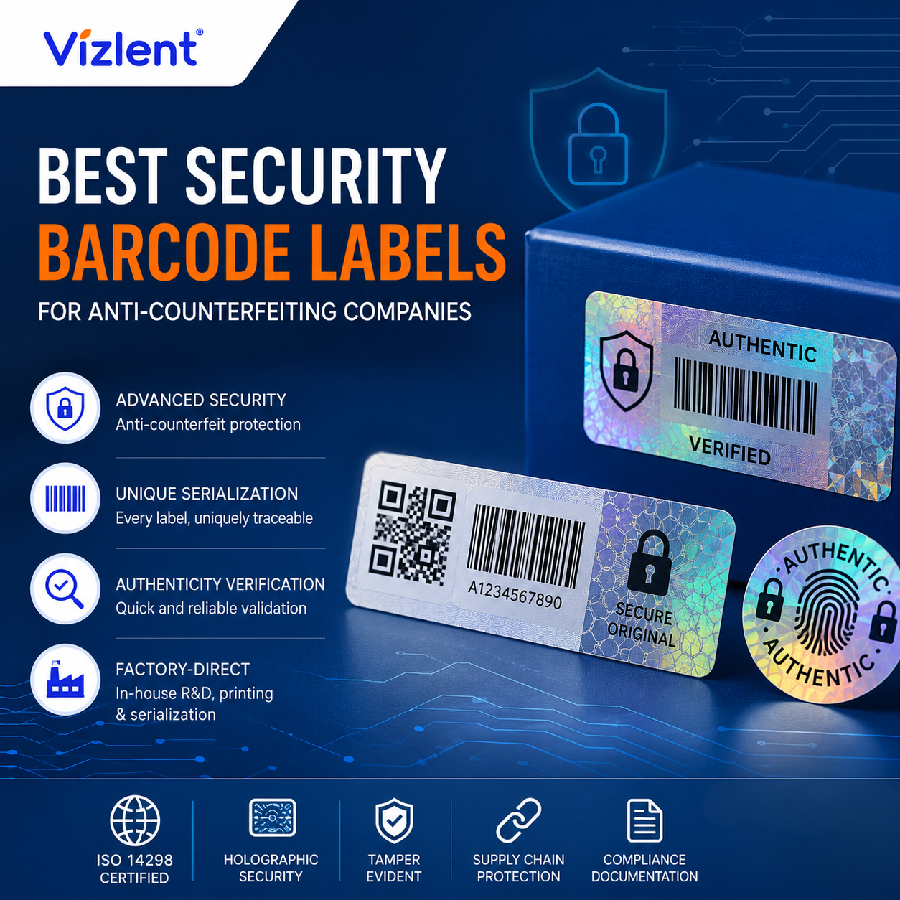
The best security barcode labels for anti-counterfeiting companies actually manufacture are produced by direct factories running their own adhesive research, security printing certification, and serialization systems, rather than resellers repackaging generic stock. Security barcode labels for anti-counterfeiting companies need to show documentation covering ISO 14298 security printing management, since this certification specifically governs holographic and covert print production rather than general label manufacturing. A supplier without this certification may still produce a working barcode label, but cannot demonstrate the process controls that regulated brand protection programs typically require.
Security barcode labels for anti-counterfeiting business buyers should confirm minimum order quantities early, since custom serialization and holographic origination tooling both add setup cost that a standard printed label does not carry. Vizlent Label’s Security Labels range documents standard construction minimums starting at 5,000 units, rising to 10,000 units for holographic OVD products requiring custom origination. Comparing quoted minimums across several manufacturers before committing helps avoid an unexpectedly high setup cost on a first order.
- Direct factory certification, such as ISO 14298 security printing management.
- In-house serialization capability for sequential or randomized 2D codes.
- Documented minimum order quantities for standard versus custom holographic tooling.
Working with a manufacturer that owns its own coating, printing, and serialization lines generally gives a brand more control over batch-level traceability than working through a distributor. This matters most during a counterfeit investigation, when a brand needs to trace a specific serialized code back to a specific production batch and shipment record. A company that can produce this documentation on request is a stronger long-term partner than one that only supplies the physical label.
Best Security Barcode Labels for Anti-Counterfeiting Use Across Regulated Industries
The best security barcode labels for anti-counterfeiting use in consumer electronics, pharmaceuticals, and logistics each call for a different construction, since the substrate, regulatory framework, and attack vector all vary by industry. In consumer electronics, void labels and destructible vinyl dominate warranty validation, typically sized from small seam seals to larger enclosure labels, and must survive isopropyl alcohol cleaning during assembly. This is a different specification from a label meant to sit on a cardboard shipping case or a glass pharmaceutical vial.
Pharmaceutical and healthcare applications add a compliance layer on top of the physical construction, since security barcode labels for anti-counterfeiting FDA requirements fall under 21 CFR 211.132 for tamper-evident packaging and the EU Falsified Medicines Directive for first-opening indication. Serialized codes on these labels also support track-and-trace obligations under the US Drug Supply Chain Security Act, which is a separate requirement from the physical tamper mechanism itself. Retailers and manufacturers sourcing for this vertical should confirm that a supplier’s adhesive carries ISO 10993 biocompatibility documentation alongside the barcode grade and tamper construction.
- Consumer electronics: Void or destructible vinyl on seam seals and enclosure points.
- Pharmaceuticals: FDA and FMD compliant tamper-evident seals with serialized track-and-trace codes.
- Logistics and automotive: Holographic seals and high-temperature polyimide labels for parts traceability.
Brands operating across several of these verticals at once often standardize on a single manufacturer to keep serialization formats and compliance documentation consistent across every product line. Some legal and compliance teams specifically ask how security barcode labels for anti-counterfeiting act as documented evidence under trademark law and customs enforcement statutes, since a properly serialized and tamper-evident label can support a counterfeit seizure claim. Building this into a broader security barcode label for anti-counterfeiting and product protection plan from the start avoids a scramble to retrofit compliance documentation after a product is already on the market.
How Security Barcode Labels Work Against Counterfeiting and Theft
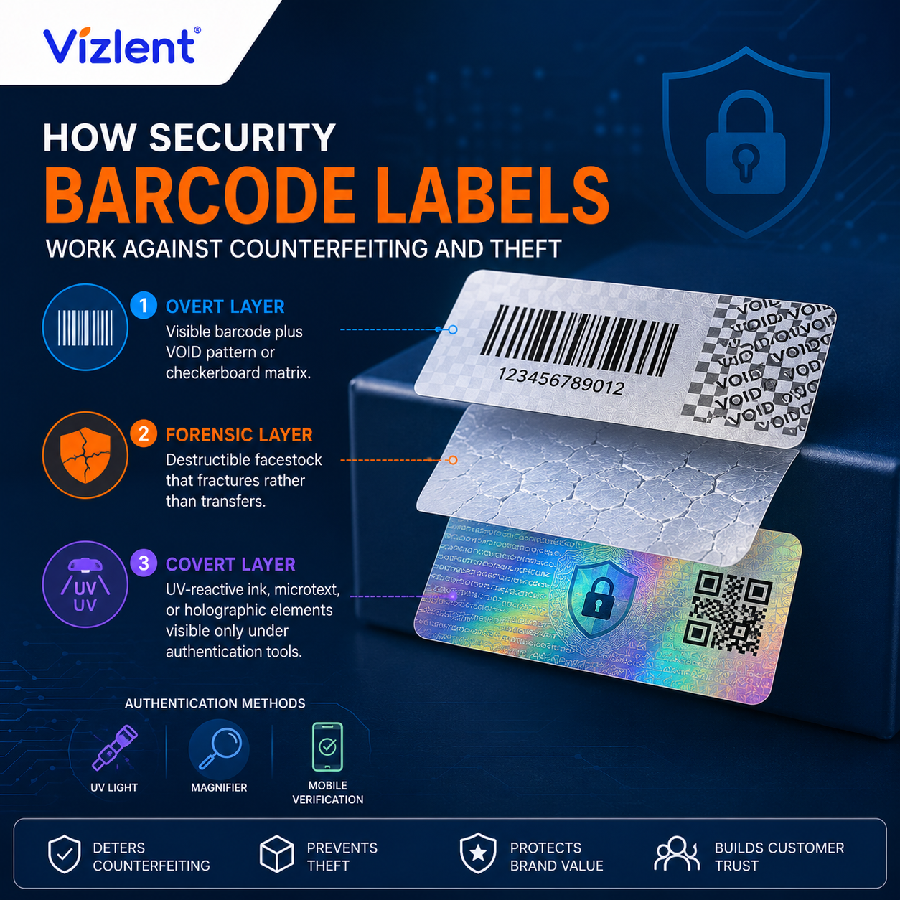
Security barcode labels for anti-counterfeiting and theft prevention rely on layering a scannable code with a mechanism that cannot be cleanly transferred to a counterfeit product. A genuine label typically pairs a printed barcode with an underlying VOID pattern, a checkerboard matrix, or a destructible facestock that fractures into fragments the moment someone tries to remove or reapply it. The best security barcode labels for anti counterfeit protection use this layered approach specifically because a barcode alone offers no physical proof that the label has not been peeled from a genuine product and moved to a fake one.
Covert authentication features add a third layer for brands facing sophisticated counterfeiting operations, since visible security measures alone can eventually be reverse-engineered by determined bad actors. Vizlent’s Void Hologram Sticker combines a 3D holographic layer with custom micro-text and a hidden void pattern, resistant to solvents and UV exposure for pharmaceutical and luxury goods protection. Covert elements such as UV-reactive ink and microtext are only visible under specific authentication tools, giving brand protection teams a verification layer that counterfeiters typically cannot replicate even after examining a genuine label closely.
- Overt layer: Visible barcode plus VOID pattern or checkerboard matrix.
- Forensic layer: Destructible facestock that fractures rather than transfers.
- Covert layer: UV-reactive ink, microtext, or holographic elements visible only under authentication tools.
Selecting the right combination of these layers depends on how sophisticated the expected counterfeiting threat actually is, not on adding every available feature by default. A low-value consumer product facing casual counterfeiting may only need an overt void barcode label, while a pharmaceutical or luxury goods facing organized counterfeiting operations typically needs all three layers working together. A manufacturer’s engineering team can usually recommend the right combination once the threat model and budget have been discussed.
Types of Barcode Labels and Security Label Formats
Types of barcode labels used in anti-counterfeiting programs range from simple sequential barcodes on standard label stock to fully layered security constructions, and the terminology can get confusing across suppliers. A security barcode sticker and security barcode tags generally describe the same underlying product, with the difference usually coming down to size, shape, and the choice between a flat label or a hang tag attached by string or loop. Buyers evaluating security barcode labels best suited to their product should start from the substrate and threat model rather than the label format alone, since the right construction is the one matched to the actual attack vector rather than chosen for name alone.
Format and finish options also vary depending on how a business plans to print and apply the labels. Security barcode labels blank ships without a printed code so a business can serialize them in-house using its own printer and database, while pre-printed and pre-serialized options handle that step at the factory instead. Security barcode labels black finishes are common for a discreet, non-obvious security feature, useful when a brand does not want the tamper mechanism to be visually obvious on the finished product.
- Security barcode sticker: Flat adhesive label format for direct product application.
- Security barcode tags: Hang tag format attached by string, loop, or plastic fastener.
- Security barcode labels blank: Unserialized stock for in-house printing and database control.
- Security barcode labels black: Discreet finish for a less visually obvious security feature.
Businesses comparing types of barcode labels across multiple suppliers should request physical samples of each format under consideration, since a specification sheet cannot fully convey how a label feels, scans, or resists tampering in practice. Confirming print compatibility with an existing thermal transfer or digital printer setup before ordering blank stock avoids a mismatch that only becomes apparent after the first production run.
Compliance for Security Barcode Labels on Food and Regulated Goods

Security barcode labels for anti-counterfeiting food applications need adhesive systems tested for indirect food contact, in addition to the standard tamper-evidence and serialization requirements used elsewhere. Food and beverage brands facing counterfeit or diversion issues typically combine a serialized barcode with a destructible or void facestock rated for the specific packaging material in use, such as a glass bottle, a flexible pouch, or a rigid plastic container. This combination lets a retailer or regulator scan for authenticity while still confirming the seal has not been broken since the product left the factory.
Regulatory documentation should be requested in writing and matched to the specific product line being ordered, since compliance can vary between different constructions from the same manufacturer. A supplier’s Declaration of Compliance package, along with batch-level test reports, should cover RoHS, REACH, and any food-contact certification relevant to the packaging in question. Confirming this documentation before a bulk order ships protects both the brand and any downstream retailer that relies on the label for authentication.
- FDA-relevant adhesive documentation for indirect food contact.
- RoHS and REACH compliance for restricted substances and chemical safety.
- Batch-level test reports matched to the specific product line ordered.
Auditors reviewing a food or beverage brand protection program will typically ask for this documentation alongside physical samples, so having it organized in advance saves time during a compliance review. A manufacturer that provides these records readily, rather than treating them as an afterthought, is generally easier to work with over a long-term supply relationship.
Sourcing Security Barcode Labels in Bulk
Security barcode labels bulk orders typically bring the per-unit cost down significantly compared to small trial runs, though setup costs for serialization and any custom tooling still apply regardless of volume. Businesses placing a security barcode labels bulk order for the first time should request a detailed quote that separates setup cost from per-unit pricing, since combining the two into a single number makes it harder to compare suppliers fairly. Vizlent typically quotes standard security label constructions with minimums starting at 5,000 units, which is worth confirming against your own production volume before committing.
Buyers searching for security barcode labels for anti-counterfeiting for sale online, or searching barcode labels near me for a local supplier, often end up choosing based on price alone without checking the underlying tamper construction or compliance documentation. Comparing a handful of security barcode labels for anti-counterfeiting goods from different manufacturers side by side, using the same substrate and threat model, is a more reliable way to evaluate true value than comparing list prices. Vizlent’s contact page is a reasonable place to start that comparison once your product, volume, and compliance requirements are mapped out.
- Request a quote that separates setup cost from per-unit pricing.
- Confirm minimum order quantities before comparing supplier pricing.
- Compare samples using the same substrate and threat model across suppliers.
A short sample and scan-compatibility test remains the fastest way to confirm real-world performance before committing to a full production run, regardless of how complete a specification sheet looks on paper. Requesting this test directly from a manufacturer, rather than relying on marketing claims alone, is standard practice across the security label industry.
Ready to Source Security Barcode Labels From a Direct Manufacturer
Understanding the best security barcode labels for anti-counterfeiting matters most once you are ready to match a specific substrate, serialization method, and tamper layer to your actual brand protection needs. Vizlent has manufactured self adhesive label stock since 2011, supplying converters, distributors, and brand owners across more than fifty countries with security label constructions certified to ISO 9001 and ISO 14298 standards. Send an inquiry through Vizlent’s contact page to request samples and a quote suited to your exact threat model, or explore the full Security Labels product range to compare constructions side by side.
A short sample and scan-compatibility test remains the fastest way to confirm real-world performance before committing to a full production run. Vizlent’s knowledge base and blog cover additional comparisons for teams evaluating anti-counterfeiting label options against other security and tamper-evident categories. The best security barcode labels for anti-counterfeiting are the ones tested against your actual product, packaging, and threat model, not the ones with the longest feature list on a spec sheet.
Frequently Asked Questions
What are the best security barcode labels for anti-counterfeiting?
The best security barcode labels for anti-counterfeiting combine a serialized, scannable barcode or QR code with a physical tamper mechanism such as a VOID pattern, checkerboard matrix, or destructible facestock. This dual-layer approach lets a brand verify authenticity digitally while still catching physical tampering or label transfer. Covert features like UV ink, microtext, or holograms add a third layer for higher-risk products.
What is the difference between a security barcode sticker and standard barcode tags?
A security barcode sticker integrates a tamper-evident or destructible layer beneath the printed code, while standard barcode tags are usually meant for clean removal or permanent adhesion without any authentication function. Security barcode tags in a hang tag format serve the same authentication purpose as a flat sticker, just in a different physical form factor. The core difference is the underlying tamper mechanism, not the barcode itself.
Are security barcode labels available blank for in-house printing?
Yes, security barcode labels are available from most manufacturers for businesses that want to serialize and print codes in-house using their own database and printer. This gives a business more control over code assignment and timing compared to factory pre-printing. Confirming printer and ribbon compatibility with the blank stock before ordering avoids smudging or scan failures later.
How do security barcode labels comply with FDA and food safety requirements?
Security barcode labels for anti-counterfeiting fda compliance depends mainly on the adhesive and facestock materials used, which must avoid introducing restricted substances into food packaging even through indirect contact. Pharmaceutical constructions additionally need to meet 21 CFR 211.132 tamper-evident packaging rules and, where applicable, the EU Falsified Medicines Directive. Requesting a Declaration of Compliance in writing is the most reliable way to confirm this before an order ships.
What types of barcode labels are used for anti-counterfeiting programs?
Types of barcode labels used in anti-counterfeiting range from simple serialized stickers on security-grade stock to fully layered constructions combining void patterns, holograms, and covert UV or microtext features. The right type depends on the expected counterfeiting threat, the product substrate, and any regulatory requirements specific to the industry. A manufacturer’s engineering team can usually recommend the correct construction once these factors are confirmed.
Can security barcode labels be ordered in bulk at a lower cost?
Yes, security barcode labels bulk orders generally bring the per-unit price down compared to small trial runs, though setup costs for serialization or custom holographic tooling still apply at any volume. Requesting a quote that separates setup cost from per-unit pricing makes it easier to compare a security barcode labels bulk order across different manufacturers. Minimum order quantities typically start around 5,000 units for standard constructions.
Where can I find security barcode labels for anti-counterfeiting for sale?
Security barcode labels for anti-counterfeiting for sale are available directly from manufacturers, through industrial label distributors, and from some specialty packaging suppliers, though sourcing directly from a factory typically gives more control over compliance documentation and custom serialization. Searching barcode labels near me can help for very small, local trial orders, but larger production volumes are usually better served by a direct manufacturer relationship. Requesting samples before committing to volume applies regardless of which sourcing route is chosen.
Do security barcode labels help with theft prevention as well as counterfeiting?
Yes, security barcode labels for anti-counterfeiting and theft prevention share the same underlying tamper-evident mechanisms, since both rely on visible proof that a seal or package has been opened or altered. Serialized codes additionally support inventory reconciliation, which helps identify where in a supply chain a theft or diversion may have occurred. This dual function is one reason retailers and logistics providers often adopt the same label construction for both purposes.






