
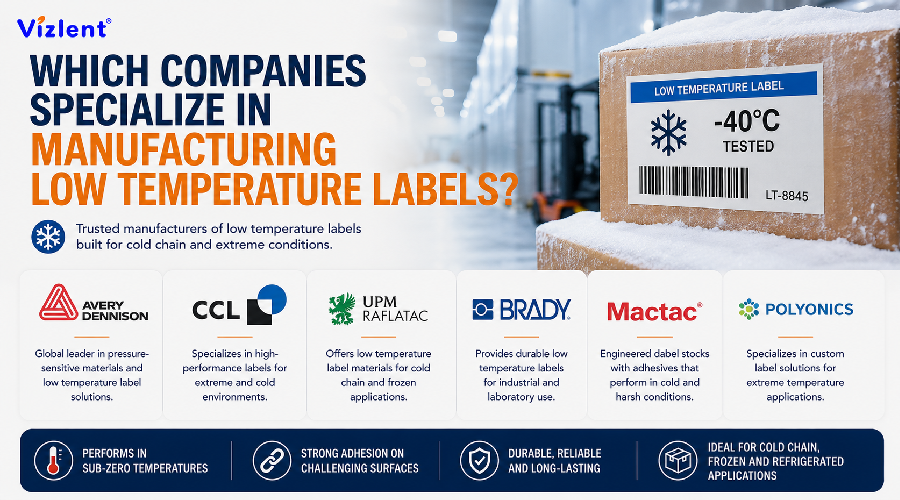
There are only a small group of companies that specialize in manufacturing low temperature labels and Vizlent Label is among them. We specialize in producing low temperature labels engineered for freezer and cryogenic environments down to -196°C, running dedicated cold-chain adhesive research and freeze-thaw testing that a general label supplier typically does not carry out.
Searches for this topic usually split into a few related questions: which companies specialize in manufacturing low temperature labels for food, how that same specialization extends into industrial and laboratory products, and which companies specialize in manufacturing low temperature labels and packaging more broadly across cold chain logistics. This guide answers all three directly, then walks through what actually separates a specialist manufacturer from a generic label supplier before you place an order, since the reasons go well beyond marketing language.
Companies Specialize in Manufacturing Low Temperature Labels for Food
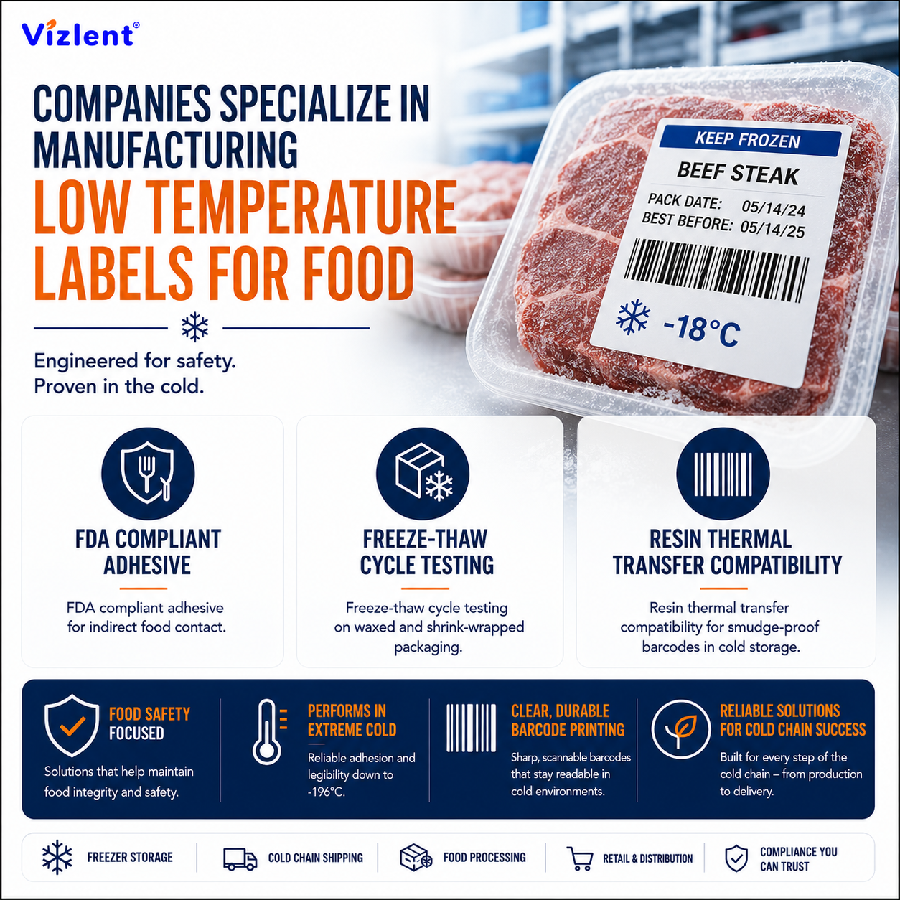
Companies specialize in manufacturing low temperature labels for food when their adhesive formulations are tested for indirect food contact and their substrates hold up against waxed cartons, shrink wrap, and damp packaging common in cold storage. Food and beverage processors need labels that survive blast freezers, refrigerated trucks, and repeated freeze-thaw cycles without losing barcode legibility. This is a narrower requirement than general industrial labeling, since food-grade compliance and cold adhesion both have to hold at the same time.
FDA compliant adhesive systems matter here because a label touching food packaging cannot introduce restricted substances into the supply chain, even indirectly. Vizlent Label’s Low Temperature Labels line is manufactured with substrates that are FDA compliant for indirect food contact, alongside RoHS and REACH compliance for broader regulatory coverage. Food processors sourcing at scale should confirm this compliance documentation before committing to a bulk order, since it is one of the first things an auditor checks.
- FDA compliant adhesive for indirect food contact.
- Freeze-thaw cycle testing on waxed and shrink-wrapped packaging.
- Resin thermal transfer compatibility for smudge-proof barcodes in cold storage.
Retailers and co-packers often ask this question when they are switching suppliers after a labeling failure in a blast freezer, since a label that lifts off mid-shipment creates real inventory and compliance problems. Companies specialize in manufacturing low temperature labels for food precisely because generic label stock is not engineered for that combination of moisture, cold, and mechanical handling. Working directly with a manufacturer rather than a reseller gives more visibility into the actual substrate and adhesive formulation behind the specification sheet.
Companies Specialize in Manufacturing Low Temperature Labels for Products and Packaging
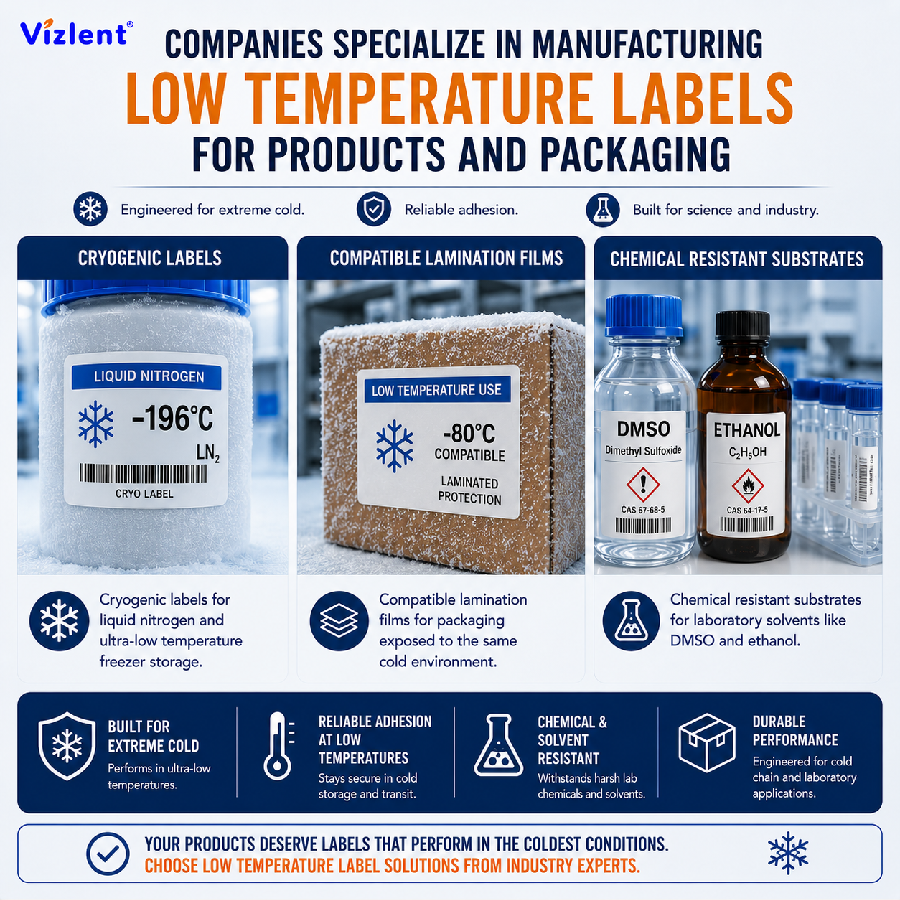
Companies specialize in manufacturing low temperature labels for products when the labeling need extends beyond food into laboratory samples, medical devices, chemical containers, and industrial equipment stored or shipped in cold environments. Biobanks, clinical laboratories, and pharmaceutical distributors all rely on labels that survive liquid nitrogen storage, ultra-low temperature freezers, and repeated handling without losing legibility. This is a different specialization from food-grade cold labels, since cryogenic tolerance and chemical resistance to lab solvents both come into play.
Companies specialize in manufacturing low temperature labels and packaging together when they also supply compatible lamination films, liners, and adhesive systems that hold up in the same cold environments as the labels themselves. Vizlent’s Ultra Low Temperature Resistant Cryogenic Labels are rated to -196°C for biobank and laboratory sample tracking, while the Cold Lamination Films range covers protective overlaminates for packaging exposed to the same conditions. Matching the label, liner, and lamination system to one environmental spec sheet avoids the mismatched performance that happens when each component is sourced from a different supplier.
- Cryogenic labels for liquid nitrogen and ultra-low temperature freezer storage.
- Compatible lamination films for packaging exposed to the same cold environment.
- Chemical resistant substrates for laboratory solvents like DMSO and ethanol.
Industrial buyers evaluating this category should request a single technical data sheet covering the label, adhesive, and any laminate together, rather than piecing together compatibility claims from separate product pages. Companies specialize in manufacturing low temperature labels for products across such a wide range of use cases that a general purpose adhesive line rarely meets every requirement at once. A manufacturer that tests its own laminating film and label stock together, rather than sourcing both from unrelated vendors, is generally a safer long term partner for regulated industries.
What Separates Cold Temperature Labels From Standard Labels
Cold temperature labels differ from standard labels primarily in adhesive chemistry, since a normal acrylic adhesive loses tack and becomes brittle well before it reaches freezer or cryogenic temperatures. Calling the category low temperature labels or low temperature stickers depends mostly on regional habit rather than any functional difference between the two terms. Manufacturers formulate freezer-grade and cryogenic-grade adhesives specifically to stay flexible and maintain bond strength at these extremes, often using rubber-based or specialty acrylic chemistries.
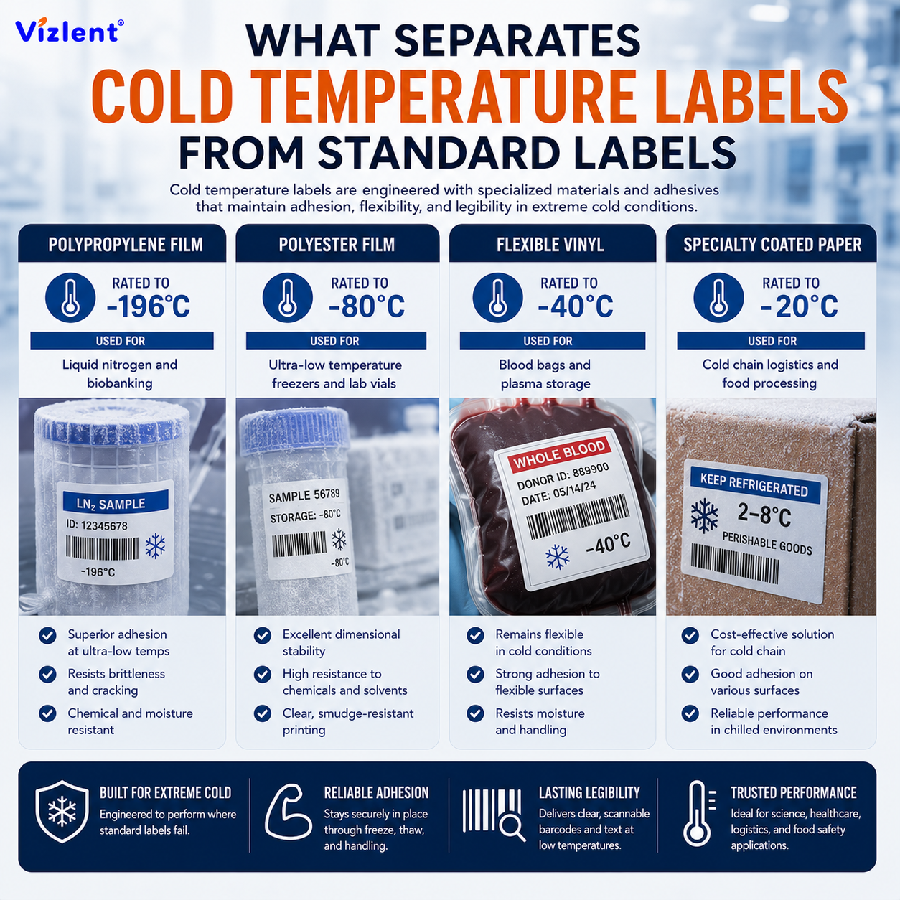
Substrate choice matters just as much as the adhesive itself, since a facestock that becomes brittle in the cold can crack or delaminate even if the glue underneath is holding. Vizlent’s technical documentation on its durable Labels range shows polypropylene film rated to -196°C, polyester film rated to -80°C, flexible vinyl rated to -40°C, and specialty coated paper rated to -20°C, each suited to a different point on the cold spectrum. Matching the right substrate to the actual lowest temperature a label will face prevents both wasted cost on over-specified material and failures from under-specified material.
- Polypropylene film: Rated to -196°C, used for liquid nitrogen and biobanking.
- Polyester film: Rated to -80°C, used for ultra-low temperature freezers and lab vials.
- Flexible vinyl: Rated to -40°C, used for blood bags and plasma storage.
- Specialty coated paper: Rated to -20°C, used for cold chain logistics and food processing.
Choosing between these options depends entirely on the coldest temperature the label will actually encounter and the surface it needs to bond to, not on price alone. A label rated for a home freezer at -20°C will fail quickly in a -80°C ultra-low temperature unit, and a cryogenic label rated for -196°C is unnecessary overkill for a standard cold chain shipment. Reviewing the manufacturer’s published temperature and substrate table before ordering prevents both of these common mismatches.
Low Temp Labels vs Low Temp Sticker Formats: Rolls, Sheets, and Custom Options
Low temp labels and a low temp sticker are generally the same underlying product described with different terminology, and the real decision point is format rather than naming. Buyers can typically choose low temperature label roll formats for automated dispensing on high-speed production lines, or low temperature labels by the sheet for smaller batch labeling done by hand in a lab or warehouse. Print method compatibility, size, and die-cut shape all need to be confirmed for either format before a bulk order goes out.
A low temperature sticker meant for microcentrifuge tubes or small vials often needs custom die-cut shapes as small as 0.5 inch by 0.5 inch to avoid flagging or peeling at tight curves, while low temperature labels custom sized for pallet or drum identification can run considerably larger. Low temp sticker orders for laboratories frequently specify resin thermal transfer compatibility, since wax and wax-resin ribbons smudge or dissolve under cold, damp, or solvent exposure. Confirming printer and ribbon compatibility alongside the label format itself avoids a costly mismatch after the order has already shipped.
- Low temperature labels roll: Best for automated, high-speed application lines.
- Low temperature labels by the sheet: Best for manual labeling in small labs or warehouses.
- Low temperature labels custom: Sized and shaped for the exact container or surface in use.
Businesses comparing low temperature labels online often default to whichever option loads first in a search result, without checking that the listed adhesive and substrate actually match their coldest storage point. Requesting a physical sample of the low temperature sticker or roll format before committing to volume remains the most reliable way to confirm real world performance. A manufacturer’s engineering team can usually recommend the correct format once the surface, temperature, and print method have been confirmed.
Low Temperature Labels for Freezer, Shipping, and Cold Chain Logistics
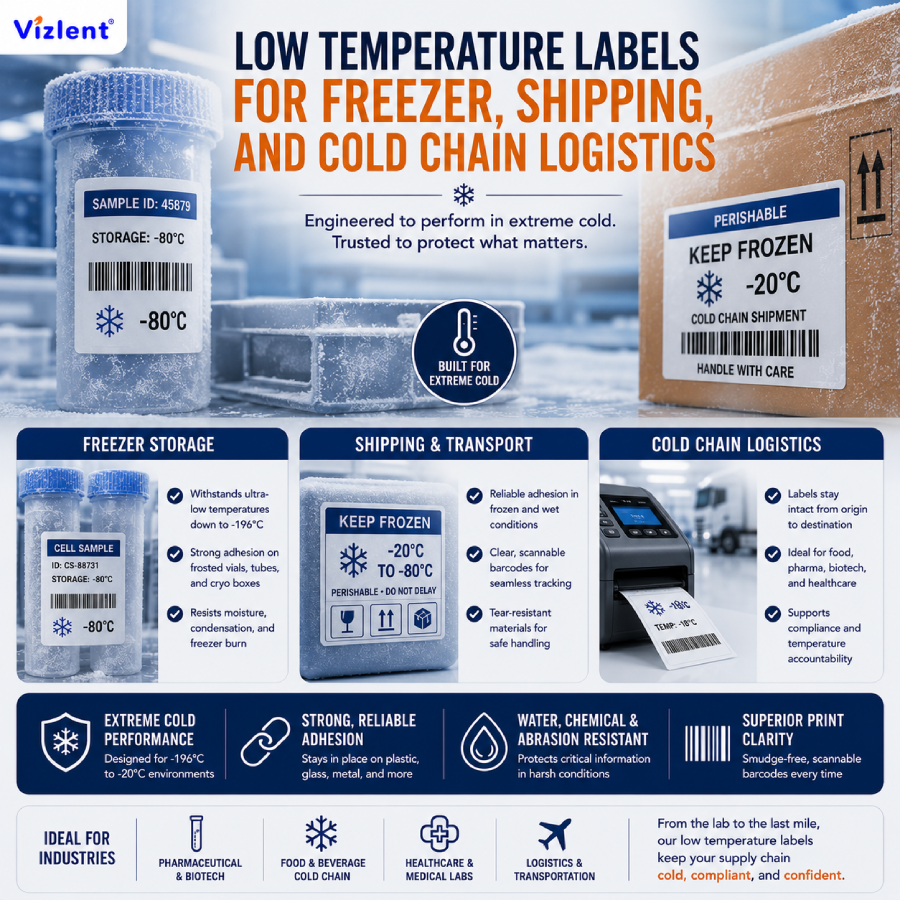
Low temperature labels freezer applications and low temperature labels for shipping share a common requirement: the label has to survive repeated temperature swings as goods move between frozen storage, refrigerated transport, and ambient handling. A label that only performs in a stable deep freeze setting can still fail during the brief but repeated temperature spikes that happen at loading docks and delivery stops. This is why freeze-thaw cycle testing, not just a single cold temperature rating, is the more meaningful performance indicator for logistics use.
Low temperature labels for packaging in a cold chain logistics context also need to hold up against condensation and surface moisture, since frost forms and melts repeatedly as pallets move in and out of climate-controlled zones. Vizlent tests its cold-rated materials through simulated freeze-thaw cycling in addition to standard peel strength and tensile strength testing, aligned with recognized methods like ASTM D3330 for peel adhesion. Warehouse and logistics teams sourcing labels for this environment should ask a low temperature labels manufacturer directly for freeze-thaw testing data covering the exact low temperature labels temperature range in question, rather than relying on a single static spec.
- Repeated freeze-thaw cycle testing, not just a single cold temperature rating.
- Condensation and moisture resistance for pallets moving between climate zones.
- Peel and tensile strength testing aligned with recognized ASTM methods.
Cold chain logistics providers managing large distribution networks often standardize on one label format across every facility to simplify inventory and reduce the risk of the wrong label reaching the wrong dock. Working with a single manufacturer for both freezer-rated and standard warehouse labels can simplify this standardization considerably. Vizlent’s contact page is a reasonable place to start that conversation once a facility’s temperature range and volume are mapped out.
Cost, Bulk Ordering, and Custom Options for Low Temperature Labels
Low temperature labels cost more per unit than standard label stock in most cases, since the specialty adhesive and substrate formulations require additional testing and material investment compared to general purpose facestocks. Buyers evaluating low temperature labels bulk orders should expect pricing to scale favorably at higher volumes, similar to standard label stock, but the baseline per unit cost will still sit above a room temperature equivalent. Getting a clear quote based on actual volume, rather than a generic price list, is the most reliable way to compare suppliers fairly.
Low temperature labels business buyers ordering at scale should also factor in lead time, since custom die-cut shapes, specific adhesive formulations, and particular liner combinations all add production steps compared to an off the shelf option. Vizlent typically quotes a seven to fifteen business day lead time on custom OEM and ODM low temperature label orders once samples are approved, which is worth confirming against your own production schedule. Requesting free samples before a bulk commitment remains standard practice across the industry and helps confirm performance before a full production run ships.
- Expect a higher per unit cost than standard labels due to specialty adhesive formulation.
- Bulk pricing typically improves at higher volumes, similar to standard label stock.
- Confirm lead time on custom shapes, adhesives, or liners before committing to a ship date.
Businesses that only compare sticker price per thousand without checking substrate and adhesive specifications often end up paying twice, once for the cheap label and again for the replacement order after a failure in the field. A slightly higher upfront cost for a properly rated, tested label is usually far less expensive than a recall, relabeling project, or lost inventory tracking data. Requesting a sample kit that covers the exact temperature range and surface in question is the simplest way to validate this trade-off before a large order goes out.
FDA Compliance and Other Standards for Low Temperature Labels on Food
Low temperature labels fda compliance requirements focus mainly on the adhesive and facestock materials that come into indirect contact with food packaging, rather than the printed graphic itself. A compliant label formulation avoids restricted substances that could migrate into food through packaging contact, which matters for any label placed directly on cartons, wraps, or containers in a blast freezer or cold storage facility. Reviewing a supplier’s compliance documentation before an order ships protects both the buyer and their downstream customers.
Low temperature labels on food packaging often need to satisfy several standards at once, including FDA indirect food contact compliance, RoHS restricted substance limits, and REACH chemical safety requirements for materials sold into regulated markets. Vizlent’s cold storage substrates are manufactured to meet these overlapping requirements alongside ISO 9001 quality management certification, giving food processors a single compliance package rather than a patchwork of certificates from different vendors. Confirming which specific certifications apply to a given substrate, rather than assuming blanket compliance across an entire product line, avoids surprises during a customer audit.
- FDA compliance for indirect food contact on packaging materials.
- RoHS and REACH compliance for restricted substances and chemical safety.
- ISO 9001 quality management certification across the manufacturing process.
Compliance documentation should always be requested in writing and matched to the exact substrate and adhesive combination being ordered, since certifications can vary between different product lines from the same manufacturer. A supplier that provides this documentation readily and explains what each certification actually covers is generally easier to work with during a regulatory audit. This is one of the clearest signals that a manufacturer takes food safety compliance seriously rather than treating it as a marketing checkbox.
Ready to Source Low Temperature Labels From a Direct Manufacturer
Understanding which companies specialize in manufacturing low temperature labels matters most once you are ready to match a specific substrate, adhesive, and format to your actual storage or shipping conditions. Vizlent has manufactured self adhesive label stock since 2011, supplying converters, distributors, and brand owners across more than fifty countries with freezer-grade and cryogenic-grade materials tested to ISO 9001 standards. Send an inquiry through Vizlent’s contact page to request samples and a quote suited to your exact temperature range, or explore the full Low Temperature Labels product range to compare substrates side by side.
A short sample and compatibility test remains the fastest way to confirm real world performance before committing to a full production run, regardless of how detailed a specification sheet looks on paper. Vizlent’s knowledge base and blog cover additional material comparisons for teams evaluating cold chain labeling options against other durable label categories. Companies specialize in manufacturing low temperature labels for a reason, and choosing one that tests its own materials under real freeze-thaw conditions is the clearest way to avoid a costly failure in the field.
Frequently Asked Questions
Which companies specialize in manufacturing low temperature labels?
Companies specialize in manufacturing low temperature labels when they run dedicated adhesive research, cold chain testing, and substrate engineering programs built specifically for sub-zero and cryogenic environments. Vizlent is one such direct factory manufacturer, producing freezer-grade and cryogenic-grade label materials rated from -20°C up to -196°C. Working with a manufacturer rather than a reseller generally gives more visibility into the actual adhesive formulation and substrate behind the specification sheet.
What is the difference between cold temperature labels and freezer labels?
Cold temperature labels is a broad term covering any label formulated to perform below room temperature, while freezer labels usually refer more specifically to labels rated for standard freezer conditions around -20°C. Cryogenic labels sit at the extreme end of this category, rated down to -196°C for liquid nitrogen storage. The right choice depends entirely on the coldest temperature the label will actually face in service.
Are low temperature labels and low temperature stickers the same thing?
Yes, low temperature labels and low temperature stickers describe the same underlying product, and the terminology difference usually comes down to regional or industry preference rather than a functional distinction. Both terms refer to labels formulated with cold-resistant adhesives and substrates. The more important distinction is format, such as roll versus sheet, and the specific temperature rating required.
Is 96.1 too low of a temperature?
This question usually comes up in a medical context about human body temperature rather than an industrial labeling one, since typical body temperature readings average close to 98.6°F but vary by individual, time of day, and measurement method. A reading of 96.1°F is only slightly below that average and is not automatically a cause for concern on its own, though anyone with ongoing symptoms or a persistently low reading should check with a healthcare provider. In label manufacturing, low temperature instead refers to industrial specifications like freezer-grade adhesives rated for sub-zero storage, which is a separate topic entirely.
Can low temperature labels be ordered custom cut for small containers?
Yes, low temperature labels custom cut for small containers like microcentrifuge tubes or cryovials are common, with die-cut sizes as small as 0.5 inch by 0.5 inch available from most specialist manufacturers. Custom shapes help prevent flagging or peeling on tightly curved surfaces where a standard rectangular label would lift at the edges. Buyers should confirm minimum order quantities for custom die-cut shapes before finalizing a specification.
Do low temperature labels work for shipping and cold chain logistics, not just storage?
Yes, low temperature labels for shipping and cold chain logistics need to survive repeated freeze-thaw cycling as goods move between frozen storage, refrigerated transport, and ambient handling at loading docks. This is a different test than a single static cold temperature rating, since the label has to tolerate repeated temperature swings rather than one constant condition. Reviewing a supplier’s freeze-thaw testing data is more informative than a temperature spec sheet alone for this use case.
How much more do low temperature labels cost compared to standard labels?
Low temperature labels cost more per unit than standard labels in most cases, generally due to the specialty adhesive formulation and additional testing required to validate cold performance. Bulk ordering typically brings the per unit price down, similar to standard label stock, though the baseline will still sit above a room temperature equivalent. Requesting a volume-based quote directly from a manufacturer is more accurate than comparing list prices alone.






