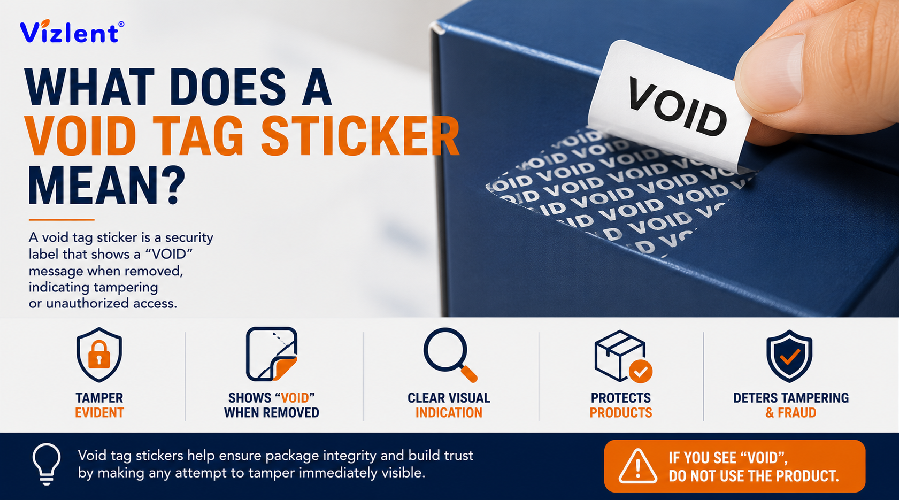
A void tag sticker means a tamper evident label that leaves behind a permanent “VOID” pattern, message, or residue the moment someone tries to peel, lift, or swap it, and this single feature is what makes it useful for everything from vehicle registration tags to electronics warranty seals. People search for what does a void tag sticker mean for two very different reasons: some are staring at a sticker on their license plate or vehicle registration renewal tag, and others are asking about the security labels used on shipped goods, warranty seals, or asset tags. This guide answers both, in plain language, so you know exactly what you are looking at and why it matters.
What Does a Void Tag Sticker Mean in Everyday Use
In the simplest terms, what does a void tag sticker mean comes down to one function: proof. The sticker is engineered so that any attempt to remove it triggers a visible change, either through a hidden “VOID” imprint left on the surface, a pattern left on the sticker itself, or both. This proof of tampering is the entire reason these labels exist, and it applies to a government issued tag as much as it does to a manufacturer applied seal.
- A void tag sticker confirms a seal has not been broken since it was applied.
- It gives inspectors, buyers, or agencies a fast visual check without needing extra tools.
- It replaces older methods like wax seals or wire ties that were easier to fake.
Most people only encounter the term when something looks unusual, such as a sticker on a car window or a shipped package that shows a faint “VOID” text they did not expect. Understanding the answer to what does a void tag sticker mean at that point can prevent unnecessary panic, since in most cases it simply confirms the item has not been opened or altered. The same logic applies across government tags, retail packaging, and industrial equipment. For product packaging specifically, Vizlent Label’s VOID Sticker line documents how these constructions are engineered for consistent tamper evidence across surfaces.
What Does a Void Tag Sticker Mean for Vehicle Registration
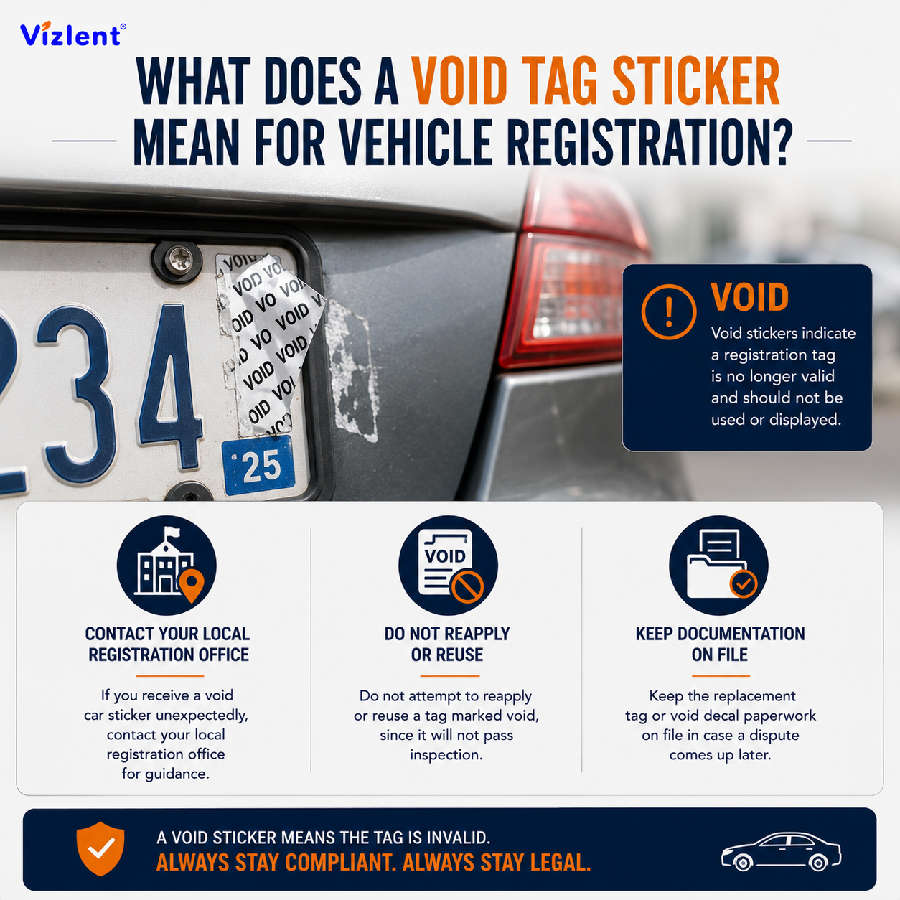
For drivers, a void registration sticker usually appears on a license plate tab, a windshield decal, or a renewal sticker issued by a transportation authority. If a tag has already been marked void, it typically means the registration was cancelled, reissued, or replaced before the original expiration date, and the vehicle should not be driven on that tag. This is different from a security label failing, since a void plate sticker is intentionally marked that way by the issuing office rather than through tampering.
A common follow up question is what is the void plate sticker for, and the short answer is fraud prevention and record accuracy. Agencies use this marking to stop an old or duplicate tag from being reused on the road, and it keeps vehicle records aligned with the correct sticker in circulation. A void car sticker on a windshield or plate means that specific decal is no longer valid, even if the vehicle itself remains properly registered under a newer tag.
- Contact your local registration office if you receive a void car sticker unexpectedly.
- Do not attempt to reapply or reuse a tag marked void, since it will not pass inspection.
- Keep the replacement tag or void decal paperwork on file in case a dispute comes up later.
Vehicle manufacturers and fleet operators also rely on tamper evident constructions for VIN plates, under hood labels, and asset tags, which is a related but distinct use case from registration tags. Vizlent Label’s automotive label solutions are built to survive engine bay heat, road salt, and years of outdoor exposure while keeping identification data legible. A government tag and a manufacturer applied label are answering the same underlying question of what does a void tag sticker mean, and in both cases it signals that a specific tag or seal is no longer the valid, original one.
Fleet managers who oversee dozens or hundreds of vehicles often deal with void tags more frequently than an individual driver, since renewal cycles, transfers, and lease returns generate a steady stream of cancelled decals. Keeping a simple log of which tags were voided and when helps avoid confusion during roadside checks or audits. A driver who knows the answer ahead of time can avoid an awkward conversation with an officer or a rental return desk.
What Does a Void Tag Sticker Mean for Product Security
Away from vehicles, a void tag sticker business context usually involves manufacturers, distributors, or logistics providers protecting a product, shipment, or warranty from unauthorized access. These labels are placed over seams, screws, access panels, or box flaps so that opening the item without permission leaves unmistakable evidence. This use case is where most of the demand for custom sizes, colors, and printed data comes from.
Retailers and electronics brands frequently ask what does a void tag sticker mean when they see one on a returned product, since the answer directly decides if a warranty claim is honored. If the seal shows a “VOID” pattern, staff can quickly tell the unit was opened outside of an authorized service center. This single detail can save a company significant returns fraud exposure, which is why Vizlent Label’s security label range is built around visible, hard to fake tamper indicators.
- Warranty enforcement on electronics and appliances.
- Asset protection on IT hardware, meters, and equipment enclosures.
- Chain of custody documentation on regulated or high value shipments.
Retail loss prevention teams also train staff to recognize what a broken void seal looks like versus a factory applied one, since the two can appear similar at a quick glance. This matters just as much for anti tamper labels for jars on food and cosmetic packaging as it does for electronics, since a slightly lifted corner, a faint outline of a “VOID” pattern, or a mismatched adhesive sheen are all signs worth a closer look before approving a return or warranty claim. Building this check into a standard operating procedure reduces disputes and gives staff a consistent, defensible reason for approving or denying a claim.
Types and Finishes of Void Tag Stickers
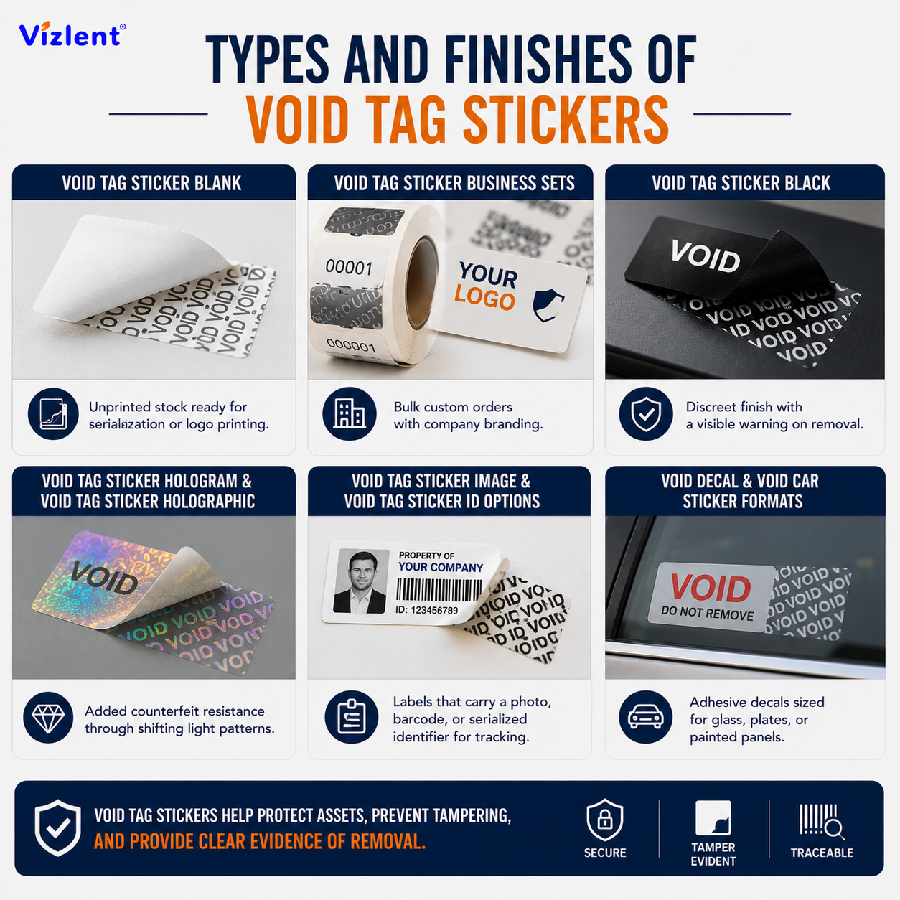
Businesses rarely need just one version of a void tag sticker, since different products, budgets, and branding needs call for different finishes. A void tag sticker blank option, with no printed graphics, suits companies that plan to add serial numbers or logos later using their own printer. A void sticker custom order, by comparison, includes a company name, logo, or specific wording baked into the label before it ships.
Color and visual style also matter for both branding and function. A void tag sticker black finish is popular for a stealth appearance that still reveals a bright warning message on removal, while a void tag sticker hologram or void tag sticker holographic option adds a shifting rainbow effect that is difficult to replicate with basic printing equipment.
- Void tag sticker blank: Unprinted stock ready for serialization or logo printing.
- Void tag sticker business sets: Bulk custom orders with company branding.
- Void tag sticker black: Discreet finish with a visible warning on removal.
- Void tag sticker hologram and void tag sticker holographic: Added counterfeit resistance through shifting light patterns.
- Void tag sticker image and void tag sticker id options: Labels that carry a photo, barcode, or serialized identifier for tracking.
- Void decal and void car sticker formats: Adhesive decals sized for glass, plates, or painted panels.
Choosing between these options usually comes down to how much counterfeit resistance a business needs versus how much it wants to spend per unit. A retailer protecting low cost accessories may only need a void tag sticker blank or basic custom print, while a pharmaceutical or luxury goods brand often justifies the added cost of a hologram or holographic layer. Vizlent Label’s eggshell paper line offers a lower cost alternative for businesses that want visible tamper evidence without the holographic upgrade.
Print method is another factor worth planning for early, since a void tag sticker image or void tag sticker id often needs to hold up against scanning equipment and years of handling. Printable anti tamper stock is built with topcoats tuned for thermal transfer, digital, and screen printing, and choosing the wrong combination can lead to smudged barcodes or faded serial numbers within months. Businesses printing their own serialized data in house should request compatibility guidance before locking in a facestock, since revisiting what does a void tag sticker mean in terms of print durability after a bulk order has already shipped is a costly mistake to correct.
How a Void Tag Sticker Works
The mechanism behind what does a void tag sticker mean is mostly about adhesive engineering rather than the printed graphic itself. A specialized adhesive layer is designed to bond more strongly to the surface than to the label’s own polyester face stock, so when someone tries to peel the sticker off, the top layer separates and reveals a hidden pattern underneath. Depending on the construction, this pattern can transfer fully onto the surface, partially onto both surfaces, or stay entirely within the label material.
This is why a genuine void tag sticker cannot simply be reapplied or hidden after removal, unlike a printed sticker with ordinary adhesive. The chemistry is tuned so that any lifting attempt, even a slow and careful one, breaks the bond in a visible way. Manufacturers test this repeatedly across temperature ranges and surface types before a batch ships, since a label that fails in cold storage or high heat defeats the entire purpose.
- Total transfer: the full VOID pattern moves onto the surface, leaving a clear film behind.
- Partial transfer: both the surface and the peeled label show part of the VOID message.
- Non transfer: the message stays on the label itself, leaving the surface clean.
Will a Void Tag Sticker Work on Every Surface
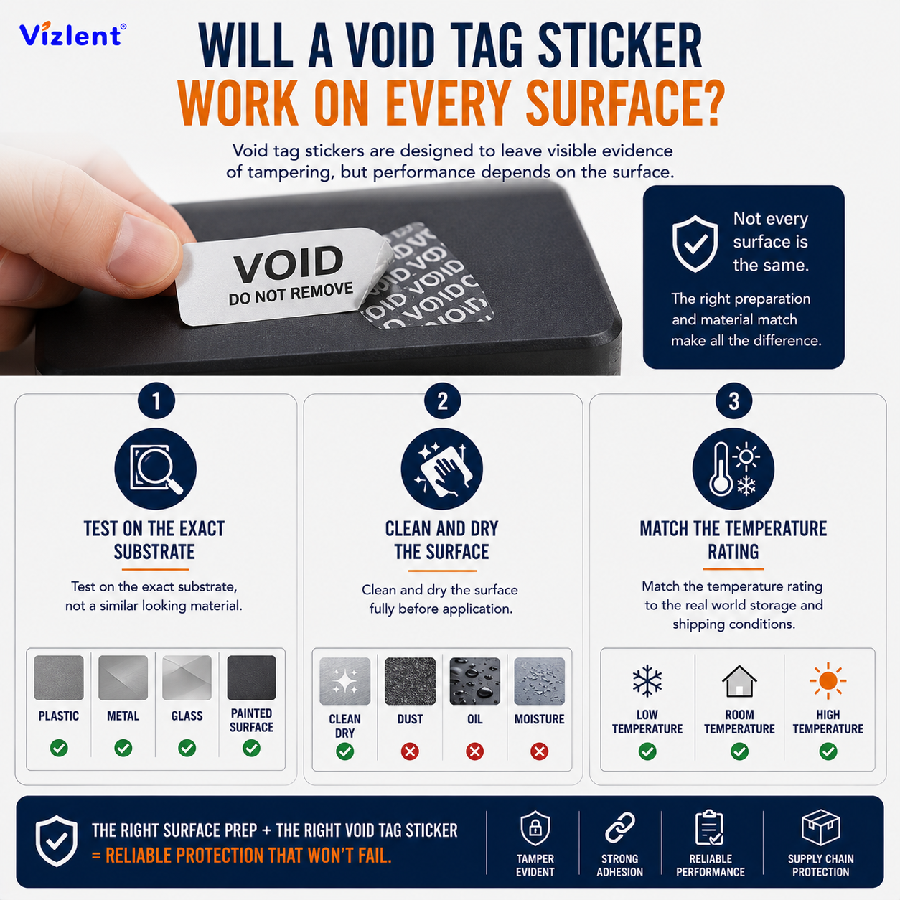
A frequent and fair question is will void tag sticker work on a specific surface, and the honest answer is that it depends on surface energy, texture, and cleanliness. Smooth, high energy surfaces like glass, painted metal, and coated plastics generally give the most reliable tamper reaction, since the adhesive bonds evenly across the full contact area. Rough, porous, or heavily textured surfaces such as raw cardboard can sometimes need a different adhesive formulation to get the same result.
Before ordering in bulk, most experienced buyers request samples and run their own peel tests on the actual product surface rather than trusting a general specification sheet alone. Dust, oil residue, or moisture on the application surface can also interfere with adhesion, so proper surface preparation matters as much as the label itself. Outdoor applications add another variable, since UV exposure and temperature swings can affect long term performance if the wrong formulation is chosen.
- Test on the exact substrate, not a similar looking material.
- Clean and dry the surface fully before application.
- Match the temperature rating to the real world storage and shipping conditions.
For labels headed outdoors or into harsh environments, Vizlent Label’s outdoor weather resistant range is built specifically to hold its tamper performance through UV exposure, rain, and temperature swings.
Buyers asking will void tag sticker work in cold storage, humid warehouses, or direct sun exposure should treat each environment as a separate test case rather than assuming one formulation covers all three. A label rated for freezer conditions may not hold the same tamper reaction on a sun baked loading dock, and the reverse is also true. Getting a clear answer to will void tag sticker work in your specific setting before committing to volume is the fastest way to avoid a costly reorder later.
Choosing the Right Void Tag Sticker for Your Business
Selecting the correct void tag sticker starts with identifying what you are actually protecting and how much residue or damage is acceptable afterward. A reusable asset like a server rack or rental equipment usually calls for a non transfer option, while disposable packaging can use a total transfer label for maximum visible deterrence. Budget also plays a role, since blank stock costs less than a fully custom, serialized, or holographic version.
Working with a manufacturer rather than a reseller often gives more control over adhesive formulation, size, and print method, especially for businesses ordering at scale. A good supplier will walk through substrate testing, environmental requirements, and print compatibility before recommending a specific construction. This upfront process is what separates a label that performs from one that fails during an actual tampering attempt.
New buyers sourcing this category for the first time often revisit what does a void tag sticker mean several times during the process, since the answer shifts slightly depending on substrate, climate, and internal policy on residue. That is a normal part of specifying a security label correctly rather than a sign the product itself is complicated. A short call with a technical contact at the manufacturer usually resolves any remaining questions faster than testing several options independently.
- Define the substrate and environment first.
- Decide on residue tolerance before comparing pricing.
- Request samples and test before committing to a bulk order.
Vizlent’s durable label range and knowledge base cover additional material options for teams comparing tamper evident constructions against standard security labels. Reach out through Vizlent’s contact page to get a quote based on your exact surface, quantity, and environmental requirements.
Ready to Source Void Tag Stickers That Actually Perform
Understanding what does a void tag sticker mean is only the first step, since choosing the right adhesive, finish, and size decides if the label performs when it matters. Vizlent has manufactured tamper evident label materials since 2011, supplying converters, distributors, and brand owners across more than fifty countries. Send an inquiry through Vizlent’s contact page to request samples and a quote suited to your exact surface and environment, or browse the full VOID Sticker product range to compare finishes side by side.
Once you have matched a construction to your surface and environment, the last question to settle is production scale and lead time. A small trial run helps confirm real world performance before committing to a full production order, and most experienced buyers request this step regardless of how confident they are in the specification sheet. Getting this answer right for your specific product or fleet is worth the extra week of testing, since a failed seal is far more costly than a delayed launch.
Frequently Asked Questions
What does a void tag sticker mean?
A void tag sticker means a label engineered to leave permanent proof if it is removed, either through a transferred pattern, a hidden message, or visible damage to the label itself. It is used on vehicle registration tags, product packaging, warranty seals, and asset labels. The core purpose is always the same: to make any tampering or unauthorized access immediately visible.
What is the void plate sticker for?
A void plate sticker marks a license plate tab or registration decal that has been cancelled, replaced, or superseded by a newer tag. It exists to prevent an old or duplicate sticker from being reused on a vehicle. Seeing one on your plate typically means a replacement tag has already been issued.
Is a void registration sticker the same as a security label?
A void registration sticker and a tamper evident security label share the same basic idea, but they serve different purposes. The registration version is intentionally marked void by an issuing authority, while a security label activates automatically when someone tries to remove it. Both rely on a clear “VOID” indicator to communicate status at a glance.
Will a void tag sticker work on plastic and glass?
Yes, a properly formulated void tag sticker will work reliably on clean, smooth plastic and glass surfaces, since these materials offer strong, even adhesive contact. Performance can vary on rough, oily, or heavily textured surfaces, so a peel test on the actual substrate is recommended. Matching the adhesive formulation to the surface type is the most reliable way to confirm performance ahead of a bulk order.
Can a void tag sticker be reapplied after removal?
No, a genuine void tag sticker cannot be reapplied cleanly, since the adhesive is designed to break or transfer its pattern the moment it is lifted. This is what separates it from an ordinary printed label with standard adhesive. Any attempt to press it back down will still show visible evidence of the original removal.
What is the difference between a void tag sticker blank and a custom version?
A void tag sticker blank ships without printed graphics, giving a business room to add serial numbers, logos, or barcodes later using their own printing equipment. A custom version arrives with company branding, wording, or serialized data already printed before shipment. Businesses ordering at scale often choose custom printing to save time on a separate printing step.
Why do some void tag stickers use a hologram or holographic finish?
A void tag sticker hologram or holographic finish adds a shifting light pattern that is difficult to reproduce with standard printing equipment, making counterfeit labels easier to spot. This finish is popular in pharmaceutical, electronics, and luxury goods packaging where counterfeit risk is higher. The holographic layer works alongside the standard tamper adhesive rather than replacing it.
How do I know if a void tag sticker is right for my product or vehicle documentation?
The right void tag sticker depends on the surface material, environmental exposure, and how much adhesive residue is acceptable after removal. Reviewing sample labels against your actual product surface is the most reliable way to confirm fit before a bulk order. A manufacturer can recommend total transfer, partial transfer, or non residue construction based on those same factors.