
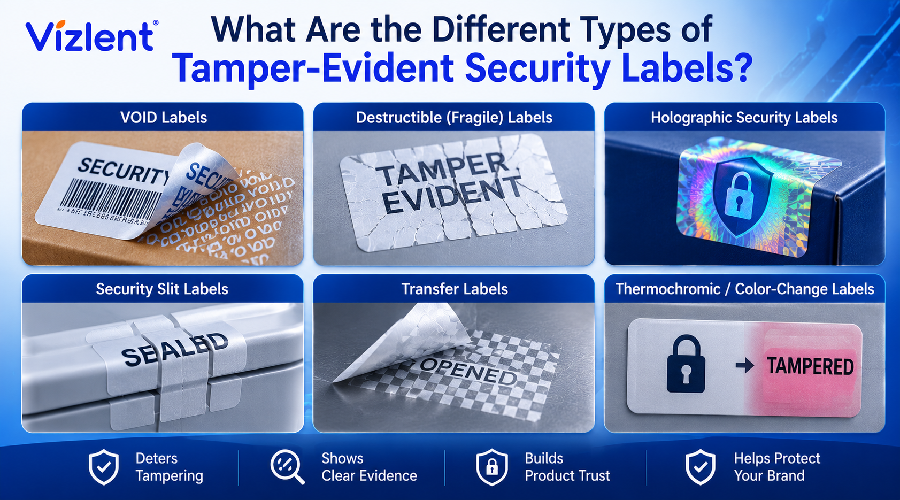
The different types of tamper-evident security labels fall into five main categories: void polyester labels, destructible vinyl labels, holographic OVD labels, non-residue void labels, and pharmaceutical tamper seals, each engineered for a specific substrate and threat level. Vizlent manufactures all five of these constructions directly, alongside the covert and serialized features that get layered on top of them for higher-risk applications. This guide walks through how each type works, where it gets used, and how to choose between tamper evident, tamper proof, and tamper resistant terminology before placing an order.
Different Types of Tamper-Evident Security Labels for Product Security
The different types of tamper-evident security labels used across consumer products start with void polyester, which uses a modified acrylic adhesive on 50-micron PET film to reveal a hidden VOID pattern the moment someone attempts removal. Destructible vinyl takes a different approach, using a brittle 60-micron PVC facestock that fractures into small fragments rather than transferring a printed message, which prevents any attempt at reapplication. Holographic OVD labels add a metallized PET layer with diffractive optical elements on top of a tamper-release adhesive, making them difficult to photocopy or replicate even when the underlying void mechanism is understood.
Non-residue void labels and pharmaceutical tamper seals round out the core five, each solving a narrower problem than the general-purpose types above. Vizlent Label’s Security Labels range documents non-residue void constructions using a transfer-release acrylic that leaves no adhesive residue on removal, useful for medical devices and premium electronics where clean removal after authorized service matters. Pharmaceutical tamper seals use a medical-grade acrylic rated for 21 CFR 211.132 compliance, specifically built for first-opening indication on bottles, cartons, and blister packs.
- Void polyester: Modified acrylic adhesive on PET film, reveals a VOID pattern on removal.
- Destructible vinyl: Brittle PVC facestock that fractures rather than transfers.
- Holographic OVD: Metallized PET with diffractive elements, difficult to replicate.
- Non-residue void: Transfer-release acrylic for clean removal after authorized service.
- Pharmaceutical tamper seal: Medical-grade acrylic for FDA-compliant first-opening indication.
Choosing between these different types of tamper-evident security labels depends on the substrate, the expected attack vector, and the acceptability of adhesive residue after removal. A manufacturer’s technical data sheet should specify substrate compatibility, temperature range, and compliance certification for each type rather than listing generic claims across an entire product line. Requesting a sample of each relevant type before committing to volume remains the most reliable way to confirm which construction actually fits your application.
Tamper Evident vs Tamper Proof vs Tamper Resistant: What’s the Difference
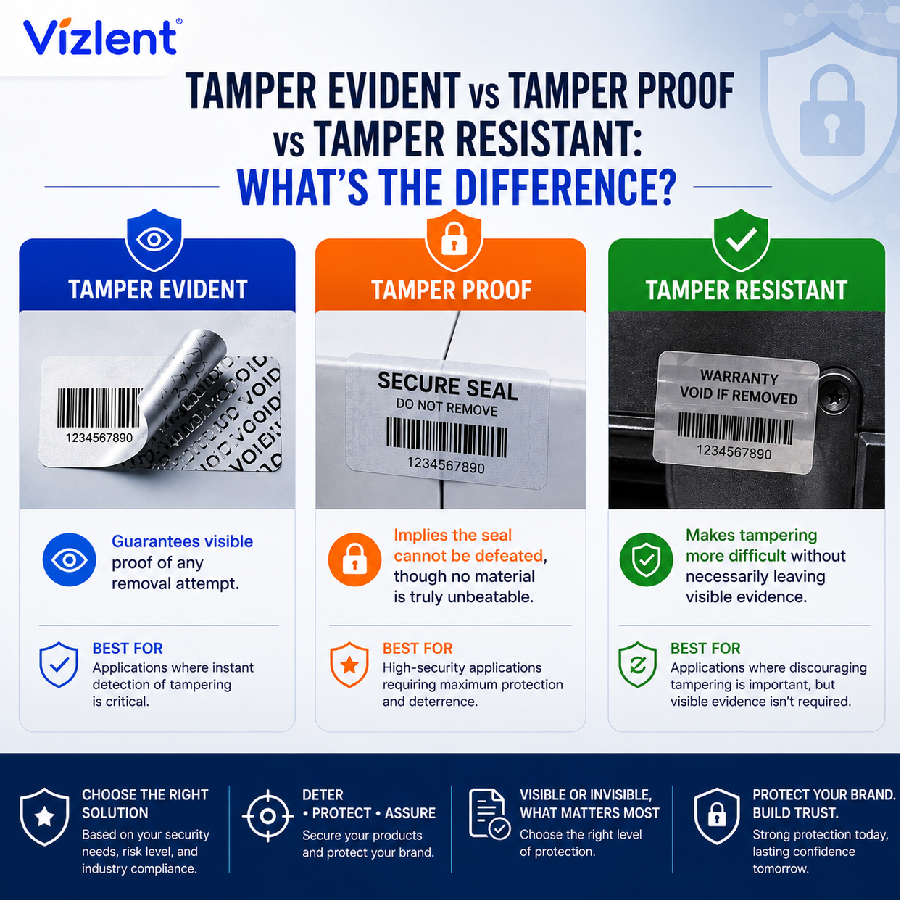
Tamper evident security labels and tamper proof security labels get used interchangeably in casual conversation, but the terms describe different levels of protection in a technical specification. Sorting out the different types of tamper-evident security labels from tamper proof and tamper resistant claims starts with understanding what each term actually promises. A tamper evident security label does not prevent tampering outright, it only guarantees that any tampering attempt leaves visible, irreversible proof, such as a VOID pattern or a fractured facestock. Tamper proof security tags imply a stronger claim, suggesting the seal cannot be defeated at all, though in practice no adhesive label is truly immune to a sufficiently determined and resourced attacker.
Understanding tamper evident security labels vs tamper resistant terminology matters most when writing a specification or compliance document, since regulators and auditors often expect precise language. Tamper resistant generally describes a design that makes tampering more difficult without necessarily leaving visible evidence, which is a different engineering goal than tamper evidence. Security tamper proof labels marketed without a clear description of the underlying mechanism should prompt a follow-up question about exactly what happens when someone attempts removal.
- Tamper evident: Guarantees visible proof of any removal attempt.
- Tamper proof: Implies the seal cannot be defeated, though no material is truly unbeatable.
- Tamper resistant: Makes tampering more difficult without necessarily leaving visible proof.
Brand protection and compliance teams should ask a supplier to describe the specific failure mechanism rather than relying on marketing terminology like tamper proof security labels or tamper security labels alone. A construction that clearly explains how the VOID pattern, fracture behavior, or covert feature actually triggers gives a much more useful basis for comparison than a label’s marketing name. This distinction becomes especially important when a label needs to hold up in a legal dispute or insurance claim.
How Tamper Evident Seals and Stickers Work
A tamper evident seal or tamper evident security sticker relies on an adhesive system engineered to bond more strongly to the substrate than to its own face stock, so any peel attempt separates the layers and exposes a hidden pattern. The different types of tamper-evident security labels covered so far all rely on some version of this same underlying principle, even though the specific trigger mechanism varies by construction. Label tamper evident mechanisms generally fall into three categories: void transfer, where the pattern moves onto the surface; destructible fracture, where the facestock itself breaks apart; and covert authentication, where UV ink, microtext, or serialized codes only appear under specific tools. Security tamper evident constructions often combine two or three of these mechanisms in a single label for higher-value applications.
Tamper evident security tags in a hang tag format work through the same underlying principles as a flat sticker, just attached by a string, loop, or plastic fastener rather than applied directly to a surface. Tamper security stickers used on cardboard cases or shrink-wrapped bundles typically rely on a high-tack adhesive that bonds aggressively to porous surfaces, since a weaker adhesive would allow the box to be opened and resealed without leaving evidence. Testing the specific tamper evident security stickers or tags against the actual packaging material remains the only reliable way to confirm the mechanism triggers correctly in practice.
- Void transfer: The hidden pattern moves onto the surface upon removal.
- Destructible fracture: The facestock itself breaks into fragments.
- Covert authentication: UV ink, microtext, or serialized codes visible only under specific tools.
Manufacturers test these mechanisms through peel adhesion testing at multiple angles, thermal cycling, and chemical resistance immersion, rather than relying on a single static specification. A construction that passes this testing on stainless steel may still fail on a low-surface-energy plastic without adhesive reformulation, so substrate-specific testing matters more than a generic pass or fail claim. Buyers should request this testing data directly rather than assuming every product in a supplier’s catalog performs identically.
Are Tamper Evident Security Labels Effective in Skimming Prevention
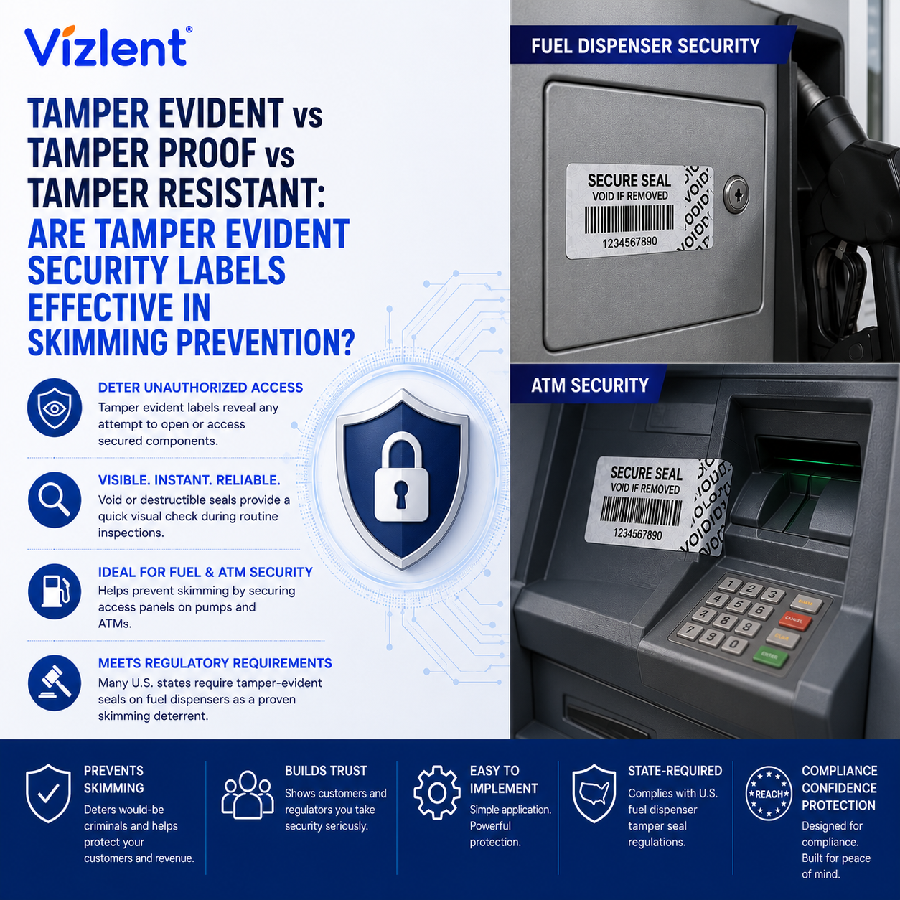
Are tamper evident security labels effective in skimming prevention is a common question from fuel retailers and ATM operators, since card skimming devices are frequently installed inside pump panels and ATM card readers where a tamper seal would catch unauthorized access. A void or destructible seal placed over an access panel gives station staff and inspectors a fast visual check during routine walkthroughs, without needing to open every unit physically. This approach has become common enough that several US states now require tamper-evident seals on fuel dispenser panels specifically as a skimming deterrent.
The effectiveness of this application depends heavily on staff actually checking the seals on a regular schedule, since a broken seal that goes unnoticed for weeks provides little practical protection. Serialized numbering on each seal helps staff confirm that the seal currently on a panel matches the one recorded during the last inspection, rather than a replacement seal a skimmer installer swapped in after breaking the original. Pairing a tamper evident seal with a documented inspection log gives retailers a much stronger skimming deterrent than the label alone.
- Serialized seals let staff confirm the current seal matches the last recorded inspection.
- Regular scheduled checks are necessary since an unnoticed broken seal offers little protection.
- Seals work as a detection and deterrence layer, not a physical lock against access.
Retailers researching this topic should understand that a tamper evident label detects and deters rather than physically prevents access to the panel underneath. This is consistent with how the different types of tamper-evident security labels function everywhere else, since the entire category is built around visible proof of tampering rather than making an enclosure impossible to open. Combining tamper evident seals with camera coverage and staff training generally produces better skimming prevention results than any single measure alone.
Do Not Tamper Labels and Safety Device Signage
Do not tamper labels and warning signage that reads do not tamper with safety devices serve a different purpose than the different types of tamper-evident security labels covered earlier in this guide, even though the terminology overlaps. These are typically informational warning labels placed on fire extinguishers, electrical panels, machine guards, and emergency equipment, instructing personnel not to interfere with safety-critical devices rather than detecting unauthorized access after the fact. OSHA and similar workplace safety regulations often require this type of signage on equipment where tampering could create a safety hazard.
A do not tamper warning label typically uses bold text, a standard safety color like red or yellow, and sometimes a pictogram, rather than the VOID pattern or destructible mechanism used in a security seal. Facilities that need both categories, warning signage and tamper-evident detection, should treat them as separate specification items rather than assuming one label type covers both functions. Confusing the two during a safety audit can create compliance gaps, since a do not tamper warning sign provides no forensic evidence if someone actually does interfere with the device.
- Do not tamper labels: Informational warning signage for safety-critical equipment.
- Tamper-evident security labels: Detection labels that prove unauthorized access after the fact.
- Facilities often need both categories as separate, clearly labeled specification items.
Safety managers specifying signage for a facility should confirm with their compliance team which category a location needs, a warning label, a tamper-evident seal, or both, since the regulatory requirements and product specifications differ significantly between the two categories. A supplier that manufactures both types can usually advise on which applies to a specific piece of equipment. Getting this distinction right during a safety audit prep avoids a scramble to source the correct signage after a citation.
Formats, Colors, and Custom Options
Blank tamper evident labels ship without a printed VOID pattern or logo, letting a business add serialization, branding, or barcodes in-house using its own printer and database. Format choice is one of the more overlooked factors when comparing the different types of tamper-evident security labels, since two labels built on the same underlying mechanism can still perform very differently depending on size and shape. Tamper-evident security labels black finishes are popular for a discreet appearance, useful when a brand does not want the security feature to be visually obvious on the finished product.
Security tamper proof labels and tamper evident security labels & stickers come in a range of standard sizes, from small dot seals for screw holes to larger rectangular seals for shipping cases and equipment panels. Custom die-cut shapes are common for irregular surfaces, curved edges, or specific branding requirements that a standard rectangular or circular label cannot accommodate cleanly. Confirming print compatibility, such as thermal transfer, digital, or pre-printed at the factory, should happen before finalizing a format decision.
- Blank tamper evident labels: unprinted stock for in-house serialization and branding.
- Tamper-evident security labels black: discreet finish for a less visually obvious feature.
- Custom die-cut shapes: sized for screw holes, seams, panels, or irregular surfaces.
Buyers comparing formats across suppliers should request samples of each finish under real application conditions rather than relying on a catalog photo alone. A label that looks correct in a product photo can still perform poorly if the adhesive formulation does not match the actual substrate in use. Physical testing remains the most reliable way to confirm a format choice before a full production run ships.
Cost and Bulk Ordering for Tamper-Evident Security Labels
Tamper-evident security labels cost more per unit than standard labels in most cases, since the specialty adhesive, void mechanism, and testing requirements add material and quality control expense compared to a general-purpose facestock. Cost varies noticeably across the different types of tamper-evident security labels, with holographic and pharmaceutical-grade constructions generally priced above standard void polyester or destructible vinyl. Tamper-evident security labels bulk orders typically bring the per-unit price down significantly compared to small trial runs, though setup costs for serialization or custom holographic tooling still apply regardless of volume ordered.
Buyers searching tamper-evident security labels online, or searching tamper proof stickers near me for a local supplier, often default to whichever result loads first without checking the underlying construction or compliance documentation behind the listing. Tamper-evident security labels best suited to a specific application depend on the substrate, threat model, and any regulatory requirements, not on price alone. Vizlent’s contact page is a reasonable place to request a volume-based quote once your product, substrate, and compliance requirements are confirmed.
- Request a quote that separates setup cost from per-unit pricing.
- Confirm minimum order quantities before comparing tamper-evident security labels bulk pricing.
- Test samples on the actual substrate before committing to a full production run.
A short sample and compatibility test remains the fastest way to confirm real-world performance before a bulk commitment, regardless of how complete a specification sheet looks on paper. Manufacturers that provide this testing support readily are generally easier to work with over a long-term supply relationship than suppliers who only quote price per thousand.
Ready to Source Tamper-Evident Security Labels From a Direct Manufacturer
Understanding the different types of tamper-evident security labels matters most once you are ready to match a specific substrate, mechanism, and compliance requirement to your actual application. Vizlent has manufactured self adhesive label stock since 2011, supplying converters, distributors, and brand owners across more than fifty countries with security label constructions certified to ISO 9001 and ISO 14298 standards, covering every one of the different types of tamper-evident security labels described in this guide. Send an inquiry through Vizlent’s contact page to request samples and a quote suited to your exact threat model, or explore the full Security Labels product range to compare constructions side by side.
For applications specifically needing a destructible, irreversible fracture mechanism, Vizlent’s Eggshell Paper line documents a brittle facestock that tears into fragments on removal, while the VOID Sticker range covers standard void-pattern constructions for general asset and warranty protection. Vizlent’s knowledge base and blog cover additional comparisons for teams evaluating security label options against other tamper-evident categories. The different types of tamper-evident security labels each solve a specific problem, and matching the right one to your substrate and threat model is what actually determines performance in the field.
Frequently Asked Questions
What are the different types of tamper-evident security labels?
The different types of tamper-evident security labels include void polyester, destructible vinyl, holographic OVD, non-residue void, and pharmaceutical tamper seals, each suited to a specific substrate and threat level. Covert features like UV ink, microtext, and serialized codes can be layered onto any of these base types for higher-risk applications. The right type depends on the substrate, expected attack vector, and the acceptability of adhesive residue after removal.
What is the difference between tamper evident and tamper proof labels?
Tamper evident security labels guarantee visible proof of any removal attempt, while tamper proof security labels imply the seal cannot be defeated at all, a stronger and less technically precise claim. In practice, most manufacturers use tamper evident as the more accurate term, since no adhesive label is truly immune to a sufficiently determined attacker. Requesting a description of the specific failure mechanism is more useful than relying on either term alone.
Are tamper evident security labels effective in skimming prevention?
Yes, tamper evident security labels are effective in skimming prevention when paired with regular staff inspection, since a void or destructible seal over an access panel gives a fast visual check for unauthorized entry. Serialized numbering helps staff confirm the current seal matches the last recorded inspection rather than a swapped replacement. The label alone detects and deters rather than physically preventing access, so combining it with camera coverage and inspection schedules improves results.
What is the difference between a tamper evident seal and a do not tamper label?
A tamper evident seal is a security label that leaves visible, irreversible proof when removed, typically through a VOID pattern or destructible facestock. A do not tamper label is informational warning signage, often required for safety-critical equipment like fire extinguishers or electrical panels, instructing personnel not to interfere with the device. The two serve different regulatory purposes and are usually specified as separate items.
Can blank tamper evident labels be printed with custom serialization later?
Yes, blank tamper evident labels ship without a printed VOID pattern, logo, or code, allowing a business to add serialization, branding, or barcodes in-house using its own printer and database. This gives more control over code assignment timing compared to factory pre-printing. Confirming printer and ribbon compatibility with the blank stock before ordering avoids smudging or scan failures later.
How much do tamper-evident security labels cost, and can they be ordered in bulk?
Tamper-evident security labels cost more per unit than standard labels due to the specialty adhesive and testing involved, though a tamper-evident security labels bulk order typically brings the per-unit price down significantly at higher volumes. Setup costs for serialization or custom holographic tooling apply regardless of order size. Requesting a quote that separates setup cost from per-unit pricing is the clearest way to compare suppliers.
Where can I find tamper-evident security labels for sale online or nearby?
Tamper-evident security labels online are available directly from manufacturers, industrial label distributors, and some specialty packaging suppliers, with direct factory sourcing typically giving more control over compliance documentation and custom serialization. Searching tamper proof stickers near me can help for small, local trial orders, but larger production volumes are usually better served through a direct manufacturer relationship. Requesting samples before committing to volume applies regardless of sourcing route.
Do tamper-evident security labels and stickers work the same way as tamper-evident tags?
Yes, tamper evident security labels & stickers and tamper evident security tags rely on the same underlying void, destructible, or covert mechanisms, with the difference coming down to form factor rather than function. Tags in a hang tag format work through string, loop, or plastic fastener attachment, while stickers apply directly to a flat surface. Choosing between them depends on the product shape and how the label will be inspected during use.






