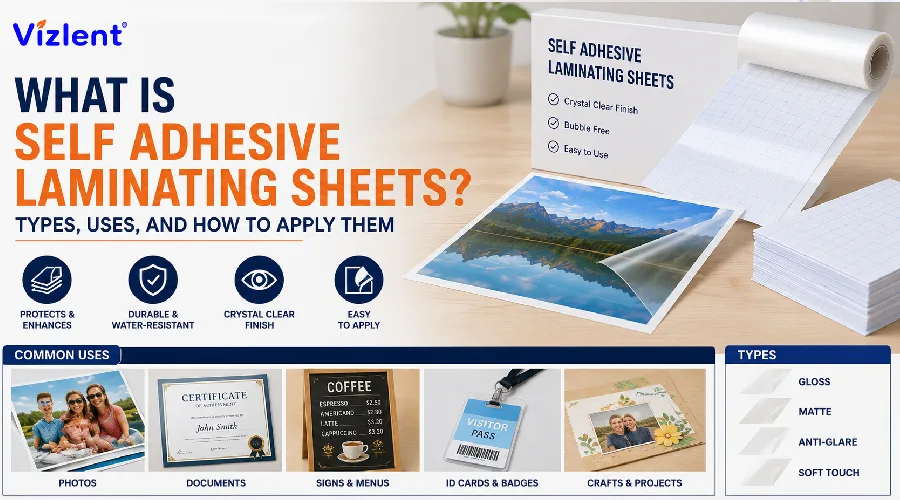
Self adhesive laminating sheets are clear or matte plastic films coated with a pressure sensitive adhesive that bonds to paper, photos, cards, and labels using only hand pressure, with no heat and no machine required. You peel away the backing liner, position the film over your document, and smooth it down. The adhesive grabs on contact and reaches full strength at room temperature within about 24 hours.
Vizlent has manufactured pressure sensitive materials since 2011, and our cold lamination films remain one of the most requested product lines we coat. Our team formulates the adhesive, slits the rolls, and lab tests every batch in house, so the advice below comes from factory practice rather than guesswork. Anyone asking what is self adhesive laminating sheets will find the material, the method, and the buying options explained in plain terms here.
How Do Self Adhesive Laminating Sheets Work?
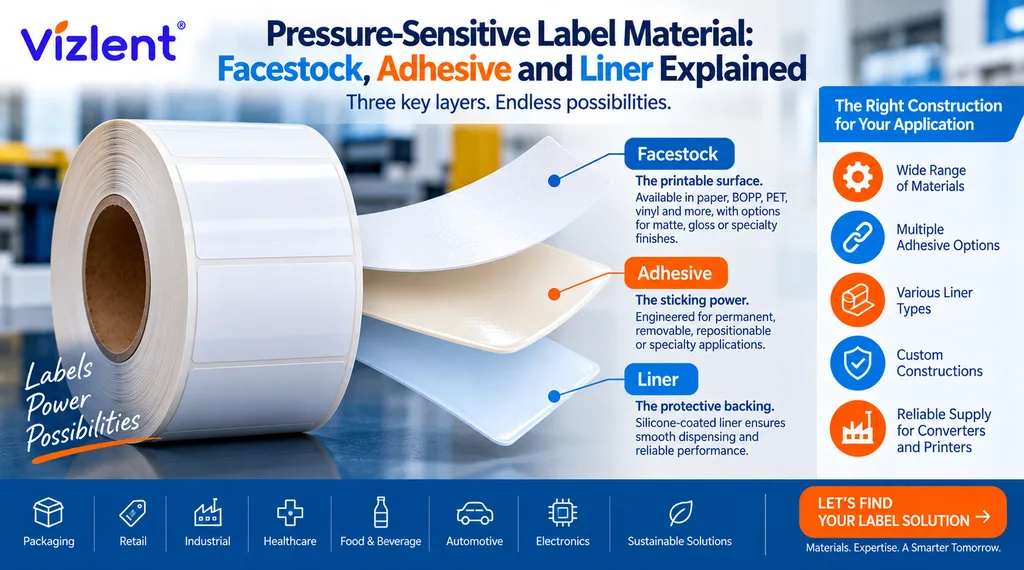
Every sheet is built from three layers that do separate jobs. The top layer is a transparent film, usually PET, PVC, BOPP, or PP, chosen for clarity, stiffness, and resistance to moisture and scuffing. Beneath it sits a pressure sensitive acrylic adhesive, and under that a silicone coated release liner that protects the glue until you are ready to apply it.
Pressure sensitive adhesives bond through contact and light force instead of heat. When you press the film onto paper, the adhesive flows into the tiny valleys of the surface and locks the two materials together. That bond keeps building for about a day, which is why a freshly applied sheet feels secure immediately yet becomes even harder to lift the following morning.
- Film layer: PET, PVC, BOPP, or PP in gloss or matte finishes, typically 25 to 250 microns thick
- Adhesive layer: Water based or solvent acrylic formulated for clarity and long term stability
- Release liner: Silicone coated paper or PET that peels away cleanly without stringing
Types of Self Adhesive Laminating Sheets

Cold lamination materials come in more variety than most buyers expect. Finish is the first split, with gloss sheets giving colors extra pop and self adhesive laminating sheets matte versions cutting glare for framed pieces and signage under bright lights. Thickness matters just as much, since a thin 25 micron film wraps around curves while a 150 micron film adds real rigidity to cards and tags.
Format is the other decision point. Retail packs offer pre-cut sizes such as self adhesive laminating sheets a4, letter, and photo dimensions, while converters and print shops buy the same construction as jumbo or slit rolls. Our full range of laminating films covers both cold and thermal grades, slit to widths from 30mm up to 1300mm.
- Gloss finish: Maximum clarity and color depth for photos, menus, and product displays
- Matte finish: Low glare, fingerprint resistant, and easy to write on with permanent markers
- A4 and letter sheets: Sized for standard documents with a small overlap border on each edge
- Roll formats: Continuous lengths for wide format prints, floor graphics, and production lines
How Do You Use Self Adhesive Laminating Sheets? Step by Step
Application takes about two minutes once you know the sequence, and the same self laminating sheets directions apply to nearly every brand on the market. Work on a clean, flat table and wash your hands first, because dust and skin oils are the two main causes of visible defects. Keep a soft plastic squeegee or an old gift card within reach for smoothing.
People search how do you use self-adhesive laminating sheets and how to use self-adhesive laminating sheets in almost equal numbers, and the answer is identical for both phrasings. Peel, position, press, and trim, in that order. The steps below expand each stage so your first attempt looks like your fiftieth.
- Step 1: Wipe the document and table free of dust, and trim any loose paper fibers from the edges
- Step 2: Peel back about 3cm of the release liner and fold it under, exposing a strip of adhesive
- Step 3: Align the exposed strip with the top edge of your document and press it down lightly
- Step 4: Pull the liner away underneath while smoothing the film downward with your squeegee
- Step 5: Work from the center out to the edges to push any trapped air toward the border
- Step 6: Trim the overlap with scissors or a craft knife, leaving a 2 to 3mm sealed margin
Need cold lamination material that applies cleanly every time? Request free A4 sample sheets from Vizlent and test the adhesive on your own documents before you order. Send your inquiry today.
Self Adhesive Laminating Sheets for Stickers and Labels
Sticker makers were early adopters of cold lamination, and self adhesive laminating sheets for stickers remain one of the biggest use cases we supply. A clear or matte overlaminate protects inkjet printed stickers from water, UV fading, and scratching, which matters because most home inkjet inks smear on first contact with moisture. The film goes on before die cutting, so the finished sticker peels and applies as a single laminated piece.
The workflow is simple: print your sticker sheet, apply the laminating film over the full page, then run it through your cutting machine with a slightly deeper blade setting. Small businesses selling on Etsy and similar platforms use this exact method to turn ordinary self adhesive material into waterproof, retail grade products. Choosing self adhesive laminating sheets for stickers with a permanent acrylic adhesive prevents edge lift after cutting.
Can You Put Self Adhesive Laminating Sheets in a Laminator?
The short answer is no for standard hot machines. Running self adhesive laminating sheets in a laminator that uses heated rollers can melt the pressure sensitive adhesive, ooze glue onto the rollers, and jam the machine. These films are engineered for hand application or for cold roll laminators that apply pressure without any heating element.
A related mistake happens when someone partially peels a sheet, changes their mind, and tries to run the film and liner back together through a machine to re-seat them. Once separated, the liner rarely re beds perfectly, so treat each sheet as single use. If your workflow depends on a heated pouch machine, choose purpose built thermal lamination films instead, since their EVA glue layer is designed to activate under heat.
Self Adhesive Laminating Sheets vs Thermal Lamination Film

Both products end in the same place, a document sealed under protective plastic, but they get there differently. Cold sheets rely on a pressure sensitive adhesive that works at room temperature, while thermal film carries a dry EVA glue layer that only activates between heated rollers at roughly 100 to 150 degrees Celsius. That single difference decides the equipment you need, the materials you can protect, and the speed of the job.
Thermal film wins on cost per sheet and edge seal strength, which is why schools and copy shops with pouch machines favor it for high volume runs. Cold film wins on convenience and material safety, since it needs no machine and never exposes heat sensitive prints to hot rollers. Many print businesses stock both and pick per job rather than declaring one format better.
- Cold sheets: no equipment needed, safe for inkjet photos, thermal paper, and vinyl
- Thermal film: lower material cost at volume, stronger fused edge seal
- Cold sheets: apply anywhere, including on site signage and finished walls
- Thermal film: faster throughput once a pouch or roll laminator is running
Common Uses for Self Adhesive Laminating Sheets
Cold applied film shows up in far more places than school projects. Offices use it to protect ID badges, safety notices, and reference cards that pass through many hands each day. Restaurants laminate menus and QR code table cards, while warehouses seal bin labels and rack signs against dust, forklift scuffs, and washdown cleaning.
The heat free application is the deciding factor in many of these settings. Inkjet photos, thermal receipts, vinyl prints, and wax based artwork can all be damaged or discolored by a hot laminator, yet a cold film protects them without risk. That is why photographers, archivists, and print shops keep self adhesive laminating sheets on hand even when they also own thermal equipment.
- ID cards, membership cards, and visitor badges
- Menus, price lists, and countertop signage
- Photos, certificates, and children’s artwork
- Warehouse labels, equipment tags, and safety instructions
- Sticker sheets, planner decals, and craft projects
Matte or Gloss: How to Choose the Right Sheet
Start with where the finished piece will live. Gloss film deepens color saturation and suits photos, menus, and retail displays viewed at close range, though it reflects overhead lighting. Self adhesive laminating sheets matte finishes diffuse that reflection, hide fingerprints, and accept handwriting, which makes them the standard pick for signage, teaching charts, and anything displayed under fluorescent lights.
Then match size and thickness to the job. A self adhesive laminating sheets a4 pack handles standard documents, while oversized posters call for roll stock trimmed to fit. For items handled daily, step up to 100 microns or more, and for curved or flexible surfaces, stay under 50 microns so the film conforms without tenting at the edges.
- Gloss: Photos, menus, product cards, and color heavy prints
- Matte: Signage, worksheets, wayfinding, and writable surfaces
- Thin film, 25 to 50 microns: Curved containers and flexible labels
- Thick film, 100 to 250 microns: Badges, tags, and high handling documents
Where to Buy Self Adhesive Laminating Sheets
For small quantities, the question of where to buy self adhesive laminating sheets has easy answers. Office supply chains, craft stores, and online marketplaces stock retail packs in A4, letter, and photo sizes, and a quick search for self-adhesive laminating sheets near me will surface local stationers who carry them. Retail packs suit occasional users, though the per sheet cost runs several times higher than trade pricing.
Print shops, converters, and label businesses do better buying factory direct. Vizlent ships cold lamination film in sheets and rolls to customers in more than 50 countries, with custom widths, liners, and adhesive grades produced on our own coating lines in 7 to 15 days. Searching self adhesive laminating sheets near me makes sense for a ten pack, but container volumes belong with a manufacturer.
Buying in volume? Get a factory direct quote on cold lamination sheets and rolls cut to your exact specifications. Contact the Vizlent team for pricing within 24 hours.
Storage and Handling Tips for Self Adhesive Laminating Sheets
Adhesive coated film is a shelf stable product, but only when stored the way the coating plant intended. Keep packs flat in their original packaging at 15 to 25 degrees Celsius and below 60 percent relative humidity, away from direct sunlight and heat vents. Stored this way, most acrylic adhesive sheets hold full tack for 12 to 24 months from the production date.
Handling habits matter just as much as the storage room. Touch only the liner side and the outer edges, because fingerprints on the exposed film show permanently once the sheet is applied over dark print. Let refrigerated or cold shipped packs return to room temperature for a few hours before use, since a cold adhesive grabs poorly and can release later.
- Store flat, in original packaging, out of sunlight and away from heat sources
- Keep humidity moderate to stop paper liners from curling or wrinkling
- Use older stock first, since adhesive tack slowly changes over long storage
- Bring sheets to room temperature before application in cold climates
How Vizlent Manufactures Cold Lamination Film
Production starts with a base film, PET, PVC, BOPP, or PP, fed into one of our eight automated coating lines in Shenzhen and Ganzhou. The line applies a measured layer of acrylic adhesive, cures it, and marries the coated film to a silicone release liner in a single continuous pass. Coat weight is checked repeatedly along the run, because uneven adhesive is the root cause of bubbling, haze, and edge lift in the field.
Finished master rolls then move to slitting, where we cut widths from 30mm to 1300mm and sheet sizes including A4 to customer order. Every batch passes shear testing for adhesive strength and Xenon Arc exposure for light stability before dispatch, with results traceable to the roll number. Technical explainers on these test methods are available in our knowledge base if you want the details behind the certificates.
Why Choose a Vizlent Label Self-Adhesive Laminating Sheet
Every Vizlent Label self-adhesive laminating sheet starts as a master roll coated on our own automated lines in Shenzhen, then passes Xenon Arc weathering and shear testing before it ships. We are ISO 9001, FSC, and SGS certified, and we have supplied pressure sensitive materials to more than 1,000 distributors, converters, and print houses since 2011. Learn more about our factory and testing lab on our about us page.
Factory direct supply also means real technical support rather than a reseller reading a spec sheet. Our engineers advise on film type, adhesive tack, and liner selection for your exact application, and free samples let you verify performance before committing to a bulk order. For more guides on lamination and label materials, browse the Vizlent blog written by our production team.
Get Factory Direct Cold Lamination Film from Vizlent
Vizlent coats, slits, and tests self adhesive laminating sheets in house, then ships them factory direct in sheets, A4 packs, and jumbo rolls up to 1300mm wide. Free samples are available so you can check clarity, tack, and print compatibility on your own equipment before ordering. Tell our engineering team what you laminate and we will match the film, adhesive, and liner to the job.
Ready to test the material yourself? Send your inquiry to Vizlent today and receive free sample sheets plus a custom quote within 24 hours.
Frequently Asked Questions
What are self adhesive laminating sheets made of?
Self adhesive laminating sheets are made of a clear plastic film, a pressure sensitive acrylic adhesive, and a silicone coated release liner. The film is usually PET, PVC, BOPP, or PP in thicknesses from 25 to 250 microns. The adhesive bonds under hand pressure at room temperature, and the liner keeps it protected until application. Together the three layers create a protective seal without any heat.
How do you apply self adhesive laminating sheets without bubbles?
The way to avoid bubbles is to peel the liner gradually while smoothing the film from one edge with a squeegee. Never remove the entire liner at once and drop the film flat, because that traps air across the whole surface. Work from the center outward with firm, overlapping strokes. Small bubbles near the edge can be pushed out, and stubborn ones can be pierced with a pin and pressed flat.
Can you put self adhesive laminating sheets in a laminator?
No, self adhesive laminating sheets should not go through a heated laminator. The heat can soften the pressure sensitive adhesive, force glue onto the rollers, and jam the machine. These sheets are designed for hand application or for cold roll laminators that use pressure only. For heated machines, use thermal lamination pouches or films made with heat activated EVA adhesive.
Are self adhesive laminating sheets good for stickers?
Yes, self adhesive laminating sheets for stickers are one of the most popular protective options for home and small business sticker production. The film shields inkjet ink from water, sunlight, and scratches, turning a fragile print into a durable product. Apply the laminate after printing and before die cutting so each sticker comes out fully sealed. A permanent acrylic adhesive grade prevents the layers from lifting at cut edges.
Do self adhesive laminating sheets come in A4 size?
Yes, A4 is one of the most common retail sizes, and packs are usually cut slightly oversized so the film overlaps each edge of an A4 document. This overlap lets you seal the border completely and trim to a clean 2 to 3mm margin. Letter, photo, and business card sizes are also widely stocked. Manufacturers such as Vizlent supply the same material in custom sheet sizes and rolls for trade buyers.
What is the difference between matte and gloss laminating sheets?
The difference is surface finish and how each handles light. Gloss sheets are highly reflective and make printed colors look deeper, which suits photos and menus. Matte sheets diffuse light to remove glare, resist fingerprints, and can be written on with permanent marker, which suits signage and worksheets. Both finishes use the same adhesive and protect equally well.
Where can I find self-adhesive laminating sheets near me?
Most office supply stores, craft retailers, and large supermarkets with stationery aisles stock self adhesive laminating sheets in standard sizes. Searching online maps for stationers or print shops in your area will usually turn up same day options. For bulk quantities, custom sizes, or specific finishes, ordering from a factory direct from a manufacturer is more economical. Vizlent ships worldwide with a 7 to 15 day production lead time.
How long do self adhesive laminating sheets last?
A quality acrylic adhesive sheet lasts 3 to 5 years indoors and often much longer without yellowing or lifting. Outdoor life depends on the film type, with PET and PVC grades tested to around 3 years of weather exposure. The adhesive reaches full bond strength about 24 hours after application. Vizlent validates durability with Xenon Arc weathering equipment on every material batch.