
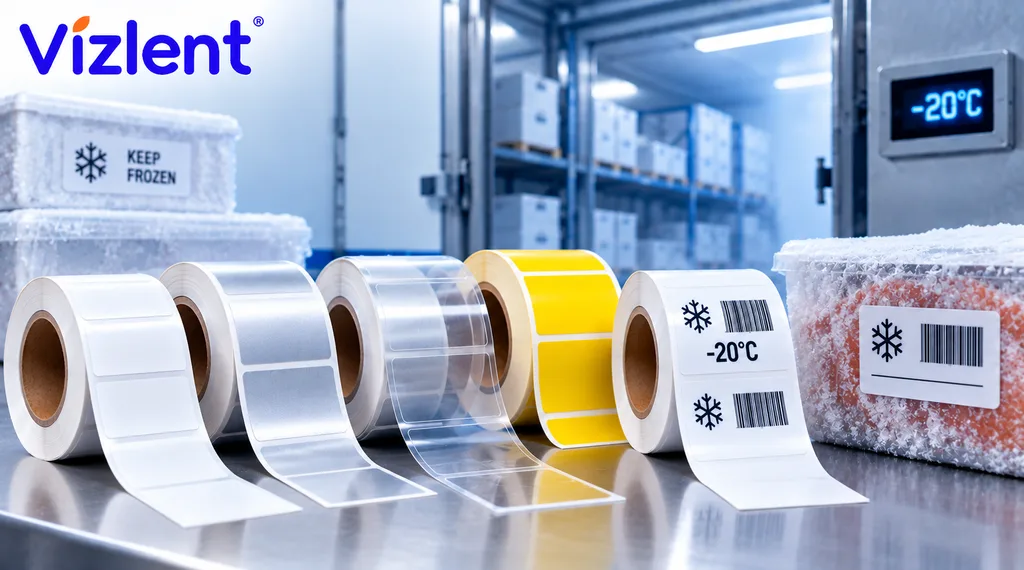
The different types of cold storage labels divide along three axes: what the label identifies, how cold it has to get, and whether it needs to come off again. A frozen food carton, a pallet moving through a blast freezer, a steel rack in a warehouse aisle, and a cryovial in liquid nitrogen all need labels, and none of the four constructions is interchangeable with the others. Buyers who sort by function first and material second make far fewer expensive substitutions.
Most facilities run several types at once and buy them from one supplier on one specification. That is where failures start, because a construction that suits a shipping carton at -25 °C may not suit a metal rack upright or a specimen vial. Sorting the estate by type before quoting is the practical fix.
What Makes a Label a Cold Storage Label
A cold storage label is a self-adhesive, pressure-sensitive construction specified to apply and stay applied across a defined sub-ambient temperature range. The distinguishing feature is not the printed design but the combination of facestock, adhesive, and print system chosen for that range. Ordinary label stock applied to a chilled surface is not a cold storage label, whatever the artwork says.
Two numbers define the requirement and both belong on the request for quotation. Service temperature is how cold the bonded label can get, while application temperature is how cold the surface can be when the label goes on. Many constructions rated for deep cold still expect a warm, dry surface at the moment of application, so the two figures are quoted separately.
Different Types of Cold Storage Labels by Function
The different types of cold storage labels are most usefully grouped by what the label identifies, because function determines size, data content, format, and print volume before material enters the conversation. A pallet label carries a serialised licence plate and gets read by a scanner across an aisle. A cryovial label carries a specimen identifier on a surface a few millimetres wide.
Grouping this way also exposes duplication. Facilities often discover they are buying three near-identical film grades for three departments that could share one construction, or one grade stretched across applications it was never specified for. The table below is a starting inventory rather than a product list.
| Label type | What it identifies | Typical surface | Common format |
|---|---|---|---|
| Product and primary pack | The retail or wholesale unit | Carton, film pouch, tub, tray | Roll-fed, die-cut |
| Case and pallet | The logistic unit in transit | Corrugated case, stretch wrap, slip sheet | A5 or A6 print-and-apply |
| Rack and location | The storage position | Painted or galvanised steel beam, upright | Long, narrow, often laminated |
| Asset and equipment tag | The freezer, dewar, or trolley | Powder-coated metal, painted panel | Die-cut plate or wrap |
| Specimen and clinical | The sample or patient unit | Cryovial, microtube, blood bag | Wrap-around, cap-top dot |
| Indicator and monitoring | A condition, not an object | Pack, case, or container exterior | Adhesive patch or strip |
Types listed are functional groupings, not product grades. The construction for each is set by the temperature band and adhesive requirement.
Primary Pack and Frozen Product Labels
Primary pack labels carry brand, ingredient, and regulatory content and are usually applied warm, before the product enters the freezer. That application sequence is an advantage, because the adhesive gets a room-temperature dwell before the pack is chilled. Condensation on retrieval is the main durability stress rather than the cold itself.
Facestock choice here is often driven by appearance and print quality as much as by temperature. Coated paper handles frozen carton work economically, while film grades suit damp, wiped, or high-humidity packs. Where handling is heavy or packs are wiped down on retrieval, a laminating film overlay adds abrasion and moisture protection.
Case, Pallet, and Logistic Unit Labels
Case and pallet labels identify the logistic unit rather than the product, and their content is largely dictated by trading partner standards. GS1’s Logistic Label guideline builds the label around the Serial Shipping Container Code encoded in a GS1-128 barcode, with other data carried alongside it (industry convention). A label without an SSCC is not a GS1 Logistic Label under that guideline, though a carton can still carry GS1 identification such as a GTIN without qualifying as one.
These labels take the roughest handling of any type in the estate. They meet stretch wrap, corrugated board that has already absorbed moisture, forklift contact, and repeated cold chain transitions between dock, freezer, and truck. The logistics and e-commerce range is specified for consistent peel force and scanability across those transitions.
Cold Storage Rack Labels and Location Identification
Cold storage rack labels identify the storage position rather than anything stored in it, which makes them the longest-lived labels in the building. They go onto painted or galvanised steel beams and uprights, often at height, and are expected to stay readable and scannable for years without reapplication. Replacing them means working at height in a freezer, so the specification premium is easy to justify.
Two constraints dominate. The beam is frequently cold, dusty, or lightly frosted at the moment of application, which pushes the requirement toward an aggressive cold-apply adhesive rather than a standard freezer grade. Where the bond must be permanent on steel, ultra low temperature thermal transfer labels for metal surface are the matched construction; where labels may need repositioning during a slotting change, a removable or magnetic alternative is worth pricing.
Cold Storage Tags for Assets, Equipment, and Containers
Cold storage tags identify the equipment itself: freezers, dewars, roll cages, totes, and monitoring probes. They carry asset numbers, calibration dates, and service records, and they usually live on powder-coated metal or painted panels rather than on packaging. Legibility over years matters more than initial appearance.
Durability requirements here overlap with general industrial asset tagging rather than with food packaging. Polyester and vinyl constructions dominate because they tolerate cleaning chemicals and abrasion, and the durable label range covers the usual substrates. Where a tag must also show evidence of removal, tamper-evident constructions add that function to the same asset label.
Specimen, Vial, and Clinical Labels
Specimen labels are the most demanding type by temperature and the least demanding by size. They go onto cryovials, microtubes, blood bags, and freezer boxes, and depending on the specified construction they may be designed for liquid nitrogen vapour-phase or liquid-phase storage. Facestock flexibility and low-temperature brittleness are important properties here, because embrittlement can cause cracking when a rack is pulled from a dewar.
Format is usually a wrap-around or a cap-top dot sized to a container a few millimetres across. Vizlent supplies cryogenic vial labels and medical cryogenic labels in those formats, alongside waterproof low temperature resistant blood bag labels for PVC surfaces (Vizlent product data). For mechanical ultra-low freezers rather than liquid nitrogen, deep-freeze labels for ultra-low temperature laboratory freezers are the matched construction.
Working out which types your facility actually runs? Send your label inventory by function to a Vizlent engineer and request free samples for the two or three constructions that would consolidate it.
Types Sorted by Temperature Band
Different sectors publish different environmental targets, and none of them is a label specification. The US Food and Drug Administration advises keeping freezers at 0 °F, or -18 °C, for safe food storage, which is consumer food-storage guidance rather than a label-performance standard (FDA food-storage guidance).
Clinical storage runs colder and narrower. CDC vaccine-storage guidance uses 2 °C to 8 °C for refrigerators, -50 °C to -15 °C for freezers, and -90 °C to -60 °C for ultra-cold freezers (CDC vaccine-storage guidance). Deep freeze and liquid nitrogen storage sit lower again, at around -80 °C and -196 °C respectively.
| Band | Environment | Facestock classes commonly specified | Example published service range |
|---|---|---|---|
| 2 °C to 8 °C | Refrigerated retail, pharmacy | Coated paper or film | Ambient-rated stock is often adequate |
| -18 °C to -25 °C | Commercial and blast freezers | Coated paper, BOPP, vinyl | to -20 °C on specialty coated paper |
| -40 °C | Cold-soak transport, industrial | Vinyl, polyester | to -40 °C on flexible vinyl |
| -80 °C | Mechanical ULT freezers | Polyester, polyolefin | to -80 °C on polyester film |
| -196 °C | Liquid nitrogen, vapour phase | Cryogenic polyolefin constructions | to -196 °C on cryogenic constructions |
Illustrative application bands, not universal label ratings. Service ranges are drawn from published Vizlent product data and apply only to the specified constructions. Confirm against the current technical data sheet for the grade you intend to buy.
Types Sorted by Adhesive Behaviour
Adhesive behaviour is the axis buyers most often forget, and it cuts across every functional type. The question is not only how cold the bond must survive but whether the label is ever meant to come off, and how cleanly. Getting this wrong produces either labels that fall off or labels that will not.
Four behaviours cover most cold storage work, and a single facility usually needs at least three of them. At the time of writing, Vizlent publishes eight adhesive grades spanning permanent, removable, freezer, and wash-off across its self adhesive material range (Vizlent product data). Specify the behaviour alongside the temperature, not after it.
- Permanent cold-grade. For product packs, specimen vials, and anything that must never be separated from what it identifies.
- Cold-apply or frost-tolerant. For rack beams, pre-frozen stock, and any surface that will be cold or lightly frosted when the label is applied.
- Removable. For returnable totes, roll cages, and slotting labels that change with the season or the SKU mix.
- Wash-off. For reusable containers that go through a washer between cycles and must release without residue.
- Low surface energy. For polyethylene and polypropylene crates and cryoboxes, where standard adhesives may not wet out; the super sticky low-energy range addresses this case.
Indicator and Monitoring Label Types
Indicator labels are a distinct type because they identify a condition rather than an object. Time-temperature indicators, freeze indicators, and moisture indicators change appearance irreversibly when a threshold is crossed, giving receiving staff a visual check without opening a data logger. They supplement temperature records rather than replacing them.
Treat indicator selection separately from identification labels, since the two are specified against different criteria and often come from different suppliers. Vizlent’s adjacent construction in this space is water sensitive paper, which produces an irreversible colour change on moisture contact (Vizlent product data). Where a monitoring device is required for regulatory purposes, follow the applicable guidance rather than substituting an indicator patch.
Print Systems Matched to Each Label Type
The print method varies more by type than most buyers expect, and matching it wrongly wastes the material spent. Full resin thermal transfer ribbon is generally preferred where film labels face abrasion, chemicals, condensation, or repeated handling, which covers specimen, rack, and asset applications. Wax and wax-resin grades can suit less demanding paper-based work, depending on the facestock and durability target.
Direct thermal has a legitimate place in high-volume pallet and case labelling where the label’s working life is days rather than years. Laser and inkjet suit short-run laboratory and office production on compatible stocks. Select the ribbon as a system with the printer, printhead, facestock, print settings, and durability target, then check the wider thermal transfer ribbon range.
Regulatory Considerations Across Cold Storage Label Types
Regulatory exposure differs sharply by type, which is another reason to sort the estate before buying. Product and primary pack labels in food applications may engage food-contact rules: 21 CFR 175.105 covers adhesives used as components of articles for packaging, transporting, or holding food, while 21 CFR 175.125 lists substances permitted where a pressure-sensitive adhesive is the food-contact surface of a label applied to food (regulatory requirement). Citing a CFR section does not by itself establish compliance for a finished construction, since food-contact status depends on the complete construction and its intended conditions of use, including the adhesive, facestock, and ink.
Case and pallet labels often support traceability workflows rather than being the regulated object themselves. The FDA Food Traceability Rule under FSMA Section 204 establishes recordkeeping requirements for covered entities handling foods on the Food Traceability List, who must capture Key Data Elements at Critical Tracking Events, with the compliance date moved from January 20, 2026 to July 20, 2028 (regulatory requirement). Several “fresh” entries on that list exclude previously frozen forms, so confirm your product’s scope rather than assuming coverage. Rack labels and asset tags typically carry no product regulatory burden at all, which is worth knowing before you over-specify them.
How to Choose Between Cold Storage Label Types
Choosing is a sequence, and running it in order prevents the most common substitution errors. Start from what the label identifies, then apply the environment, then the removal requirement. Material comes last, not first.
Answering these before requesting quotations lets a manufacturer recommend against a construction you asked for, which is more useful than a supplier who simply fills the order. It also produces a defensible record for audits and supplier changes. Issue the same document to every shortlisted supplier so the responses are comparable.
- Identify the function. Product pack, logistic unit, storage location, asset, specimen, or indicator.
- Set the temperature band. The coldest point the label reaches, not the nominal setpoint.
- Set the application temperature. Warm and dry, refrigerated, or cold and possibly frosted.
- Set the removal requirement. Permanent, removable, or wash-off.
- Define the surface. Corrugated, film, glass, PP, PE, painted steel, or galvanised steel, plus the tightest radius.
- Match the print system. Printer, printhead, ribbon type, print settings, and expected chemical exposure.
- Scope the compliance need. Food contact, clinical, traceability, or none, and the documents you need on file.
Mistakes When Mixing Label Types in One Facility
Multi-type estates fail in characteristic ways, and most of the failures are sourcing decisions rather than product defects. The pattern is a single specification written for the highest-volume type and then applied to everything else. Reviewing the list below against a failed application usually narrows the cause quickly.
Validate each type separately, on its own substrate, under representative conditions. ASTM D3330 is a peel adhesion test method for pressure-sensitive tape and can be used to measure peel adhesion for pressure-sensitive adhesive systems, with the configuration selected for the application; it does not by itself qualify a finished label for a specific cold storage application (industry convention). Acceptance thresholds and freeze-thaw cycle counts belong in your own specification or your customer’s.
- Buying one freezer grade for packs, pallets, and rack beams because it is the cheapest per square metre.
- Specifying a permanent adhesive for returnable totes that then need scraping between cycles.
- Applying rack labels to cold steel with a standard freezer adhesive rather than a cold-apply grade.
- Treating a published construction rating as a property of the whole facestock family.
- Running direct thermal on labels expected to stay legible for years.
- Ignoring surface energy on polyethylene crates and polypropylene cryoboxes.
- Grading barcodes at ambient conditions and never re-checking them at retrieval temperature.
Sort Your Label Estate Before You Reorder
Understanding the different types of cold storage labels is worth more at the specification stage than at the reorder stage, because that is when consolidation is still possible. List every label your facility applies below ambient, group them by function, then attach a temperature band, an application condition, and a removal requirement to each group. Many facilities find that exercise consolidates the estate into two or three validated constructions.
The fastest route from that list to a working specification runs in five steps: submit the grouped specification, receive a recommended construction per group, request the current technical data sheet for each, test free samples on your own line and surfaces, then quote at volume. Vizlent manufactures self-adhesive label stock at its Shenzhen facility and supplies converters, distributors, and brand owners across more than 50 countries. Send your specification and request samples plus technical data sheets, or compare constructions first in the raw material label range.
Frequently Asked Questions
What are the different types of cold storage labels?
They group by function into product and primary pack labels, case and pallet labels, rack and location labels, asset and equipment tags, specimen and clinical labels, and indicator or monitoring labels. Each type is then specified by temperature band and adhesive behaviour. Function sets the format and data content, while band and adhesive set the material.
What is the difference between cold storage stickers and cold storage tags?
In practice the terms overlap, but stickers usually means self-adhesive labels applied to product packs, cases, or containers, while tags more often means identification carriers for equipment and assets such as freezers, dewars, and roll cages. Tags typically prioritise multi-year legibility and chemical resistance, whereas pack stickers prioritise print quality and food-contact scope. The adhesive requirement differs accordingly.
What makes cold storage rack labels different from product labels?
Cold storage rack labels identify the storage position rather than the goods, so they are expected to last years without reapplication and are often applied to cold, dusty, or lightly frosted steel. That application condition usually calls for a cold-apply adhesive rather than a standard freezer grade. Product labels, by contrast, are generally applied warm before the pack is chilled.
Do all cold storage labels need resin thermal transfer printing?
No. Full resin is generally preferred where film labels face abrasion, chemicals, condensation, or repeated handling, which covers specimen, rack, and asset labels. High-volume pallet and case labels with a working life of days can often use direct thermal, and paper-based frozen carton work may suit wax or wax-resin ribbons depending on the durability target.
Can one label construction cover every type in a cold storage facility?
Rarely, and attempting it is a common source of failure. A construction suited to a warm-applied carton label may not bond to a cold rack beam, and a permanent specimen adhesive is wrong for a returnable tote. Many facilities can consolidate several applications into two or three validated constructions; consolidating to one is rarely workable.
Which cold storage label types carry regulatory requirements?
Product and primary pack labels in food applications may engage the food-contact provisions in 21 CFR 175.105 and 21 CFR 175.125, and case or pallet labels may engage FSMA 204 traceability recordkeeping for foods on the Food Traceability List. Rack labels and asset tags usually carry no product regulatory burden. Request current documentation covering the specific grade rather than relying on a citation alone.
Are freezer labels and cryogenic labels the same type?
No. Freezer label is a broad application term covering constructions designed for sub-zero storage, with actual temperature ratings varying by product, while cryogenic label means a construction specifically engineered and validated for liquid nitrogen service. Published ratings such as -20 °C, -40 °C, or -196 °C are product-specific, not definitions of the category. Buying by the broad term often returns a general-purpose freezer grade, so quote the number you need.
What is the minimum order quantity for custom cold storage labels?
At the time of writing, Vizlent publishes a 1,000 piece minimum per size on its cryogenic label products, with 7 to 15 business day production after artwork confirmation. Minimums differ across material families and formats, so confirm for the grade and type you are specifying. Free samples in A4 sheet and short roll form are available before any volume commitment.






