
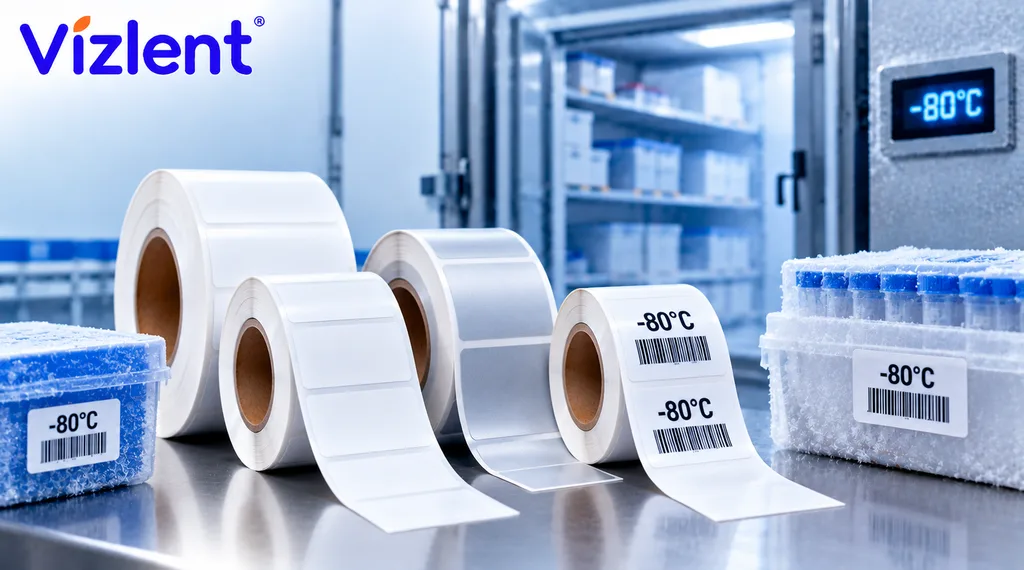
Suppliers of durable labels for ultra-low freezers are material manufacturers and converters like Vizlent Label that supply pressure-sensitive constructions engineered to stay bonded and legible between -60°C and -196°C. The qualified ones quote a facestock, an adhesive class, an application temperature, and a validated ribbon as one matched stack. Buyers who source on price per thousand instead of on construction are the ones who find a blank liner at the bottom of a cryobox two years later.
What Actually Counts as an Ultra-Low Freezer
An ultra-low temperature (ULT) freezer holds a chamber setpoint far below a laboratory chest freezer, typically between -60°C and -86°C. Most installed units in biobanks, hospital pharmacies, and research labs run at -80°C. The distinction matters because the temperature at which a given adhesive and facestock stops performing is a property of that specific construction, and many general-purpose constructions reach their published limit well above ULT depth.
CDC vaccine-storage guidance separates the equipment bands cleanly. Refrigerators sit between 2°C and 8°C, freezers between -50°C and -15°C, and ultra-cold freezers between -90°C and -60°C. That is guidance for vaccine storage units, not a label standard, but it is the clearest public reference when procurement asks why freezer labels and ULT labels differ.
| Storage band | Typical range | Common contents | Label difficulty |
|---|---|---|---|
| Refrigerated | 2°C to 8°C | Reagents, vaccines in use | Low |
| Standard freezer | -50°C to -15°C | Frozen food, working stocks | Moderate |
| Ultra-low (ULT) | -90°C to -60°C | Biobank aliquots, mRNA vaccines | High |
| Cryogenic (LN2) | Down to -196°C | Cell lines, germplasm, gametes | Highest |
Storage-equipment bands, not label ratings. Confirm any label rating against its technical data sheet.
Why Standard Label Stock Fails at -80°C
Semi-gloss paper with a general-purpose permanent acrylic is built for a warm warehouse, and its published service range usually says so. As temperature falls, the adhesive loses the mobility it needs to maintain a bond, and the paper facestock becomes less able to follow a curved vial wall. Failure is rarely dramatic on day one, which is what makes it expensive.
Damage arrives as a slow retreat, not a sudden drop. An edge lifts, frost creeps underneath, the lift propagates around the radius, and the label leaves during a gloved retrieval. Sample identity then rests on a handwritten cryobox map nobody has updated.
Adhesive Stiffening and Bond Loss
Bond performance at depth is not governed by any single property. Polymer mobility, coat weight, container surface energy, and moisture at the moment of application all contribute. Treating glass transition temperature as the whole explanation oversimplifies a multi-variable problem.
Cryogenic acrylics keep tack at application and cohesive strength at depth, resisting the shrink stress that builds as polypropylene contracts. That formulation work is what you pay for at a specialist low temperature label manufacturer. A quote line reading “freezer adhesive” tells you almost nothing.
Facestock Embrittlement and Edge Lift
Paper facestocks are hygroscopic, so they take up moisture from humid air and from condensation during handling. Repeated freeze and thaw cycling can then drive dimensional change, fibre swelling, and coating or ply separation, which distorts printed barcode modules. Synthetic films absorb far less moisture, so they are less exposed to this particular mechanism.
Film choice then reduces to depth and radius. Polypropylene facestock and polyester facestock are commonly used for ULT and cryogenic constructions for that reason. Vinyl and coated paper still earn a place in shallower cold chain labels where unit cost outweighs survival at depth.
Print Abrasion and Smearing
A perfectly bonded label with an illegible code is still a failed label. Wax and wax-resin ribbons are more prone to scratching and smearing under condensation, ethanol wipes, DMSO, and repeated frost. Full resin thermal transfer ribbon is commonly selected for ULT and cryogenic identification where abrasion, chemicals, and condensation demand high print durability.
Print compatibility depends on the complete print system, not the printer model alone. Facestock topcoat, ribbon formulation, printhead, temperature, pressure, and speed all interact. Confirm the ribbon and facestock pairing in writing, then verify it on your own printer before buying either in volume.
What Separates Real Suppliers of Durable Labels for Ultra-Low Freezers From Resellers
Vendors split into two groups, and the quote format reveals which one you have. A material manufacturer describes a construction: facestock family, caliper, adhesive class, liner, application window, validated ribbon. A reseller describes a size and a colour.
The fastest test is a question about a variable a reseller does not control. Ask the minimum application temperature for the adhesive, and whether it shifts on an already-frosted container. A manufacturer answers with a figure and a caveat about surface moisture.
Signals worth checking before you shortlist:
- Published data sheets naming facestock family, adhesive class, and liner, not marketing copy alone
- A stated application temperature listed separately from service temperature
- Free samples offered for your own converting line and printer
- In-house coating and slitting rather than purchased stock resold under a new name
- A named engineering contact who will review your specification sheet
- Current quality certification such as ISO 9001, with certificates available on request
How to Choose Durable Labels for -80°C Ultra-Low Freezers: Four Decisions You Control
Every ULT labeling programme rests on four specification decisions. Specify only one and you inherit the other three by default. Facestock governs flexibility and dimensional stability, while adhesive governs whether the bond survives contraction and freeze-thaw cycling.
Liner and converting tolerance decide whether the label dispenses cleanly or jams an applicator. The ribbon and print system, which sits alongside the label rather than inside the construction, decides whether the barcode still scans after two years of frost and disinfectant. Change any one of the four and the previous validation no longer applies.
| Facestock in the construction | Published construction rating | Typical ULT use | Print pairing |
|---|---|---|---|
| Specific PP cryogenic construction | Published to -196°C | LN2 vapour phase, cryovial labels | Resin thermal transfer |
| Specific PET construction | Published to -80°C | ULT freezers, laboratory vials | Resin thermal transfer, laser |
| Specific flexible PVC construction | Published to -40°C | Blood bags, plasma storage | Thermal transfer |
| Specific coated paper construction | Published to -20°C | Cold chain outer packaging | Direct thermal, digital |
Supplier product data published by Vizlent at the time of writing. Each rating belongs to one named construction and is not a property of the facestock family. A polypropylene label is not rated to -196°C because it is polypropylene. Confirm against the technical data sheet for your exact construction.
Adhesive Class and Application Window
The specification that matters most is not the coldest temperature the low temperature adhesive survives. It is the warmest temperature at which it must be applied. Many cryogenic acrylics need application at or above roughly +10°C to wet out fully before the container goes into storage.
A label applied at 4°C in a cold room and dropped straight to -80°C may never build the bond it was rated for. Frosted-surface application is a separate adhesive category with its own tack requirement. If your workflow labels frozen vials without thawing, state it in the specification, because it changes the construction your supplier should recommend.
Liner and Converting Tolerance
Small-diameter cryovials punish loose tolerance. A 1.5 ml tube has a radius tight enough that slightly over-caliper facestock flags at the trailing edge within weeks. Liner release force, roll tension, and core size all affect whether an applicator places the label square.
Buying from a manufacturer that coats and slits in house gives you more control here than buying from a broker. Coating and slitting under one roof makes caliper and release force controlled variables. Ask for the tolerance band, not the nominal figure.
Durable Barcode Labels and Scan Reliability After Frost
Durable barcode labels in ULT storage clear a bar room-temperature labels never face. They must scan through condensation, after frost has formed and melted, and often through ice on the container wall. Contrast degrades when ink cracks, and module edges blur when facestock swells.
ISO/IEC 15416 defines measurement and grading methods for linear barcode print quality, and ISO/IEC 15415 does the same for 2D symbols. These define how you measure, not a pass mark for your application. Set your acceptance grade with your quality team and verify it after a freeze-thaw cycle.
Practical steps that protect scan rates:
- Verify grade after thermal cycling, not only at the point of printing
- Increase X-dimension wherever vial diameter allows, since small modules degrade first
- Use 2D symbols on small tubes where linear codes cannot fit at readable size
- Match thermal transfer ribbon grade to facestock topcoat, not to printer brand
- Record the construction code in the sample inventory so a future substitution stays visible
Durable Asset Labels, Rack Tags and Facility Identification
The freezer needs identification, and so does everything around it. Durable asset labels on the ULT unit, the CO2 backup, and the temperature logger carry the equipment ID that ties an excursion record to a physical box. These face condensation and handling rather than deep cold.
Inside the chamber the problem changes. Metal racks pull heat out of an adhesive quickly, which is why ultra low temperature thermal transfer labels for metal surface exist as a distinct construction. Durable adhesive labels specified for painted steel will not behave like durable adhesive labels specified for polypropylene cryovials.
Buyers searching for durable plant labels arrive with two unrelated needs, so name which one you mean before you request a quote. The two are separated below, along with the other categories usually sourced alongside them.
- Plant genetic resource labels. Used by seed banks and germplasm repositories storing accessions at ULT and cryogenic depth, where accession numbers must stay legible for decades
- Industrial plant identification labels. Equipment, valve, and pipe marking in the facility housing the freezers, where UV exposure and washdown chemicals drive the specification
- Blood bag identification. Low temperature resistant medical blood bag labels must conform to flexible PVC without flagging
- Cryobox and vial identification. Covered by cryogenic vial labels and dedicated deep freeze labels for ultra-low temperature laboratory freezers
Standards and Guidance Worth Citing in Your Specification
ISO 20387:2018 sets general requirements for biobanking competence, covering traceability across collection, preservation, storage, and distribution. It does not specify a label material or a label service life. For biobanks it supports the importance of traceability and controlled identification throughout the biobank lifecycle, which is the argument to use when finance questions the gap between paper and film.
Food-contact wording deserves care. In the United States, 21 CFR 175.105 covers adhesives used with a functional barrier, and 21 CFR 175.125 covers pressure-sensitive adhesives forming the food-contact surface of labels applied to food. Citing a section does not by itself establish compliance, so request the supplier’s current compliance documentation for your intended use and jurisdiction rather than accepting marketing copy.
Ready to move from research to specification? Send your container material, application temperature, storage depth, and printer model to the Vizlent engineering team and ask for a recommended construction with the data sheet attached.
How to Qualify Suppliers of Durable Labels for Ultra-Low Freezers
Qualification is a documentation exercise before it is a commercial one. The first conversation establishes whether the vendor controls the variables you care about or passes your question upstream. Ten minutes of technical questioning usually tells you which.
Run the same question set with every candidate so answers stay comparable. Score on specificity, because a label stock supplier who says “we would need to test that on your vial” is telling you more than one who says yes to everything. Keep the responses on file as your justification if a construction is challenged in an audit.
- What is the facestock family and caliper, and what is the tolerance band?
- What is the adhesive class, and what is its minimum application temperature?
- Does the construction support application to frosted or pre-frozen surfaces?
- What ribbon grade is validated with this topcoat, and under what test conditions?
- What liner is used, and what is the release force range?
- What quality certifications are current, and can you supply the certificates?
- What test conditions sit behind any published service temperature or service life?
- What is the minimum order quantity, the confirmed lead time in writing, and the notification process if a raw material is substituted?
A Sample Testing Protocol Before Volume Commitment
Free samples only help if you test them the way you will use them. Run the trial on your own containers, at your application temperature, with your printer and ribbon. A supplier lab result proves the construction works under supplier conditions, which are almost never yours.
Keep the protocol short enough that people finish it. A short controlled trial can expose obvious compatibility problems before a volume commitment, at the cost of a box of vials and some technician time. Document the method so you can repeat the qualification when a raw material changes.
- Print a batch with your production printer, ribbon, and barcode symbology
- Apply to your actual container material at your actual application temperature
- Hold at room temperature for the supplier’s stated dwell time before freezing
- Store at your operating setpoint for a minimum of 72 hours as an initial screening condition, not as proof of long-term service life
- Run three freeze-thaw cycles including a room-temperature hold and condensation exposure
- Scan every label and record grade, then attempt manual peel and record edge lift
- Repeat with one alternative construction so you finish with a comparison, not a single result
Screening does not substitute for extended validation. Adhesive creep, ageing, chemical exposure, and multi-year cryogenic storage need a longer study designed with your quality team. Treat the seven steps as a gate before volume, not as a service life claim.
Where Buyers Overspend on ULT Labeling
A common overspend is buying cryogenic construction for an application that never drops below -20°C. Liquid nitrogen rated constructions cost more than coated paper for good reason. Match the construction to the coldest point the label reaches, not the coldest point in the building.
Underspending usually costs more. Saving a little per thousand on cryobox labels can mean re-identifying a whole box, which burns technician hours and puts sample integrity in question. Freezer-grade label stock and cold chain labels sit in different price bands because the carton and the vial are different problems.
Move From Specification to Qualified Supply
Suppliers of durable labels for ultra-low freezers should make qualification easy rather than sell around it. A supplier’s ability to provide a construction, a technical data sheet, and a representative sample gives you an early indication of its technical support process. The sequence below is the one that works.
- Submit your specification. Container material, application temperature, storage setpoint, printer and ribbon, dimensions, annual volume.
- Receive a recommended construction. Facestock, adhesive class, liner, and validated ribbon named as one matched stack.
- Request the technical data sheet. Read the test conditions behind every published figure before accepting it.
- Test samples on your own line. Run the seven-step protocol above on your containers, in your freezer.
- Quote at volume. Confirm MOQ, lead time, and substitution notification terms in writing before the first production order.
Send your ULT labeling specification to the Vizlent engineering team. Browse the full durable label range, compare the ultra low temperature resistant cryogenic labels and ultra low temperature durable cryo labels constructions, or contact the team directly with your specification sheet for a recommended construction and sample dispatch.
Frequently Asked Questions
What temperature rating do I need for a -80°C freezer?
Choose a construction validated for your operating setpoint and for any temperature excursions defined in your application specification, which in practice usually means synthetic film rather than paper. Individual constructions are published to -80°C and to -196°C, though each rating belongs to that named construction rather than to the material family. Ask for the test conditions behind the figure, since a rating measured after 24 hours is a different claim from one measured after 12 months.
Can I apply labels directly to already-frozen vials?
Some constructions are designed for application to frosted or pre-frozen surfaces, but performance must be validated on your actual container and frost condition. Frost thickness, surface contamination, substrate, application pressure, dwell, and label geometry all affect the result alongside the adhesive formulation. State the requirement in your specification if your workflow skips thawing, then test it before committing to volume.
Why do my barcodes stop scanning after a few months in storage?
Two mechanisms usually explain it. Either the image is abrading because a wax or wax-resin ribbon was used instead of full resin, or the facestock is absorbing moisture and distorting module edges. Both are construction problems rather than scanner problems, so verify barcode grade after freeze-thaw cycling.
Do suppliers of durable labels for ultra-low freezers offer free samples?
Some established material manufacturers offer samples, typically with the buyer covering courier freight. Vizlent publishes a free sample program covering paper, film, and thermal materials at the time of writing, intended for peel strength and print compatibility trials. Treat any sample as the start of a qualification rather than a formality. A supplier’s sample policy is worth weighing during qualification, especially when the application is technically demanding.
Is coated paper ever acceptable in cold storage?
Yes, for shallower applications and outer packaging that never reaches ULT depth. Coated paper constructions are commonly published to around -20°C and are widely used on cold chain shipping cartons. Failure risk rises sharply once condensation and freeze-thaw cycling enter the picture, so reserve paper for outer layers and use film wherever sample identity lives.
What is the difference between freezer labels and cryogenic labels?
Freezer label is a broad application term rather than a fixed temperature band, and products sold under it span a wide range of ratings. Cryogenic label generally implies validation for liquid nitrogen conditions, a harder specification. Compare the published rating and its test conditions rather than the product name, since two products sharing a name can differ by more than 100°C.
Should I buy label stock or finished die-cut labels?
Buy stock if you have converting capacity and want control over the construction across multiple sizes. Buy finished labels if you need small quantities in complex shapes without in-house die-cutting. Many organisations do both, sourcing stock for standard sizes and finished labels for specialty formats. The decision is about internal capability, not material quality.






