
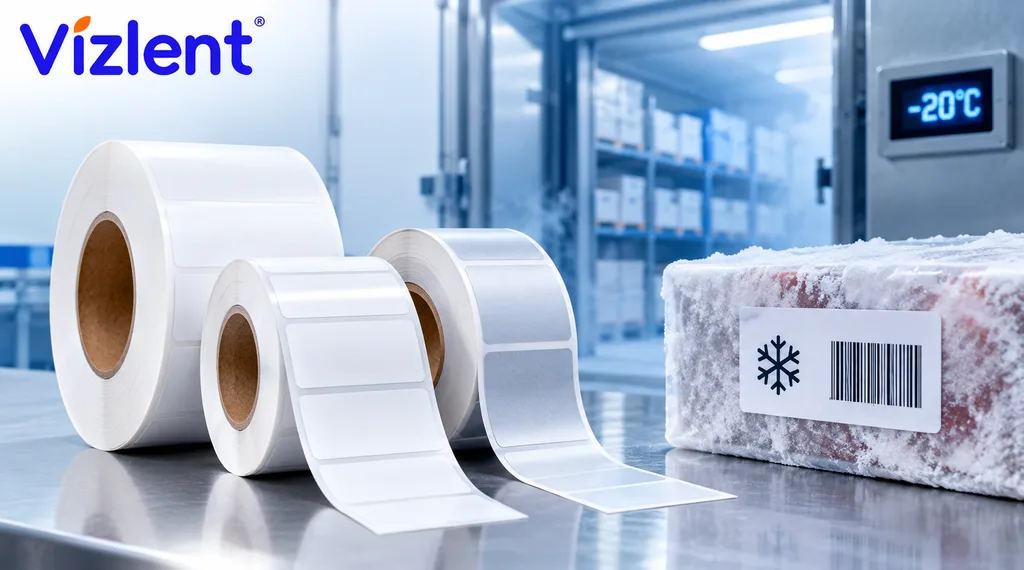
The best low temperature labels for cold storage applications are complete constructions that pair a synthetic facestock with a cold-rated adhesive and a print system matched to the durability requirement. Paper facestocks and general-purpose adhesives can contribute to freezer label failure, particularly where moisture, condensation, or low application temperatures are present. No single layer determines performance on its own.
Cold storage is not one environment. A blast freezer at -25 °C, a mechanical ultra-low freezer at -80 °C, and a liquid nitrogen dewar at -196 °C load the same label very differently. Specify by storage band first, then by surface, then by print method.
What Cold Storage Actually Means in Label Specification Terms
Cold storage spans roughly 8 °C down to -196 °C, and different sectors publish different operating targets. The US Food and Drug Administration advises keeping freezers at 0 °F, or -18 °C, for safe food storage, which is a food-storage recommendation rather than a label-performance standard (regulatory guidance). For a separate example, CDC vaccine-storage guidance uses 2 °C to 8 °C for refrigerators, -50 °C to -15 °C for freezers, and -90 °C to -60 °C for ultra-cold freezers (regulatory guidance).
Those figures describe the environment, not the label. A label is rated against a tested construction, never against “cold” as a category. Buyers who request cold temperature labels without naming a number often receive a general-purpose freezer grade suited to a distribution freezer rather than a biobank.
Why the Storage Band Decides the Material
| Storage band | Typical environment | Facestock classes commonly specified | Governing constraint |
|---|---|---|---|
| 2 °C to 8 °C | Refrigerated retail, pharmacy | Coated paper or film | Condensation resistance |
| -18 °C to -25 °C | Commercial and blast freezers | Coated paper, BOPP, vinyl | Cost per label at volume |
| -40 °C | Cold-soak transport, industrial | Vinyl, polyester | Conformability on curves |
| -80 °C | Mechanical ULT freezers | Polyester, polyolefin | Freeze-thaw cycling |
| -196 °C | Liquid nitrogen, vapour phase | Cryogenic polyolefin constructions | Facestock flexibility |
Facestock classes listed are those commonly specified for each band. They are not universal temperature limits, and the finished construction determines actual capability.
Vizlent publishes facestock service temperatures that follow this pattern, spanning polypropylene, polyester, flexible vinyl, and specialty coated paper grades (Vizlent product data). Those published figures apply to the specified constructions they describe. They should not be read as inherent properties of every label built on the same facestock family.
Naming your band on the request for quotation is the highest-leverage step a buyer can take. It removes a full round of sampling and forces the adhesive question into the open. Browse the low temperature label range to see how each band maps to a stock construction.
Why Standard Paper Labels Struggle in Freezers
Cold failure is rarely one mechanism, so “the glue got hard” is an incomplete answer. A general-purpose adhesive stiffens as it cools and flows less readily into surface texture. Without adequate wet-out, there is little bond strength to retain.
Three other mechanisms often run alongside it. Paper can absorb condensation, swell, and delaminate, while the container contracts at a different rate from the label and loads the bond edge in shear. Frost adds a fourth: ice crystals can keep the adhesive from contacting the substrate, so the bond forms against ice that may later sublimate away. Durable label constructions for cold work are therefore specified as complete systems.
Best Low Temperature Labels for Cold Storage Applications, Ranked by Facestock
The best low temperature labels for cold storage applications sort into four facestock families, with minimum service temperature and container geometry deciding the fit. Film facestocks are often preferred below -18 °C because they generally offer better moisture resistance and dimensional stability than conventional paper. Specialised paper constructions and topcoats can perform well in specific applications, so the choice is application-dependent rather than automatic.
Cost climbs with cold capability. Specifying a cryogenic construction for a -20 °C carton wastes budget, and specifying commodity paper for a dewar risks the samples. Match the grade to the band rather than defaulting to the highest rating available.
| Facestock family | Example published service range | Adhesive class | Typical application | Print method |
|---|---|---|---|---|
| Cryogenic polypropylene / polyolefin film | to -196 °C | Cryogenic permanent acrylic | Liquid nitrogen storage, biobanking | Resin thermal transfer |
| Polyester (PET) film | to -80 °C | High-performance acrylic | ULT freezers, lab vials, metal racks | Resin thermal transfer, laser |
| Flexible vinyl (PVC) | to -40 °C | Conformable cold-grade | Blood bags, plasma, curved containers | Thermal transfer |
| Specialty coated paper | to -20 °C | Standard cold-temp | Frozen food cartons, cold chain logistics | Direct thermal, digital |
These values are drawn from published Vizlent product data and apply only to the specified constructions. They should not be treated as universal temperature limits for the facestock family. Confirm against the current technical data sheet for the grade you intend to buy.
Cryogenic Polypropylene and Polyolefin Constructions for Liquid Nitrogen
Labels specifically engineered and validated for cryogenic service are the appropriate class for liquid nitrogen applications. The governing facestock requirement is flexibility rather than raw strength, because a film that embrittles at -196 °C can crack when a technician pulls a rack from a dewar. Ordinary polypropylene label stock is not suitable by virtue of the polymer alone; the finished label has to be validated as a complete facestock-and-adhesive system.
Vizlent publishes a -196 °C to +120 °C service range on its ultra low temperature resistant cryogenic labels, with a 50 to 80 μm face and a cryogenic permanent acrylic (Vizlent product data). The same product page lists a 1,000 piece minimum per size and 7 to 15 business day production after artwork confirmation. For steel racks and canisters, the ultra low temperature thermal transfer labels for metal surfaces are the matched construction.
Polyester for ULT Freezers and Metal Racking
Polyester is widely specified in the -80 °C band because it tends to hold dimension through repeated freeze-thaw cycling. It also accepts resin ribbon cleanly and resists the alcohol wipes stored beside most ULT freezers. The deep-freeze labels for ultra-low temperature laboratory freezers are built for this profile.
On small, tightly curved containers, facestock calipers can become the limiting factor rather than temperature rating. A thick film may not conform to a 1.5 ml microtube and can flag at the edges within a few cycles. Thin polyolefin or polyester in a die-cut wrap is the usual answer, and cryogenic vial labels ship in those formats.
Vinyl and Coated Paper for Standard Frozen Logistics
Flexible vinyl serves the -40 °C band and conforms to tight radii, which is why it appears on blood bags and plasma containers. The waterproof low temperature resistant medical blood bag labels use that construction on PVC surfaces. For refrigerated laboratory work above the ultra-low range, freeze-refrigerated low temperature resistant labels cover the middle.
Specialty coated paper remains a volume choice for frozen food cartons and shipping labels. It runs on direct thermal hardware and costs a fraction of film, working reliably around the -20 °C band on dry surfaces. Where condensation, washdown, or abrasion is present, a film face or a protective laminating film is generally the better call.
Not sure which band you are buying for? Send your minimum service temperature and container material to a Vizlent engineer and request free samples before committing to volume.
The Adhesive Is Often the Failure Point, Not the Facestock
Many cold storage complaints trace back to the adhesive rather than the face. Freezer-grade and cryogenic acrylics are formulated to retain enough mobility at low temperature to hold the bond, and to build tack during the dwell period before chilling. Rubber-based hot melts can offer higher initial tack on some surfaces but are generally specified for narrower temperature windows.
Surface energy compounds the problem. Polyethylene and polypropylene are low surface energy substrates, so an adhesive that wets out on glass may not wet out on a PE cryobox. Vizlent supplies eight adhesive grades across permanent, removable, freezer, and wash-off in its self adhesive material range, plus a super sticky low-energy construction for difficult plastics (Vizlent product data).
Application Temperature Versus Service Temperature
These are two different specifications, and confusing them is a costly mistake in cold labelling. Service temperature is how cold the label can get once bonded. Application temperature is how cold the surface can be when the label goes on.
A construction rated to -196 °C service may still require application at +10 °C or warmer, because the adhesive needs mobility and dwell time to form the bond. Vizlent lists +10 °C and above as the recommended application temperature for its cryogenic construction, with a 24 hour dwell on clean, dry cryovials before transfer to storage (Vizlent product data). If you must label frosted or pre-frozen stock, an aggressive cold-application adhesive is a separate specification you have to request explicitly.
Print Method and Ribbon Choice for Cold Storage Labels
The print is the other half of the system and fails for different reasons than the adhesive. Full resin thermal transfer ribbon is generally preferred when film labels require high resistance to abrasion, chemicals, condensation, or repeated handling. Wax and wax-resin ribbons can be suitable for less demanding applications, depending on the facestock and the durability requirement.
Direct thermal has a place in refrigerated logistics but suits long-duration frozen storage less well, since the coating can darken with heat and abrasion. Laser printing works on some polyester grades and is common for short-run laboratory work. Select the ribbon as a system with the printer, printhead, facestock, print settings, and durability target, then review the thermal transfer ribbon range before finalising.
Keeping Barcodes Scannable Through Frost and Handling
A label that stays attached but cannot be scanned has still failed. Barcode print quality can be evaluated under ISO/IEC 15416:2025 for linear symbols and ISO/IEC 15415:2024 for two-dimensional symbols, both of which define methods for measuring and grading symbol quality (industry convention). Results are commonly expressed as overall quality grades derived from the applicable grading methodology.
Grading a code at ambient conditions tells you little about how it reads at retrieval, because frost, surface ice, and condensation all affect symbol contrast. Where barcode performance is critical, validate the printed construction after cryogenic or freezer storage using the scanners and verification criteria used in your own facility, and ask your supplier for the test conditions behind any published grade. For high-throughput sortation, the logistics and e-commerce range is specified for consistent peel force alongside scanability.
Regulatory Context for Low Temperature Labels and Packaging
Regulation touches low temperature labels and packaging mainly through food contact and traceability. In the United States, 21 CFR 175.105 covers adhesives used as components of articles for packaging, transporting, or holding food, while 21 CFR 175.125 lists substances permitted where a pressure-sensitive adhesive is the food-contact surface of a label applied to food (regulatory requirement). Citing a CFR section does not by itself establish compliance for a finished construction, since food-contact status depends on the specific adhesive, facestock, ink, construction, intended use, and applicable conditions of use.
Traceability is the second pressure point. The FDA Food Traceability Rule under FSMA Section 204 requires covered entities handling foods on the Food Traceability List to capture Key Data Elements at Critical Tracking Events, with the compliance date moved from January 20, 2026 to July 20, 2028 (regulatory requirement). Several “fresh” entries on that list exclude previously frozen forms, so confirm your product’s scope rather than assuming coverage. For regulated clinical supply, start with the pharmaceutical and healthcare range.
How to Choose Low Temp Labels for Your Facility
Specification is a sequence, and skipping a step is where overruns come from. Work the profile in order rather than starting from a catalogue, because a catalogue will always offer something available and operationally wrong. The five questions below are what a competent supplier should ask you first.
Answering them before you request quotations compresses the sampling cycle. It also gives you a defensible record of why a construction was chosen, which matters during audits and supplier changes. Keep the answers in one document and issue it to every shortlisted supplier.
- Minimum service temperature. The coldest point the label reaches, not the nominal freezer setpoint.
- Application temperature and surface condition. Room temperature and dry, refrigerated, or already frosted.
- Container material and geometry. Glass, PP, PE, coated carton, or steel, plus the tightest radius.
- Print method and durability target. Printer, printhead, ribbon type, print settings, and expected chemical exposure.
- Compliance scope. Food contact, clinical, or industrial, and the documentation you need on file.
Specification Mistakes That Cause Cold Storage Label Failures
Certain errors recur across industries and most are avoidable at the specification stage. The pattern is a buyer optimising for one variable, usually unit price, while leaving another undefined. Low temp labels that fail in service are often correct products bought against an incomplete brief.
Reviewing a failure against the list below usually narrows the cause quickly. Where it stays unclear, running samples through the real workflow resolves it faster than correspondence. Vizlent supplies free samples in A4 sheet and short roll form for exactly this purpose (Vizlent product data).
- Specifying a service temperature but omitting the application temperature.
- Buying cold temperature labels by facestock name only, without confirming the adhesive grade.
- Treating a published construction rating as a property of the whole facestock family.
- Applying low temperature stickers to frosted surfaces with a standard freezer adhesive.
- Testing at ambient conditions and skipping freeze-thaw cycling before volume.
- Ignoring surface energy on polyethylene and polypropylene containers.
- Assuming a -20 °C paper grade will hold at -40 °C in cold-soak transport.
What to Send Your Supplier, and How to Validate
A complete specification package removes most of the back and forth from sourcing. It also lets a manufacturer recommend against a construction you asked for, which is worth more than a supplier who simply fills the order. Send it to every shortlisted supplier in identical form so responses are comparable.
Validate the finished construction on your own line, on the intended substrate, under representative conditions. ASTM D3330 is a peel adhesion test method for pressure-sensitive tape and can be used to measure peel adhesion for pressure-sensitive adhesive systems, with the test configuration selected for the application; it does not by itself validate a finished cold storage label (industry convention). Acceptance thresholds and freeze-thaw cycling counts belong in your own specification or your customer’s, not in a supplier’s catalogue.
- Minimum and maximum service temperatures, plus the application temperature.
- Container material, surface energy if known, and the tightest radius.
- Label dimensions, shape, and finished format: roll, sheet, or die-cut.
- Print method, printer model, ribbon type, and print settings in use.
- Annual volume and required lead time.
- Compliance documents needed on file, including current certificates and declarations of conformity.
- A sample of the actual container for adhesion testing.
Ready to specify? Send those seven items to Vizlent and request free samples plus the current technical data sheet for the grade under evaluation.
Specify With an Engineer, Not a Catalogue
Getting the best low temperature labels for cold storage applications comes down to naming three numbers and validating the result on your own line. Send your minimum service temperature, your application temperature, and your container material to Vizlent, then request the current technical data sheet and free samples for the grade under evaluation. Vizlent manufactures self adhesive label stock at its Shenzhen facility and has supplied converters, distributors, and brand owners across more than 50 countries since 2011.
Bulk buyers can request jumbo rolls, precision-slit rolls, or finished die-cut formats matched to existing converting equipment. Certification documentation, including ISO 9001, FSC, and SGS, is available on request for the material under consideration. Contact the Vizlent team with your specification, or compare constructions first in the raw material label range.
Frequently Asked Questions
What are the best low temperature labels for cold storage applications?
They are constructions matched to your minimum service temperature and validated as a facestock-and-adhesive system, with the print method chosen for the durability requirement. Cryogenic polyolefin constructions serve liquid nitrogen, polyester serves ultra-low freezers, vinyl serves conformable sub-zero work, and specialty coated paper serves frozen logistics. Confirm the adhesive grade separately, since the facestock alone does not determine performance.
What is the difference between low temp labels and cryogenic labels?
Low temp labels is a broad term covering refrigerated through deep freeze service, while cryogenic labels means constructions specifically engineered and validated for liquid nitrogen service. All cryogenic labels are low temperature labels, but most low temperature labels are not cryogenic. Buying by the broad term without naming a number often gets you a general-purpose freezer grade.
Can low temperature stickers be applied to already frozen surfaces?
Some can, but only where the adhesive is formulated for cold application, which is a separate specification from service temperature. Many cryogenic constructions still recommend application at +10 °C or above with a dwell period before transfer to storage. State the requirement explicitly on your request for quotation.
Why do freezer labels peel off after a few weeks?
Common causes include an adhesive that did not achieve wet-out because the surface was cold, damp, or low surface energy, or a paper face absorbing condensation and delaminating. Insufficient dwell time before freezing is another frequent contributor. Checking the application temperature and container material usually narrows it down.
What ribbon should I use for cold storage barcode labels?
Full resin ribbon is generally preferred where film labels face abrasion, chemicals, condensation, or repeated handling. Wax and wax-resin ribbons can suit less demanding applications depending on the facestock and durability target. Choose the ribbon as a system with the printer, printhead, facestock, and print settings, then confirm on your own hardware.
Is low temp sticker material safe for food packaging?
Some constructions are supplied against the food-contact provisions in 21 CFR 175.105 and 21 CFR 175.125, but a citation alone does not establish compliance for a finished label. Food-contact status depends on the specific adhesive, facestock, ink, construction, and intended use. Request current documentation covering the exact grade, including certificates and declarations of conformity.
How long do cold temperature labels last in deep freeze storage?
Vizlent publishes a service-life figure for its cryogenic grade under specified application conditions, and you should request the current technical data sheet for the applicable test conditions. Real service life depends on storage temperature, retrieval frequency, freeze-thaw cycling, and chemical exposure in your workflow. Validate against your own conditions rather than a catalogue figure.
What is the minimum order quantity for custom low temperature labels and packaging?
Vizlent publishes a 1,000 piece minimum per size on its cryogenic label products, with 7 to 15 business day production after artwork confirmation. Minimums differ across material families, so confirm for the grade you are specifying. Free samples are available before any volume commitment.






