
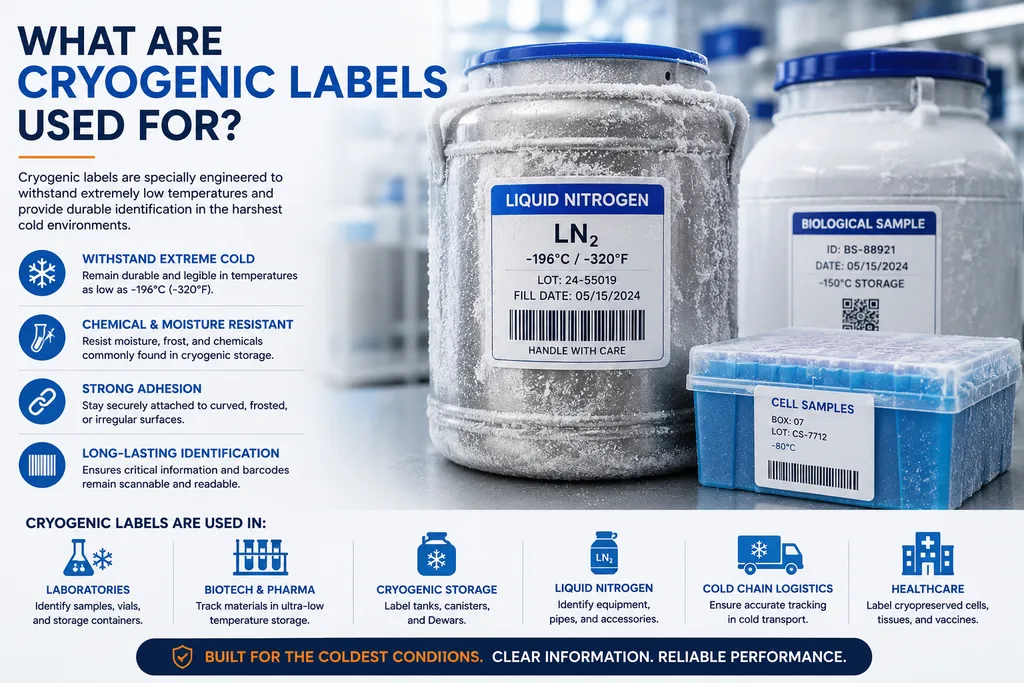
Cryogenic labels are pressure-sensitive constructions engineered for ultra-low-temperature identification, with some grades qualified for exposure near -196°C, the approximate boiling point of liquid nitrogen at atmospheric pressure. The short answer to what are cryogenic labels used for is permanent identification of samples and containers held in ultra-low temperature storage. They go on cryovials, freezer boxes, blood bags, straws, and the steel racks that hold them.
The category exists because ordinary label stock is not built for deep cold. Adhesives can lose bond strength, paper facestocks can absorb moisture and delaminate, and unsuitable print systems can smear or degrade during alcohol wipe-down. A purpose-built construction addresses all three failure modes together.
What a Cryogenic Label Actually Is
A cryogenic pressure-sensitive label typically combines a suitable facestock, a cold-rated adhesive, and a release liner, with a print system selected for the storage and handling environment. Each element is chosen against the same storage protocol, and a mismatch in any one of them tends to surface during sample retrieval. The construction earns the name, not the wording on the roll.
Suppliers sometimes market ordinary freezer labels as cryo labels, and the distinction matters at purchase. Standard low temperature labels are commonly built for commercial freezer ranges. True cryogenic label material is qualified for liquid nitrogen exposure, which is a different order of thermal stress.
What each element has to do:
- Facestock. Retains useful flexibility at temperature, so it resists cracking on retrieval.
- Adhesive. Wets out on a small-diameter tube, then holds without edge lift over the intended storage period.
- Release liner and die-cut. Releases cleanly on applicators and matches the container radius.
- Print system. Selected to resist abrasion, frost, and disinfection with ethanol or isopropanol.
Where Cryogenic Labels Are Used
Common uses include biobanking, cell and gene therapy, IVF and blood banking, and pharmaceutical or cold-chain identification.
Deep-cold storage is not one environment, and the application drives the specification. A cryovial in liquid nitrogen faces different stress than a food carton in a blast freezer. Matching the two is most of the sourcing job.
The four profiles below cover most of the deep freeze labels we quote. Each carries its own container material, temperature floor, and traceability rules. Read them as buyer profiles rather than a market list.
1. Biobanking and Biorepositories
Biobanks store specimens for years, and an identification failure can compromise the sample’s research value. Cryogenic storage labels carry the accession number and barcode linking a tube to its inventory record. A failed label can compromise specimen identification and traceability, potentially making the sample unusable for its intended research purpose.
Traceability here is a documented obligation. Regulatory requirement: ISO 20387:2018 sets general requirements for biobanking competence and covers traceability across collection, preservation, storage, and distribution. Labelling is the physical layer that makes that chain real.
Common biobank formats:
- Cryovial wrap-arounds with a clear self-laminating tail
- Cap-top dots for 1.5 ml and 2 ml cryogenic tube labels
- Freezer box and rack identification labels
- Cane and cassette markers for LN2 dewars
2. Cell and Gene Therapy Manufacturing
Autologous cell therapy products are patient-specific and irreplaceable. Cryopreserved apheresis material, drug product bags, and intermediate vials all need identification that survives controlled-rate freezing and vapour-phase storage alike. Chain-of-identity controls rely on multiple identification and recordkeeping measures, with the label providing the physical identifier on the container.
Industry convention: coding and labelling of medical products of human origin may use the ISBT 128 standard from ICCBBA, which defines data structures, barcode placement, and product terminology, though adoption varies by market and accreditation scheme. Our medical cryogenic label constructions supply these programmes. Confirm the applicable version with your quality team before printing.
3. IVF, Blood Banking, and Clinical Laboratories
Reproductive clinics store gametes and embryos in liquid nitrogen for years, where misidentification is a patient safety event. Straws and goblets are narrow and curved, which punishes weak edge adhesion. Plasma bags add a second problem: flexible PVC that creases and sweats with condensation.
Clinical laboratories layer chemistry on top of cold. Vials meet ethanol, DMSO, and repeated thaw cycles, so blood bag labels and vial stock both need solvent resistance. Author recommendation: state solvent exposure in your enquiry, because a label rated for cold alone can still fail on a disinfection wipe.
4. Vaccines, Pharmaceuticals, and Food Cold Chain
Vaccine programmes run several temperature bands. Regulatory guidance: the CDC Vaccine Storage and Handling Toolkit sets refrigerator storage at 2°C to 8°C, freezer storage at -50°C to -15°C, and ultra-cold storage at -90°C to -60°C. Product package inserts remain controlling for any individual vaccine.
Frozen food runs warmer but harder on adhesion, since waxed cartons and frosted wrap are low-energy surfaces. Regulatory requirement: in the US, label adhesives on food packaging may fall under 21 CFR Part 175, including 175.105 and 175.125. Citing a section does not by itself establish compliance, so request documentation for the exact construction.
Need a construction matched to one of these environments? Send your storage protocol to our engineering team for a face stock and adhesive recommendation.
Why Standard Label Stock Fails Below -40°C
Cold failure is rarely single-cause. Adhesive polymers stiffen as temperature drops and flow less readily into surface irregularities, so bond strength falls. Facestock and container also contract at different rates, loading the bond line in shear and peel.
Condensation can introduce a major adhesion challenge during cold-chain handling. A container pulled from a freezer can form frost and then liquid water within seconds, so a label applied at that moment may bond to ice rather than the container surface. Industry convention: cold-chain specifications therefore treat application temperature and service temperature as two separate numbers.
The four failure modes we see most in returned samples:
- Pop-off. The whole label releases, usually starting at a corner.
- Edge lift. The label stays on but curls away from a tight radius.
- Embrittlement. Paper or unsuitable film cracks and tears on retrieval.
- Print loss. Barcodes smear or fade under abrasion or solvent.
Face Stock and Service Temperature
Facestock is a primary factor in setting the temperature floor. Polypropylene and polyester are commonly selected for cryogenic work because suitable grades can hold useful flexibility at temperatures where conventional paper constructions become brittle. Coated paper has a place in cold chain logistics, but it is not a cryovial material.
Vizlent product data: the figures below are published minimum service temperatures for specified Vizlent constructions, not generic ratings for the raw film. A material’s tolerance of a given temperature does not by itself establish adhesive performance at that temperature, so the complete construction is what carries the rating. Confirm against the technical data sheet for the exact grade you order.
| Facestock | Published minimum service temperature (specified Vizlent construction) | Typical application | Print compatibility |
|---|---|---|---|
| Polypropylene (PP) film | -196°C (-320°F) | Liquid nitrogen storage, biobanking | Resin thermal transfer |
| Polyester (PET) film | -80°C (-112°F) | ULT freezers, laboratory vials | Thermal transfer, laser |
| Flexible vinyl (PVC) | -40°C (-40°F) | Blood bags, plasma storage | Thermal transfer |
| Coated paper | -20°C (-4°F) | Cold chain logistics, food | Direct thermal, digital |
Vizlent product data: our ultra low temperature resistant cryogenic labels use polyolefin or polyester film at 50 to 80 micron caliper, with a published service range of -196°C to +120°C for short-term warm exposure and die-cut geometry specified per order.
Application Temperature Is Not Service Temperature
These two numbers get confused constantly, and the confusion causes avoidable field failures. Service temperature is the range a bonded label survives once attached. Application temperature is the surface temperature at which the adhesive can still wet out and form that bond.
A label rated for -196°C service may still have a higher minimum application temperature, unless the construction is specifically designed for cold-surface application. Vizlent product data: our cryogenic construction lists a recommended application temperature of +10°C and above, with a published room-temperature dwell of 24 hours before storage. Author recommendation: follow the dwell time specified for your construction where workflow permits, since pressure-sensitive acrylics can continue developing bond strength after application.
Cryogenic Labels for Frozen Surfaces
Labelling an already-frozen container is a separate problem needing a different adhesive. Cryogenic labels for frozen surfaces use cold-application constructions formulated for improved tack on chilled or damp substrates, but visible frost should still be removed from the label area before application. Used correctly, they let technicians relabel deep-freeze inventory without thawing samples.
The trade-off is worth stating plainly. Cold-application adhesives generally give up clean removability, so they suit permanent identification rather than temporary marking. Author recommendation: apply at room temperature where possible, since a clean dry surface gives the adhesive the best chance to wet out.
Steps when labelling frozen containers:
- Wipe visible frost from the label zone with a dry lint-free cloth.
- Apply firm pressure across the full label, not just the centre.
- Smooth leading and trailing edges last to prevent flagging.
- Return the container to storage promptly to limit thaw exposure.
- Verify the barcode scans before the container goes back in the rack.
Relabelling an existing freezer inventory? Request free samples and run a peel test on your own containers first.
Cryogenic Labels for Laser Printers
Laser printing suits laboratories printing small batches on demand from sheeted stock. Cryogenic labels for laser printers are often built on polyester film, since dimensional stability through the fuser is a material-selection consideration rather than a property of the category. Vizlent product data: our cryogenic construction lists thermal transfer with resin ribbon and laser as compatible print methods.
One caveat deserves attention at the specification stage. Laser printers expose label stock to elevated fuser temperatures, which can exceed the short-term warm rating of some cryogenic constructions, so the exact printer model and film construction must be qualified together. Author recommendation: request a fuser trial with your printer model and confirm laser suitability on the data sheet rather than assuming it from the category, starting with our laser printing label range.
When Resin Thermal Transfer Beats Laser
For many continuous-production applications requiring strong abrasion and chemical resistance, resin thermal transfer is a common choice. A full resin thermal transfer ribbon fuses a solvent-resistant image into the film surface, which is what tends to survive alcohol wipes and freeze-thaw cycling. Wax and some wax-resin constructions generally provide less resistance to aggressive solvent and abrasion exposure than compatible resin systems.
Direct thermal is generally better suited to short-life applications than to cryogenic identification requiring long-term durability, solvent resistance, and freeze-thaw stability. The imaging layer is heat-sensitive by design and can fade with friction and chemical exposure. Industry convention: laboratories tend to specify resin thermal transfer or laser for deep-cold work and keep direct thermal for short-life logistics, a split you can trace across our thermal transfer ribbon range.
Barcode Readability and Container Fit
Cryogenic barcode labels have one job: scan reliably after years of storage and a thaw cycle. Print contrast, edge definition, and substrate flatness degrade differently under thermal stress, and any one can push a code below a readable grade. Scanner failure at retrieval is the expensive version.
Container geometry matters as much as print quality. Tubes at 0.5 ml and 1.5 ml have tight radii that cause flagging, so curvature distorts the code before cold ever does. Industry convention: barcode quality is commonly graded against ISO/IEC 15416 for linear symbols and ISO/IEC 15415 for 2D, with Grade B often set as an internal acceptance floor, though the required grade should be defined by your validation protocol, scanner environment, and applicable specifications.
What affects readability most in our testing:
- Ribbon grade, with resin systems generally outperforming wax-resin under solvent and abrasion
- Module size relative to face stock texture and print resolution
- Frost or condensation present at the moment of scanning
- Label flatness on small-diameter vials and cryogenic vial labels
How to Specify Cryogenic Labels: An Eight-Point Enquiry
Sourcing moves faster when the enquiry carries the right information for the first time. Our engineering team can usually recommend a construction the same day when these eight points arrive together. Missing data is the main cause of quote delays.
Vague enquiries produce vague quotes, and vague quotes produce field failures. Author recommendation: answer all eight even where you are unsure, flagging the uncertain ones so we can propose alternatives. Our durable label range is a useful reference point.
- Minimum temperature. Liquid phase LN2, vapour phase, -80°C ULT, or standard freezer.
- Application temperature. Room temperature before freezing, or onto frozen surfaces.
- Container material and diameter. Polypropylene, polyethylene, glass, PVC, or steel.
- Chemical exposure. Ethanol, isopropanol, DMSO, or other solvents in the workflow.
- Print method. Resin thermal transfer, laser, or digital, with the printer model.
- Format and die-cut. Wrap-around, cap dot, or rectangle, plus roll or sheet supply.
- Regulatory context. ISBT 128, food contact, or internal validation requirements.
- Volume and schedule. Annual usage, sizes needed, and first delivery date.
Frequently Asked Questions
What are cryogenic labels used for in a hospital laboratory?
In a hospital laboratory, they identify patient specimens, plasma units, and cellular therapy products in ultra-low temperature storage. Each label carries the accession number, barcode, and identifiers supporting chain of custody from collection to release. Constructions are chosen to survive both the storage temperature and routine alcohol disinfection at the bench.
What temperature can cryogenic labels withstand?
Some purpose-built polypropylene or polyester constructions are qualified for service near -196°C. The exact rating depends on the complete label construction rather than the film alone, so confirm it on the technical data sheet for the grade you order. Exposure type matters as well: liquid-phase immersion, vapour-phase storage, and intermittent thermal cycling are different duty conditions and should not be treated as interchangeable. Vinyl and coated paper constructions carry much higher temperature floors, and warm-side ratings vary too.
Can cryogenic labels be applied directly to frozen vials?
Yes, provided the construction uses a cold-application adhesive formulated for chilled or damp surfaces. Standard cryogenic acrylics are designed for room-temperature application with a dwell period and tend to underperform on frozen substrates. Cold-application grades trade removability for immediate tack, and visible frost should still be wiped from the label area before application.
Do cryogenic labels work with laser printers?
Some do, and polyester film is often the better candidate because dimensional stability through the fuser is a material-selection consideration. Verify laser compatibility on the data sheet rather than assuming it, since laser printers expose label stock to elevated fuser temperatures that can exceed the short-term warm rating of some films. Qualify the printer model and the construction together with a trial before ordering volume.
Why not just use regular freezer labels?
Regular freezer labels are typically built for commercial freezer ranges, not liquid nitrogen exposure. Below roughly -40°C, many general-purpose adhesives can lose bond strength, and paper facestocks can embrittle or delaminate under condensation. The cost difference per label is usually small against the value of a lost sample.
How long do cryogenic labels last in liquid nitrogen storage?
Service life depends on the construction, the application procedure, and the container surface. Vizlent product data: our ultra low temperature range publishes a service life of five or more years in cryogenic storage, applied to clean dry cryovials with a room-temperature dwell. Treat any longevity figure as conditional on those conditions rather than as a guaranteed durability period. Ask any supplier, including us, for the test method, substrate, exposure duration, print system, and acceptance criteria behind the number.
What is the minimum order quantity for custom cryogenic labels?
Vizlent product data: the standard minimum is 1,000 pieces per size, with free samples available for testing beforehand. Published lead time on the product page is 7 to 15 business days after artwork confirmation, though current lead times should be confirmed at order. Size, shape, face stock, adhesive grade, and colour are all customisable.






