
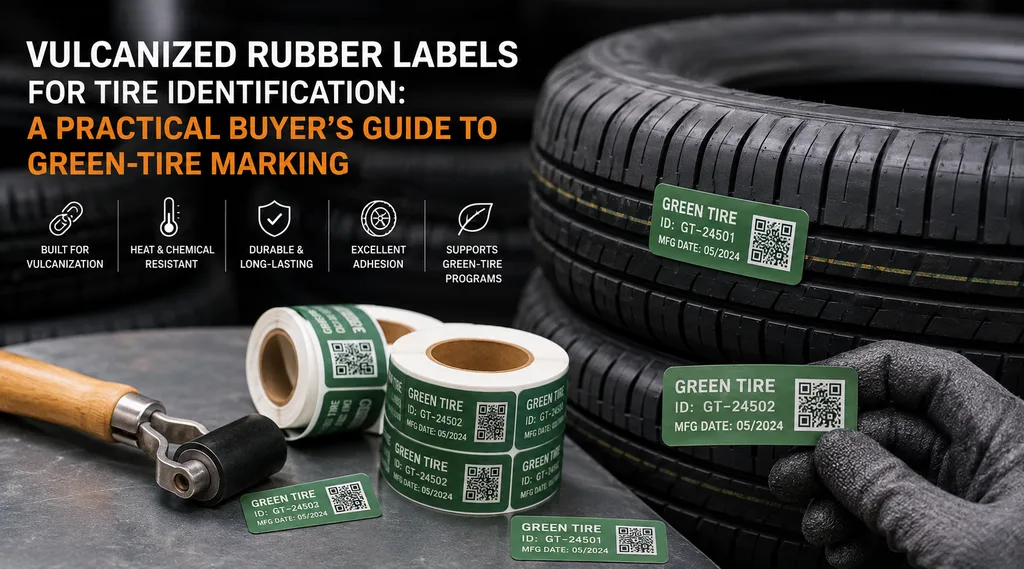
Vulcanized Rubber Labels for Tire Identification are high-temperature label constructions applied to a green, uncured tire so that they bond with the rubber during the curing cycle and stay readable on the finished product. They are not applied afterward. Vizlent describes the bond as forming during the same cycle that seals the tread and sidewall into their final shape.
The appeal for a tire plant is sequence. Vulcanized Rubber Labels for Tire Identification go on before the cure and are still there afterward, so a single application step carries work-in-process data through curing, cooling, final inspection and dispatch. The practical questions are which construction to use, where to place it, and how to print it so the code still verifies afterward.
What Are Vulcanized Rubber Labels for Tire Identification?
A vulcanized rubber labels for tire identification is a printable film plus adhesive system engineered for application to uncured rubber and for bonding with that rubber during the cure. The cured construction becomes durably integrated with the rubber surface rather than remaining a conventional pressure-sensitive sticker. Vizlent groups these constructions under its vulcanized rubber label category. (Vizlent product data.)
Suppliers in this category generally offer three constructions:
- Co-vulcanizing labels, applied to green rubber and bonding during the cure.
- Vulcanization-resistant labels, applied before the cure and formulated to survive it.
- Post-cure durable labels, applied to the finished tire for warehouse, retail or fleet use.
These are supplier and product categories rather than standardized industry classifications, so compare actual cure-cycle performance instead of relying on the product name. Procurement teams often write the requirement as vulcanized rubber labels for tire identification labels, which is wordy but a useful signal, because it asks for in-mold survivability rather than heat resistance applied after the fact. In my experience those two requirements get confused more often than any other point in a tire label specification. (Author recommendation.)
How the Label Bonds Inside the Curing Press
Vulcanization is a crosslinking reaction. Sulfur or a sulfur donor forms sulfide bridges between polymer chains under heat and pressure, on a published recipe running at 140 to 180 degrees Celsius, with accelerators delaying the onset of crosslinking. Co-vulcanizing constructions sold as Vulcanized Rubber Labels for Tire Identification are formulated to develop a durable bond with the rubber during that same cycle, and any specific bonding mechanism belongs in the product’s technical documentation rather than in a category description.
Vizlent Label describes the resulting bond as chemical integration rather than surface adhesion, and states that a co-vulcanized label cannot be removed without damaging the rubber. It publishes a cure window of 150 to 200 degrees Celsius for its tire bead barcode labels, and rates the strong adhesive car tyre vulcanization barcode label for 170 to 200 degrees Celsius at up to 25 bar. Those figures describe two specific constructions, not the category, so confirm them against the current data sheet. (Vizlent product data.)
What the Vulcanized Rubber Labels Adhesive Has to Do
The vulcanized rubber labels for tire identification adhesive has to do several things in sequence. It has to hold the label in position on a tacky, uncured tire during handling and loading. Then it has to stay put while the tire is shaped inside the mold.
Only after that does the cure chemistry matter. Vizlent describes its formulation as a rubber-compatible high-tack adhesive that integrates with uncured rubber during the cycle, and its product pages cite resistance to sulfur agents and silicone-based mold releases. A data sheet is a screening tool rather than a result, so run a plant trial on your own compound and cure profile before committing to tooling. (Vizlent product data and author recommendation.)
Marking the Tire Identification Number Correctly
Under 49 CFR § 574.5(a), each new tire manufacturer must conspicuously label one sidewall by permanently molding into or onto it a TIN of 13 symbols, while retreaded tires carry a TIN of seven symbols. Section 574.5(b) sets the groupings: a three-symbol plant code assigned to the manufacturer or retreader by NHTSA upon request (§ 574.5(b)(1)), a six-symbol manufacturer’s code that is the second group for all new tires and is not used on retreads (§ 574.5(b)(2)), and a final date code of four numerical symbols (§ 574.5(b)(3)). The 13-symbol format and the three-symbol plant code come from NHTSA’s final rule effective 13 April 2015, which permitted previously assigned two-symbol plant codes to remain in use until 13 April 2025. (Regulation.)
One detail is narrower than it is usually described. The laser-etching allowance at § 574.5(d)(1) applies to the information in paragraph (b)(3), the date code, rather than to the whole TIN, and that etching must occur during manufacture and not later than 24 hours after the tire is removed from the mold. Because a label is not among the permitted marking methods, requests written as vulcanized rubber labels for tire identification numbers refer to serialized plant and traceability codes rather than to the molded DOT TIN. (Regulation.)
Three markings coexist on a finished tire:
- The molded TIN, with the date code optionally laser etched, is the regulatory identifier for recall and registration under 49 CFR Part 574.
- The cured-in barcode or 2D code is the plant and supply-chain identifier carrying build order, machine, shift or press data.
- The EU tyre label under Regulation (EU) 2020/740 is a consumer-facing marking for fuel efficiency, wet grip and external rolling noise.
Material Construction and Thickness
Vulcanized Rubber Labels for Tire Identification are built from a dimensionally stable high-temperature film facestock, a protective topcoat and a rubber-compatible adhesive. Vizlent credits the topcoat with resisting chemical exposure from sulfur agents and silicone-based mold releases during the cure. That layer protects the printed image, which is why topcoat and ribbon have to be specified together. (Vizlent product data.)
Published thicknesses give a useful reference band. Vizlent lists 80 to 150 microns for bead barcode labels and 75 to 125 microns for the strong adhesive tyre barcode label, and its vulcanization resistant labels and vulcanized tire labels pages describe polymers rated for sustained exposure past 200 degrees Celsius. Treat those as construction-specific figures rather than as a definition of the category. (Vizlent product data.)
Blank Stock, Converting and Print Method
A common approach for serialized work is to buy vulcanized rubber labels blank, on rolls, and print variable data at or near the production line. That keeps the printed code matched to the build order in front of the operator. Blank stock also lets you standardize one facestock across several tire lines and change only the die.
Vizlent’s published guidance recommends thermal transfer with a high-durability resin ribbon for surviving curing press conditions. Direct thermal media forms its image by heating a coating, so it responds to process heat as well as to the printhead, which makes it structurally unsuited to a cure cycle. Match the ribbon to the specific topcoat rather than to the printer brand, and check the pairing across Vizlent’s thermal transfer ribbon range before committing to a run. (Vizlent product data and author recommendation.)
Where Labels Go on the Green Tire
Placing Vulcanized Rubber Labels for Tire Identification is a compromise between scanner access and rubber movement. Vizlent sizes and formulates a dedicated product for the bead region, and describes bead placement as keeping identification accessible for scanning on the finished tire. Inner liner placement is the other published option where the code only needs to survive to final inspection. (Vizlent product data.)
The green tire is shaped inside the mold during the cure, so a label on it is deformed as well as heated. Barcode quality is measurable rather than a matter of judgment, and the applicable standard follows the symbology: ISO/IEC 15416 covers print quality for linear symbols, and ISO/IEC 15415 covers two-dimensional symbols. Search phrasing such as vulcanized rubber labels automotive tires points to the same need: verify cured samples against the applicable standard rather than assessing them by eye. (Standard.)
Ready to test placement on your own compound? Send your cure profile and bead geometry to the Vizlent technical team and ask for sample rolls before you commit to tooling.
Beyond Tires: Rubber Goods, Packaging and Industrial Traceability
The approach behind Vulcanized Rubber Labels for Tire Identification extends to other cured rubber parts that need a permanent mark. Vizlent lists conveyor belts, air springs, automotive coolant hoses, seals and industrial rubber goods alongside tire bead and tread labeling. That is why the category sits next to heat resistant labels and general durable label stocks. (Vizlent product data.)
Buyers researching vulcanized rubber labels and packaging are usually solving two problems at once. The cured-in code handles the part itself, while a separate outer label handles the carton, pallet or shipping unit through distribution. Those outer labels are ordinary self-adhesive material or outdoor weather resistant constructions, and specifying one construction for both jobs is a pattern I would avoid. (Author recommendation.)
Buying: Specification, MOQ and Supplier Screening
Vulcanized Rubber Labels for Tire Identification are engineered stock, so search phrasing such as vulcanized rubber labels for sale leads quickly to minimum order quantities. Vizlent publishes an MOQ of 5,000 pieces with 10 to 15 working days production for the strong adhesive tyre barcode label, and 5,000 to 10,000 pieces with 12 to 18 working days for bead barcode labels. Those are published figures for two specific products, so confirm current MOQ and lead time at quotation. (Vizlent product data.)
Enquiries phrased as vulcanized rubber labels business usually come from plants moving out of trial and into repeat purchasing, and the pricing conversation changes at that point. For tire plants purchasing repeatedly, pricing should be quoted around coated width, roll length, die tooling and annual volume rather than piece count alone. Ask how the supplier handles lot traceability on the label stock itself, because a recall investigation that cannot link a label lot to a build order defeats the purpose. (Author recommendation.)
A Numbered Specification Checklist to Send With Your RFQ
These ten items are what our team asks for when a tire plant opens a new program. Supplying them up front is what turns a general enquiry into a quotable vulcanized rubber labels bulk order. The list works with any competent supplier, not only with us.
- Cure profile: peak temperature, dwell time, ramp and pressure.
- Rubber compound: base polymer, cure system, and any silicone-based mold release.
- Application point: bead, inner liner, sidewall or tread shoulder, with a drawing.
- Application method: hand, semi-automatic or in-line, and label temperature at application.
- Label size and die shape, plus corner radius and matrix removal.
- Print requirement: symbology first (Code 128, QR, Data Matrix), then module size and the target grade under the applicable standard, ISO/IEC 15416 for linear symbols or ISO/IEC 15415 for 2D.
- Printer and ribbon in use, or a request for a recommended pairing.
- Post-cure read point: fixed scanner or handheld, plus distance and lighting.
- Service life: to final inspection, to dispatch, or through the full tire life.
- Annual volume, MOQ tolerance and packaging (roll diameter, core size, labels per roll).
Two items get left blank most often, and both cause rework. Mold release chemistry changes the adhesion problem, and the read point changes the die size and code module width. Include them even if the answer is provisional. (Author recommendation.)
Common Failure Modes and How to Prevent Them
Common failure modes include print smearing, loss of barcode verification grade, and edge lift. Print smearing traces back to a ribbon and topcoat that were never matched, and verification loss to placement across a high-strain zone. Edge lift traces back to green rubber that was dusty, cold or dressed with a release agent at the application point.
Prevention is mostly procedural rather than material. Run a graded verification read on a cured sample from each new compound, keep a retained sample per lot, and re-qualify whenever the cure profile or mold release changes. Vizlent’s knowledge library and its vulcanized tire label primer are useful starting points, and the automotive label category covers the adjacent parts marking a tire plant usually needs.
Next Step
If you are scoping Vulcanized Rubber Labels for Tire Identification for a new line, or replacing a construction that is failing verification, the fastest path is a sample trial on your own compound and cure profile. Send the ten specification items listed above, request sample rolls, and ask for the current technical data sheet and declaration of conformity for the construction you are quoting.
Request a quotation and sample rolls from Vizlent or read more about the company and its manufacturing scope before you shortlist suppliers.
Frequently Asked Questions
Do Vulcanized Rubber Labels for Tire Identification replace the DOT tire identification number
No. Under 49 CFR § 574.5(a) the TIN must be permanently molded into or onto the sidewall, and the laser-etching allowance at § 574.5(d)(1) covers only the date code in paragraph (b)(3). A label is not among the permitted marking methods, so it cannot serve as the TIN. Cured-in labels carry plant, build order and traceability data alongside the TIN, serving manufacturing and logistics rather than recall and registration.
What is the current TIN structure for a new tire?
Thirteen symbols in three groups: a three-symbol plant code assigned by NHTSA on request, a six-symbol manufacturer’s code, and a four-symbol numerical date code, per 49 CFR § 574.5(b)(1) to (b)(3). Retreaded tires carry a seven-symbol TIN and do not use the manufacturer’s code. The format comes from NHTSA’s final rule effective 13 April 2015, which allowed previously assigned two-symbol plant codes until 13 April 2025. Verify against the current eCFR text before relying on it for a compliance decision.
At what temperature do these labels have to perform?
That depends on the construction, and category-wide figures are not reliable. Vizlent publishes a 150 to 200 degrees Celsius cure window for its bead barcode labels, rates the strong adhesive tyre barcode label at 170 to 200 degrees Celsius and up to 25 bar, and describes other products as rated past 200 degrees Celsius. For context, a published sulfur vulcanization recipe runs at 140 to 180 degrees Celsius. Ask for the data sheet and validate against your own cure profile.
Can I apply the label after the tire is cured instead?
You can, but it is a different product and a different bond. A post-cure label relies on pressure-sensitive adhesion to a textured, low-surface-energy rubber face rather than on bonding during the cure. Post-cure labels suit warehouse, retail and fleet marking; for identification that must pass through the curing press, a co-vulcanizing construction is the intended product.
Are these labels available blank for in-house printing?
Yes, and blank roll stock is a common format for serialized work. Buying vulcanized rubber labels blank lets you print variable data at or near the line so the code matches the build order in real time. It also simplifies inventory, since one facestock and a small set of dies can cover several tire lines. Confirm roll diameter, core size and labels per roll at quotation.
Is a vulcanized rubber labels bulk wholesale arrangement worth it?
It depends on whether the construction has become repeat business rather than a one-off trial. Engineered label stock is quoted on coated width, roll length and die tooling as well as piece count, so an annual volume commitment gives a supplier something to price against. Vizlent publishes MOQs of 5,000 to 10,000 pieces and lead times of 10 to 18 working days for two of its tire products. Ask for current figures at quotation rather than relying on a published number.
How do these labels fit with RFID tire tagging?
They address different parts of the same program. ISO gives the scope of ISO 20909:2019 as specifying requirements for using an RFID tag to individually identify a tyre, covering embedded, patch and sticker tag types across all tyre categories. An optical code and an RFID tag can serve different identification and workflow requirements within one traceability plan, and the optical code needs no reader infrastructure at the press. Sequencing the barcode first and adding RFID where the payback is identifiable is my own recommendation rather than a documented industry norm.






