
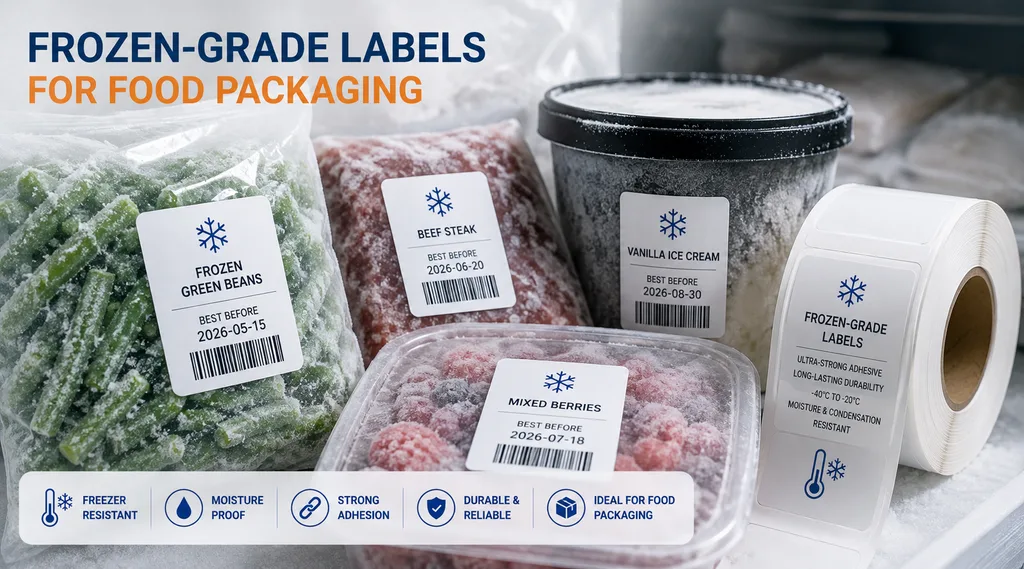
Unsure where to find Frozen-grade labels for food packaging? Check out five supplier types: pressure-sensitive material manufacturers who coat the laminate, label converters who print and die-cut it, stock distributors who ship blank rolls, packaging equipment dealers, and B2B marketplaces. Go to a material manufacturer like Vizlent Label or its converter when you need documented adhesive performance at freezer temperature plus a food-contact declaration. Use a stock distributor when the spec is ordinary and you need rolls this week.
How to read this guidance: statements citing a regulation are regulatory requirements, statements about typical practice are industry convention, figures attributed to Vizlent are our published product data, and the rest is our recommendation as a manufacturer.
What “Frozen-Grade” Actually Means on a Spec Sheet
The term gets used loosely, and that looseness costs money. In practice, frozen-grade labels for food packaging are constructions whose adhesive holds a measurable bond at freezer temperature and whose facestock will not swell or shred once frost forms. Face, adhesive, and liner all have to survive the same trip.
Two temperatures matter, and they are not the same figure. Application temperature is the container surface at the moment of contact; service temperature is the range the labeled pack lives in afterward. No single universal range defines “frozen-grade” stock, because suppliers classify constructions differently, so compare published minimum application and service temperatures for the complete construction rather than the category name.
Freezer-Grade Adhesive vs. All-Temperature Adhesive
Buyers confuse these two constantly. An “all-temperature” adhesive is typically rated to apply just above freezing, which describes a chilled cooler rather than a freezer. It looks fine on the line and can be released weeks later in a deep cold.
Freezer adhesives are formulated to retain workable wetting, tack, and peel adhesion as temperature falls, with polymer properties such as glass-transition behaviour among the influencing factors. Substrate energy, application pressure, dwell time, and surface moisture shape the outcome alongside the chemistry. Our low-temperature label materials range spans commercial blast freezer conditions through constructions intended for liquid nitrogen storage.
| Adhesive class | Application temperature | Service range | Typical use |
|---|---|---|---|
| Standard permanent acrylic | Room temperature | Ambient and chilled | Dry goods, shelf-stable packs |
| All-temperature | Just above freezing | Down to about -20°F | Chilled dairy, produce |
| Freezer-grade acrylic | Below freezing, formulation dependent | Down to about -40°F | Frozen retail packs, cases |
| Deep-freeze / cryogenic | Apply at ambient, hold in deep cold | Specialized ultra-low constructions, some published for liquid-nitrogen conditions near -196°C | Ultra-low freezers, LN2 storage |
Indicative industry convention, not a regulatory classification. Performance is construction-specific, so confirm every figure against the technical data sheet for the exact facestock, adhesive, and liner.
Frozen Grade Labels Requirements You Should Verify First
Sourcing frozen-grade labels for food packaging starts with four documents, not four phone calls. Ask for an adhesive data sheet stating application and service temperature separately, a food-contact declaration, a print-and-scan report, and a retained-sample policy. Suppliers who cannot produce those quickly are often reselling stock they did not coat.
The frozen grade labels requirements that catch first-time buyers are rarely about raw cold. Condensation, freeze-thaw cycling, and rough carton fiber create failure modes that a static temperature rating does not capture. Write your real test conditions into the purchase order so the quote reflects your process, not a lab bench.
- Adhesive TDS showing minimum application temperature, not just service range
- Food-contact statement citing the applicable regulation by number
- 180° peel value on your substrate after conditioning at your storage temperature
- Barcode grade measured after repeated freeze-thaw cycles
- Lot traceability with retained samples and a stated retention period
Ready to spec a construction instead of guessing? Send your container material and coldest storage temperature through the Vizlent contact form.
Food-Contact Compliance Most Suppliers Gloss Over
Most food labels sit on the outside of a sealed film, tray, or carton, which places them in indirect food contact. In the United States, some indirect food-packaging adhesive applications can be covered by 21 CFR 175.105, subject to its conditions and limitations, which include separation by a functional barrier or contact limited to dry food and trace amounts at seams and edges. Where the adhesive would itself be the food-contact surface of a label applied to food, 21 CFR 175.125 sets separate prescribed conditions, with different permitted substances for poultry, dry foods, and processed or frozen fruits and vegetables.
Europe layers a general safety duty on top. Regulation (EC) No 1935/2004 requires that food-contact materials not transfer constituents in quantities that endanger human health or unacceptably change the food’s composition or organoleptic characteristics. Vizlent product data for custom labels for the food and beverage industry states FDA 21 CFR indirect food contact with EU 1935/2004 declarations on request, and buyers should obtain the declaration covering their exact construction before relying on it.
Field note: FDA does not “approve” finished label stock as a blanket category, and 175.105 separately requires finished food-packaging adhesive containers to be marked “food-packaging adhesive.” Ask the supplier to identify the specific regulatory basis and conditions of use rather than accepting the slogan.
Where to Find Frozen-Grade Labels for Food Packaging: Five Channels
Each channel solves a different problem, and choosing wrong is why sourcing drags on. Manufacturers control the laminate, converters print and die-cut, distributors hold blank stock, dealers bundle labels with applicators, and marketplaces aggregate everyone. Volume, artwork, and paperwork decide which one fits.
Buying frozen-grade labels for food packaging and storage from the wrong tier shows up as a gap between what was promised and what the roll does. A distributor cannot change an adhesive formulation. A converter can, but only by asking the coater who made it.
1. Pressure-Sensitive Material Manufacturers
These factories coat adhesive onto facestock and wind the master rolls. Going direct makes sense with steady annual volume, an adhesive matched to a specific carton or film, or documentation needed from the source. Vizlent has coated and slit pressure-sensitive laminates since 2011 and publishes ISO 9001, FSC, and SGS certification, which any buyer should request as current dated copies.
The trade-offs are minimum order quantity and tooling lead time. Custom coatings are quoted per project, so ask for the MOQ and the sampling schedule in the same email. Our deep-freeze label stock page sets out the synthetic faces and cold adhesives available.
2. Label Converters and Commercial Printers
Converters buy master rolls, print your artwork, die-cut to shape, and deliver finished rolls. They suit most food brands because they own the plate, color, and varnish decisions. Ask which manufacturer supplies their low temperature label stock, because that answer names who is accountable for cold performance.
Good converters run a press proof on your substrate and let you freeze it first. Frozen-grade labels and packaging need validating together, since a matte carton and a gloss-laminated film behave differently at -18°C. Print chemistry matters too, and our beverage label materials notes cover why UV-cured inks resist moisture better than water-based systems.
3. Stock Label Distributors
When you need blank thermal rolls this week, distributors win. They warehouse standard sizes in direct thermal and thermal transfer constructions with freezer adhesive already applied. Expect a narrower spec sheet and little appetite for substrate testing.
This channel suits internal traceability, date coding, and case marking. It is a weaker fit for retail packaging where color fidelity drives shelf appeal. If you print inside a cold room, pair the stock with a resin or resin-hybrid ribbon rather than wax.
4. Packaging Equipment Dealers
Applicator vendors sell labels because a bad label makes their machine look broken. Use them when commissioning a line, since they match label caliber, liner, and roll diameter to the dispensing plate. They also know whether your cold product needs a tamp or tamp-blow head.
The catch is price, since you pay for integration rather than material depth. Use dealers for validation and first-article approval, then decide where repeat volume goes. Our logistics and e-commerce label materials page covers the barcode grades carriers apply to shipping labels.
5. B2B Marketplaces and Trading Companies
Alibaba, Made-in-China, and regional directories surface hundreds of suppliers in an afternoon. Those listings are price discovery, not qualification. Treat any freezer label offer without a published adhesive data sheet as unverified.
Ask three questions before sampling: who coats the adhesive, what is the minimum application temperature, and can you supply a food-contact declaration. Suppliers who answer all three in writing deserve a sample order. Suppliers who answer with photographs do not.
Not sure which tier fits you? Tell us your annual roll count and we will say honestly whether to buy from us or from a local converter. Start there.
Frozen-Grade Labels for Food Packaging and Shipping: Two Different Jobs
Retail packs and shipping cases fail differently, so one construction for both is a false economy. Retail labels face ice crystal abrasion and handling under bright light, which favors film faces that stay flat and legible. Frozen-grade labels for food packaging and shipping instead face conveyor scuffing, pallet strapping, and scans through frosted optics.
The substrate decides more than buyers expect. Cartons out of a blast freezer carry raised fibers and a cold, damp surface, which is what defeats a general-purpose acrylic. For yard storage and reefer transfers, our outdoor weather-resistant materials hold up better than a paper face with a topcoat.
- Retail frozen packs: BOPP or PE face, freezer acrylic, UV-cured inks
- Cases and cartons: high-tack freezer acrylic, thermal transfer paper with resin ribbon
- Reefer and pallet labels: PET face, permanent acrylic, laminate overlay
- Internal traceability: direct thermal freezer stock applied before the blast freezer
Facestocks That Survive Frost and Condensation
Conventional paper facestocks are cheap, and they are usually the first to struggle in humid cold. They absorb moisture from condensation, fibers swell, and print contrast can drop exactly when a scanner needs it, though engineered wet-strength papers resist this far better. Filmic frozen-grade labels are therefore common on consumer packs, built on BOPP, PE, or PET where moisture resistance and dimensional stability are the priority.
Published service ranges differ enough to change the decision. Polyester offers the widest window, BOPP sits in the middle at moderate cost, and flexible vinyl trades range for conformability. Construction data sits in our self-adhesive material reference, and a laminating film overlay adds abrasion resistance.
Frozen Grade Labels for Food Traceability and Lot Coding
Traceability is quietly becoming a major driver of cold storage label spend. The FDA’s Food Traceability Rule (FSMA 204) requires specified Key Data Elements associated with defined Critical Tracking Events and traceability lot codes, covering activities such as cooling, initial packing, shipping, receiving, and transformation. Congress directed FDA not to enforce the rule before 20 July 2028, which leaves a real window to fix labeling first.
The rule does not reach every food, because those records apply to items on the Food Traceability List and to foods containing them in the same form. Several “fresh” entries expressly exclude previously frozen forms, so check the list against your SKUs before assuming your frozen line is covered. Where the rule does apply, frozen grade labels for food traceability should be verified at your coldest point rather than on a warm office bench.
- Print lot codes with resin ribbons on synthetic stock for smear resistance
- Verify barcode quality after freezing, not before
- Keep retained samples matched to material lot numbers
Application Errors That Kill Cold-Chain Labels
Most frozen-grade labels for food packaging fail at the application step, not the material step. Cold air holds less moisture, so water condenses on anything entering a freezer, and emulsion acrylics perform poorly on wet surfaces. Air knives and other surface-drying measures can reduce moisture-related application problems where the process allows them.
Dwell time is the second culprit. Adhesives need time to reach full bond, and dropping a pack straight into deep cold interrupts that build. Label at ambient temperature wherever the process allows, then freeze.
- Apply before the blast freezer wherever the line permits
- Use tamp-blow heads for recessed lids and uneven cartons
- On edge lift, check surface preparation, application pressure, dwell, label geometry, and contact area before moving to a more aggressive adhesive
- Store rolls in controlled conditions and let cold stock acclimate before running
Cost, MOQ, and Lead Time Reality Check
Freezer constructions cost more than general-purpose stock because face and adhesive both change. Film faces carry the larger premium, and ultra-low grades sit higher again. Budget for frozen grade labels as a food safety line item, since the honest comparison is one rejected pallet against price per thousand.
Lead times split by channel. Stock rolls ship quickly, converted work adds artwork approval and tooling, and a bespoke coating trial adds a sampling round. Build sampling and a freeze test into the schedule rather than discovering the gap mid-production.
Want proof before you commit? Ask for test rolls of low-temperature laminate with the matching technical data sheet, then freeze them on your own packaging before approving anything. Request samples here.
Frequently Asked Questions
Are frozen-grade labels for food packaging safe for direct food contact?
Usually not, and the distinction matters commercially. Standard frozen-grade labels for food packaging are qualified for indirect contact, meaning they sit outside a sealed pack or behind a functional barrier. Where the adhesive would be the food-contact surface of a label applied to food, 21 CFR 175.125 sets its own prescribed conditions, so flag direct contact at the quoting stage and expect a different construction, ink set, and documentation package.
Where can I buy frozen-grade labels for food packaging in small quantities?
Stock label distributors are the fastest route for small runs, because they warehouse blank freezer-adhesive rolls in standard sizes. Converters will also run short digital jobs when you need printed artwork rather than blanks. Material manufacturers are the wrong first call for a one-off box, since master roll coating is built around scheduled production.
Can I apply a label to an already frozen container?
Yes, if the adhesive’s minimum application temperature is low enough and the surface is dry. Frost or condensation blocks wetting no matter how aggressive the adhesive is, so wipe or air-knife the surface first. The safer engineering answer is to label ahead of the freezer, and where the line cannot move, to size up the label and pick the most aggressive freezer acrylic available.
What is the difference between freezer-grade and cryogenic label stock?
Freezer-grade covers ordinary frozen food temperatures, which is where retail packs, cases, and cold-chain shipments live. Cryogenic stock targets ultra-low freezers and liquid nitrogen storage, using different faces and far more aggressive acrylics, as shown in our ultra-low temperature cryogenic labels. Food operations rarely need cryogenic grades, so match the grade to the coldest point in your real chain and add one step of margin.
Do frozen-grade labels work on corrugated cartons?
They can, but corrugated is one of the harder surfaces in cold storage. Recycled liners are porous and often dusty, and a carton pulled from a blast freezer carries both cold and surface moisture. A high-tack freezer acrylic and a larger label area help, but test on the exact board grade you buy, because liner quality varies between suppliers.
Which printing method suits frozen food labels best?
Thermal transfer is often preferred for durable variable data in cold-chain work, with ribbon choice matched to the facestock and to abrasion, moisture, and scanning requirements rather than temperature alone. Direct thermal is cheaper and works well for short-life internal labels applied before freezing. Retail artwork is normally flexo, UV offset, or digital, and the print method should be chosen together with the facestock rather than after it.
Do I need a different label for refrigerated versus frozen products?
Often yes, because chilled and frozen are different adhesive problems. A chilled cooler sits above freezing, where an all-temperature adhesive is usually sufficient. Frozen storage pushes past the point where those adhesives stay flexible, so specify for the colder condition whenever a single SKU moves through both.
How do I prove a frozen label will actually hold?
Run a condition-and-peel test using your own pack, filling temperature, and storage profile. Apply the labels on the line rather than by hand, since applicator pressure and dwell differ from thumb pressure. Freeze, cycle, check both adhesion and barcode readability at the coldest point, and keep retained samples tied to the material lot number.
Ready to specify frozen-grade labels for food packaging with confidence? Send the eight lines below to the Vizlent technical team and we will return matched samples with the technical data sheet and the applicable compliance statement attached.
- Container or carton substrate, including board grade or film type
- Surface temperature at the moment of application
- Lowest service temperature the labeled pack will reach
- Moisture exposure: condensation, ice contact, wash-down, or immersion
- Label size, shape, and whether the surface is curved or recessed
- Print method and, for thermal transfer, the ribbon you currently run
- Annual volume and required lead time
- Compliance standard your auditor wants cited by number
Prefer to compare materials first? Worked comparisons sit in the Vizlent knowledge base.






