
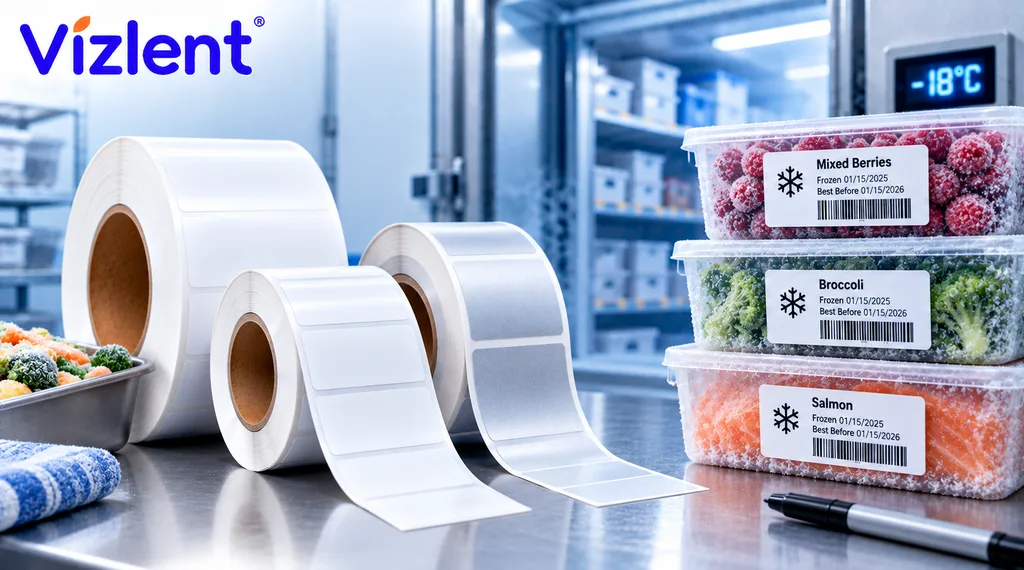
When you choose labels for frozen food containers, this means matching four things to the coldest, wettest moment in the product’s life: face stock, adhesive, print system, and food-contact documentation. Get one wrong and the label lifts, curls, or goes unreadable between the filling line and the retail case. It is a materials decision first and a design decision second.
Most buyers reach this question after a failure rather than before one. A pallet leaves the blast freezer with corners flagging, or a case barcode will not scan after two weeks at temperature. Below is the sequence our engineering team uses with converters and food brands.
Why Ordinary Labels Fail on Frozen Packs
A general purpose permanent adhesive is designed to wet out and flow across a surface at room temperature, and that flow builds bond strength over the first 24 hours. Apply it to a container already at -20°C and it never gets that chance. The bond you measure on day one is close to the bond you keep.
Face stock behaves differently in the cold too. Uncoated and lightly coated papers are hygroscopic, taking up moisture from condensation and frost, then changing dimension and separating between plies as they cycle. Film face stocks do not absorb water the same way, which is why durable label constructions are common where legibility must hold for months.
The failure modes that actually show up:
- Edge flagging on curved tubs and pouches, where the face stock is too stiff for the radius.
- Whole-label release after blast freezing, usually traced to application on a frosted surface rather than the adhesive rating.
- Print degradation, where direct thermal images fade or smear under wet handling.
- Barcode no-reads on retrieval, when frost plus low contrast pushes the symbol below a readable grade.
The Five Variables That Decide the Construction
Every workable specification for low temperature label stock resolves to five variables, and they are not equally weighted. Application temperature can matter as much as service temperature, particularly where labels go onto cold or frosted surfaces, which surprises buyers who lead with the freezer number. Surface, geometry, dwell time, and handling all sit alongside them, because no adhesive compensates for a face stock fighting a tight curve.
Work through them in order rather than in parallel, since each answer narrows the material set before you spend time on the next. Write the answers down. A supplier can only recommend a construction as good as the brief it receives.
1. Application Temperature Versus Service Temperature
Application temperature is the container surface temperature when the label touches it, and it is often the harder of the two to satisfy. A construction applied at ambient and then frozen has a far wider material set than one applied to a frosted pack. Vizlent product data specifies cryogenic constructions for application at +10°C or warmer, with aggressive cold-application adhesives where labelling onto pre-frozen surfaces is unavoidable.
Service temperature is what the pack sees afterwards, mapped across the whole route. FDA food-storage guidance recommends freezers at 0°F, or -18°C, a storage recommendation rather than a label standard. Blast-freezing and dry-ice shipments can expose packaging to temperatures well below normal freezer storage, depending on packaging configuration, contact, duration, and handling.
2. Container Material, Surface Energy, and Geometry
Frozen food arrives in a wider mix of substrates than almost any other category. Waxed corrugated, polyethylene liners, polypropylene tubs, PET trays, and shrink film all carry different surface energies, and the low-energy ones resist adhesion whatever the temperature. Constructions built for them are grouped as super sticky low-energy stock.
Geometry decides how much stress the bond carries. As label width increases relative to a curved container, the face stock and adhesive face greater conformability and peel stresses, and that stress concentrates at the corners where flagging starts. Radiused die corners, a more flexible face stock, and a smaller footprint solve more cold-storage complaints than switching adhesive does.
3. Moisture, Condensation, and Freeze-Thaw Cycling
Moisture attacks at three stages: condensation at application, frost in storage, and a rapid dew layer on retrieval. A construction that survives static cold can still fail when the pack cycles between warehouse, van, and retail case. Cycling, not absolute temperature, is what breaks marginal specifications.
Film face stocks with suitable moisture resistance are often preferred where condensation and repeated wet handling are expected, though laminated paper and revised application sequencing solve some cases. Vizlent publishes a moisture vapour transmission rate below 0.3 g/m²/day for a specified 45-micron BOPP label material construction under that product’s stated test conditions, so ask for the test method, temperature, and relative humidity on the data sheet. Where the pack is washed down or hot-filled before chilling, polyester label material is usually more forgiving.
4. Print System, Not Just Printer
Print durability in the cold depends on the complete print system: top coat, ribbon chemistry, printhead settings, and handling, not the printer model alone. Direct thermal suits short-life case and date labels because it needs no consumable, but the coating is heat and abrasion sensitive. Thermal transfer is often selected where labels need durable printed information through extended cold-chain handling.
Ribbon choice follows the face stock. Wax grades sit at the economical end of the thermal transfer ribbon range and print well on coated paper for short-cycle cases. For film face stocks, wet handling, or any barcode facing months of cold, our engineers specify a full resin ribbon.
5. Food-Contact Scope and Printed Content
Two regulatory questions apply, and buyers routinely merge them. The first is whether the materials suit their proximity to food, addressed in the United States by 21 CFR 175.105, which covers adhesives in food-packaging articles where the adhesive is separated from food by a functional barrier or meets specified limitations, and 21 CFR 175.125, which covers pressure-sensitive adhesives used as the food-contact surface of labels and tapes applied to food under prescribed conditions. Citing a section does not by itself establish compliance, so request current compliance documentation for your intended use and jurisdiction.
The second question is what must be printed, which in the United States falls under the FDA Food Labeling Guide for most packaged foods and USDA FSIS for meat, poultry, and egg products, with the FTC Fair Packaging and Labeling Act covering consumer commodities subject to scope and exemptions. In the EU, framework Regulation (EC) 1935/2004 governs food-contact materials. Requirements vary by market, product category, and intended use, so confirm the applicable rules for every destination market before approving artwork or materials.
Labels for Frozen Food Containers and Packaging: Matching Face Stock to Format
Pack format changes the answer as much as temperature does. Retail primary packs prioritise print quality and shelf appearance, so film face stock with a clear top coat is the usual pick, and the logic behind chilled beer and beverage labels carries over to frozen ready meals. Case and pallet labels prioritise scannability and cost, which points to coated paper cold-temp constructions unless the case faces wash-down.
Buyers searching for labels for frozen food containers and freezer storage systems are usually solving two problems at once. The retail pack needs one construction; rack, aisle, and bin identification inside the cold store needs another, typically a heavier film or an aggressive-adhesive tag on painted steel. Specifying both from one self adhesive material supplier keeps ribbon and printer inventory consistent.
Published minimum ratings for named Vizlent constructions. Each rating belongs to the construction shown, not to the face stock family, so a polypropylene label is not rated to -196°C simply because it is polypropylene.
| Named construction (Vizlent published) | Published construction rating | Frozen food application | Print pairing |
|---|---|---|---|
| Specific polypropylene cryogenic construction | Published to -196°C / -320°F | Ultra-cold holding and cryogenic sample storage | Resin thermal transfer |
| Specific polyester deep-freeze construction | Published to -80°C / -112°F | Blast freezing, long-hold frozen inventory | Resin thermal transfer, laser |
| Specific flexible vinyl construction | Published to -40°C / -40°F | Tight-radius tubs and flexible packs | Thermal transfer |
| Specific coated paper cold-temp construction | Published to -20°C / -4°F | Cold-chain cases, corrugated outers, food processing | Direct thermal, digital |
Source: Vizlent Low Temperature Labels product data at the time of writing. Indicative only; confirm against the technical data sheet for your grade.
How to Label Frozen Food So the Data Survives
Knowing how to label frozen food is partly a materials question and partly a data question. The label has to hold, and the information on it has to stay traceable when someone asks. For labels for frozen products moving through distribution, the lot identifier matters as much as the brand panel.
Traceability rules are tightening on a known timetable. The FDA Food Traceability Rule under FSMA 204 sets recordkeeping requirements that labels support rather than regulating the label itself, and its compliance date moved out 30 months to July 20, 2028 in a Federal Register notice of August 7, 2025. Several fresh entries on the Food Traceability List exclude previously frozen forms, so confirm whether your product is in scope.
Data elements worth locking into artwork before you order:
- Traceability lot code, printed and encoded rather than handwritten on a blank flash.
- Production and durability dates in the format your market requires.
- A GS1-128 case barcode, and an SSCC on pallet units; under the GS1 Logistic Label Guideline, a logistic label without an SSCC is not a GS1 Logistic Label.
- Storage instructions, since frozen and previously frozen carry different handling obligations.
- Allergen and ingredient panels sized to stay legible through condensation.
- A verified symbol, graded under ISO/IEC 15416:2025 for linear or ISO/IEC 15415:2024 for two-dimensional codes, checked after a freeze-thaw cycle rather than straight off the printer.
Labels for Freezer Meals and Reusable Containers
Not every frozen application wants permanence, and this is where specifiers over-engineer most often. Labels for freezer meals in reusable tubs need to be released cleanly at the end of the cycle, which points to removable or wash-off grades rather than aggressive permanent ones. The same holds for labels for containers in freezer rotation systems, where the tub outlives the contents by hundreds of cycles.
Water-soluble constructions are the cleanest answer here. A water soluble sticker dissolves in the wash instead of leaving residue to scrape. If you are working out how to label food containers in a professional kitchen, removability matters more than a cold rating the container will never test.
- Reusable tubs and prep containers: removable or water-soluble grades, small footprint, high-contrast print.
- Retail freezer meal packs: film face stock, permanent cold-application adhesive, full-colour print.
- Home freezer use: labels for freezer food containers only need to hold at -18°C, so a coated paper cold-temp construction is usually enough.
- Foodservice bulk packs: coated paper cases plus a resin-printed film label where handling is wet.
Test and Source Before You Commit to Volume
A specification on paper is a hypothesis, and sampling is where it gets tested. Vizlent’s published sampling policy at the time of writing provides free A4 sheets and short sample rolls dispatched with the batch-specific technical data sheet. Whether a supplier sends both is an early indication of its technical support process.
Commercial terms deserve the same scrutiny. Vizlent coats 12 or more face stocks against 8 adhesive grades spanning permanent, removable, freezer grade, and wash-off, with published lead times for custom OEM and ODM runs in the 7 to 15 day range at the time of writing and a stated minimum around 1,000 sqm on many grades. Some established manufacturers will customize the adhesive to your surfaces rather than selling the nearest catalogue item, and for demanding cold applications that development work can justify its additional cost when standard grades fail qualification testing.
- Define acceptance criteria first, in writing: maximum permitted edge lift, minimum barcode grade, no delamination, no print transfer, and a minimum peel result. Without them, the trial is subjective.
- Request the technical data sheet for the exact named construction, not the product category.
- Apply at line speed onto containers at their real surface temperature, condensation included.
- Cycle the samples through the freeze-thaw pattern your distribution route actually produces.
- Verify the barcode after cold retrieval using the applicable grading method, not a phone scan.
- Peel test the survivors, noting that ASTM D3330 is a peel adhesion method for pressure-sensitive tape and does not by itself validate a finished label.
Ready to specify? Short trials are screening conditions rather than proof of long-term service life, so ask whether the quoted grade has run in a comparable frozen food packaging application and request the documentation with the quote rather than after the order. Our guide on where to buy food labels stickers covers the routes from print shop to factory direct. Request a quote and free samples.
Get the Construction Right the First Time
Frozen applications punish guesswork, and the cost of a failed label is rarely the label itself. It is the rejected pallet, the unreadable lot code, and the relabelling shift nobody planned for. Specifying properly at the start is the cheapest step in the sequence.
Vizlent supplies low temperature label stock and finished constructions including ultra low temperature resistant cryogenic labels and deep-freeze labels to converters, brand owners, and distributors across the cold chain worldwide. More material selection background sits in our knowledge library. Five steps take you from question to validated construction:
- Submit your specification: container material, application temperature, lowest service temperature, print method, annual volume.
- Receive a recommended construction from our engineering team, with alternatives where a trade-off exists.
- Request the technical data sheet for the named grade and review it against your compliance requirements.
- Test free samples on your own line and through your own freeze-thaw cycle.
- Quote at volume once validated, with roll width and core size matched to your equipment.
Next step: send your specification to our engineering team and we will return a recommended construction and samples.
Frequently Asked Questions
How do I choose labels for frozen food containers for a new product line?
Work the two temperatures first, application and service, then the container surface, then the print system, and confirm food-contact documentation last. With no historical data, specify the coldest point in the intended route rather than the retail case, since blast freezing and transit run colder. Test two or three candidate constructions on your own line before locking artwork or die lines.
What temperature rating do I actually need for retail frozen food?
FDA food-storage guidance recommends freezers at 0°F, or -18°C, which is the holding floor rather than the coldest point a pack experiences. If the product goes through blast freezing, a hardening tunnel, or dry-ice shipping, specify to that lower number. Published ratings belong to specific constructions, so ask for the rating of the exact grade quoted.
Can labels be applied directly onto already frozen containers?
Yes, but it needs an adhesive formulated for frosted, damp, or pre-frozen surfaces, which is a different specification from a label applied warm and then frozen. Vizlent publishes aggressive cryogenic-grade acrylic adhesives for that situation. Applying at ambient and freezing afterwards, where you have the choice, is more forgiving and widens your material options.
Do washed-down packs need a different construction?
Wash-down adds chemical and pressure exposure on top of cold, so a film face stock with a resin-printed image is the safer pairing. Coated paper handles cold storage acceptably but degrades under repeated wet handling and sanitiser contact. Give your supplier the sanitiser chemistry and wash temperature, because a construction that survives cold water can fail against a caustic cleaner.
Which ribbon should I use for freezer labels?
Full-resin ribbons are often selected for film face stocks where abrasion, chemicals, moisture, or long service life demand high print durability. Wax and wax-resin grades are cheaper and print well on coated paper for short-cycle case labels shipping within days. Print durability depends on the complete system, so validate the ribbon against your face stock and printhead settings.
Are freezer labels safe to use on food packaging?
Constructions can be made with adhesives and face stocks suitable for indirect food contact, addressed in the United States by 21 CFR 175.105 and, where the adhesive is the food-contact surface of a label applied to food, 21 CFR 175.125. Citing a regulation does not by itself establish compliance for your application. Ask your supplier for current compliance documentation covering your intended use and jurisdiction.
How do primary pack labels differ from cold-chain logistics labels?
Primary pack labels prioritise print quality, shelf appearance, and regulated consumer-facing content, so film face stocks with clear top coats are common. Cold-chain logistics labels prioritise scannability, adhesion to corrugated and shrink film, and lot traceability, which points to coated paper cold-temp constructions. Many operations run both, and standardising ribbon and printer across them cuts consumable inventory.
How long will a freezer label stay attached and legible?
Service life depends on the construction, application conditions, print system, and handling, so any figure quoted without those conditions is incomplete. Well-specified film constructions printed with resin ribbon are used in applications measured in years, but a short trial is a screening test rather than proof of long-term performance. Ask for the supplier’s test conditions alongside any published service-life figure.






