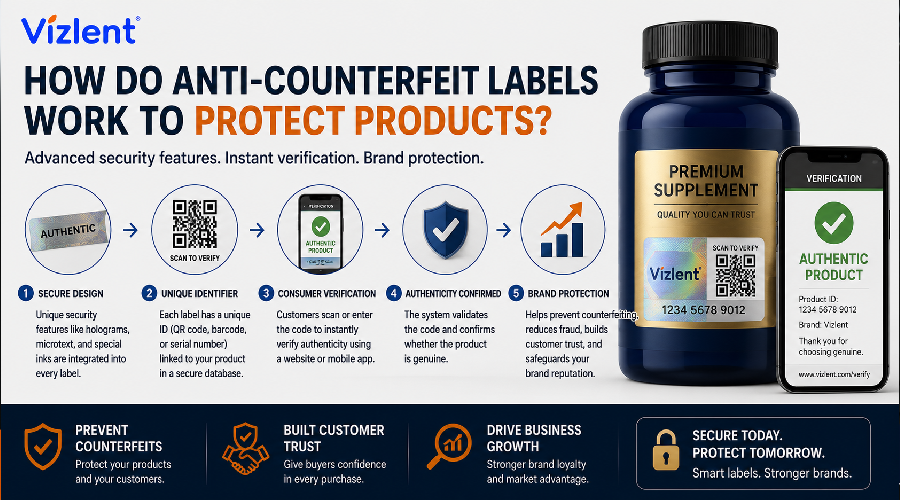
Anti-counterfeit labels work to protect products by combining visible, hidden, and digital security features into a single adhesive construction that proves a product is genuine and reveals any attempt to copy, tamper with, or divert it. These labels layer overt elements like holograms, covert elements like UV-reactive inks, and forensic or digital elements like serialized codes, so defeating one layer still leaves the others intact. The result is a physical and digital barrier that makes faking a product harder, costlier, and easier to detect across the supply chain.
Counterfeiting is no longer a niche problem confined to luxury handbags. According to the Organisation for Economic Co-operation and Development, roughly half of all tracked product categories are now affected by fakes, and counterfeit goods account for a meaningful share of global trade. Understanding how do anti-counterfeit labels work to protect products is the first step toward choosing a security construction that matches the real threat your brand faces.
What Anti-Counterfeit Labels Are and Why They Matter
Anti counterfeit labels are specialized adhesive tags engineered to verify authenticity and reveal interference, rather than simply carry branding or product information. The anti counterfeit label meaning centers on a single idea: the label itself becomes evidence, proving both that a product is genuine and that no one has opened or swapped it. This is what separates a security construction from an ordinary sticker that anyone could reproduce on a home printer.
The stakes are high because a single counterfeit or tampered unit damages trust across an entire brand, not just the affected item. Fakes now reach food, beverages, electronics, and pharmaceuticals, where a counterfeit can threaten health as well as revenue. Understanding how do anti-counterfeit labels work to protect products and services helps brands see that authentication defends not only the physical item but the reputation and customer relationship attached to it, which is why anti counterfeit stickers and seals give manufacturers a cost-effective way to protect consumers and maintain integrity from the factory to the shelf.
Key reasons brands adopt anti-counterfeit labels include:
- Proving a product is genuine at the point of sale
- Revealing tampering or unauthorized opening
- Detecting gray market diversion across regions
- Meeting regulatory authentication requirements
The Real Cost of Counterfeiting to Brands

The financial case for anti counterfeit labels rests on the scale of the counterfeit economy, which now touches nearly every consumer category. Industry and government estimates place the value of counterfeit and pirated goods in the hundreds of billions of dollars annually, with fakes accounting for a significant percentage of world trade. Each counterfeit sale represents lost revenue, a damaged customer relationship, and a small erosion of the brand equity a company spent years building.
The damage extends well beyond the immediate lost sale, which is what makes prevention so valuable. A counterfeit supplement or medicine can harm a consumer and expose the brand to liability, while a fake electronic component can fail in the field and trigger recalls. Gray market diversion, where genuine products are sold outside their intended channels, quietly undercuts pricing and distributor relationships, and anti counterfeiting label solutions with serialization are often the only practical way to detect it.
Counterfeiting inflicts several distinct forms of damage:
- Direct revenue loss from substituted fake sales
- Liability exposure from unsafe counterfeit goods
- Reputation erosion that weakens the entire brand
- Channel conflict from gray market diversion
The Three Layers: How Do Anti-Counterfeit Labels Work to Protect Products?
Understanding how do anti-counterfeit labels work to protect products starts with the industry’s three-layer model of overt, covert, and forensic features. Overt features are elements anyone can check by eye, such as holograms, color-shift effects, and visible tamper evidence, giving consumers and store staff a fast authenticity signal. Covert features are hidden elements like UV-reactive inks and microtext that require a tool or trained eye, which counterfeiters struggle to copy because they cannot confirm a successful match.
Forensic and digital features form the third layer, using serialized codes and laboratory-verifiable markers that let investigators authenticate an item and trace where a diverted unit entered the market. No single layer survives every attack forever, since a hologram that is hard to copy today gets easier as equipment spreads. Stacking layers keeps the cost of a successful attack higher than the reward, which is the real objective of any anti counterfeiting label solutions program.
The three protection layers work together as follows:
- Overt: Holograms, color-shift inks, visible VOID patterns
- Covert: UV-reactive inks, microtext, hidden markers
- Forensic and digital: Serialized QR codes, 2D barcodes, NFC inlays
Worried about counterfeiting in your supply chain? Talk to Vizlent about a security-label assessment built around the threats your brand actually faces.
Tamper-Evident and VOID Labels
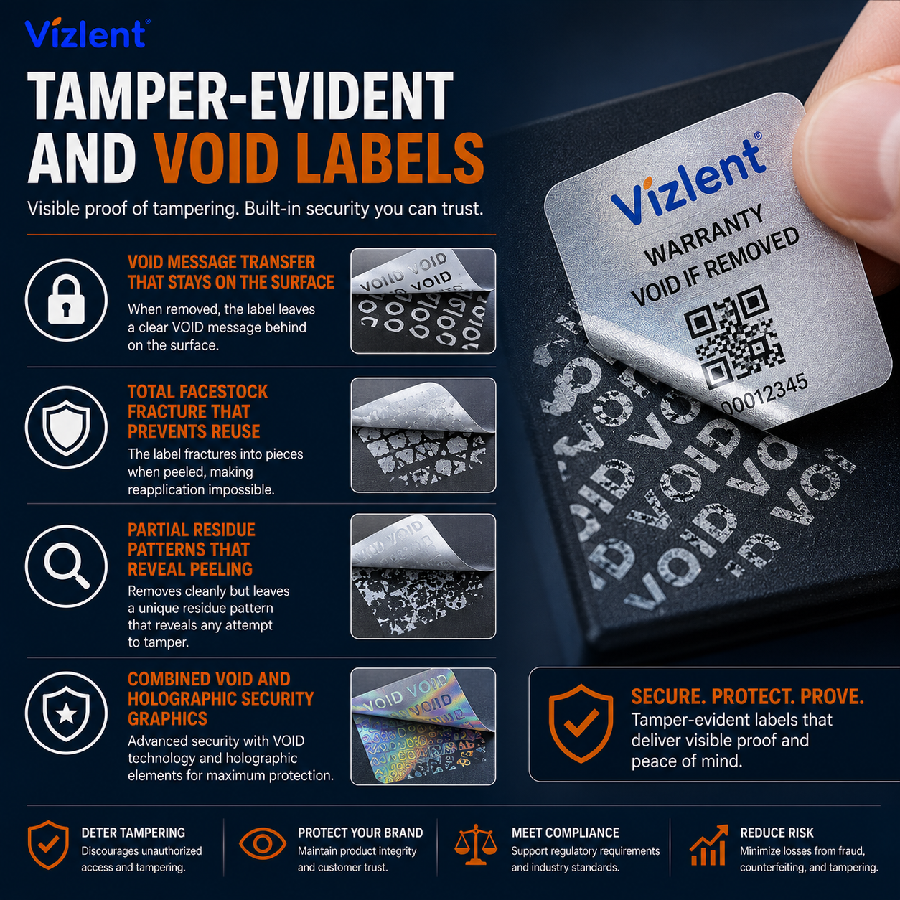
Tamper evidence is the property most anti-fake labels specify first, because it stops a genuine label from being peeled off and reapplied to a counterfeit product. A tamper-evident security label shows clear, irreversible proof when someone attempts removal, which makes relabeling impractical. For food, supplements, and electronics, that visible proof is often the difference between a contained incident and a full recall.
VOID stickers achieve this through the adhesive layer itself rather than the printed surface. When the label is lifted, a printed pattern such as the word VOID transfers to the surface and stays behind, and the residue cannot be cleaned off without leaving its own evidence. Vizlent’s VOID sticker constructions turn the adhesive from a simple bonding agent into an active part of the security design.
Tamper-evident constructions come in several forms matched to different surfaces and risk levels. Some leave a message behind, others fracture on contact, and still others combine both behaviors with a printed security graphic that is hard to reproduce. Choosing among them depends on the packaging material, the storage environment, and how visible the brand wants the tamper signal to be at the point of sale.
Common tamper-evident label behaviors include:
- VOID message transfer that stays on the surface
- Total facestock fracture that prevents reuse
- Partial residue patterns that reveal peeling
- Combined VOID and holographic security graphics
Destructible and Eggshell Security Materials
Destructible facestocks take a different route to the same goal of preventing label transfer. Instead of leaving a message behind, the label fragments into small pieces when anyone tries to peel it, so there is never an intact label to move to another product. This approach suits warranty seals, asset tags, and closure seals where the label must die rather than travel.
Eggshell paper is the most brittle construction in this family, breaking apart at the slightest removal attempt. Vizlent pairs these destructible faces with aggressive adhesives matched to the target surface, since a destructible film only works when the bond is stronger than the facestock. This is why eggshell paper and similar materials need surface-specific engineering to perform as an anti counterfeit tag.
Common destructible security materials include:
- Eggshell paper that fractures on removal
- Destructible vinyl for warranty and asset seals
- VOID-release films that leave a permanent message
- Brittle polyester for high-security closures
Holographic Authentication and Custom Origination
Holograms give shoppers an instant, no-tools authenticity check, which is why they appear on spirits, cosmetics, and electronics worldwide. The security value depends entirely on where the hologram comes from, because a stock pattern bought from a catalog can be purchased by a counterfeiter just as easily. A generic hologram decorates a package more than it protects it.
Custom origination changes that equation completely. A hologram mastered specifically for one brand, with the master held under controlled custody and never reused, creates a genuine reproduction barrier that answers the question of how do anti-counterfeit labels work to protect products from counterfeit imitation. When evaluating suppliers, ask who owns the origination, how the master is stored, and if the optical design appears anywhere else.
Holograms also pair effectively with other layers to raise the difficulty of a successful fake. A holographic overlay combined with a serialized QR code gives both an instant visual check and a database-backed verification, while adding covert UV elements creates a third barrier that a counterfeiter cannot even see to copy. This layering is why holograms remain a common anchor feature in anti counterfeiting label solutions despite advances in copying technology.
Serialized Codes and Digital Track-and-Trace
Serialization gives every unit its own identity, which is the foundation of most modern brand protection programs. A unique QR code, 2D barcode, or NFC inlay printed into the label lets anyone with a phone verify a single item against a database of legitimate serial numbers. This is how anti-counterfeit labels barcode systems move authentication from a physical guess to a digital certainty.
Scan patterns add a second benefit beyond simple verification, because the same code appearing in two markets at once is a reliable flag for diversion or cloning. The label material decides if that digital layer survives the supply chain, since codes must stay scannable through abrasion, moisture, and handling. A serialized system also needs deployed verification, because a code that no one ever scans protects nothing.
Digital authentication features commonly include:
- Serialized QR codes verifiable by smartphone
- 2D DataMatrix barcodes linked to a database
- NFC and RFID inlays for tap-to-verify checks
- Scan-pattern analytics that flag diversion
Planning a serialized program? Ask a Vizlent engineer about scannable security constructions built for your distribution conditions.
Regulated Industries and Compliance Requirements
Some industries cannot treat authentication as optional, because regulators mandate it. Pharmaceutical and healthcare packaging carries serialized 2D codes under regulations such as DSCSA in the United States and the Falsified Medicines Directive in the EU, with tamper evidence layered on top. In these markets, anti-counterfeit labels, FDA oversight and equivalent international rules make serialization and tamper evidence a legal baseline rather than a marketing choice.
Food and beverage brands face their own pressures, from refill fraud to misleading labels on food that misrepresent origin or contents. Anti-counterfeit labels for food and beverages combine tamper-evident closures with authentication to protect both the consumer and the brand, while beer and beverage producers fight bottle refilling and label swapping. Regulatory compliance is often the fastest business case for a security label, because the cost of non-compliance dwarfs the cost of the label.
Electronics, luxury goods, and excise products round out the high-risk list, each pairing authentication with its own field conditions. Even logistics and e-commerce operations now use tamper-evident seals on cartons to document chain of custody through fulfillment. Wherever a brand name travels beyond the owner’s direct control, the label becomes the part of the product that testifies for it, which is the clearest illustration of how do anti-counterfeit labels work to protect products across complex global supply chains.
High-risk categories that commonly require authentication:
- Pharmaceuticals and medical devices under serialization laws
- Spirits, wine, and tobacco with excise and refill exposure
- Electronics and components prone to cloning
- Luxury goods and cosmetics targeted by organized counterfeiting
Choosing the Right Anti-Counterfeit Label for Your Products
Selecting anti-counterfeit labels for products begins with naming the attacker, because the right construction depends on the threat. A store brand fighting refill fraud faces a different adversary than a spirits label targeted by organized counterfeiting in an export market. Defining who attacks, what tools they hold, and what they gain keeps the specification honest and the spending efficient.
From there, match the feature set to the risk and the budget rather than buying every possible layer. Low-risk goods may need only a tamper seal, while excise and pharmaceutical applications justify holograms, covert inks, and full serialization in one construction. Even specialized needs like anti-counterfeit labels for books, which protect limited editions and academic materials from piracy, benefit from this threat-first approach to anti counterfeiting sticker selection.
When specifying a security label, weigh:
- The specific counterfeiting or tampering threat you face
- The surface, storage, and transit conditions the label must survive
- The level of overt, covert, and forensic protection required
- The order volume and per-unit budget available
How to Test and Source Anti-Counterfeit Labels
Testing before scaling is essential, because tamper evidence and serialization both vary with surface, temperature, and humidity. Apply free samples to your actual packaging surface, run them through real transit and storage conditions, then attempt removal to confirm that VOID transfer or facestock destruction occurs cleanly. Verify that serialized codes still scan after abrasion and moisture exposure, since rigid-surface test data does not predict flexible packaging behavior.
Sourcing from a direct manufacturer gives you the control that a broker cannot, because a factory can adjust an adhesive formula or investigate a batch that behaves differently. Vizlent manufactures brand protection and security label stock at a Shenzhen facility, combining VOID adhesives, destructible and eggshell facestocks, holographic elements, and serialized QR constructions calibrated to your threat model. As a direct manufacturer since 2011 with ISO 9001, FSC, and SGS certification, Vizlent supports every order with free samples and test data.
Ready to protect your brand? Contact Vizlent for a quote and free samples, or explore the full brand protection and security range to match a construction to your products.
Frequently Asked Questions
How do anti-counterfeit labels work to protect products and goods?
Anti-counterfeit labels protect products and goods by layering overt, covert, and forensic security features into one adhesive construction. Overt features like holograms let anyone verify authenticity by eye, covert features like UV inks resist copying, and serialized codes trace each unit through the supply chain. When people ask how do anti-counterfeit labels work to protect products and products across a full range, the answer is the same layered defense applied consistently to every item. Together these layers make faking a product harder to do and easier to detect.
What does the anti counterfeit label meaning actually cover?
The anti counterfeit label meaning covers any adhesive security construction designed to prove a product is genuine and reveal tampering. It differs from a standard label because it carries features that are difficult to reproduce, such as custom holograms, destructible facestocks, or serialized codes. The label itself becomes the evidence of authenticity.
What is the difference between tamper-evident and anti-counterfeit labels?
A tamper-evident label proves a specific item has not been opened or relabeled, while an anti-counterfeit label proves the label itself is genuine through features like custom holograms and serialization. They answer different attacks, which is why serious protection programs combine both functions in one construction. Many security labels perform both roles at once.
Are anti-counterfeit labels required by law?
Most product categories do not mandate them, but regulated products do. Pharmaceuticals carry serialized 2D barcodes under DSCSA in the United States and the Falsified Medicines Directive in the EU, and tobacco and alcohol markets often require tax stamps. For everything else, security labeling is a commercial decision driven by counterfeit risk and brand value.
Do anti-counterfeit labels work on food packaging?
Yes, anti-counterfeit labels for food combine tamper-evident closures with authentication features to protect both consumers and brands. They reveal opening, resist relabeling, and can carry serialized codes for traceability, which also helps counter misleading labels on food that misrepresent origin or contents. The construction must be validated on the actual packaging surface and storage conditions.
How much protection does a hologram provide?
Protection depends on origination. A custom-mastered hologram held under controlled custody is genuinely hard to reproduce, while a stock catalog hologram can be bought by a counterfeiter as easily as by the brand. Always ask a supplier who owns the master and if the design serves any other customer before relying on it.
Can anti-counterfeit labels use barcodes and QR codes?
Yes, anti-counterfeit labels barcode and QR code systems give each unit a unique digital identity verifiable by smartphone. Scanning checks the code against a database of legitimate serials, and repeated scans in different regions flag diversion or cloning. The label material must keep these codes scannable through abrasion, moisture, and handling.
How do I choose an anti-counterfeit label supplier?
Choose a direct manufacturer with its own coating and converting lines, verifiable certifications such as ISO 9001, FSC, and SGS, and a willingness to provide free samples and a Technical Data Sheet. Test tamper evidence and code scanning on your actual substrate under real conditions before scaling. A supplier that supports testing shows the control your brand will depend on.
Still deciding how to defend your products? Reach out to Vizlent for factory-direct anti counterfeiting label solutions, or browse the blog resources to learn more about security label materials.