
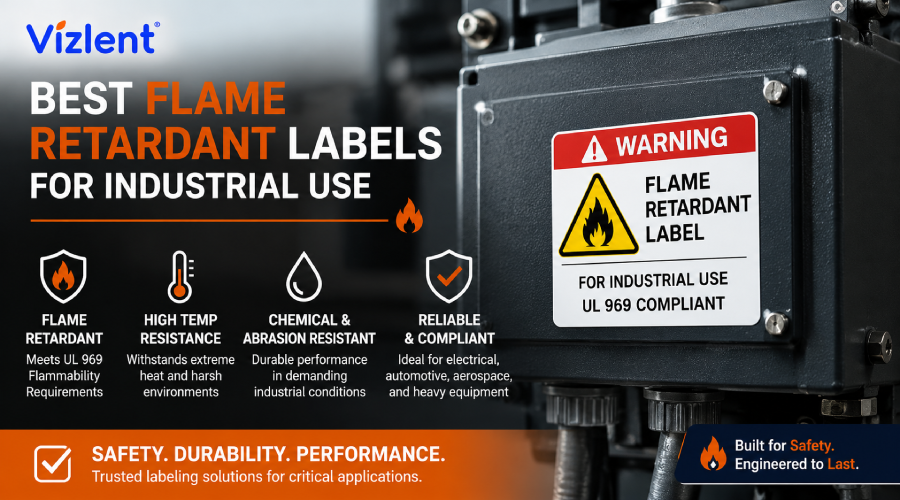
The best flame retardant labels for industrial use are UL 94 V-0 rated, halogen-free constructions built on polyimide or polyester facestocks with high-temperature adhesives, engineered to self-extinguish and stay legible on electrical panels, wire harnesses, and heavy equipment. These labels resist ignition, limit flame spread, and hold their print through heat, chemicals, and mechanical stress in demanding manufacturing environments. Vizlent manufactures this material factory-direct, supplying converters and brand owners worldwide with certified, traceable flame retardant label stock.
Choosing the right label for a fire-risk environment is a technical decision, not a cosmetic one, and the wrong material can fail exactly when safety matters most. Fire safety, regulatory compliance, and long-term legibility all depend on matching the facestock, adhesive, and print method to the real conditions the label will face. Understanding what makes the best flame retardant labels for industrial use is the first step toward specifying a material that protects both your product and the people around it.
The standards, materials, colors, applications, and sourcing decisions below define the best flame retardant labels for industrial use in practical terms. Each section speaks to engineers, procurement teams, and converters who need real detail rather than marketing claims. With that grounding, you can specify the best flame retardant labels for industrial use with confidence, from the facestock rating to the supplier you trust with the order.
What Makes the Best Flame Retardant Labels for Industrial Use
The best flame retardant labels for industrial uses share a common foundation: a facestock that resists ignition and a construction that self-extinguishes once the flame source is removed. Flame retardant materials are engineered to slow ignition and suppress flame spread rather than simply avoiding fire altogether, which is the behavior the UL 94 V-0 standard measures. This distinction matters because industrial labels sit on components that generate heat, carry current, or operate near flammable materials.
A truly industrial-grade flame retardant label combines three properties that cheaper stock cannot deliver at once. It must hold adhesion on the target surface, survive the continuous and peak temperatures of the application, and keep its printed information readable through the life of the equipment. The best flame retardant labels for industrial use and safety are validated as a complete system, so the facestock, adhesive, and ink survive together rather than failing at the weakest layer.
Core properties to look for include:
- UL 94 V-0 rated, self-extinguishing facestock
- Halogen-free construction for reduced toxicity
- High-temperature adhesive matched to the surface
- Print durability through thermal cycling and abrasion
Flame Retardant Standards Every Buyer Should Know
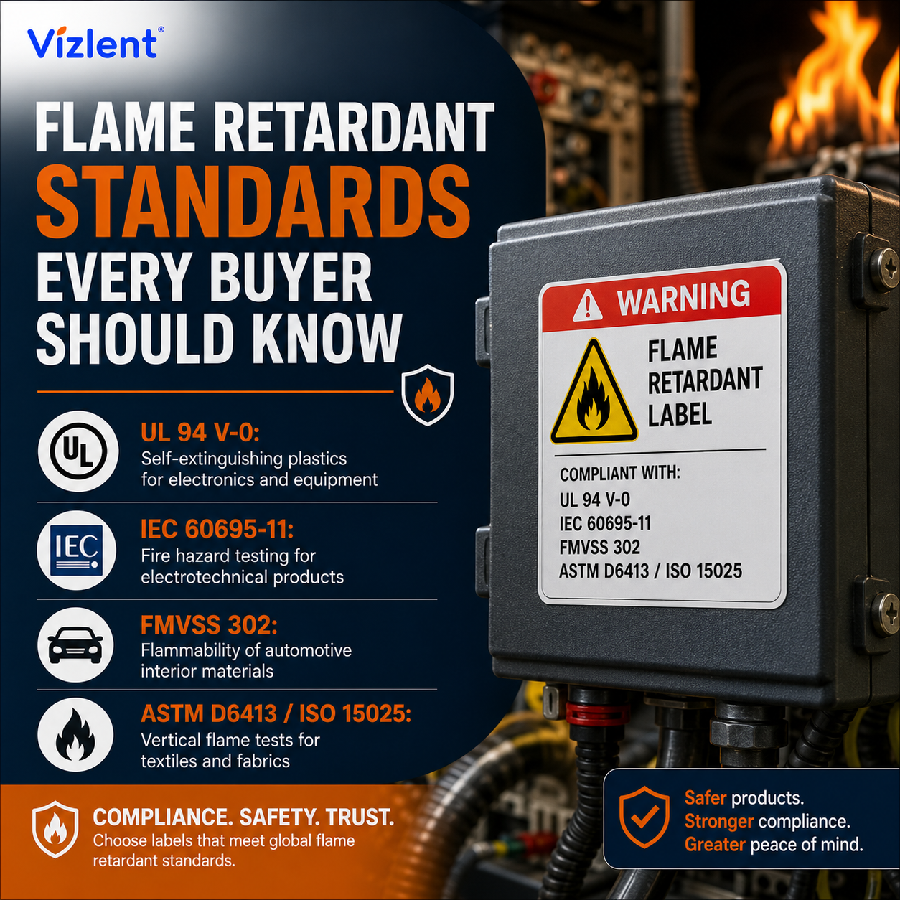
The best flame retardant labels for industrial use meet recognized flammability standards, and buyers should know which ones apply to their application. UL 94 is the plastics flammability standard developed by Underwriters Laboratories, and a V-0 rating means the material self-extinguishes quickly and does not produce flaming drips that ignite a secondary indicator. Other relevant benchmarks include IEC 60695-11 for fire hazard testing and FMVSS 302 for automotive interior flammability.
Standards also draw an important line between flame retardant and flame resistant materials, which are not the same thing. Flame retardant materials may ignite but self-extinguish once the ignition source is gone, while flame resistant materials resist ignition entirely and are tested under standards such as ASTM D6413 or ISO 15025. Knowing where your application falls tells you if you need a UL 94 V-0 label or a different class of material, and the best flame retardant labels for industrial use are specified against the correct standard from the start.
A quick reference for common flame retardant examples and standards:
- UL 94 V-0: Self-extinguishing plastics for electronics and equipment
- IEC 60695-11: Fire hazard testing for electrotechnical products
- FMVSS 302: Flammability of automotive interior materials
- ASTM D6413 / ISO 15025: Vertical flame tests for textiles and fabrics
One detail that trips up buyers is that UL 94 ratings are thickness dependent, so a material that passes at one caliper may not pass when it is thinner. This is why a facestock’s rating must be validated at the actual thickness used in production rather than assumed from a datasheet headline. Working with a manufacturer that tests its own constructions removes this risk, which is another reason the best flame retardant labels for industrial use come from factories that control coating and slitting in house.
Best Materials and Facestocks for Fire-Risk Environments
The facestock is where flame retardance begins, and the best flame retardant labels for industrial use are typically built on polyimide or polyester film. Polyimide, widely known by the trade name Kapton, stays dimensionally stable and legible at continuous temperatures well above 200 degrees Celsius, which makes it the benchmark for the hottest applications. Polyester film covers a large share of industrial needs, handling sustained heat while resisting most fluids and printing cleanly for identification and certification labels. For the hottest processes, these constructions overlap with heat resistant label material engineered to hold print through thermal cycling.
Beyond the facestock, the adhesive and any protective topcoat determine how the label performs over time. High-temperature silicone and acrylic adhesives keep the label anchored where standard adhesives would char or release, and a resin-grade thermal transfer image resists smearing under heat and abrasion. The best flame retardant labels for industrial use have been beneficial to manufacturers precisely because these layers are engineered to work as one durable system rather than as separate parts.
Common flame retardant label raw materials include:
- Flame retardant films such as treated polyimide and polyester
- Flame retardant papers coated for ignition resistance
- Flame retardant adhesives formulated to limit flame spread
- Protective topcoats for chemical and abrasion resistance
Industry Applications and Use Cases
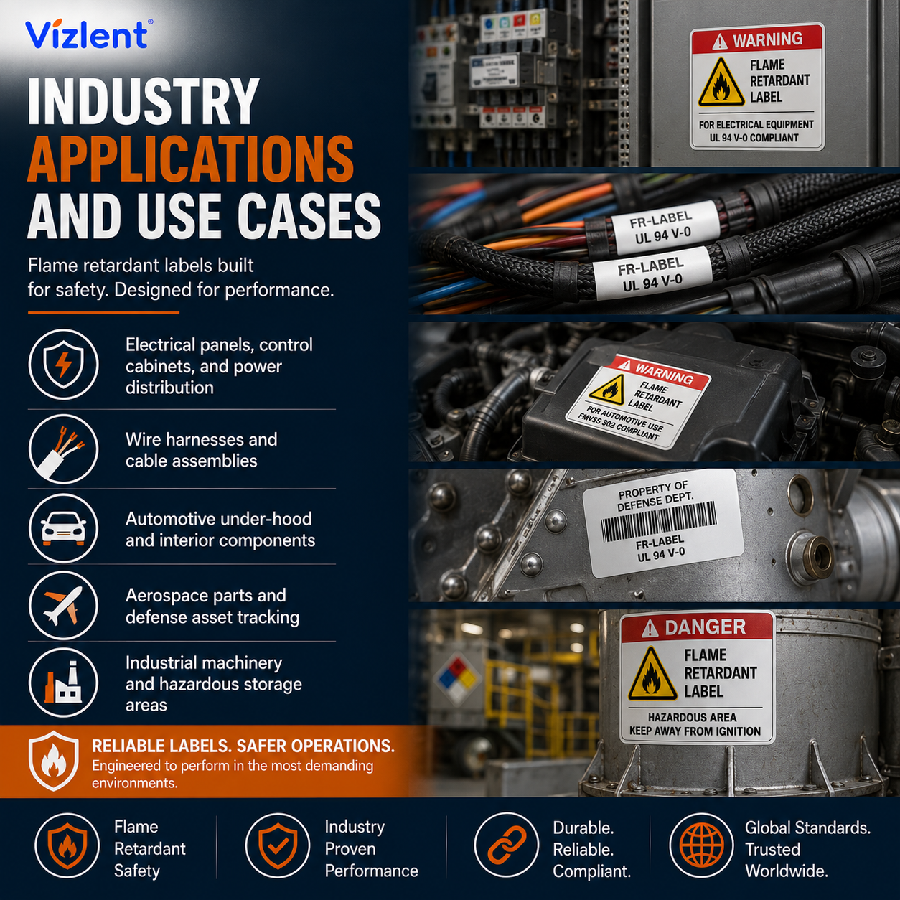
The best flame retardant labels for industrial use cases span electrical, electronic, automotive, aerospace, and heavy manufacturing environments. In electrical and electronic equipment, these labels identify components, devices, and appliances that generate heat or sit near live current, where a non-rated label would be a fire hazard. Wire harness and cable assembly labeling is one of the most common applications, and Vizlent’s flame retardant label stock provides UL 94 V-0 rated identification built for exactly this work.
Automotive and aerospace programs rely on flame retardant labels where fire safety is critical, from under-hood component identification to aircraft part tracking. Industrial facilities use them on machinery, control panels, and storage areas that involve high temperatures or flammable materials, while construction projects apply them to meet building fire safety requirements. Across all of these, the best flame retardant labels for industrial use have been set apart by their ability to stay readable and adhered through the full service life of the asset.
Key sectors that depend on flame retardant labels and packaging:
- Electrical panels, control cabinets, and power distribution
- Wire harnesses and cable assemblies
- Automotive under-hood and interior components
- Aerospace parts and defense asset tracking
- Industrial machinery and hazardous storage areas
Each of these environments punishes labels in a different way, which is why one generic material rarely fits them all. A control cabinet subjects labels to continuous heat and electrical proximity, an under-hood component adds oil, vibration, and thermal cycling, and an aerospace part demands both flame performance and strict traceability. Matching the construction to the specific stress profile is what turns a rated label into a reliable one, and the best flame retardant labels for industrial use are chosen against that profile rather than a single headline number.
Best Flame Retardant Labels for Industrial Use in Bulk
Sourcing the best flame retardant labels for industrial use bulk is where manufacturing capability and pricing become decisive for a business. Buying flame retardant labels bulk from a direct factory spreads fixed production costs across large runs, lowering the per-unit price while keeping quality consistent across every roll. This matters because flame retardant material carries higher raw-material costs than standard stock, so volume efficiency has a real impact on your landed cost.
Bulk sourcing also protects quality and lead time in a way that small retail purchases cannot. A direct manufacturer produces flame retardant labels by the sheet, in precision-slit rolls, or as jumbo rolls, all cut to your converting needs and inspected for consistency. For any company evaluating the best flame retardant labels for industrial use business decisions, buying flame retardant labels and stickers in bulk from the factory that coats and slits the material delivers both lower cost and full traceability.
For a growing flame retardant labels business, a dependable bulk supplier is a strategic partner rather than a simple vendor. Consistent material means predictable converting runs, stable scan rates, and fewer compliance surprises across every order you place. This is exactly why brands that depend on the best flame retardant labels for industrial use tend to consolidate their sourcing with a single certified manufacturer.
Bulk sourcing advantages include:
- Lower per-unit price on certified flame retardant stock
- Consistent caliper, adhesive tack, and print surface across batches
- Flexible formats from jumbo rolls to sheets
- Full documentation and material traceability
Need certified flame retardant stock at factory-direct pricing? Contact the Vizlent team for a custom quote and free samples so you can test performance before scaling your order.
Color and Printing Options for Industrial Labels
Color is a functional feature in flame retardant labeling, not just a branding choice, and the best options are available in the shades industrial work demands. The best flame retardant labels for industrial use blue facestocks are common for coding and identification, allowing quick visual sorting on crowded panels and harnesses. Blue, white, and metallic constructions all remain readable under harsh lighting and help operators distinguish circuits, components, and safety categories at a glance.
Dark constructions serve a different but equally important role in industrial identification. The best flame retardant labels for industrial use black facestocks provide strong contrast for laser-marked or reverse-printed information and hide surface soiling in dirty environments. Across color-coded systems and high-contrast asset tags alike, the best flame retardant labels for industrial use are produced with print surfaces compatible with thermal transfer, laser, and digital methods for sharp, lasting results.
The print method should be matched to the durability target just as carefully as color. Thermal transfer printing with a resin-grade ribbon on polyester is the standard for labels that must resist chemicals, abrasion, and heat, because the resin image cures into the topcoat and resists smearing. When color coding and print durability are specified together, the best flame retardant labels for industrial use deliver identification that survives the same conditions as the equipment they mark.
Choosing the Right Flame Retardant Label Supplier
The best flame retardant labels for industrial use brands come from manufacturers that control the full production process and hold verifiable certifications. A direct factory that coats, siliconizes, and slits its own material can guarantee consistency in a way that trading companies reselling third-party stock cannot. Certification and testing capability separate a genuine industrial supplier from a general label printer. The best flame retardant labels for industrial use are validated through defined process controls that check adhesive anchorage, dimensional tolerance, and print durability before the material ships.
Vizlent operates as an ISO 9001, FSC, and SGS certified manufacturer, giving converters and brand owners the traceability and specification confidence that fire-safety applications require. Its flame retardant constructions sit within a broader self adhesive label material range, so a single supplier can cover multiple substrate needs. A supplier’s technical support is often the deciding factor on complex programs. Matching the correct facestock, adhesive tack, and topcoat to an unusual surface or temperature profile takes engineering input, not a catalog lookup. The manufacturers behind the best flame retardant labels for industrial use work directly from your specification sheet, advising on construction before you commit to a full production run.
When evaluating suppliers, prioritize:
- Direct manufacturing rather than trading or reselling
- Recognized certifications such as ISO 9001, FSC, and SGS
- Free samples for real-condition testing before bulk commitment
- Technical support on facestock, adhesive, and print matching
Ready to specify certified flame retardant material for your next program? Reach out to Vizlent for factory-direct pricing and free samples, or explore the full durable label range and blog resources to find the right stock for your application.
Flame Retardant Labels Best Practices for Application and Storage
Following flame retardant labels best practices ensures the material performs as intended once it reaches the production line. Surface preparation is critical, so the substrate should be clean, dry, and free of dust, grease, or residue before application, since contaminants compromise both adhesion and flame performance. Applying firm, even pressure without bubbles or wrinkles preserves the integrity of the flame retardant construction across the full label surface.
Storage and handling matter just as much as application for long-term reliability. Unused stock should be kept in a cool, dry place away from direct sunlight and heat sources to prevent premature degradation of the facestock and adhesive. The best flame retardant labels for industrial use reward correct handling with dependable performance, which is why validating material with free samples before a full run is one of the most valuable best practices any buyer can adopt.
Documentation is the final piece of a sound labeling process. Keeping the material certifications, batch records, and test results on file supports audits and demonstrates compliance to customers and regulators alike. Specifying the best flame retardant labels for industrial use from a certified manufacturer makes this straightforward, because the traceability travels with every roll.
Practical application best practices:
- Clean and dry the surface before applying any label
- Apply at room temperature for optimal adhesion
- Use firm, even pressure to avoid bubbles and wrinkles
- Store unused stock cool, dry, and out of direct sunlight
Frequently Asked Questions
What are the best flame retardant labels for industrial use?
The best flame retardant labels for industrial use are UL 94 V-0 rated, halogen-free labels built on polyimide or polyester facestocks with high-temperature adhesives. They self-extinguish, resist flame spread, and stay legible on electrical panels, wire harnesses, and equipment. Sourcing them from a certified direct manufacturer ensures consistent quality and full traceability.
What is the difference between flame retardant and flame resistant labels?
Flame retardant labels may ignite but self-extinguish once the ignition source is removed, and they are tested under standards like UL 94. Flame resistant materials resist ignition entirely and are tested under textile standards such as ASTM D6413 or ISO 15025. For most electrical and industrial equipment, a UL 94 V-0 flame retardant label is the correct choice.
Are flame retardant stickers available by the sheet and in bulk?
Yes, flame retardant stickers and labels are available both by the sheet and in bulk rolls from direct manufacturers. Buying flame retardant labels by the sheet suits prototyping and small runs, while bulk jumbo or slit rolls lower the per-unit cost for production. A direct factory can supply both formats cut to your converting needs.
Do flame retardant labels contain harmful chemicals?
Modern industrial flame retardant labels increasingly use halogen-free constructions to reduce toxicity and simplify recycling. Some flame retardant chemicals list entries face regulatory scrutiny, so halogen-free stock is preferred for many applications. Buyers with specific environmental or regulatory concerns should confirm material composition with the manufacturer.
What standards should flame retardant labels meet?
Flame retardant labels should meet recognized standards matched to the application, including UL 94 for plastics, IEC 60695-11 for electrotechnical fire hazard testing, and FMVSS 302 for automotive interiors. The right standard depends on the industry and surface. Specifying the correct benchmark from the start avoids costly compliance failures later.
Can flame retardant labels be printed in different colors?
Yes, flame retardant labels are produced in blue, black, white, and metallic finishes to support color-coding and high-contrast identification. Blue facestocks aid quick visual sorting, while black provides strong contrast for laser-marked information. Print surfaces are compatible with thermal transfer, laser, and digital methods for durable results.
Are flame retardant fabric labels different from film labels?
Yes, a flame retardant fabric label and fire retardant clothing tags are textile-based and tested under fabric flame standards, while industrial film labels use polyimide or polyester facestocks under UL 94. Fabric labels serve apparel and textile compliance, whereas film labels serve equipment and component identification. The application determines which construction is correct.
Why buy flame retardant labels from a direct manufacturer?
Buying from a direct manufacturer removes reseller markups and gives you factory control over quality, format, and lead time. A factory that coats and slits its own material can guarantee consistency and provide certifications like ISO 9001, FSC, and SGS. This makes direct sourcing the most reliable option for fire-safety-critical labeling.






