
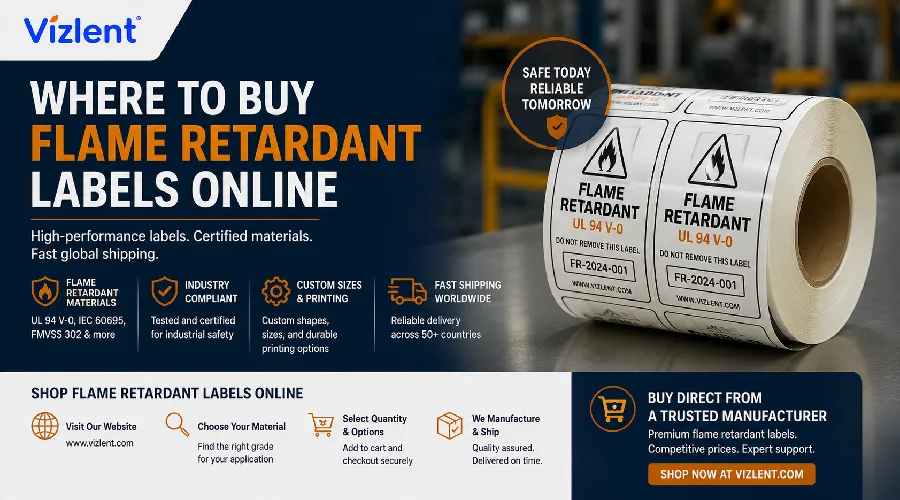
You can buy flame retardant labels online directly from specialist manufacturers, authorized industrial distributors, and B2B marketplaces that supply UL 94 rated materials. The most reliable source for volume and custom requirements is a direct factory that can document flammability certification, adhesive performance, and substrate specifications for your exact application. Buying from a manufacturer removes the trading-company markup and gives you access to the compliance paperwork your engineering and procurement teams need.
Flame retardant labels carry identification data through fire, heat, and chemical exposure without curling, burning, or dropping flaming debris. They protect traceability on electrical panels, wire harnesses, battery packs, and printed circuit boards where a standard label would fail. Choosing the right online supplier means weighing certification transparency, minimum order flexibility, and the ability to customize size, adhesive, and facestock to your operating environment.
What Are Flame Retardant Labels and Why They Matter
A flame retardant label is a pressure-sensitive identification product built on a facestock that resists ignition and self-extinguishes once an open flame is removed. These materials use polymers such as polyimide or treated polyester that carry a high limiting oxygen index, so they stop burning quickly rather than feeding a fire. A flame retardant label earns its designation only after passing standardized flammability testing, not by manufacturer claim alone.
The stakes are highest in industries where component failure can trigger fire propagation or destroy critical data. Lithium-ion battery packs, aerospace wire harnesses, and high-density circuit boards all depend on flame resistant labels that survive the exact conditions that would consume ordinary stock. When you understand this baseline, the decision to buy flame retardant labels online becomes a sourcing question about certification, consistency, and supplier depth rather than a simple price comparison.
- Self-extinguishing facestock that stops burning within seconds of flame removal
- Halogen-free construction that avoids toxic, corrosive gas release during thermal decomposition
- Dimensional stability that keeps barcodes scannable after soldering and heat cycling
It helps to separate two ideas that buyers sometimes merge. Flame resistant labels resist ignition and self-extinguish, while heat resistant labels simply tolerate high temperatures without necessarily being fire-rated. A product can be one, the other, or both, and a certified flame retardant label is verified for the self-extinguishing behavior that fire safety demands. Confirming which property you actually need prevents overspending on a rating your application does not require and, more importantly, prevents underspecifying where fire safety is at stake.
Need to match a material to your fire safety requirement? Talk to a Vizlent engineer and get spec guidance before you order.
Where to Buy Flame Retardant Labels Online?
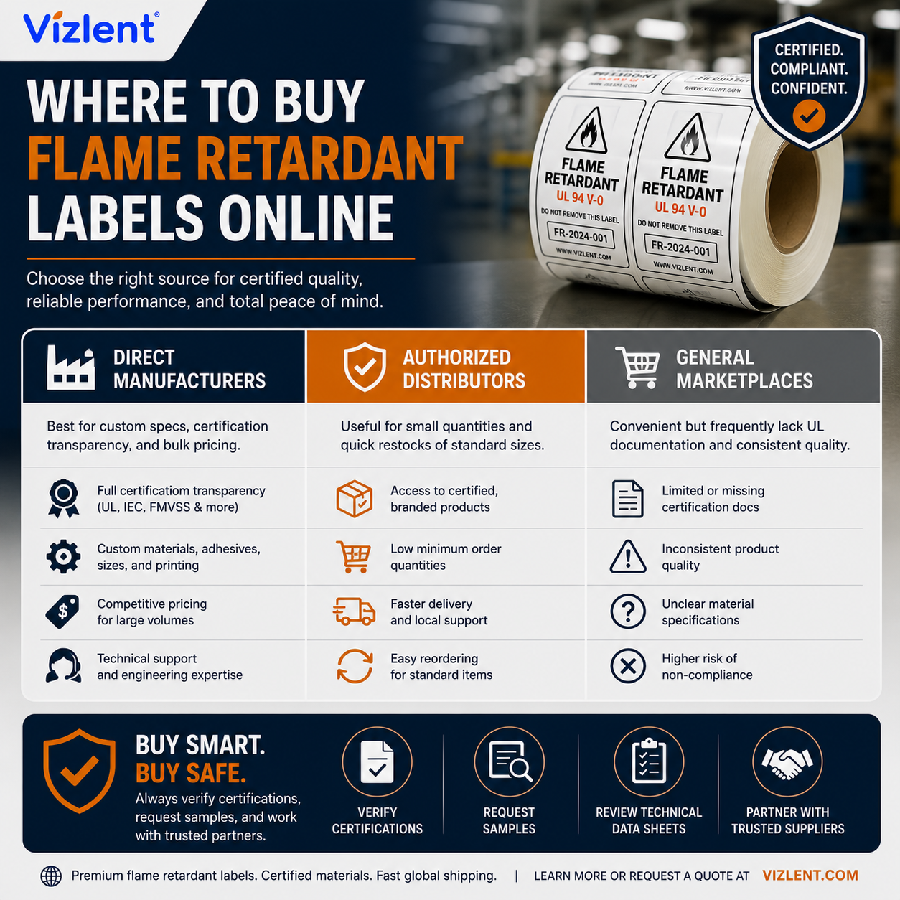
The strongest option is to buy flame retardant labels online from a direct manufacturer that coats and slits its own material. A factory-direct supplier such as Vizlent Label controls the facestock, adhesive, and quality inspection in one place, which means the certification you receive reflects the exact roll you buy. This route suits converters, OEMs, and procurement teams who need documented compliance and repeatable performance across large runs.
Industrial distributors and B2B marketplaces form the second tier of online sourcing. They offer convenience and faster access to small quantities, but they often resell material without the original test data, and specifications can vary between batches. For any flame retardant labels online business that orders through these channels, the tradeoff is speed and low commitment against reduced traceability and thinner technical support.
Structured flame retardant labels online buy follows a simple sequence regardless of channel. First confirm the flammability rating, then request the adhesive data sheet, then test a physical sample on your own equipment. Completing those three steps before you place a purchase order protects you from costly rework, failed print runs, and compliance gaps that only surface after the labels are already in service.
- Direct manufacturers: Best for custom specs, certification transparency, and bulk pricing
- Authorized distributors: Useful for small quantities and quick restocks of standard sizes
- General marketplaces: Convenient but frequently lack UL documentation and consistent quality
When you compare sources for flame retardant labels online, ask each one to send the flammability rating, the adhesive data sheet, and a physical sample. A supplier that provides all three quickly is signaling the depth you want. You can review the full flame retardant label range and request samples before committing to any order.
Request a free sample and quote to compare Vizlent material against your current supplier.
Buying Flame Retardant Labels in Bulk
Ordering flame retardant labels online bulk is where a direct factory relationship pays off most clearly. Bulk buyers need consistent coat weight, stable adhesive tack, and identical flammability performance from the first roll to the last. A manufacturer with in-house coating and roll-by-roll inspection can hold those tolerances across a container-load run in a way that a reseller cannot guarantee.
Flame retardant labels online bulk order also improves your economics and planning. Volume pricing lowers your per-label cost, and a documented lead time lets you schedule production without stockouts. Vizlent supports both trial quantities and high-volume runs, so you can validate performance on a small batch before scaling to a flame retardant labels bulk commitment.
- Verified batch-to-batch consistency in adhesion, caliper, and flammability rating
- Volume pricing that reduces per-unit cost on flame retardant labels online bulk purchases
- Scheduled production and moisture-proof export packaging for on-time global delivery
Planning a large run? Get a factory-direct bulk quote with sample rolls included.
Custom, Blank, and Catalog Options
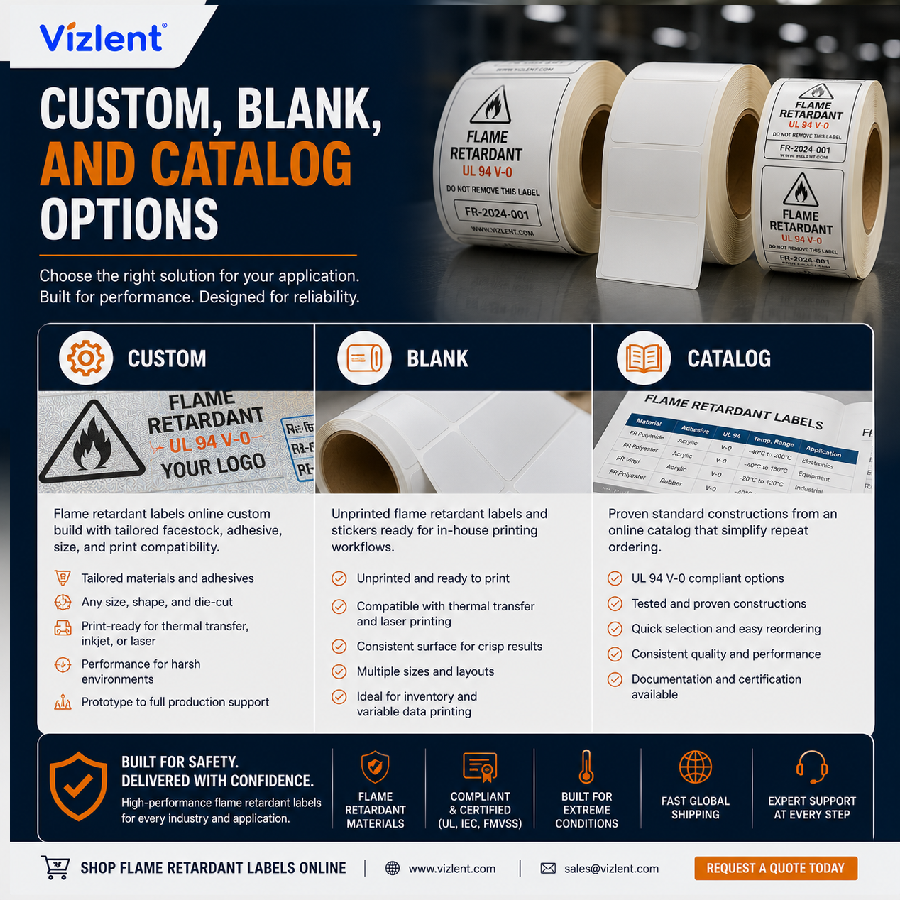
Not every project needs the same format, which is why a flame retardant labels online custom capability matters. Custom orders let you specify facestock, adhesive grade, die-cut size, and print method so the label fits your machinery and environment exactly. This is essential when a standard size will not seat correctly on a wire harness, a battery casing, or a densely populated circuit board.
Buyers who print in-house often prefer a flame retardant labels online blank option, receiving unprinted stock ready for their own thermal transfer or laser output. Others want to browse a flame retardant labels online catalog of proven standard constructions to shortcut the specification process, while teams with tight tolerances lean on a flame retardant labels online custom service to control every variable. Vizlent supports all three approaches, offering printable stock through its printable fire retardant label line alongside fully custom die-cut runs.
- Custom: Flame retardant labels online custom build with tailored facestock, adhesive, size, and print compatibility
- Blank: Unprinted flame retardant labels and stickers ready for in-house printing workflows
- Catalog: Proven standard constructions from an online catalog that simplify repeat ordering
The blank route deserves particular attention for high-mix operations. Ordering flame retardant labels and stickers as blank stock lets a single facility print variable data, batch numbers, and serials on demand without holding dozens of pre-printed SKUs. It also shifts control of print quality in-house, which many electronics and battery manufacturers prefer for traceability reasons.
A strong flame retardant label design starts with the operating temperature and the surface it must bond to. From there, adhesive selection and topcoat determine how well the printed data survives solvents, oils, and abrasion. Vizlent’s engineering team advises on these combinations directly, so your flame retardant labels design decisions are grounded in tested performance rather than guesswork.
Finding Affordable Flame Retardant Labels Online
Searching for flame retardant labels online cheap is understandable, but price alone is a risky filter for safety-critical materials. A low quoted cost often hides missing certification, inconsistent adhesive, or a facestock that has not actually passed UL 94 testing. The real measure of value is total cost of ownership: a label that fails and forces a recall is far more expensive than one that performs.
Factory-direct sourcing is usually the most economical route without sacrificing quality. Buying from the manufacturer removes the trading-company markup that inflates distributor pricing, so you get certified material at a lower landed cost. For any flame retardant labels business that orders regularly, that margin difference compounds across every purchase order and improves the numbers on a flame retardant labels bulk contract.
Cost predictability matters as much as the headline price. A direct manufacturer can quote a stable per-unit rate across scheduled flame retardant label’s online business relationship, so your budgeting is not disrupted by distributor price swings. Locking in specification and price together also removes the risk of a substituted facestock arriving mid-contract, which is a common hidden cost when buying safety-rated stock through intermediaries.
- Compare total cost of ownership, not just the sticker price per thousand labels
- Verify UL 94 documentation before treating any low quote as a genuine bargain
- Buy factory-direct to remove reseller markup on flame retardant labels and stickers
Want certified material at factory-direct pricing? Send Vizlent your inquiry today.
How to Evaluate an Online Supplier’s Credentials
Trust is the deciding factor when you buy safety-rated identification products online, so evaluate credentials before you evaluate price. A credible supplier states clearly who manufactures the material, publishes its certifications, and explains how each product is tested. Vizlent operates as a direct manufacturer founded in 2011, holding ISO 9001, FSC, and SGS certification, with full company background available on its About Us page.
Beyond certification, examine how the supplier documents its process. A trustworthy manufacturer will share flammability test methods, adhesive data sheets, and sample material so you can verify performance on your own line. This transparency is exactly what quality frameworks reward, because it lets buyers confirm claims rather than take them on faith.
- Clear manufacturer identity and published ISO, FSC, and SGS certifications
- Documented UL 94 test methods and downloadable adhesive data sheets
- Free samples so you can validate performance before a bulk commitment
First-hand experience is a signal worth looking for in a supplier. A manufacturer that has run its own coating, slitting, and testing lines for more than a decade speaks about material behavior with specifics rather than generalities. When a supplier can explain exactly how a facestock responds to reflow soldering or how an adhesive holds on a textured battery casing, that depth reflects genuine expertise rather than resold marketing copy.
Ask whether the supplier can support your specific compliance regime, whether that is FAR 25.853 for aviation or RoHS and REACH for electronics. A manufacturer that handles durable label and heat resistant label families alongside flame retardant stock usually has the engineering depth to guide edge cases correctly.
Material Types: Matching Substrate to Application
Flame retardant labels are not a single product but a family of constructions built for different thermal ceilings. Polyimide facestocks tolerate continuous temperatures up to roughly 300°C and suit the reflow and wave soldering stages of circuit board assembly. Polyester constructions handle up to about 150°C at lower cost, making them a strong fit for battery packs, power panels, and wire harnesses.
Selecting the correct substrate protects both your data and your budget. Specifying polyimide where polyester would suffice wastes money, while the reverse risks a label that melts in service. The table below summarizes the practical differences to guide your flame retardant labels design choice.
| Property | Polyimide | Polyester (PET) |
|---|---|---|
| Max Operating Temp | Up to 300°C continuous | Up to 150°C continuous |
| Flammability Rating | UL 94 VTM-0 | UL 94 VTM-0 / V-0 |
| Best For | PCB, wave soldering, reflow | Battery packs, panels, harnesses |
| Relative Cost | Higher | Lower |
For cable and harness identification, a self-laminating wrap-around wire label adds an over-wrap that protects the printed area from abrasion. Matching the construction to the job is the single most important step before you place an order.
Adhesive selection sits alongside facestock as a second decision axis. A high-temperature acrylic adhesive holds polyimide labels in place through reflow ovens, while a high-tack formulation keeps polyester labels bonded to textured battery casings and painted panels. The wrong adhesive can lift a perfectly rated facestock off the surface, so treat adhesive tack and temperature range as core specifications rather than afterthoughts.
Vinyl constructions round out the range for flexible surfaces. A vinyl flame retardant material conforms tightly around cables and irregular shapes that would cause rigid polyester to tent or peel. When you request a quote, describe the surface, the temperature ceiling, and the chemicals present so the engineering team can recommend the substrate and adhesive pairing that will actually survive the environment.
Printing, Compliance, and Chemical Terminology
Printing on flame retardant stock requires the right ribbon, not just the right label. Standard wax ribbons smear or melt under heat, so durable resin ribbons are essential for barcodes that must survive the same conditions as the facestock. Pairing the label with a specialty resin ribbon is what guarantees the printed data lasts as long as the material beneath it.
Buyers sometimes ask for a flame retardant chemicals list to understand what makes these materials work, but the practical answer is that certified halogen-free construction and a verified UL 94 rating matter more than any ingredient inventory. A flame retardant tag and flame retardant stickers earn their rating through tested self-extinguishing behavior, and the supplier should be able to prove that with documentation. Focus your evaluation on the certification and the test method rather than a raw chemical breakdown.
Terminology can also cause confusion during procurement. A flame retardant tag, a flame retardant sticker, and a flame retardant label often describe the same category of self-extinguishing product, differing mainly by format and how they attach. What matters is not the word on the purchase order but the verified rating behind it, so align on the certification standard with your supplier early. Vizlent’s team is glad to translate loose terminology into a precise specification before any order is confirmed.
- Use resin thermal transfer ribbons for barcodes that must resist heat and solvents
- Prioritize verified UL 94 ratings and halogen-free construction over ingredient lists
- Confirm RoHS and REACH compliance for electronics and export applications
Not sure which label and ribbon pairing fits your line? Ask a Vizlent specialist for a tested recommendation.
Order Certified Flame Retardant Labels From Vizlent
The safest way to buy flame retardant labels online is to source directly from a certified manufacturer that can document every specification. Vizlent has produced pressure-sensitive label stock as a direct factory since 2011, shipping ISO 9001, FSC, and SGS certified material to more than fifty countries. Whether you need custom die-cut labels, blank printable stock, or a large bulk run, the engineering team can match a construction to your exact fire safety requirement.
Start with a sample. Testing real material on your own line settles questions about adhesion, print retention, and flammability far better than any specification sheet can on its own. Once the sample confirms performance, scaling to a documented bulk order is straightforward, and you carry the same certified construction into every subsequent purchase with confidence.
Contact Vizlent for a quote and free samples | Explore the flame retardant label range | Read more on the Vizlent blog
Frequently Asked Questions
Where can I buy flame retardant labels online?
You can buy flame retardant labels online from direct manufacturers, authorized industrial distributors, and B2B marketplaces. Direct manufacturers such as Vizlent offer the strongest combination of certification transparency, custom specification, and bulk pricing. Distributors and marketplaces suit small, quick orders but often lack the original test documentation that engineering teams require.
How do I buy flame retardant labels online in bulk?
To buy in bulk, request a factory-direct quote that includes flammability certification, an adhesive data sheet, and sample rolls. A direct manufacturer holds consistent coat weight and adhesive tack across large runs, which resellers cannot always guarantee. Vizlent supports trial quantities first, so you can validate performance before committing to a full flame retardant labels online bulk order.
Are cheaper flame retardant labels reliable?
A low price is only reliable if the material carries verified UL 94 certification. Very cheap labels frequently hide missing test data, inconsistent adhesive, or facestock that has not passed flammability testing. Factory-direct sourcing usually delivers certified material at a lower landed cost than distributors, because it removes the trading-company markup.
Can I order custom or blank flame retardant labels?
Yes. Custom orders let you specify facestock, adhesive, die-cut size, and print method for an exact fit, while blank stock ships unprinted for in-house printing. Vizlent offers both custom die-cut runs and printable blank material. Choosing between them depends on whether you print internally or need finished labels delivered.
What certifications should flame retardant labels have?
The core certification is UL 94, typically the VTM-0 or V-0 rating that confirms self-extinguishing behavior. Depending on your industry, you may also need FAR 25.853 for aviation or RoHS and REACH compliance for electronics and export. A credible supplier provides these certificates and the underlying test methods on request.
What is the difference between polyimide and polyester flame retardant labels?
Polyimide labels withstand continuous temperatures up to around 300°C and suit circuit board soldering, while polyester labels handle up to about 150°C at lower cost. Polyester works well for battery packs, power panels, and wire harnesses. Selecting the correct substrate protects both your data and your budget.
Do flame retardant labels need special printing?
Yes. Flame retardant labels require durable resin thermal transfer ribbons rather than standard wax ribbons. Wax ribbons smear or melt under the heat these labels are designed to survive. Pairing the correct resin ribbon with the label ensures the barcode remains legible through the same thermal and chemical exposure as the facestock.
Does Vizlent provide samples before a bulk order?
Yes. Vizlent provides free sample rolls or sheeted stock so you can test peel strength, print compatibility, and flammability performance on your own line. This lets you verify the material before committing to a large purchase. You cover only the courier freight for the samples.






