
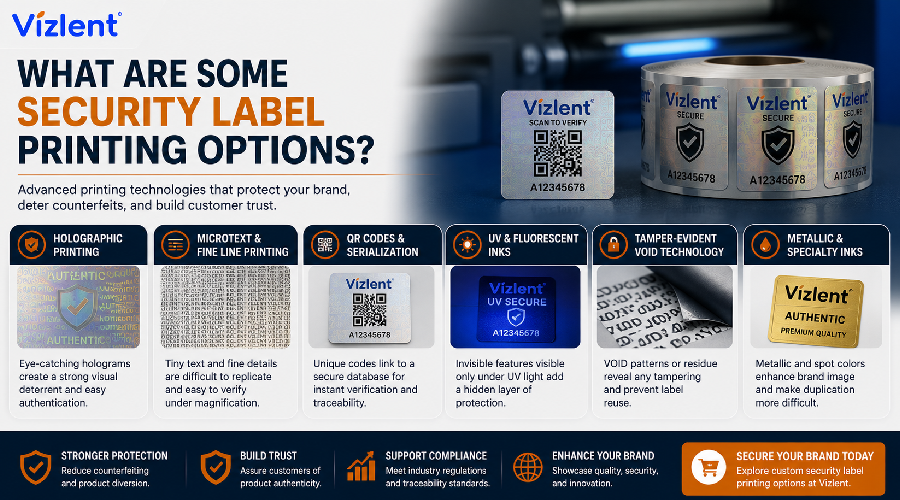
The main security label printing options include tamper-evident labels, VOID release films, destructible eggshell paper, water-sensitive and water-soluble papers, holographic overlays, and serialized barcode or RFID constructions. Each method defends a product against counterfeiting, tampering, or re-labeling in a different way, and the right choice depends on the surface, the threat, and the regulatory environment. A manufacturer that coats and converts its own material can combine several of these techniques into a single self-adhesive label.
Security labels are no longer simple stickers pressed onto a box. They are engineered constructions that reveal interference, resist removal, and carry traceable data through a product’s entire life cycle. Understanding the available options helps procurement and brand-protection teams match the technology to the actual risk they face.
Understanding Security Label Printing Options
A security label works by making any tampering or duplication attempt immediately visible or physically impossible to reverse. The range of security label printing options allows a brand to move from simple tamper evidence to full authentication and supply-chain tracking as its needs grow. Choosing among them starts with identifying whether the goal is tamper evidence, authentication, or serialized traceability.
Vizlent manufactures a full security label range as a direct factory, which means the facestock, adhesive, and security features are engineered together rather than sourced from separate suppliers. A strong security label printing options design considers the surface, the adhesive, and the visible feature as one system, because a holographic overlay is only as reliable as the bond beneath it. When you evaluate these constructions, prioritize suppliers who can document how the complete build performs, not just the visible feature.
- Tamper evidence: Reveals that a package or seal has been opened
- Authentication: Proves a product is genuine through overt or covert features
- Traceability: Carries serialized data for supply-chain tracking
Not sure which construction fits your product? Talk to a Vizlent engineer for tailored guidance.
It is worth separating the three goals early because they lead to different constructions. Tamper evidence answers the question of whether a package was opened, authentication answers whether the product is genuine, and traceability answers where a specific unit has been. A single label can serve more than one goal, but naming the primary objective first keeps the specification focused and the cost proportionate to the threat.
Tamper-Evident Security Label Printing Options
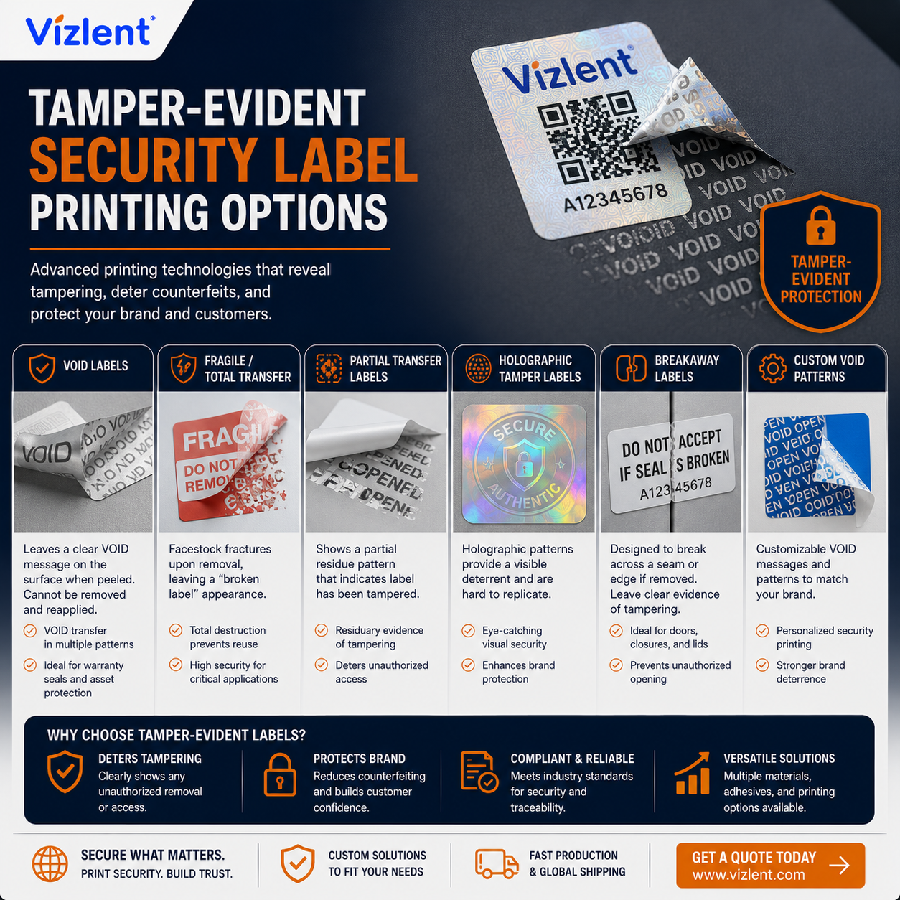
Tamper-evident constructions are among the most widely used security label printing options because they give an instant, visible signal of interference. When someone attempts to lift the label, it either fractures, delaminates, or leaves a permanent mark that cannot be reset. This makes them the standard choice for pharmaceuticals, electronics, and sealed documents where a broken seal must be obvious.
VOID release films are a leading example of security labels tamper proof enough for high-value goods. On removal, the adhesive transfers a repeating VOID pattern onto the surface, so reapplication is impossible without leaving evidence. Vizlent produces these as a dedicated VOID sticker construction with adhesive calibrated for clean transfer on painted metal, glass, and plastics.
- VOID films leave a permanent pattern that exposes any removal attempt
- Non-transfer options show damage on the label itself rather than the surface
- Low-tack seals suit food and beverage necks where clean opening still shows evidence
The right tamper feature depends on whether evidence should appear on the surface or on the label itself. Surface-transfer VOID films suit hard, smooth substrates where the pattern will show clearly, such as sealed electronics enclosures. Label-destruct constructions work better on textured or porous surfaces where a transferred pattern would be hard to read, so matching the mechanism to the substrate is essential.
Understanding how do security labels work at this level clarifies why adhesive engineering is central to tamper evidence. The bond strength must exceed the cohesive strength of the facestock so the label fails predictably when attacked. Getting that balance right is where an integrated manufacturer’s constructions outperform generic stock.
Destructible and Frangible Security Label Printing Options
Destructible constructions defend against re-labeling and asset swapping by breaking apart the instant someone tries to peel them. These constructions rely on an ultra-brittle facestock that fragments into small pieces rather than lifting cleanly. Laptops, industrial equipment, and warranty seals commonly use them to lock a serial number permanently to one device.
Vizlent’s eggshell paper is engineered for exactly this behavior, fracturing into irremovable fragments on any tampering attempt. The material accepts printed serials, barcodes, and branding, so a single label carries both identity and tamper evidence. For teams weighing options for asset tags, frangible paper offers strong protection at a lower cost than holographic film.
- Eggshell paper shatters into fragments that cannot be reassembled or reused
- Ideal for warranty voids, asset tracking, and equipment identification
- Compatible with standard barcode and serial-number printing
Frangibility is a spectrum rather than a single setting, and the degree of brittleness can be tuned to the surface. A label destined for a smooth metal housing can be made highly brittle for maximum fragmentation, while one applied to a slightly textured surface needs a formulation that still fractures without crumbling during application. Testing the exact facestock on the real surface before a production run is the only reliable way to confirm the behavior.
Protecting high-value assets? Request eggshell paper samples to test fragmentation on your surfaces.
Moisture-Reactive Security Label Printing Options
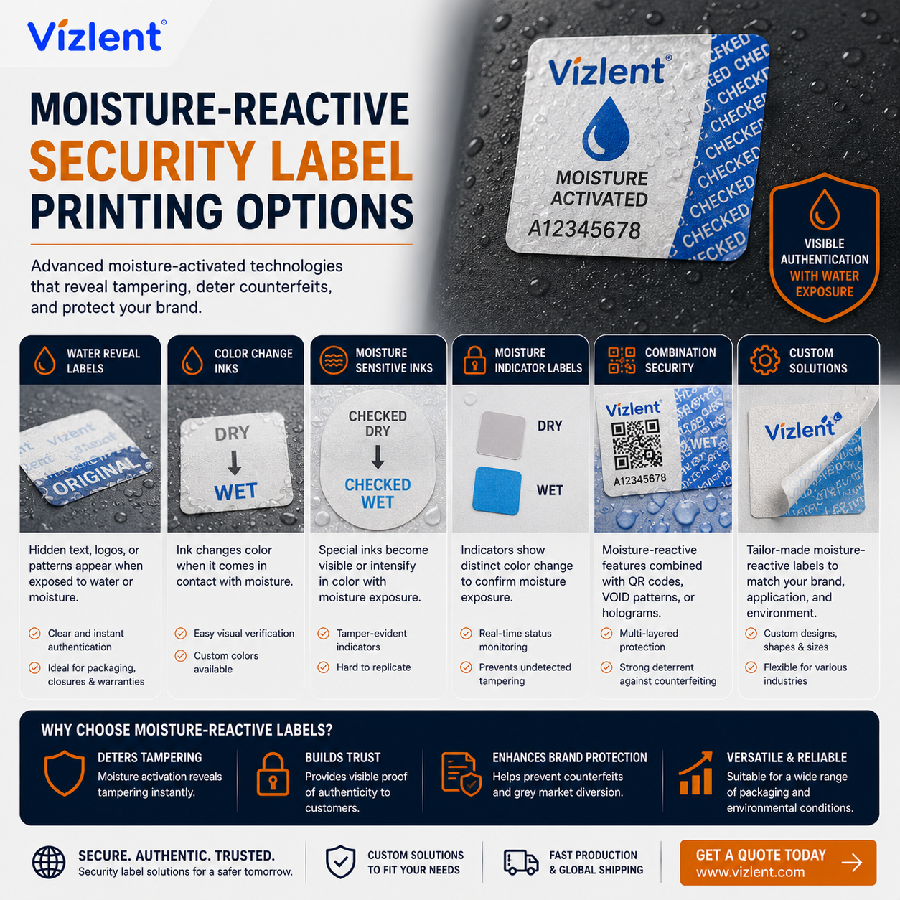
Some threats are not about peeling a label but about detecting hidden exposure or covert removal. Moisture-reactive constructions address this with facestocks that change state when they meet water. They are valuable where water ingress must be proven or where soaking is a common way to defeat an adhesive.
Vizlent’s water-sensitive paper produces an irreversible color change on contact with moisture, exposing water damage in electronics and shipments. A related water-soluble construction dissolves entirely, which suits applications where the label itself must disappear cleanly. These moisture-reactive constructions are often paired with tamper-evident features for layered protection.
- Water-sensitive paper changes color permanently when wet, proving water exposure
- Water-soluble stock dissolves fully for clean-removal and anti-soak applications
- Both integrate with printed data and additional security layers
These constructions solve problems that ordinary labels cannot address at all. A warranty claim can hinge on proving a device was exposed to water, and a color-changing indicator settles the question objectively. In logistics, a water-soluble seal that dissolves on contact defeats the common trick of soaking a label to lift and reapply it, closing a gap that tamper-evident film alone would leave open.
Overt, Covert, and Forensic Security Label Printing Options
Authentication features fall into three tiers, and the strongest programs combine all of them. Overt features such as holograms and color-shifting inks are visible to any customer, while covert features like UV-fluorescent inks and microtext require a tool to reveal. Forensic markers sit at the deepest level, verifiable only in a laboratory.
Layering these tiers is what makes a label genuinely difficult to copy, since a counterfeiter must defeat every level at once. Vizlent’s brand-protection constructions combine holographic overlaminates, covert inks, microtext, and serialized 2D codes in one self-adhesive build. When you compare methods for authentication, a multi-layer approach delivers far more resilience than any single feature alone.
- Overt: Holograms and color-shifting inks the end user can see instantly
- Covert: UV inks and microtext revealed only with a light source or loupe
- Forensic: Laboratory-verifiable taggants for legal chain-of-custody cases
The cost of each tier scales with its sophistication, so a sensible program applies protection in proportion to the risk. A mid-value consumer product may need only an overt hologram and a covert UV mark, while a pharmaceutical or luxury item justifies forensic taggants and serialized tracking. Mapping the threat to the right combination avoids both underspending, which leaves a gap, and overspending, which wastes budget on protection the product does not need.
Design also plays a role that is easy to underestimate. A guilloche pattern of fine interlaced lines, a color-shifting foil, or a custom hologram origination all raise the effort a counterfeiter must invest. When these visual elements are combined with a serialized code, verification becomes both intuitive for a customer and rigorous for an inspector, which is the balance a strong authentication label should strike.
Building a brand-protection program? Send Vizlent your requirements for a layered recommendation.
Serialized, Barcode, and Smart Security Label Printing Options
Traceability is now a core reason brands invest in security labels, not just tamper evidence. Serialized constructions assign each unit a unique code, so a product can be authenticated and tracked from the factory to the shelf. This supports recalls, gray-market detection, and regulatory compliance across regulated industries.
Smart constructions extend this further by embedding RFID or NFC inlays that carry data readable by a scanner or phone. Vizlent integrates UHF and HF inlays into self-adhesive labels alongside laser-etched label options for permanent, unalterable marking. Combining serialized data with a physical security feature gives these constructions both digital tracking and tamper resistance.
- Serialized 2D codes enable unit-level authentication and recall management
- RFID and NFC inlays add scannable, real-time supply-chain visibility
- Laser-etched marking resists alteration for permanent identification
The value of serialized and smart labels grows as supply chains lengthen and cross more borders. A unique code lets a brand confirm that a unit sold in one market was actually intended for it, which is how gray-market diversion is detected. When that code is backed by a physical tamper feature, a counterfeiter cannot simply clone the number onto a fake, because the label would still fail the physical test.
Materials, Application, and Security Label Printing Options Best Practices
Material selection shapes how well any security feature performs in the field. Synthetic facestocks such as polyester, polypropylene, and vinyl resist water, oil, and abrasion far better than paper, which matters for outdoor and industrial use. Choosing the right substrate is the foundation of every durable security construction.
Following security label printing options best practices means matching adhesive, facestock, and feature to the exact surface and environment. A polyester label material suits harsh conditions, while a biodegradable label serves brands with sustainability mandates. Applying labels consistently, whether by hand or with a security label applicator, ensures the tamper feature triggers correctly every time.
- Match facestock to environment: synthetics for harsh conditions, paper for indoor use
- Confirm adhesive tack suits the surface so tamper features fail predictably
- Use consistent application, manual or with a security label applicator, for reliable sealing
Environmental testing separates a specification that looks good on paper from one that survives real use. Labels bound for outdoor or export goods should be checked against UV exposure, temperature swings, moisture, and abrasion before they ship in volume. A supplier that runs this testing in-house can show you the results, which is far more reassuring than a datasheet claim you cannot verify.
For any security label printing options business, documenting these choices protects both compliance and brand reputation. Well-planned security label printing options label every unit with the right feature for its risk level, from a basic seal to a serialized hologram. Keeping records of material, adhesive, and test results demonstrates the transparency that quality frameworks reward, and a warning label list should be maintained alongside the security specification for audit readiness.
The print method also shapes the outcome. Choosing among security label printing options label printing techniques, whether thermal transfer, flexo, or digital, determines resolution, durability, and how well serialized data resists abrasion. Matching the print process to the facestock and the security feature is the final step that turns a good design into a reliable, tamper-resistant label.
Ready to specify the right material? Get factory-direct guidance and samples from the Vizlent team.
Industry Applications Across Retail, Pharma, and Electronics
Different sectors face different threats, so the right construction shifts with the industry. Retail battles theft and counterfeiting, and often pairs destructible vinyl with strong-tack tamper seals on high-value goods. Clothing and accessory brands frequently choose labels that reveal a hidden pattern the moment someone tries to remove them, alerting staff to potential theft.
Pharmaceutical and electronics applications raise the stakes further because health and high resale value attract determined counterfeiters. Medicine packaging relies on tamper-evident seals and void patterns so pharmacies and patients can confirm a product has not been opened. Electronics manufacturers add serialized barcodes and destructible labels to lock identity to each device and track it through the supply chain.
- Retail: Destructible vinyl and strong-tack seals deter theft and re-labeling
- Pharmaceuticals: Tamper-evident seals plus serialized traceability for compliance
- Electronics: Durable synthetics with serial numbers for authentication and tracking
Serving a regulated industry? Ask Vizlent about compliant constructions for your sector.
Choosing a Supplier and Finding Security Label Printing Options Near Me
Many buyers begin by searching for security label printing options near me, expecting a local converter to be the fastest route. Local printers offer proximity, but factory-direct manufacturers usually provide deeper feature integration, better bulk pricing, and full certification documentation. The decision comes down to whether speed or specification depth matters more for your program.
Vizlent operates as a direct manufacturer founded in 2011, holding ISO 9001, FSC, and SGS certification with full company background on its About Us page. A credible supplier will share its test methods, provide free samples, and explain how each construction performs on your surfaces. Evaluating that transparency before you order is the surest way to choose the right partner among competing suppliers.
- Local printers: fast turnaround and proximity for simpler jobs
- Direct manufacturers: integrated features, bulk pricing, and full certification
- Always request samples and test data before committing to a supplier
It helps to build a short security label printing options list before contacting suppliers, ranking the features you actually need against your budget. A written list keeps the conversation focused on tamper evidence, authentication, or traceability rather than on features that add cost without reducing your real risk. Vizlent’s engineers are glad to review such a list and recommend the leanest construction that meets your threat model.
Choose the Right Security Label Printing Options With Vizlent
Selecting from the full range of security label printing options is easier with a manufacturer that engineers every layer in-house. Vizlent has produced pressure-sensitive label stock as a direct factory since 2011, shipping ISO 9001, FSC, and SGS certified material to more than fifty countries. Whether you need tamper-evident VOID film, destructible eggshell paper, or a layered brand-protection construction, the engineering team can match the technology to your exact risk.
Start with a sample and a conversation about your threat model. Testing real material on your own products settles questions about adhesion, tamper behavior, and print retention far better than any specification sheet. From there, scaling to a certified production run is straightforward and repeatable, and you carry the same verified construction into every subsequent order.
Contact Vizlent for a quote and free samples | Explore the security label range | Read more on the Vizlent blog
Frequently Asked Questions
What are the main security label printing options?
The main options include tamper-evident VOID films, destructible eggshell paper, water-reactive papers, holographic and UV-covert overlays, and serialized barcode or RFID constructions. Each defends against a specific threat such as tampering, counterfeiting, or re-labeling. The best choice depends on the surface, the risk, and any regulatory requirement your industry imposes.
How do security labels work to prevent tampering?
Security labels work by failing in a visible, irreversible way when someone interferes with them. A VOID film transfers a permanent pattern, eggshell paper fractures into fragments, and moisture-reactive stock changes color. The adhesive is engineered so the label cannot be removed and reapplied without leaving clear evidence.
What are security labels tamper proof against?
Tamper-proof constructions defend against opening, re-sealing, label swapping, and counterfeit substitution. They make any interference obvious to inspectors, retailers, and consumers. No label is entirely impossible to defeat, but a well-designed multi-layer construction raises the effort and cost so high that tampering becomes impractical.
Do I need a security label applicator?
A security label applicator helps apply labels consistently at volume, ensuring the tamper feature triggers correctly on every unit. For lower volumes, careful manual application works well. Consistent placement matters because a poorly applied tamper label can fail to show evidence or peel prematurely.
Which materials are used for security labels and stickers?
Common materials for security labels stickers include polyester, polypropylene, vinyl, and specialty papers such as eggshell and water-sensitive stock. Synthetics resist water, oil, and abrasion for outdoor or industrial use, while brittle papers provide tamper evidence. The material is chosen to match the surface and the environmental conditions the label will face.
What is the difference between overt and covert security features?
Overt features such as holograms are visible to any customer and support quick authentication at the point of sale. Covert features like UV inks and microtext require a tool to reveal and deter sophisticated counterfeiters. Strong programs layer both, so a fake must defeat every level to pass inspection.
Should security labels be listed with warning labels?
Maintaining a warning label list alongside your security specifications supports audit readiness and regulatory compliance. Warning labels communicate hazards, while security labels protect authenticity, and documenting both together keeps a product’s labeling program organized. This transparency also demonstrates the diligence that quality frameworks reward.
Can Vizlent combine several security features in one label?
Yes. As a direct manufacturer, Vizlent engineers the facestock, adhesive, and security feature together, so a single label can combine a hologram, covert ink, microtext, and a serialized code. This integrated build is more resilient than assembling features from separate suppliers. The engineering team advises on which combination fits your specific threat model.






