
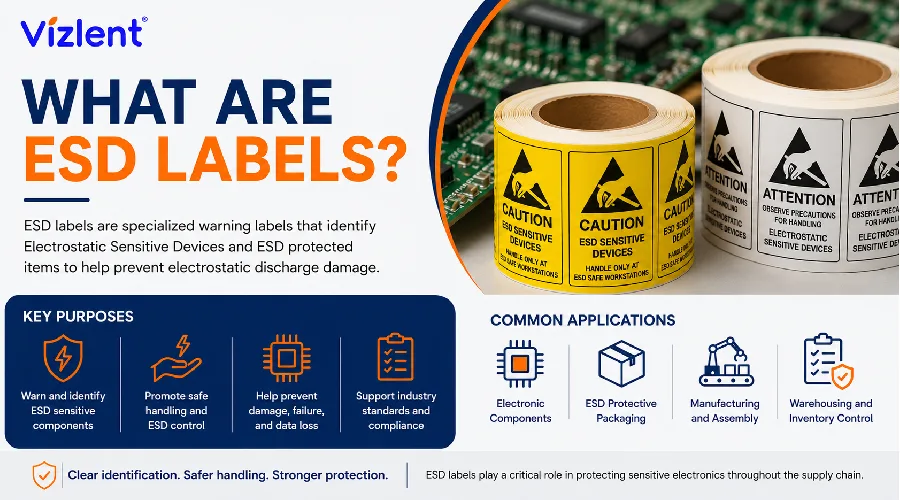
Vizlent electrostatic discharge (ESD) labels are self-adhesive labels built on static-dissipative face stocks or adhesives that stop electrostatic charge from accumulating on packaging, components, and equipment. The abbreviation stands for electrostatic discharge, the sudden flow of electricity between two objects sitting at different charge levels. Factories apply these labels to circuit boards, moisture barrier bags, foam trays, and shipping cartons to warn handlers and to keep the entire package static safe.
A discharge as small as 10 volts can destroy a semiconductor, yet a person feels nothing below roughly 3,000 volts. That gap between human perception and component damage explains why electronics plants treat static control labeling as part of the quality system rather than an afterthought. Vizlent manufactures anti static labels with a measured surface resistivity of 10⁶ to 10⁹ Ω/sq, so buyers receive verified material data with every batch instead of a printed promise.
How ESD Labels Work
An ESD label works by providing electrostatic charge with a controlled path to dissipate instead of allowing it to build up on the label surface. The face stock, the adhesive, or both are engineered with static-dissipative materials or treatments that maintain controlled electrical resistance. When applied to an ESD bag, component tray, or other protective packaging, the label helps preserve the package’s ESD performance instead of creating an insulative weak point.
Standard paper or polyester labels can accumulate thousands of volts of static electricity through ordinary handling, label application, or transportation. If that charge discharges near a sensitive electronic component, it can cause latent or immediate damage. ESD-safe labels greatly reduce charge accumulation, lowering the likelihood of damaging electrostatic discharge while maintaining the integrity of the protective packaging.
Surface resistivity classifies materials by how readily they allow static charge to move:
- Conductive materials measure below 1 × 10⁵ Ω/sq and move charge very quickly. They are commonly used for grounding applications but discharge too rapidly for most labeling purposes.
- Static-dissipative materials measure 1 × 10⁵ to less than 1 × 10¹² Ω/sq, allowing charge to dissipate in a slow, controlled manner. Many ESD-safe labels are engineered to operate around 10⁶ to 10⁹ Ω/sq, providing an effective balance between preventing charge buildup and avoiding rapid discharge.
- Insulative materials measure 1 × 10¹² Ω/sq and above, allowing static charge to remain on the surface. Ordinary labels made from insulative materials can accumulate electrostatic charge and increase ESD risk when used inside an ESD Protected Area (EPA) or on static-sensitive packaging.
Types of ESD Labels and Signs
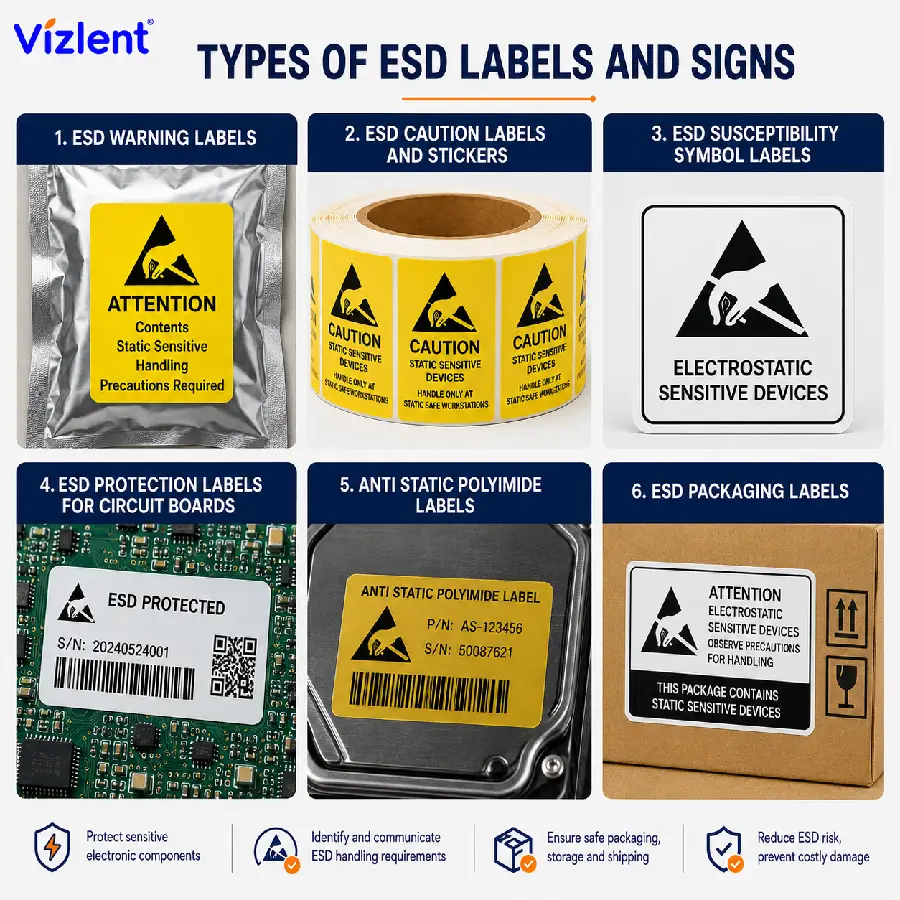
What are ESD labels in day to day factory use? The term covers several product families, from printed handler warnings to blank dissipative stock that runs through barcode printers. Most buyers sort ESD labels and signs into two groups: warning formats that alert people and functional formats that carry data.
Warning formats rely on high visibility yellow and black artwork so a handler spots them before opening a package. Functional formats look like ordinary barcode labels but sit on dissipative material, so they can be applied directly to boards, bags, and reels. Vizlent produces both, and each product ships with a technical data sheet stating the measured resistivity for its batch.
- ESD warning labels seal moisture barrier bags and tell handlers that static-sensitive contents sit inside. The yellow ATTENTION design doubles as a tamper indicator once the bag is opened.
- ESD caution labels and ESD caution stickers carry the caution wording defined in packaging practice and usually arrive on rolls for fast hand application. They mark cartons, totes, and shelving inside controlled zones.
- ESD susceptibility symbol labels print the reach hand symbol from ANSI/ESD S8.1 to identify electrostatic sensitive devices. Searches for esd sensitive labels almost always point to this symbol format.
- An ESD protection label for circuit boards combines dissipative material with reflow-safe adhesive so it survives soldering temperatures. These carry serial numbers and traceability barcodes directly on the PCB.
- Anti static polyimide labels resist temperatures up to 300°C for semiconductor, PCB, and hard drive identification. Polyimide keeps its shape and print contrast through repeated thermal cycles.
- An esd packaging label goes on the outer bag or carton so the complete container stays static safe during storage and global shipping. It is the last line of defense between the warehouse and the customer dock.
ESD Label Material Options
ESD label material usually starts with a polyester or polypropylene film coated with an ionic antistatic layer at a coat weight of 0.8 to 1.5 g/m². The coating stays effective at relative humidity as low as 20 percent, which matters because many cheaper hygroscopic treatments fade in dry winter air. Vizlent supplies this construction as anti static label stock in jumbo rolls, precision-slit rolls, and custom-cut sheets.
For high heat applications, polyimide ESD label material survives reflow soldering and wave soldering without shrinking or browning. Film face stocks typically run 50 to 100 µm thick with a service range of minus 10°C to plus 80°C for standard grades. Every batch is measured per IEC 61340-2-3 or ASTM D257 at 23°C and 50 percent relative humidity, and the value appears on the technical data sheet.
ESD Label Standards and Compliance
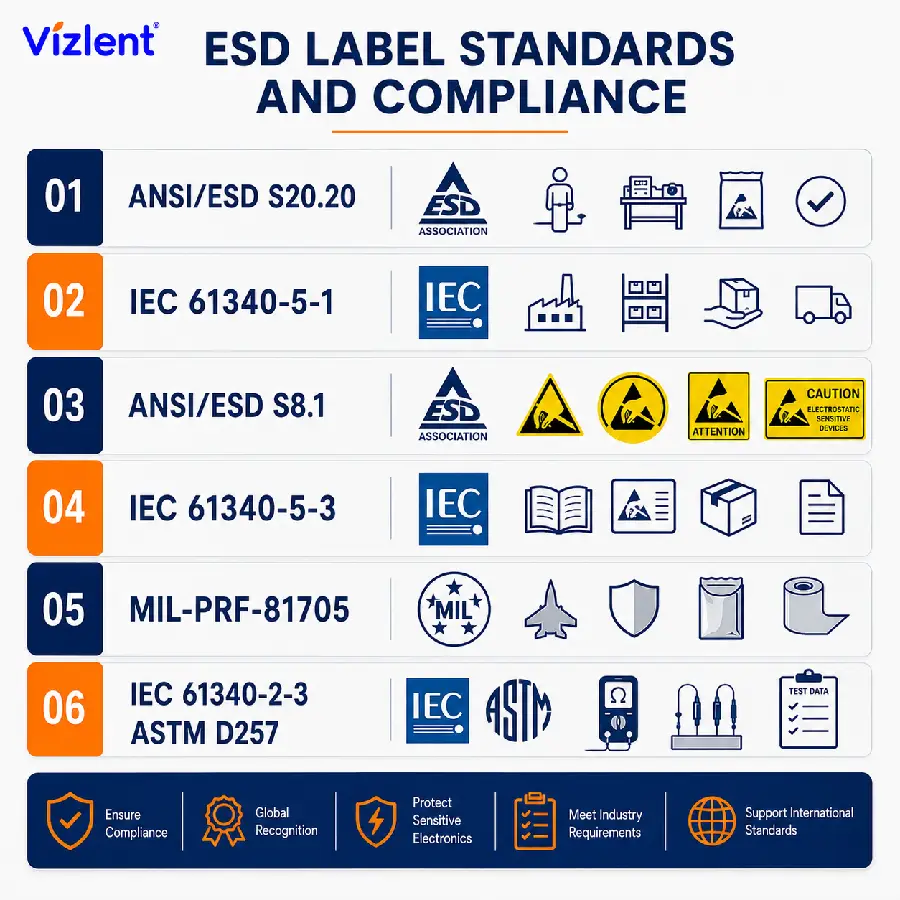
ESD labels are manufactured to support the electrostatic control requirements used throughout the electronics industry. The primary standards come from the ANSI/ESD and IEC 61340 families, which establish best practices for protecting electrostatic discharge (ESD) sensitive devices during manufacturing, storage, transportation, and handling. While these standards do not certify individual labels, they define the performance requirements and test methods used to evaluate ESD control materials.
ANSI/ESD S20.20 establishes the requirements for an ESD control program used by electronics manufacturers. Labels, packaging, and other materials introduced into an ESD Protected Area (EPA) should be selected so they do not introduce an unacceptable electrostatic risk. IEC 61340-5-1 provides internationally recognized requirements for the same objective, helping manufacturers maintain consistent ESD protection across global supply chains. For ESD awareness symbols, ANSI/ESD S8.1 is widely referenced in North America, while IEC 61340-5-3 provides guidance on ESD symbols and marking for international applications.
Industrial ESD label manufacturers commonly verify product performance through standardized electrical testing. Many suppliers provide certificates of conformance or technical data sheets listing measured electrical properties, including surface resistivity or surface resistance, to demonstrate that their products meet the intended performance requirements. Independent laboratory testing may also be used to support quality assurance and customer qualification processes.
The standards most frequently associated with ESD labels include:
- ANSI/ESD S20.20 establishes the requirements for an ESD control program, covering personnel grounding, workstations, packaging, materials, and handling practices within an ESD Protected Area.
- IEC 61340-5-1 provides internationally recognized requirements for protecting electronic devices from electrostatic discharge throughout manufacturing, storage, handling, and transportation.
- ANSI/ESD S8.1 defines the ESD awareness symbols commonly printed on warning labels, protective packaging, and ESD control products throughout North America.
- IEC 61340-5-3 provides guidance on ESD symbols, marking, and user documentation for international applications.
- MIL-PRF-81705 specifies the performance requirements for electrostatic protective barrier materials used in military and aerospace packaging applications.
- IEC 61340-2-3 and ASTM D257 describe standardized methods for measuring electrical resistance and surface resistivity, values commonly reported on ESD material technical data sheets.
Selecting ESD labels manufactured and tested in accordance with these recognized standards helps ensure compatibility with established ESD control programs and supports consistent protection for static-sensitive electronic components throughout the supply chain.
Where ESD Protection Labels Are Used
Electronics and semiconductor assembly remains the largest user, since bare die and packaged ICs can fail from discharge events of just 10 to 100 volts. An esd protection label on the bag, tray, or reel keeps the dissipative boundary intact from the production line to the receiving dock. Automotive electronics plants apply the same logic to sensor modules, control units, and cable assemblies.
Chemical and explosive handling sites specify dissipative labeling because a charged label face can ignite vapors inside classified zones. Medical device packaging adds static control to cleanroom rules, since surface charge attracts particulates onto sterile barriers. In each setting the label forms part of the protective system, never decoration.
- Logistics and distribution centers mark inbound electronics cartons so warehouse staff route them through static safe handling lanes.
- Repair and refurbishment shops label returned boards and drives to keep protection consistent after the original packaging is gone.
- Aerospace and defense programs specify labels with third-party test data to satisfy MIL-PRF-81705 supply chain audits.
How to Choose the Right ESD Label
Selection comes down to matching the label construction to the surface, the temperature, and the print method in front of you. A label that performs on a polyethylene bag may fail on a bare board headed into a reflow oven. Work through the checklist below before requesting samples.
Documentation deserves equal weight to the material itself. A supplier who cannot show batch-level resistivity data leaves your audit trail incomplete. Insist on measured values, stated test conditions, and third-party certification before any bulk commitment.
- Substrate: Polyethylene and polypropylene bags have low surface energy, so specify a solvent acrylic adhesive or confirm corona pretreatment for water-based systems.
- Temperature: Choose polyimide for reflow and wave soldering, standard PET film for ambient warehouse and transit conditions.
- Print method: PET-face dissipative stock runs on thermal transfer printers without pretreatment, while sheet formats suit laser printing for short runs.
- Resistivity proof: Request the technical data sheet showing 10⁶ to 10⁹ Ω/sq measured per IEC 61340-2-3 or ASTM D257.
- Format: Converters take jumbo rolls for in-house slitting, while assembly lines take slit rolls wound to their applicator core size and unwind direction.
Common ESD Search Terms Explained
Several popular search phrases around this topic point to products, brands, or organizations that deserve a straight explanation. Treating them honestly saves buyers time and prevents mismatched orders. The notes below cover the terms our support team sees most often.
None of these searches change the underlying material science. A label either measures inside the dissipative band or it does not, and the technical data sheet settles the question. Use the list to translate a search habit into the correct product request.
- Brady esd labels: Brady is a US brand known for pre-printed identification products. Buyers comparing brady esd labels against factory-direct stock are usually weighing finished printed labels against raw dissipative material for in-house printing, and the second route costs less at volume.
- ESD strap near me: This search points to wrist straps and grounding hardware rather than labels. Vizlent manufactures label stock, so pair a strap purchase with a grounding equipment supplier.
- ESD name tag: No separate name tag category exists in the label industry. Standard dissipative esd label stickers printed with names or asset IDs handle identification inside protected areas.
- ESD meaning environment: In this context ESD stands for electrostatic discharge, and the environment searchers ask about is the ESD protected area, or EPA, where every material within reach of components must be static safe.
- ESD label manufacturers association: No trade body carries this exact name. Searchers usually mean the EOS/ESD Association, the standards organization behind ANSI/ESD S20.20 and the S8.1 symbols.
- ESD labels labelling: This phrasing simply reflects British spelling of the labeling process. The products, standards, and resistivity requirements stay identical on both sides of the Atlantic.
How to Order ESD Labels in Bulk
Ordering esd labels in bulk from a direct factory follows a short qualification path. Submit the face stock type, adhesive grade, roll width, and print method, and the engineering team responds with a material recommendation within 24 hours. Free A4 sheets or short sample rolls let you verify print quality and resistivity on your own equipment before any production commitment.
Bulk production ships within about 15 days of order confirmation, wound to your core size and unwind direction. An esd label sticker order can arrive as jumbo rolls for converters, precision-slit rolls held to ±0.1 mm width tolerance, or custom-cut sheets for qualification runs. Send your specification through the contact page to receive a factory-direct quotation with no hidden costs.
Get Factory-Direct ESD Label Stock From Vizlent Label Materials Co., Ltd.
So, what are ESD labels worth to your operation? They act as low cost insurance against component failures that can cost thousands of times the label price. Choosing verified dissipative stock turns a printed warning into genuine protection.
Vizlent Label has manufactured dissipative label materials since 2011, supplying converters, distributors, and electronics manufacturers across more than 50 countries. Every batch ships with measured resistivity data, SGS and TUV verification, and full traceability documentation. Browse the anti static label range and send your inquiry today for free samples and a factory-direct quote on your ESD labeling program.
Frequently Asked Questions
What are ESD labels?
ESD labels are self-adhesive labels made from static-dissipative materials that stop electrostatic charge from accumulating on packaging and components. They protect items such as circuit boards, semiconductors, and disk drives from discharge damage during handling, storage, and transit. Most measure a surface resistivity of 10⁶ to 10⁹ Ω/sq, the band that bleeds charge safely without creating a conductive path. Both printed warning formats and blank printable stock fall under the term.
What is the difference between ESD warning labels and ESD caution labels?
ESD warning labels and ESD caution labels serve the same alert function and differ mainly in wording and placement. Warning versions typically seal moisture barrier bags and mark component reels, while caution versions with ATTENTION text go on cartons and totes. Both use the yellow and black scheme handlers recognize on sight. Both should also be printed on dissipative stock so the label itself adds no risk.
What surface resistivity should ESD safe labels have?
ESD safe labels should measure between 10⁶ and 10⁹ Ω/sq per IEC 61340 classification. Below 10⁶ Ω/sq the material turns conductive and discharges too fast, and above 10¹² Ω/sq it insulates and holds charge. The dissipative middle band bleeds energy away at a controlled rate. Ask for the batch technical data sheet to confirm the measured value rather than trusting a general product claim.
Which ESD label standard applies to electronics packaging?
ANSI/ESD S20.20 and IEC 61340-5-1 are the primary program standards for electronics packaging, and ANSI/ESD S8.1 defines the warning symbols printed on labels. MIL-PRF-81705 governs US defense packaging and requires traceable third-party test data. A supplier serving these markets should provide SGS or TUV documentation with every batch. Auditors treat missing data as a nonconformance.
Can ESD labels run through thermal transfer printers?
Yes, PET-face dissipative constructions run on standard thermal transfer printers without any pretreatment. The antistatic coating stays inert to wax and resin ribbons, so barcode contrast remains sharp and scannable. Slit rolls held to ±0.1 mm width tolerance also feed reliably on servo-driven automatic applicators. Confirm core diameter and unwind direction when placing the order.
Do ESD labels lose performance in dry air?
Quality ionic antistatic coatings stay effective at relative humidity as low as 20 percent. Cheaper hygroscopic treatments depend on ambient moisture and fade in heated buildings or dry climates. This difference matters most in winter production environments where humidity drops sharply. Check the technical data sheet for the humidity range at which resistivity was actually measured.
Can you buy ESD labels in bulk directly from the factory?
Yes, direct manufacturers supply dissipative label material as jumbo rolls, slit rolls, and sheets without a trading company margin. Factory sourcing also opens custom options such as adhesive formulation changes and nonstandard widths that resellers cannot offer. Free samples arrive first for press trials and resistivity testing. Bulk orders then ship within about 15 days of confirmation.
Are ESD compliant labels required for factory audits?
Auditors working to ANSI/ESD S20.20 expect every packaging and marking material inside the protected area to be dissipative and documented. ESD compliant labels with batch-level resistivity data close that audit item cleanly. Generic labels without supporting data typically get flagged as nonconforming materials. Keeping the technical data sheets on file turns the audit question into a one-minute answer.






