
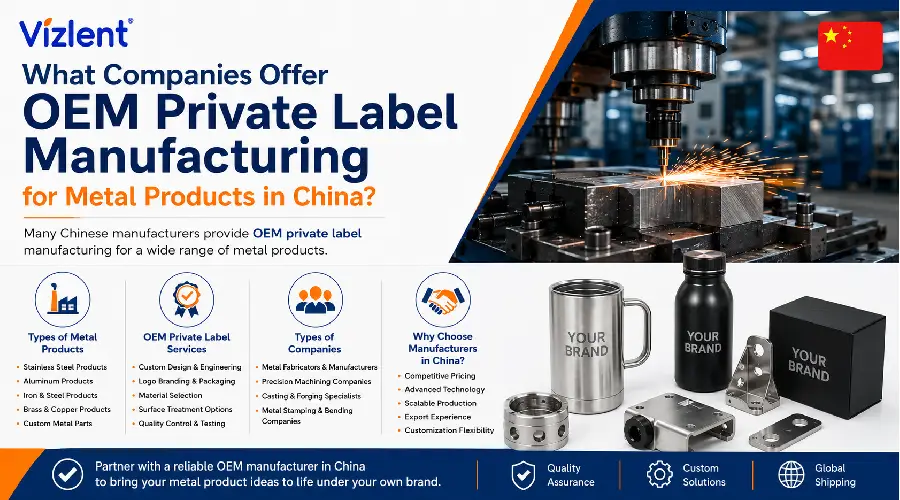
OEM private label manufacturing for metal products in China refers to Chinese factories that produce goods under contract for other brands, including labels, films, packaging, and finished metal items, with those brands selling the output under their own name. In the label and adhesive materials space, that means Chinese manufacturers producing custom stickers, foil labels, chemical-resistant film, and metallic-finish tags for application to drums, industrial equipment, cans, appliances, and premium retail goods.
Buyers looking for OEM private label manufacturing for metal products in China typically weigh three factors up front: material compatibility with the target metal, factory-direct pricing, and flexibility on artwork, size, and roll formats. Getting those three right sets the direction for the rest of the sourcing project.
What OEM Private Label Manufacturing for Metal Products in China Actually Covers
OEM private label manufacturing for metal products in China covers three overlapping activities: contract production of finished metal goods, contract production of labels and packaging designed for metal surfaces, and hybrid arrangements where a Chinese factory handles both the metal component and its branded labeling. The label and adhesive segment is one of the largest sub-industries within this category, since almost every metal product shipped internationally (drums, industrial equipment, appliances, food cans, cosmetic tins) needs a durable, correctly certified label. Buyers usually start with the label side because it moves the fastest and unlocks branding decisions before the underlying product tooling is finalized.
The scope stretches across raw label stock, printed labels, in-mold labeling, and full-service labeling programs that integrate design, printing, quality control, and shipping. Firms offering OEM private label manufacturing for metal products in China usually run their own coating lines, slitting operations, printing equipment, and quality labs, giving them tighter control over lead times and cost. Vertical integration is what separates real manufacturers from trading companies that outsource everything and mark up the invoice.
Typical activities covered by durable label OEMs in China:
- Custom-printed labels for chemical drums and industrial containers
- Aluminum foil labels for appliance nameplates and rating plates
- Anti-static and flame-retardant labels for electronic metal enclosures
- Tamper-evident stickers and void seals for metal packaging
- Metallic-finish decorative labels for premium consumer goods
- Barcode and asset ID labels for metal machinery and equipment
OEM vs Private Label vs Contract Manufacturing

The metal oem private label difference is often blurred in day-to-day conversation, but the terms carry distinct meanings in commercial contracts. OEM (original equipment manufacturer) traditionally means a factory that produces components used inside another brand’s finished product, while private label refers to a factory that produces a complete finished item sold under the buyer’s own brand name. Contract manufacturing is a broader umbrella that can cover both models, and Chinese factories frequently offer all three arrangements under one roof.
In practice, the boundary between OEM and private label has softened over the last two decades. A buyer sourcing OEM private label manufacturing for metal products in China may sign a hybrid agreement where the factory produces both the branded finished product and its underlying components. What matters more than the label on the contract is the actual scope: who owns the tooling, who owns the artwork, who controls the raw material specification, and who covers the compliance certificates.
Contract type quick reference:
- OEM: Factory manufactures to the buyer’s design or specifications; buyer brands and sells the product.
- Private Label: Factory supplies products sold under the buyer’s brand, often with limited customization.
- Contract Manufacturing: Broad term for outsourcing production to a manufacturer, including OEM and private-label arrangements.
- White Label: Standard product sold to multiple brands with different branding but minimal customization.
- Joint Development: Buyer and manufacturer jointly develop the product and may share development costs and IP rights.
Categories of Metal Products That Rely on Chinese Label OEMs

Metal products span heavy industry, consumer packaging, and premium retail, and each category carries its own labeling requirements. OEM private label manufacturing for metal products and packaging covers steel drums, aluminum cans, metal tins, and paint pails, where labels must resist chemical splash, wash-off, and abrasion during transport. OEM private label manufacturing for metal products and parts extends into appliance nameplates, automotive components, and machine tool identification, where labels carry model numbers, serial IDs, and compliance marks.
Consumer-facing metal products also drive significant OEM label demand. Wine bottle capsules, cosmetic tins, food cans, and premium spirits packaging all rely on metallic-finish, foil, and holographic labels, most of which are printed by Chinese OEMs serving global brands. Metal OEM private label products in this segment often blend security features (tamper evidence, hologram) with premium aesthetics (metallic ink, hot foil stamping) in a single label construction.
Common metal product categories served by appliances and industrial label OEMs:
- Chemical and paint drums (55 gallon steel and smaller)
- Aluminum cans for food, beverage, and aerosol packaging
- Appliance nameplates on refrigerators, washers, and HVAC units
- Automotive VIN plates and under-hood component labels
- Cosmetic tins, wine capsules, and premium spirits packaging
- Industrial equipment asset tags and safety compliance labels
What to Look For in a Chinese OEM Label Manufacturer
Picking a factory is a due-diligence exercise, and shortcuts in the vetting phase usually surface as quality problems downstream. Buyers researching OEM private label manufacturing for metal products in China should confirm three infrastructure basics up front: an in-house coating line, roll slitting capacity, and a printing floor that supports the required print methods. Certifications to check include ISO 9001, ISO 14001, SGS material test reports, and, where relevant, FSC-certified paper substrates.
Volume commitment and pricing structure matter next. Firms specializing in OEM private label manufacturing for metal products bulk orders usually offer tiered pricing that drops at 100 sqm, 500 sqm, and 1,000+ sqm brackets. A dependable metal oem private label service and reliable metal oem private label business partner also provides technical support during specification, free samples for peel and print tests, and clear lead-time commitments before deposits are wired.
Due-diligence checklist for OEM private label manufacturing for metal products business partners:
- In-house coating and slitting infrastructure (avoids trading company markups)
- ISO 9001 quality certification and SGS material test reports
- Minimum order quantity aligned with your monthly demand
- Free sample program and free A4 sheet testing before bulk orders
- Written lead-time commitment before deposit wire
- Reference customers you can call in your target export market
- Complete OEM private label manufacturing for metal products and services documentation
Custom Design, Branding, and Metallic Finishes
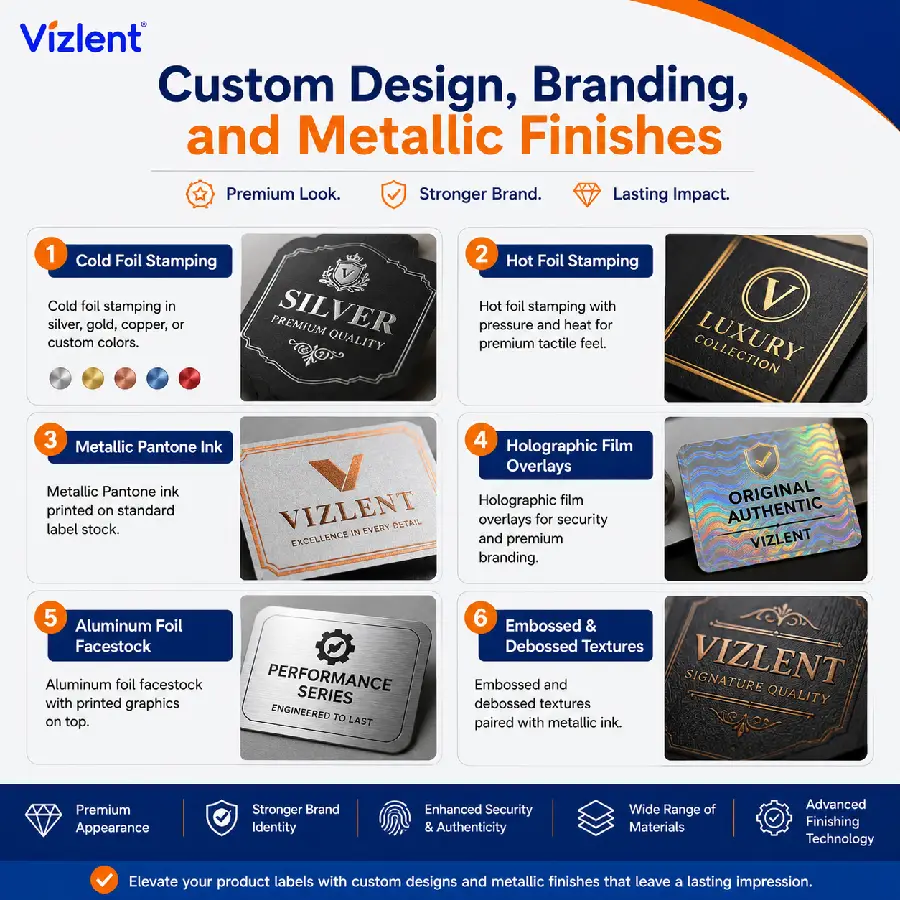
Design flexibility is one of the biggest reasons global brands pick OEM private label manufacturing for metal products in China over local sourcing. Chinese label factories typically support 6-color offset printing, digital printing for short runs, hot foil stamping for premium finishes, and embossing for tactile branding effects. Metal oem private labels for luxury goods often layer these techniques together to hit a specific brand aesthetic.
Custom design work starts with the client’s brand guidelines and a target substrate, and the factory’s DTP (desktop publishing) team turns those inputs into press-ready files. Metal oem private label custom projects can include foil stamping, metallic ink, and cold-transfer holographic overlays, all applied in a single production pass. A capable metal oem private label design team also flags production constraints early for metal oem private label brands, such as minimum text sizes for foil stamping and safe ink zones for die-cutting.
Common metallic finishing options paired with laser-etched and foil labels:
- Cold foil stamping in silver, gold, copper, or custom colors
- Hot foil stamping with pressure and heat for premium tactile feel
- Metallic Pantone ink printed on standard label stock
- Holographic film overlays for security and premium branding
- Aluminum foil facestock with printed graphics on top
- Embossed and debossed textures paired with metallic ink
Compliance, Certification, and Export Documentation
Compliance paperwork often decides how quickly a shipment clears customs, since missing certificates can hold the container in a bonded warehouse for weeks. Buyers evaluating OEM private label manufacturing for metal products in China should ask for material safety data sheets (MSDS), REACH and RoHS compliance letters, migration test reports for food-contact applications, and, where required, UL 969 label durability documentation. Metal oem private label data such as adhesion strength (measured in gf/25mm), peel force, and shear resistance should also appear on every technical data sheet.
Documentation quality is a strong proxy for factory quality overall. A serious manufacturer supplies full traceability from raw material batch numbers to finished-goods lot codes, which matters when a downstream failure needs root-cause analysis. Chinese OEMs serving regulated markets (pharmaceutical, food, aerospace) usually maintain GMP audit trails, biocompatibility test files, and third-party lab reports from SGS, TÜV, or Bureau Veritas.
Documentation checklist for regulated markets (paired with security label products where relevant):
- Material safety data sheets (MSDS) for adhesive and facestock
- REACH and RoHS compliance letters for EU imports
- FDA food-contact migration test reports for US market entry
- UL 969 durability testing for permanence and legibility claims
- Third-party lab reports from SGS, TÜV, or Bureau Veritas
- Batch and lot traceability for recall and root-cause response
Sourcing Channels: Trade Shows, B2B Directories, and Direct Contact

Buyers sourcing OEM private label manufacturing for metal products in China have three main channels: international trade shows, B2B directory platforms, and direct outreach to known factories. Trade shows such as Labelexpo Asia, Interpack, and All in Print China give buyers face time with dozens of metal oem private label manufacturers in a single visit and support hands-on sample inspection. B2B platforms including Alibaba, Made-in-China, and Global Sources list thousands of OEM private label manufacturing for metal products companies, but require careful verification of factory status versus trading company status.
Direct outreach to factory websites often shortens the vetting process. Buyers who already know the segment can bypass directory noise and reach out to metal oem private label companies and metal oem private label distributors with proven export track records. Comparing OEM private label manufacturing for metal products Canada options against OEM private label manufacturing for metal products China pricing typically shows a 30 to 50 percent cost gap in China’s favor at bulk volumes, which is why OEM private label manufacturing for metal products by China factories has become the default for cost-sensitive private label programs.
Sourcing channel comparison:
- Trade shows: Highest confidence, face-to-face vetting, higher travel cost
- Direct factory outreach: Shortest lead time, requires prior product knowledge
- Alibaba and Made-in-China: Broad selection, needs careful supplier verification
- Sourcing agents: Local Chinese contact, adds 5 to 10 percent commission fee
- Government trade offices: China Council for International Trade support
Working with Vizlent for OEM Private Label Manufacturing for Metal Products in China
Vizlent has produced pressure-sensitive labels, thermal transfer ribbons, and self-adhesive materials for OEM and private-label brands since 2011, shipping to more than 50 countries from our Shenzhen coating and slitting facility. Our engineering team specializes in metal-compatible constructions: aluminum foil facestocks, high-tack acrylic adhesives for painted metal and powder-coated surfaces, and heat-resistant materials rated for engine bays and appliance nameplates. We handle both metal oem private label china projects for domestic Chinese brands and export-oriented programs for buyers across North America, Europe, Australia, and the Middle East.
Full OEM private label manufacturing for metal products in China from Vizlent covers construction spec, artwork DTP, print production, quality assurance, and moisture-proof export packaging. Our minimum order quantities start low enough for pilot runs (typically 100 sqm of finished label stock) and scale up to jumbo roll shipments for annual supply contracts. Reach out to our engineering team through the contact page for a technical review, free A4 sample sheets, and a written quote against your target metal substrate.
Vizlent capabilities snapshot:
- Coating, slitting, printing, and QC under one roof since 2011
- ISO 9001, ISO 14001, FSC, and SGS certified operations
- 100 sqm minimum for pilot runs; jumbo rolls for volume programs
- 7 to 15 day lead times on standard repeat orders
- Free A4 sample sheets and pre-order technical support
- Export packaging tested for moisture and vibration in ocean freight
Ready to Spec Your Metal Product Label Program?
Vizlent produces factory-direct pressure-sensitive labels, thermal transfer ribbons, and metallic-finish label constructions designed for drums, appliances, cans, industrial equipment, and premium retail packaging across 50+ countries. Our engineering team works from your target metal substrate, operating environment, and annual volume to spec a construction that will bond cleanly, print sharply, and pass export inspection. Reach out for a free A4 sample sheet, a technical consultation, and a written quote sized to your program. → Send Your Inquiry.
Frequently Asked Questions
What is OEM private label manufacturing for metal products in China?
OEM private label manufacturing for metal products in China refers to Chinese factories producing goods (including labels, packaging, films, and finished metal items) under contract for buyer brands, with the buyer selling the output under its own name. In the label industry, that typically means custom labels, aluminum foil labels, and metallic-finish stickers applied to drums, appliances, cans, and industrial equipment. Buyers pick China for the combination of factory-direct pricing, mature supply chains, and integrated coating-slitting-printing capacity.
What is the metal oem private label difference between OEM and private label?
OEM (original equipment manufacturer) traditionally refers to a factory that produces components used inside another brand’s finished product, while private label refers to a factory that produces a complete finished good sold under the buyer’s own brand. In the labels industry, both terms often collapse into a single arrangement where the factory prints custom labels to buyer artwork and ships them ready to apply. What matters more than the term used is who owns the design files, tooling, and compliance paperwork.
What is the minimum order for OEM label manufacturing in China?
Minimum order quantities depend on print method and material, with digital printing supporting runs as small as 500 to 1,000 label units and flexo or offset print starting at 10,000 to 50,000 units for cost efficiency. Coating and slitting minimums usually start at 100 sqm of finished label stock. Buyers running pilot programs should ask specifically about MOQ flexibility during quoting.
How long does it take to source labels from a Chinese OEM?
Standard lead times run 7 to 15 days for repeat orders on established artwork and 25 to 40 days for new artwork requiring DTP, sampling, and approval cycles. Ocean freight adds another 25 to 45 days depending on destination, while air freight cuts that to 3 to 7 days at a higher unit cost. Total door-to-door timeline for a first-time OEM label order is typically 45 to 90 days.
Which Chinese cities are strongest for label OEM production?
Guangdong (Shenzhen, Guangzhou), Shanghai, and Zhejiang (Wenzhou, Yiwu) host the largest concentrations of label printing and coating factories in China. Guangdong dominates high-end printing and export-oriented production, Shanghai leads in pharmaceutical and cosmetic labels, and Zhejiang covers price-sensitive commodity runs. Buyers should match their product category to the regional strength when shortlisting suppliers.
Do Chinese OEMs support metallic finish and hologram security labels?
Yes. Most established Chinese label OEMs support cold foil, hot foil, holographic overlays, and metallic Pantone inks in-house, and can layer security features (void seal, tamper evidence, VOID adhesive) on the same label construction. Hologram origination typically adds a one-time tooling fee of USD 300 to 1,500 depending on complexity, with per-unit hologram cost falling sharply as annual volume rises.
How do I verify a Chinese OEM factory before placing an order?
Verification starts with a business license lookup on the Chinese government’s National Enterprise Credit Information Publicity System, followed by video calls of the production floor and a third-party inspection through SGS, Bureau Veritas, or TÜV. Buyers should also request reference customer contacts in the target export market. Sending a small paid sample order is the last check before committing to a full production run.
Where can I find OEM private label manufacturing for metal products in China?
The most common starting points are Alibaba, Made-in-China, and Global Sources for broad supplier discovery, along with international trade shows for face-to-face vetting. Direct outreach to established factory websites shortens the timeline for buyers who already know the product category and have a defined substrate specification. Reach out to the Vizlent engineering team for a specification review against your target metal substrate and volume tier.






