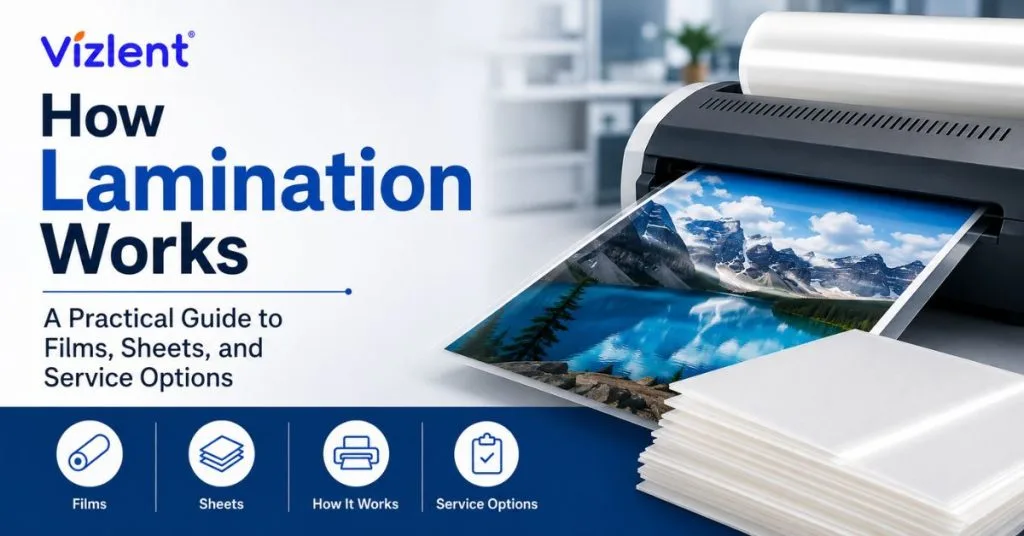
Lamination is a finishing process that bonds a thin protective film to paper, card, photographs, or printed packaging using heat, pressure, or adhesive. The film seals the printed surface against moisture, fingerprints, UV exposure, and physical wear. Common applications include ID cards, restaurant menus, retail labels, book covers, packaging artwork, and document preservation.
Anyone trying to understand how lamination works quickly discovers it covers a wide range of techniques, from cold pouch laminators in copy shops to high-speed industrial lines producing flexible packaging. The choice of film, machine, and substrate dictates clarity, durability, and finish quality. Lamination paper, polyester films, and specialty coatings each behave differently under heat, pressure, and storage conditions.
Need factory-direct laminating films for your finishing operation? Request a free sample from Vizlent to test clarity, adhesion, and finish on your own substrate before bulk ordering.
The Step-by-Step Lamination Process
The lamination process begins with preparing the substrate to confirm it is clean, flat, and free of debris that would create bubbles or weak bonds. The film is fed alongside the substrate at a controlled speed, with rollers applying even pressure across the full width. For thermal lamination, heated rollers melt the adhesive layer on the film as it contacts the paper, locking the two surfaces together.
After bonding, the laminated piece passes through cooling rollers and trimming stations that remove excess film around the edges. Quality checks verify clarity, adhesion strength, and the absence of trapped air or wrinkling. The finished output is then stacked, slit, or rolled, depending on the production format.
Types of Lamination Films Used in the Process

Lamination films come in several material families, each engineered for a specific finish, level of protection, and cost point. The most common base polymers are polyester (PET), polypropylene (BOPP), and polyethylene (PE), with PVC used for specialty applications. Adhesive systems include thermal melt adhesives, pressure-sensitive adhesives, and reactive coatings cured by heat or UV.
Beyond the base material, films are sold in different finishes including gloss, matte, satin, soft-touch, anti-scratch, and anti-fingerprint coatings. Thickness typically ranges from 1.5 mil for everyday document protection up to 10 mil for ID cards and outdoor signs. Higher thickness adds rigidity and abrasion resistance but raises material cost and machine wear.
Thermal Lamination Films
Thermal lamination films carry a heat-activated adhesive layer that softens between 90 and 130 degrees Celsius and bonds to the substrate as it passes through heated rollers. This is the standard option for high-clarity document protection, photo finishing, and packaging artwork. The bond is permanent and produces a smooth, sealed finish that resists moisture and handling.
Thermal films work best on heat-tolerant substrates such as paper, paperboard, and standard print stock. They are not suited to heat-sensitive prints made with toner that can soften or transfer at high roller temperatures. Vizlent supplies thermal laminating films in BOPP (Biaxially Oriented Polypropylene) and PET (Polyethylene terephthalate) grades with adhesive coat weights calibrated for offset, digital, and inkjet output.
Cold (Pressure-Sensitive) Lamination Films
Cold lamination films use a pressure-sensitive adhesive that bonds at room temperature without heat. They are the preferred choice for heat-sensitive prints, photographic emulsions, and outdoor signage where film clarity has to hold under sunlight. The film releases from its liner and applies through roller pressure rather than thermal activation.
These films allow positioning and limited repositioning during application, which suits manual work in print shops and small studios. UV-blocking versions protect inkjet prints, posters, and signage from fading in direct sunlight. Coat weights and liner release force are tuned so the film can be applied cleanly by hand or through a benchtop cold laminator.
Liquid Lamination Coatings
Liquid lamination, sometimes called aqueous coating, applies a clear protective layer in fluid form that cures into a hard, glass-like finish. The coating is rolled, sprayed, or curtain-coated onto the printed sheet and cured by heat, UV light, or air drying. It produces a flexible, scratch-resistant finish without the rigidity of a polyester film.
This option is common in commercial printing for catalogs, brochures, and packaging where high gloss or soft-touch finishes are required at high production speed. Liquid coatings can be applied in line with offset presses, reducing handling and trimming steps. Recycling is also easier because the coating does not need to be peeled from the paper before re-pulping.
Lamination Sheets vs Lamination Rolls
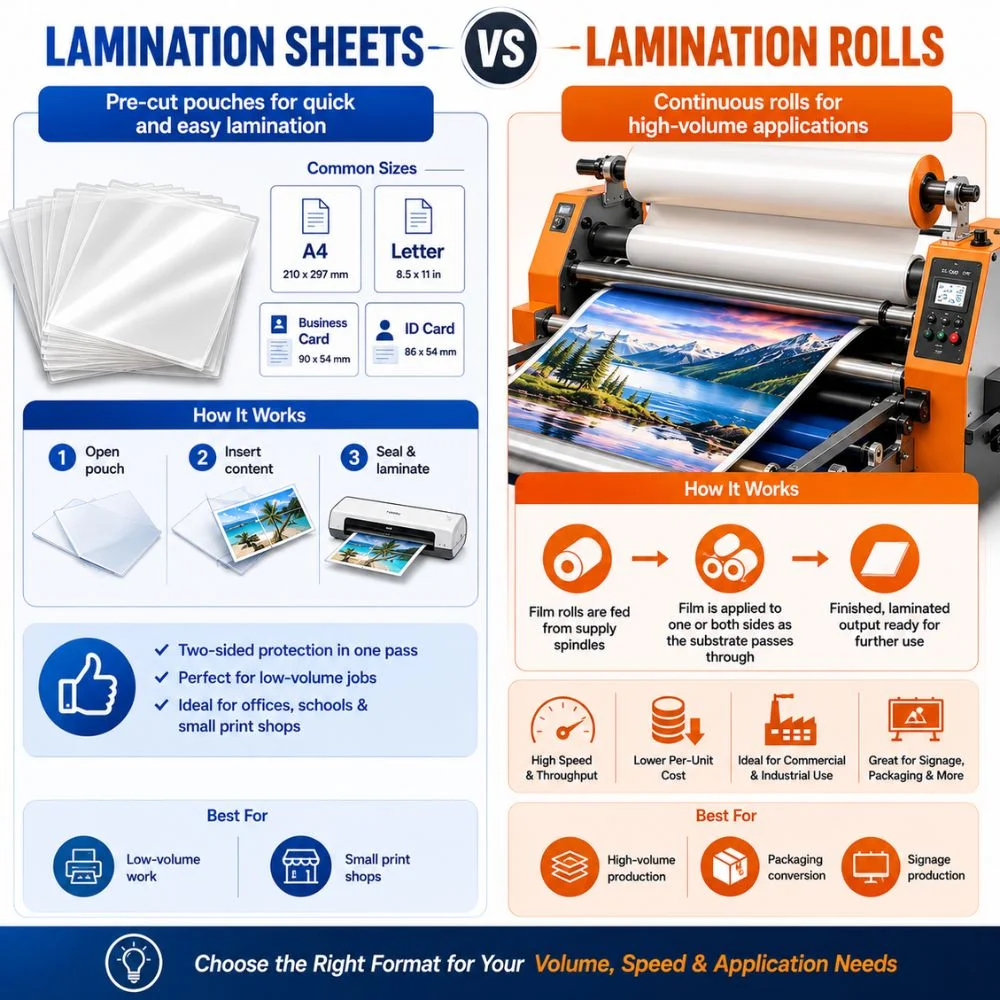
Lamination sheets are pre-cut, two-sided pouches sized to match common document formats such as A4, letter, business card, and ID card. The substrate is slipped between the two layers and run through a pouch laminator that seals the edges and bonds the film to both faces. Pouches are convenient for low-volume work and small print shops.
Roll laminators use continuous lamination rolls fed from supply spindles, applying film to one or both sides of a substrate as it passes through. This format suits high-volume operations such as commercial print finishing, packaging conversion, and signage production. Rolls deliver lower per-unit cost and faster throughput once the operator is set up.
When Lamination Sheets Make Sense
Lamination sheets work best for short runs, on-demand requests, and operators without continuous-feed equipment. They cost more per unit but eliminate setup time and reduce film waste on single-piece jobs. Common buyers include schools, libraries, restaurants, real estate offices, and small print and copy shops.
Pouch thickness ranges from 3 mil through 10 mil, with higher thicknesses used for items that need rigidity, such as ID badges and reference cards. Some pouches include a slot punch for lanyard attachment or a magnetic stripe pocket. Quality varies sharply across suppliers, so verifying clarity, adhesion, and curl resistance on a sample batch is worthwhile.
Lamination Paper and Substrate Combinations
Lamination paper refers either to paper backed with a laminating film for ready use, or to base paper qualified for laminating in a converter setup. The first form is common in school and craft contexts, while the second form is used in commercial printing and flexible packaging. Quality depends on coating, fiber content, and moisture stability.
Substrate pairing matters because the paper has to accept the adhesive without warping, fiber tearing, or ink offset under heated rollers. Coated stock laminates more cleanly than uncoated stock, and lower-bulk papers handle film bonding without curling. For packaging applications, food-safe paper and adhesive combinations also have to meet migration limits.
When and Why People Search Lamination Near Me
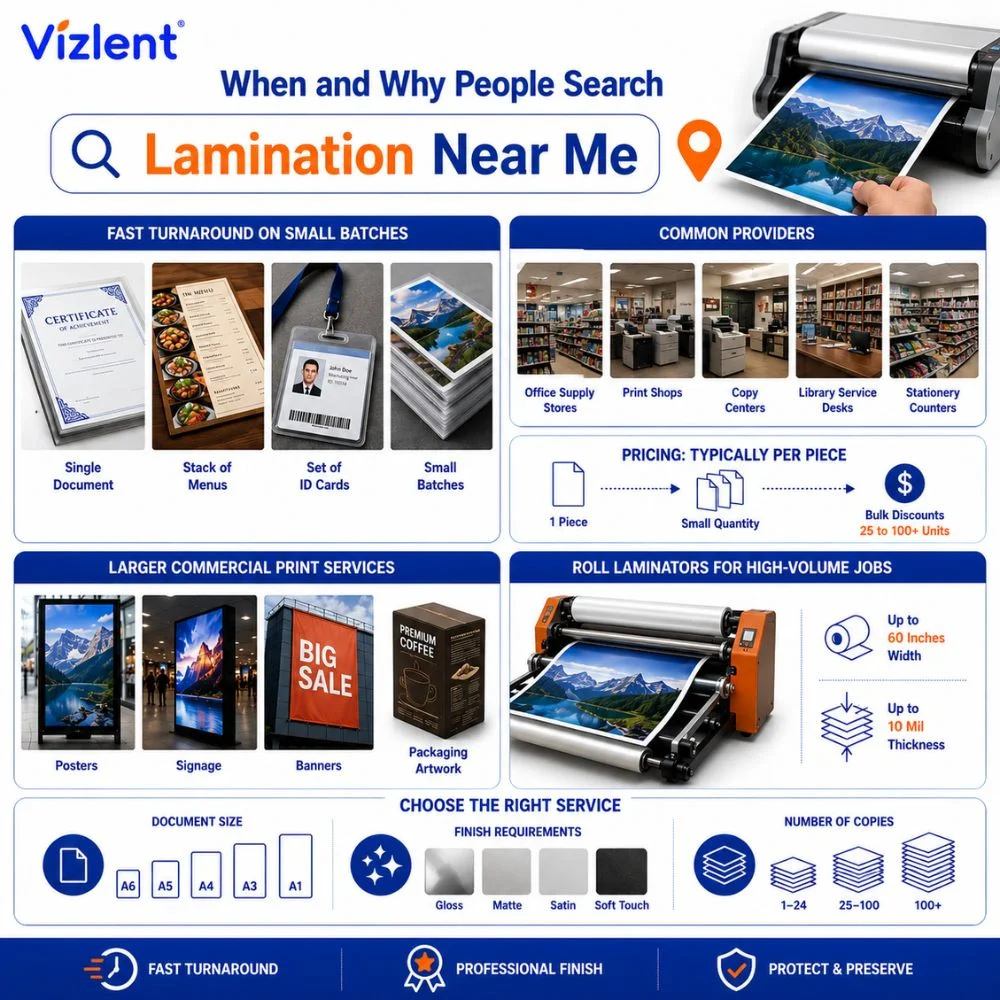
Anyone searching lamination near me is usually looking for a fast turnaround on a small batch, such as a single document, a stack of menus, or a set of ID cards. Common providers include office supply stores, print shops, copy centers, library service desks, and stationery counters in convenience stores. Pricing is typically per piece, with bulk discounts kicking in at 25 to 100 units.
Lamination services near me searches also turn up larger commercial print houses that handle posters, signage, banners, and packaging artwork. These providers run roll laminators capable of widths up to 60 inches and thicknesses up to 10 mil. Choosing the right service depends on document size, finish requirements, and the number of copies needed.
Running a lamination services business and looking for reliable film supply? Talk to our technical team about volume pricing, custom slitting, and OEM support for your finishing operation.
How Industrial Lamination Lines Operate
Industrial lamination lines run at speeds of 100 to 800 meters per minute, applying film to printed webs as they travel from unwind to rewind stations. The process integrates surface treatment, adhesive application, lamination, curing, and slitting in a single pass. Quality control sensors monitor film tension, bond strength, and registration in real time.
Anyone wanting to understand how lamination works at an industrial scale should picture multiple roller stacks, ovens, and tension controllers operating in sequence. The complexity comes from coordinating film tension, adhesive coat weight, and substrate speed across the full web width. Operator training and substrate qualification are critical to maintaining first-pass yield on long runs.
Choosing a Lamination Company Near Me vs Sourcing Materials Direct
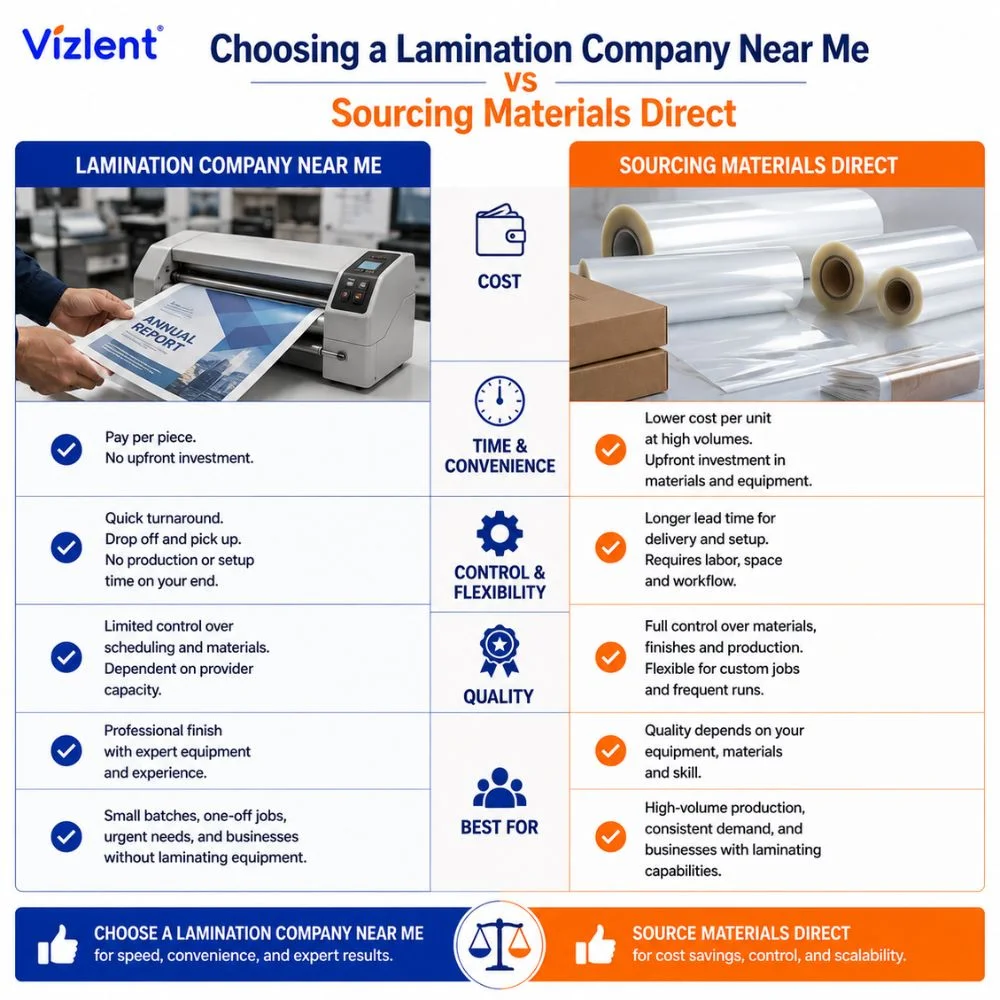
Searching lamination company near me usually surfaces local print finishing services for one-off projects or small batches. These providers handle the labor, the equipment, and the film inventory for you, which works well when a handful of laminated items is enough and the job is unlikely to repeat. Pricing reflects labor and overhead in addition to materials.
Businesses that laminate at volume usually move past local service providers and source films directly from a manufacturer. Direct sourcing gives access to broader film ranges, custom slitting, and predictable per-roll pricing across long contracts. It also opens the door to OEM (Original Equipment Manufacturer) and ODM (Original Design Manufacturer) options through suppliers like Vizlent Label Materials Co., Ltd for branded or custom-coated products.
Quality Markers in Lamination Films and Sheets
Strong lamination films and sheets share several measurable properties that separate them from low-grade products. Clarity, adhesion, dimensional stability, and finish consistency are the headline metrics. Each is measured against documented specifications during incoming quality control.
Buyers evaluating supplier options should look for the following indicators across the catalog and certification packet:
- ISO 9001 quality management certification covering coating and slitting operations
- FSC certification on paper-backed lines for sustainable sourcing
- SGS or equivalent third-party testing on coat weight and bond strength
- Documented release force, peel adhesion, and shrinkage data
- Lab samples available for compatibility testing before bulk orders
- Consistent caliper tolerance across slit widths and roll diameters
Common Lamination Issues and How to Avoid Them
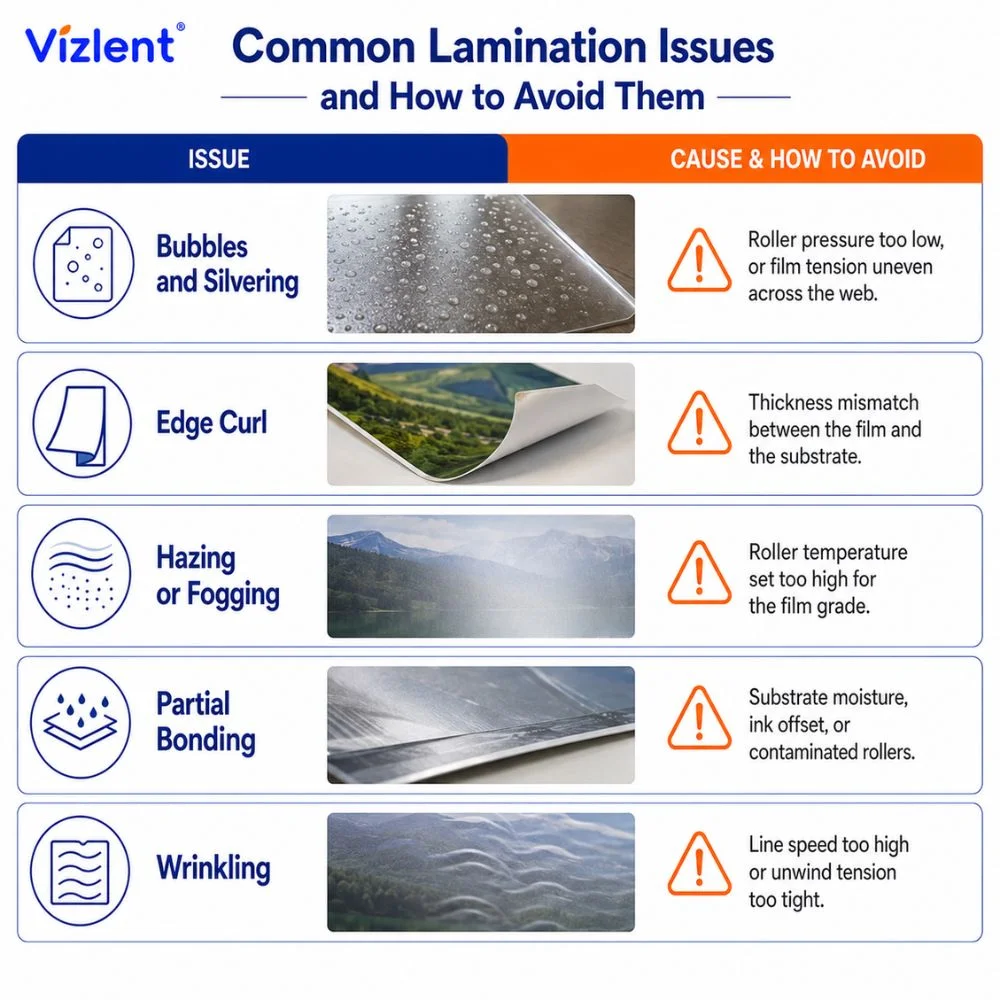
Even with the right film, problems can show up at the lamination station, especially during operator changeovers or substrate switches. Air bubbles, edge curl, hazing, silvering, and partial bonds are the most frequent. Each issue ties back to a specific root cause in film, machine, or substrate handling.
Most issues clear quickly once the underlying setting is identified and corrected. Operator training, documented machine settings, and incoming material checks keep these problems from repeating across shifts. A few patterns show up across most finishing operations:
- Bubbles and silvering: roller pressure too low, or film tension uneven across the web
- Edge curl: thickness mismatch between the film and the substrate
- Hazing or fogging: roller temperature set too high for the film grade
- Partial bonding: substrate moisture, ink offset, or contaminated rollers
- Wrinkling: line speed too high or unwind tension too tight
How Vizlent Supports Lamination Service Providers and Converters
Vizlent supplies converters, print finishers, and packaging manufacturers with factory-direct laminating films, self-adhesive materials, and thermal transfer ribbons. The company operates from a 10,000sqm ISO 9001 facility in Shenzhen and Ganzhou with FSC and SGS certifications across the full range. The portfolio covers BOPP, PET, and specialty films in gloss, matte, soft-touch, and anti-scratch finishes.
Lead times run from 7 to 15 days for stock items, with free samples available for compatibility testing before any bulk order. The company supports OEM and ODM orders, custom slitting, and dedicated technical support for substrate qualification. Customers include label converters, contract packagers, and finishers across 50+ countries, with more detail available on the About Vizlent page.
Source Factory-Direct Laminating Films From Vizlent
Sourcing reliable laminating films for your finishing operation starts with a qualified supplier and validated material. Vizlent ships factory-direct laminating films, self-adhesive materials, and thermal transfer ribbons to converters and print finishers across 50+ countries. Request a free sample roll today and see how the right film lifts every step of your work: visit vizlent.com or reach out through our contact page to speak with our engineering team.
Frequently Asked Questions
What is lamination and how does it protect printed materials?
Lamination is a finishing process that bonds a thin protective film to paper, card, or printed packaging using heat, pressure, or adhesive. The film seals the printed surface against moisture, fingerprints, UV exposure, and physical wear. Common applications include ID cards, restaurant menus, retail labels, packaging artwork, and document preservation.
What are the main steps in the lamination process?
The lamination process moves through substrate preparation, film alignment, bonding under pressure or heat, cooling, and trimming. For thermal lamination, heated rollers melt the adhesive layer on the film and lock it to the paper. For cold lamination, pressure-sensitive adhesive on the film bonds at room temperature without thermal activation.
What is the difference between thermal and cold lamination?
Thermal lamination uses a heat-activated adhesive that bonds the film to the substrate at 90 to 130 degrees Celsius. Cold lamination uses pressure-sensitive adhesive that bonds at room temperature without heat. Cold lamination is preferred for heat-sensitive prints, photographic emulsions, and outdoor signage where film clarity has to hold under sunlight.
What thickness should I choose for lamination sheets?
Lamination sheets typically range from 3 mil for standard document protection up to 10 mil for ID cards and rigid reference cards. A 5 mil pouch is the common middle ground for menus, instruction sheets, and signs that face repeated handling. Thicker pouches add rigidity and abrasion resistance but require a laminator rated for that thickness range.
How do I find reliable lamination services near me?
Reliable lamination services near me are usually found at office supply stores, dedicated print shops, copy centers, and commercial print houses. Look for providers that show sample work, list machine widths and thickness capabilities, and price clearly by piece or roll. For larger jobs, commercial print houses with roll laminators handle wider formats and bulk discounts.
What separates a strong lamination company from a basic one?
A strong lamination company near me uses calibrated machines, documented film inventory, and consistent operator training across job types. Look for finish options like matte, soft-touch, and anti-scratch in addition to standard gloss, plus the ability to handle larger formats and specialty stocks. Reorder consistency, batch records, and sample availability are practical markers of a serious operator.
Can lamination paper and laminated documents be recycled?
Lamination paper backed with plastic film is harder to recycle than uncoated paper because the film has to be separated from the fiber before re-pulping. Some recycling streams accept laminated material and process it through dedicated lines, while others reject it. Liquid lamination coatings are usually easier to recycle since they break down with the paper during pulping.
Does Vizlent supply laminating films for converters and lamination services?
Yes. Vizlent supplies factory-direct laminating films in BOPP, PET, and specialty grades, with gloss, matte, soft-touch, and anti-scratch finishes. Every roll ships from an ISO 9001 facility in Shenzhen with FSC and SGS verification, and free samples are available for compatibility testing. Browse the laminating film range or contact our team to discuss your specific application.