
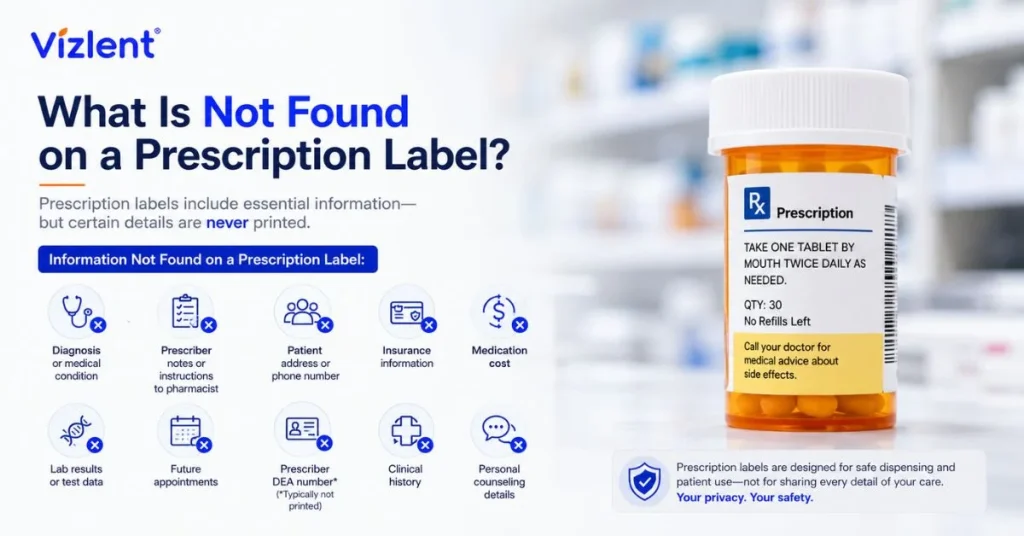
The most common item not found on a standard prescription label is the patient’s medical diagnosis or reason for taking the medication, which is omitted for HIPAA (Health Insurance Portability and Accountability Act) privacy reasons. Other commonly absent details include the wholesale drug cost, detailed side effect lists, manufacturer batch numbers, and insurance billing information. These items are typically delivered through separate medication guides, pharmacy receipts, or pharmacist consultations rather than printed on the bottle label.
What Is Not Found on a Prescription Label?
What is not found on a prescription label is often more clinically interesting than what appears on it, especially for patients trying to understand their medications. The most notable omission is the diagnosis or medical condition the drug is treating, which is intentionally left off for HIPAA privacy compliance. Other absent items include the cost of the medication, the manufacturer’s lot number, detailed side effect data, and any insurance information related to the prescription.
Pharmacies provide much of this missing information through separate channels rather than the label itself. Medication guides, drug fact sheets, pharmacy receipts, and in-person pharmacist consultations cover what the label intentionally excludes. The label is designed to be a quick reference for safe administration, not a comprehensive document about the medication or the patient’s medical history.
Required Information on Every Prescription Label
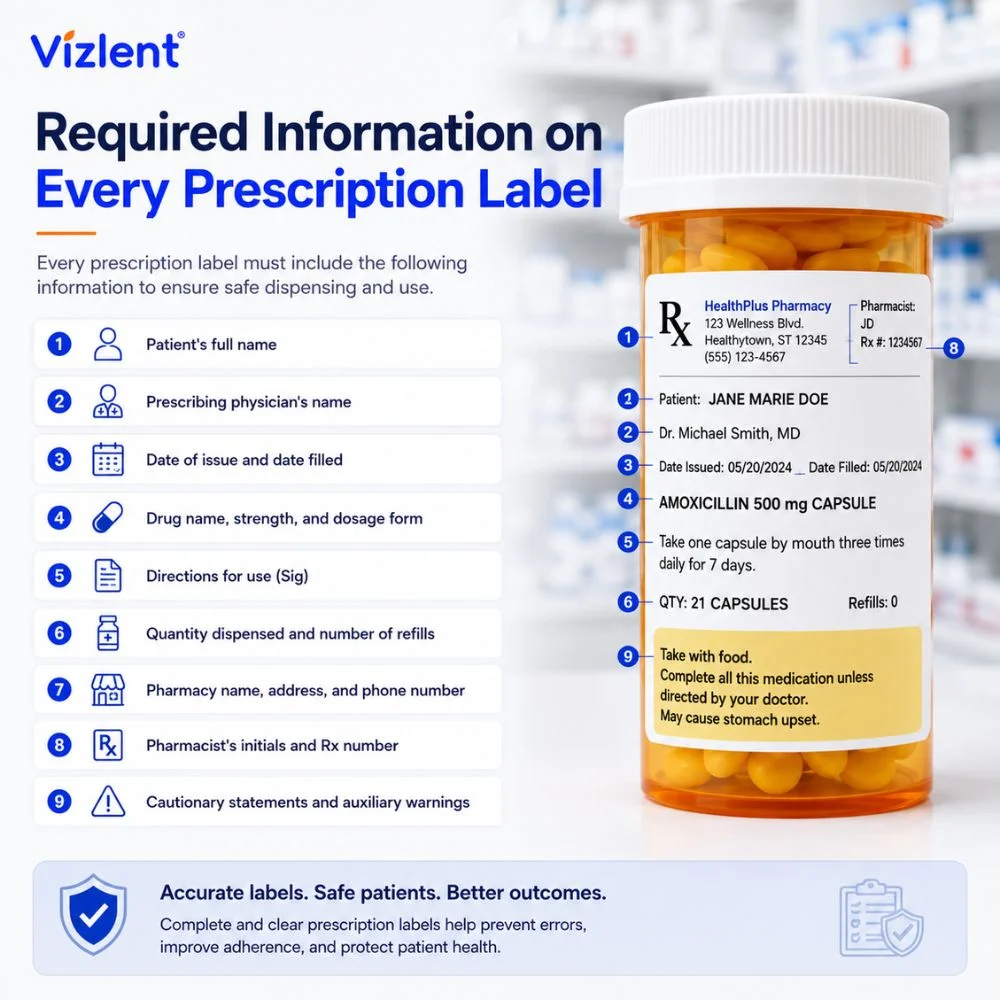
Every prescription label in the United States is required by federal and state law to display a core set of information that supports safe medication use. The Drug Enforcement Administration (DEA), the Food and Drug Administration (FDA), and state pharmacy boards each contribute to the rules that govern label content. Standard prescription label requirements are designed so that any pharmacist, healthcare provider, or patient can quickly identify the medication, the prescriber, and the correct administration plan.
Standard prescription label requirements include both patient-facing and pharmacy-facing data points across federal and state rules. Pharmacy management software builds these elements into every printed label automatically. The most common required elements are:
- Patient’s full name
- Prescribing physician’s name
- Date of issue and date filled
- Drug name, strength, and dosage form
- Directions for use (Sig)
- Quantity dispensed and number of refills
- Pharmacy name, address, and phone number
- Pharmacist’s initials and Rx number
- Cautionary statements and auxiliary warnings
Prescription Label Requirements: Federal Standards
Prescription label requirements at the federal level are established through the Federal Food, Drug, and Cosmetic Act and DEA Schedule regulations for controlled substances. The FDA sets baseline standards for drug identification and warning language, while the DEA adds specific labeling rules for Schedule II through V medications. Pharmacies that dispense controlled substances must include the federal transfer warning along with all standard label data.
Beyond federal rules, the National Association of Boards of Pharmacy publishes model regulations that many states adopt and adapt. The Poison Prevention Packaging Act adds child-resistant container requirements that affect label placement and bottle selection. Compliance with these layered requirements is non-negotiable, and pharmacies typically run regular audits to confirm their printed labels meet every applicable standard.
Prescription Label Requirements by State
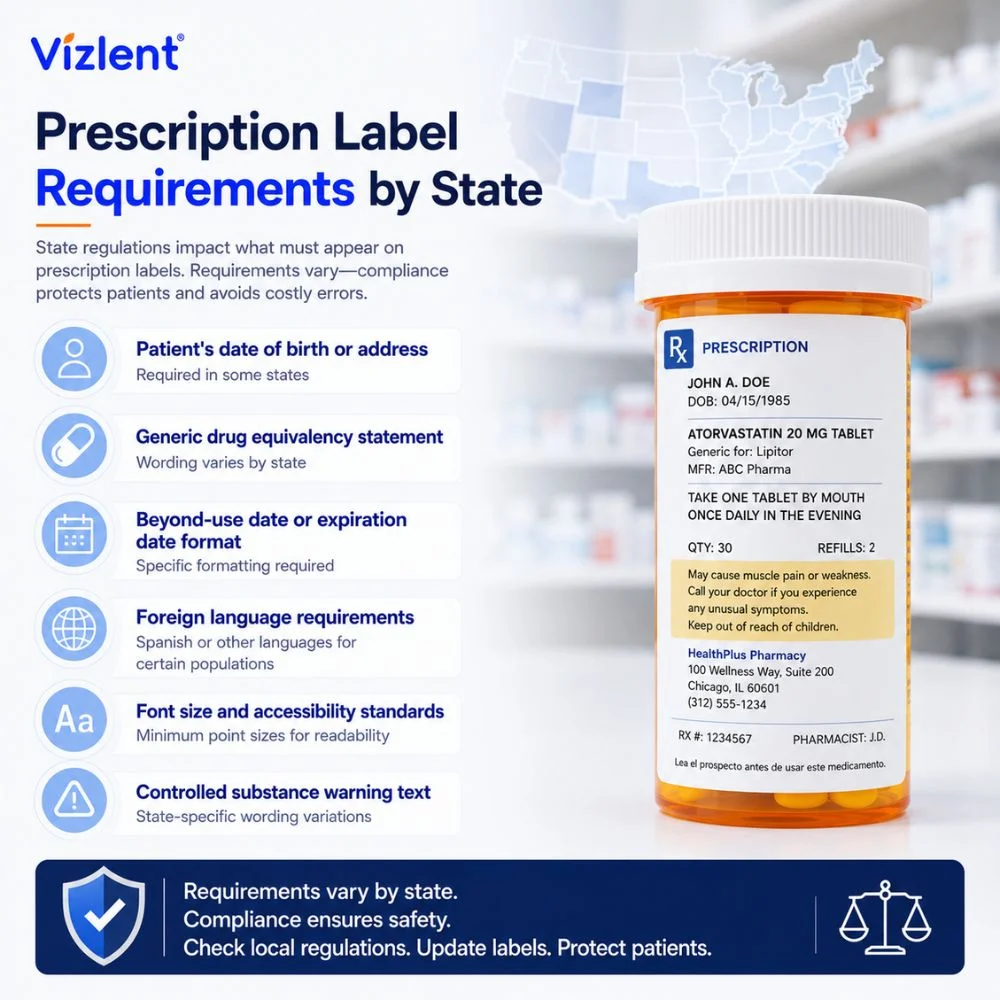
Prescription label requirements by state add another compliance layer on top of federal baseline rules. State pharmacy boards can mandate additional information, such as the patient’s date of birth, address, generic equivalence statements, controlled substance warnings, or specific expiration date formatting. Pharmacy technicians and pharmacists must check their state-specific rules before customizing label templates for their operation.
Common state-level prescription label requirements vary widely across the country. Buyers and operators should not assume one state’s template will satisfy another state’s pharmacy board. Typical state variations include:
- Patient’s date of birth or address: Required in some states
- Generic drug equivalency statement: Wording varies by state
- Beyond-use date or expiration date format: Specific formatting required
- Foreign language requirements: Spanish or other languages for certain populations
- Font size and accessibility standards: Minimum point sizes for readability
- Controlled substance warning text: State-specific wording variations
Pharmacies sourcing durable label stock for state-compliant prescription printing? Request a free sample from Vizlent.
Prescription Labels Should Contain Which of the Following? Common Exam Answers
Pharmacy technician certification exams (PTCE, ExCPT) frequently ask “prescription labels should contain which of the following” with answer options drawn from standard label elements. The correct response always includes the patient’s name, drug name and strength, dosage instructions, quantity, refill count, and pharmacist information. The wrong answer choices typically include items like patient diagnosis, drug cost, manufacturer batch number, or insurance ID.
The phrasing of “prescription labels should contain which of the following” requires test-takers to identify both required and optional content with precision. Students preparing for these exams should memorize the federal baseline elements first, then layer state-specific rules onto that base. Practice questions, case studies, and printed label examples are the fastest way to internalize what belongs on a label versus what is delivered through other channels.
Patient Diagnosis: The Most Common Omission
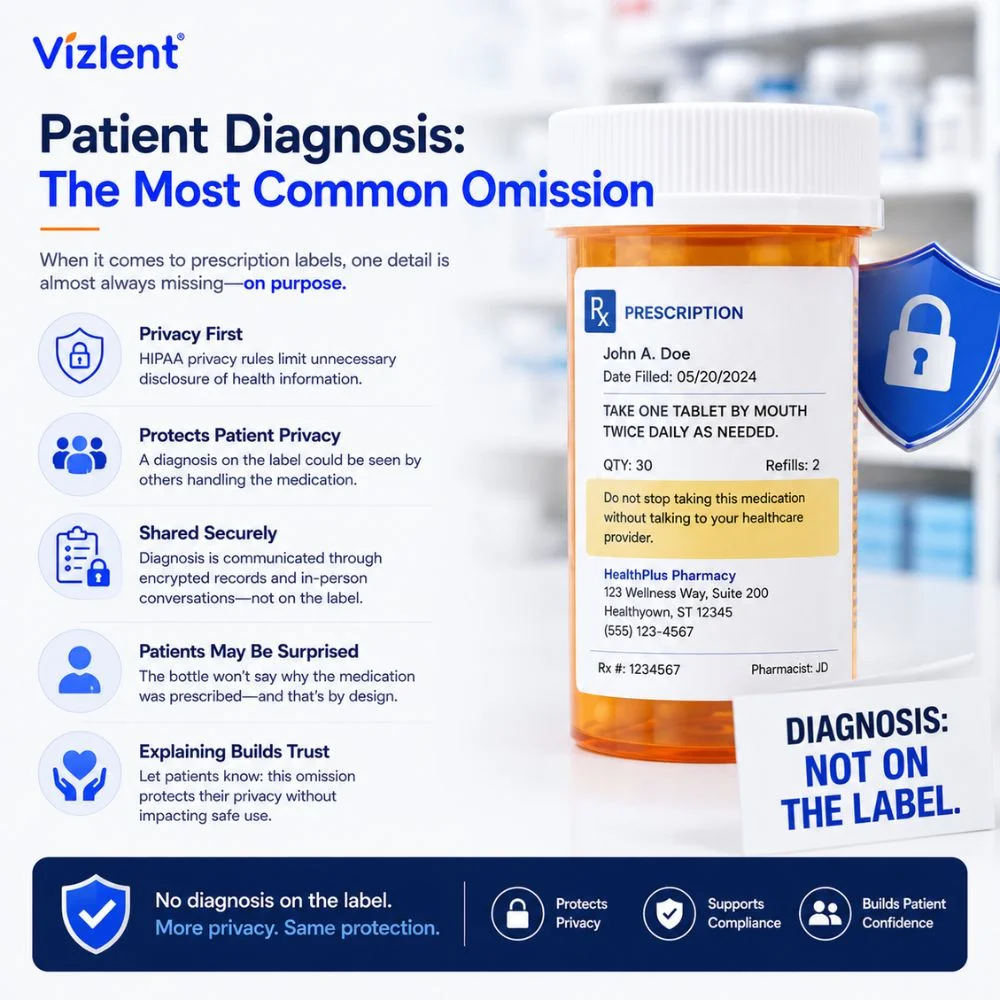
The patient’s medical diagnosis is the single most common answer to “what is not found on a prescription label” on pharmacy exams and patient education materials. HIPAA’s Privacy Rule restricts unnecessary disclosure of patient health information, and a printed diagnosis on a bottle label that may be handled by family members, caregivers, or others creates a potential privacy exposure. Pharmacists, prescribers, and patients communicate diagnostic information through encrypted medical records, in-person discussions, and protected medication guides instead.
Some patients are surprised to learn that the bottle says nothing about why the medication was prescribed, particularly when managing complex conditions. The label assumes the patient and prescriber already share an understanding of the diagnosis through the clinic encounter and follow-up communication. Pharmacy technicians explaining this to patients should emphasize that the omission protects privacy without affecting safe medication use.
Cost, Insurance, and Other Excluded Details
Beyond patient diagnosis, several other categories of information are routinely excluded from prescription labels. Drug cost and insurance copay information appear on the printed receipt or pharmacy management system, not the label itself. Manufacturer batch numbers and lot identifiers are tracked internally for recall management, but are not transferred to the patient-facing bottle.
Detailed side effect lists, drug interaction warnings, and pharmacokinetic information are delivered through the FDA-required Patient Package Insert rather than the label. The label uses brief auxiliary warning stickers (the orange and yellow labels patients often see) to communicate critical handling instructions like “take with food” or “may cause drowsiness.” This division of information keeps the label scannable while ensuring patients have access to deeper drug information through other documents.
Prescription Label Template and Prescription Label Example

A prescription label template is the standardized layout used by pharmacy management software to print labels in a predictable, compliant format. Most templates include zones for patient information, drug information, dosage, prescriber and pharmacy details, and auxiliary warnings. A prescription label example from any major chain pharmacy (CVS, Walgreens, Rite Aid) shows roughly the same layout because they all follow federal labeling standards.
Pharmacy software packages like PioneerRx, Liberty, McKesson EnterpriseRx, and Computer-Rx all ship with default prescription label templates that comply with federal and most state requirements. Independent pharmacies and compounding pharmacies often customize these templates to add their logo, NPI number, or specialty disclaimers. A clean prescription label example is also published by the U.S. Pharmacopeia (USP) as a reference for accessibility and patient comprehension.
Prescription Label Template Free Resources and Paid Tools
A prescription label template free download is available from several reputable sources for pharmacy students, mock pharmacies, and roleplay training scenarios. Templates designed for educational use must not be used for actual patient dispensing without appropriate pharmacy management software backing them up. Free resources include simplified label layouts from pharmacy textbook publishers, the National Community Pharmacists Association, and academic pharmacy programs.
Paid prescription label software and pharmacy management systems include comprehensive label engines integrated with patient records, drug databases, and insurance processing. The cost ranges from $200 per month for small independent pharmacy systems to $50,000+ per year for enterprise platforms used by large chains. Buyers should match their software choice to dispensing volume, integration needs, and state compliance requirements.
Prescription Label Printer and Prescription Label Maker Options

A prescription label printer is a specialized thermal or laser printer designed to produce pharmacy-grade labels with consistent quality and durability. Common hardware options include Zebra, Dymo LabelWriter, Brother QL series, and dedicated pharmacy printers from Pioneer and other niche manufacturers. The printer must support the label stock thickness, adhesive type, and roll size specified by the pharmacy’s label vendor.
A prescription label maker is the broader software-and-hardware combination that integrates with pharmacy management systems to produce labels on demand. Modern prescription label maker workflows pull patient and drug data directly from the dispensing system, print to the configured printer, and log the transaction for audit purposes. Label substrate quality matters here too, since labels printed on weak stock can fade, smudge, or peel before the patient finishes the prescription.
Prescription Label Bottle: Container and Label Stock Considerations
A prescription label bottle is the standardized amber, blue, or clear plastic vial that holds dispensed medication, with sizes ranging from 2 to 60 dram (roughly 7 to 220 mL). The label stock applied to the bottle must adhere through repeated handling, refrigeration, and bathroom humidity without lifting, smudging, or fading. Pharmaceutical-grade pressure-sensitive label stock typically uses polypropylene (BOPP) or polyethylene face stocks with strong acrylic adhesives.
Choosing the right label stock for a prescription label bottle depends on container material, expected handling conditions, and printer compatibility. Vizlent Label Materials Co., Ltd. supplies durable label stock and thermal lamination film suitable for pharmaceutical and over-the-counter labeling applications. Pharmacies switching from generic label stock to engineered pharmaceutical stock often report fewer reprints and patient complaints related to peeling or fading.
Sourcing pharmaceutical-grade label stock in bulk? Contact Vizlent for factory-direct pricing.
Prescription Alcohol Label and Prescription Alcohol Label and Bag
A prescription alcohol label is an auxiliary warning sticker that alerts patients to avoid alcohol while taking a particular medication, commonly applied alongside the main prescription label. These auxiliary labels are pre-printed in standard colors (most often orange or yellow) and use concise warning language like “Avoid alcoholic beverages.” Pharmacies apply alcohol warnings based on drug-specific interaction databases that flag medications with significant alcohol risk.
A prescription alcohol label and bag arrangement refers to packaging that pairs the warning sticker with a dispensing bag carrying additional handling notes, controlled substance warnings, or pharmacy contact information. Some compounding pharmacies and specialty dispensing operations use color-coded bag systems alongside auxiliary stickers to communicate handling priority at a glance. The combined alcohol label and bag approach reduces the chance of a patient missing a critical warning at home.
Prescription Label Blank Templates for Pharmacy Operations
A prescription label blank is an unprinted label sheet or roll loaded into the pharmacy printer, ready to receive patient-specific data from the dispensing system. Blank label stock comes in standard pharmacy sizes such as 4×2 inch, 4×3 inch, and 2.25×1.25 inch (for smaller vials and OTC items). High-quality prescription label blank stock holds ink or thermal print cleanly without bleeding, fading, or peeling under normal patient handling.
Independent pharmacies and small chains often source prescription label blank rolls directly from label converters to reduce per-unit cost compared to office supply chains. Vizlent supplies inkjet printing labels and laser printing label stock in bulk widths and lengths suitable for pharmacy operations. Procurement teams should verify roll core diameter, adhesive type, and face stock against their installed printers before placing a bulk order.
Prescription and Label: The Dispensing Workflow
The relationship between a prescription and label is straightforward in concept but tightly regulated in practice. A prescription begins as a written or electronic order from a licensed prescriber, enters the pharmacy management system, and triggers the generation of a label tied to the patient and the dispensed drug. Every prescription and label pair is logged with timestamps, pharmacist initials, and audit trail data for compliance and recall response.
Pharmacy workflows include verification, label printing, drug pulling, final pharmacist check, and patient consultation as discrete steps that each create or rely on the printed label. Errors at any step, including label printing problems, can lead to dispensing mistakes, regulatory violations, or patient harm. High-quality label stock and reliable printers reduce the operational risk of label-related errors in a busy pharmacy.
Source Pharmaceutical-Grade Label Stock from Vizlent
Vizlent supplies the pressure-sensitive label stock that pharmacies and pharmaceutical printers rely on for durable, smudge-resistant prescription labels. The catalog covers durable label substrates, thermal lamination films, and inkjet or laser-compatible label stock in bulk widths and lengths suitable for pharmacy operations. Free samples, technical support, and 7 to 15-day lead times apply across the full portfolio.
Procurement teams ready to evaluate label stock for high-throughput pharmacy printing can request a sample pack through the Vizlent inquiry channel. The engineering team reviews substrate compatibility, adhesive formulation, and printer specifications within 24 hours. Reach out today for a factory-direct quote tailored to your pharmacy operation.
Ready to source durable pharmaceutical-grade label stock? Contact Vizlent for a free sample pack and factory-direct quote.
Frequently Asked Questions
What is not found on a prescription label most commonly?
What is not found on a prescription label most commonly is the patient’s medical diagnosis or reason for taking the medication, which is omitted for HIPAA privacy reasons. Drug cost, manufacturer batch numbers, detailed side effects, and insurance information are also typically absent. These details are provided through separate medication guides, receipts, or pharmacist consultations.
Are diagnosis codes ever printed on prescription labels?
No, diagnosis codes are not printed on standard outpatient prescription labels because of HIPAA privacy rules. Inpatient hospital labels may include limited clinical context, but retail and mail-order prescription labels keep the diagnosis off the bottle.
Why is drug cost not on the prescription label?
Drug cost is excluded from the prescription label because pricing varies by insurance plan, copay, and dispensing pharmacy, and it is not relevant to safe medication administration. The cost appears on the pharmacy receipt or insurance explanation of benefits instead.
What are the required elements on a federal prescription label?
Required elements include the patient’s name, the prescriber’s name, the date filled, the drug name and strength, the dosage instructions, the quantity, the refill count, the pharmacy name and address, and the Rx number. Controlled substances require additional federal transfer warnings.
What is the difference between a prescription label and an auxiliary warning label?
A prescription label is the main label generated by the pharmacy system that identifies the patient, drug, and dosage. An auxiliary warning label is a smaller pre-printed sticker (often orange or yellow) applied alongside to communicate specific cautions like “take with food” or “may cause drowsiness.”






