
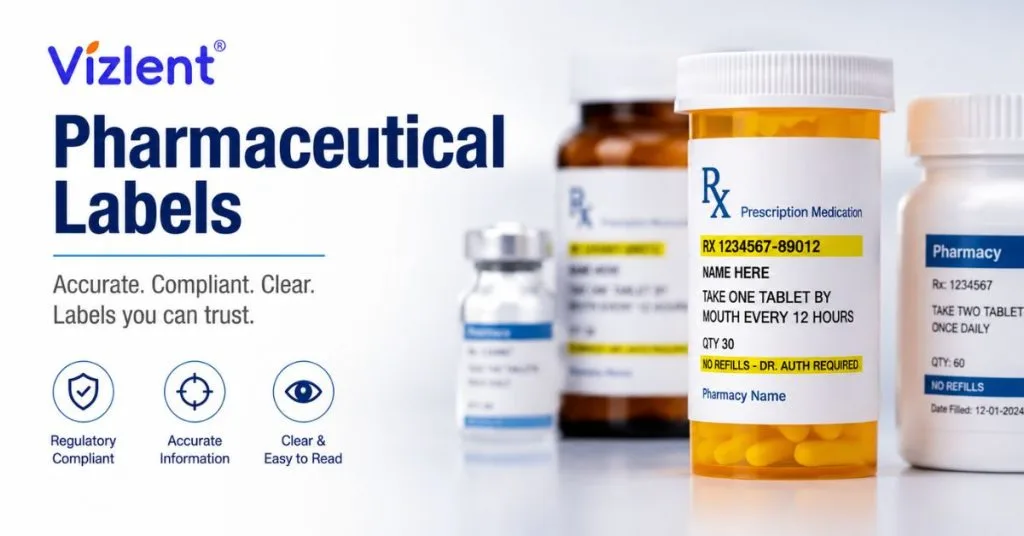
Pharmaceutical labels are important in the health industry because they are the last instruction layer between a manufacturer and a patient. A pill bottle without a label is a hazard, and a vial whose serialization barcode rubs off in transit is a recall waiting to happen. The pharmaceutical industry runs on small printed surfaces that carry life-or-death information, which is exactly why label materials, label content, and label compliance sit at the center of patient safety conversations.
Pharma labels touch every link in the healthcare supply chain, from sterile fill-finish lines in New Jersey to community pharmacy counters in Manila. Vizlent has supplied pressure-sensitive label stock to converters and packaging engineers across more than 50 countries since 2011, and that field experience shapes the technical guidance ahead. Procurement teams sourcing labels for pharmaceutical products need answers that hold up to audit, regulatory review, and real-world manufacturing pressure.
Talk to a Vizlent label specialist →
What Are Pharmaceutical Labels and Why Pharmaceutical Labels Are Important?
Pharmaceutical labels are the written, printed, and graphic information that lives on a drug, its container, or any paperwork that ships alongside it. Drug labeling or prescription labeling covers everything from the dispensing sticker on a community pharmacy vial to the multi-page patient information leaflet folded inside the carton. Regulators treat all three layers as part of the same legal artifact, not three separate items.
That definition matters because compliance is never only about what the label says. Pressure-sensitive substrate choice, ink chemistry, barcode resolution, and adhesive performance all sit inside the regulatory boundary, which is why drug manufacturers treat label materials as a controlled component under 21 CFR 211 and ICH Q7. The artwork is only half of the obligation.
What Are the 4 Types of Pharmaceutical Labels?
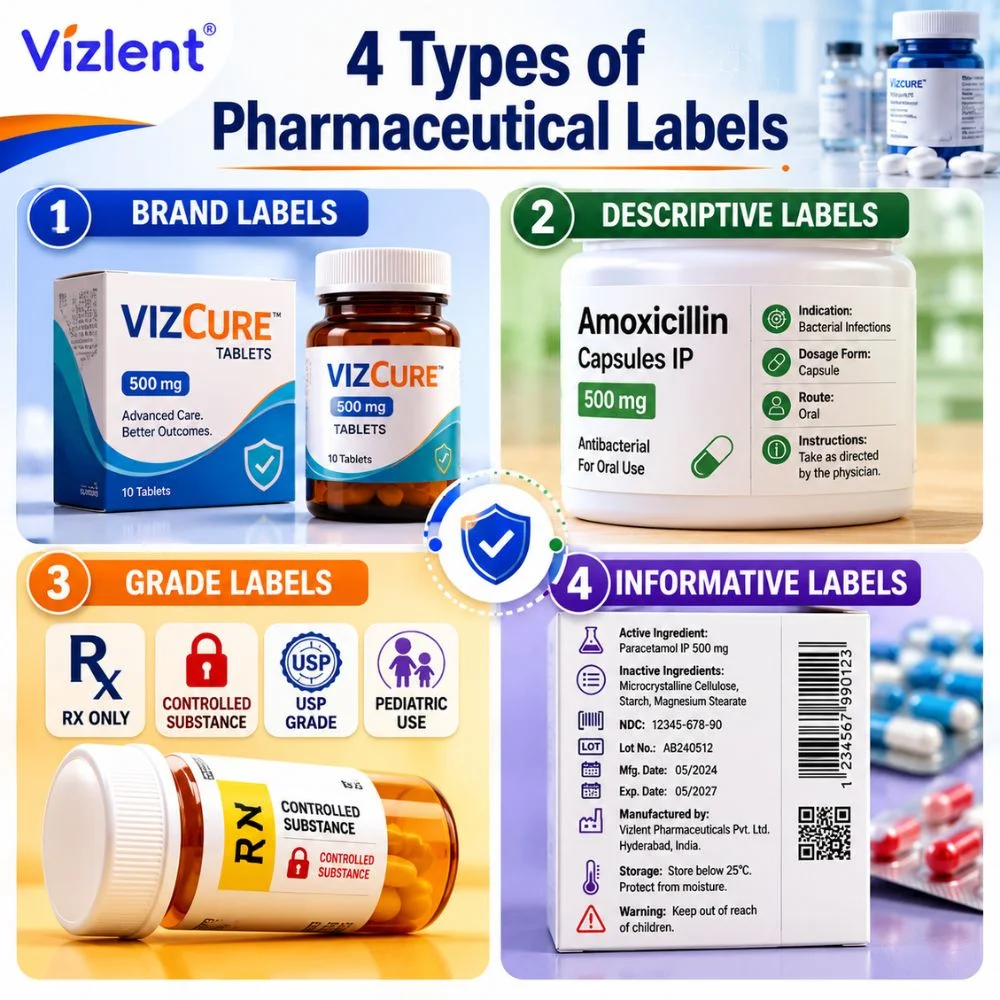
Product marketing and packaging research recognize four label categories: brand, descriptive, grade, and informative. Each one solves a different problem in the purchase decision, from grabbing attention on a crowded shelf to satisfying a regulator’s demand for hazard disclosure. Pharmaceutical labels usually combine all four at once on a single saleable unit.
A retail medicine box is the cleanest example of the overlap. The manufacturer’s logo and color block carry brand duty, the indication and dosage form sit inside the descriptive layer, “Rx only” or controlled-substance icons act as grade signals, and the side-panel warnings plus the referenced patient information leaflet carry the informative load. A separate four-category system used by print operators (Direct Thermal, Thermal Transfer, A4 Laser, Digital Inkjet) classifies labels by production method instead of consumer function.
A quick breakdown of the consumer-facing four:
- Brand labels: Built to win shelf attention through logo placement, signature colors, and pack-face typography. Recognition first, recall second. Pharmaceutical brand labels lean cautiously because most jurisdictions cap how prominent commercial branding can be on a prescription unit.
- Descriptive labels: Carry the functional story of the product, including indication, dosage form, route of administration, and use instructions. Their job is to translate what is inside the container into action that a consumer or clinician can take. In pharma, this layer overlaps heavily with the printed face on a pharma bottle label.
- Grade labels: Signal a quality, classification, or schedule tier through a short standardized marker. Examples include “Rx only,” Drug Enforcement Agency (DEA) controlled-substance icons, United States Pharmacopeia (USP) grade stamps, and pediatric or Over-the-Counter (OTC) indicators. A pharmacist scanning a shelf can read grade signals in under a second.
- Informative labels: Deliver the legally mandated disclosure stack: full active and inactive ingredient lists, lot and expiry data, National Drug Code (NDC) code, manufacturer information, hazard warnings, and the patient information leaflet by reference. These are the non-negotiables that regulators audit against. Most medicine box labels carry the bulk of their text in this category.
Note: There are many types of pharmaceutical labels. Above are only four of the few.
The Role of Pharmaceutical Labels in Patient Safety
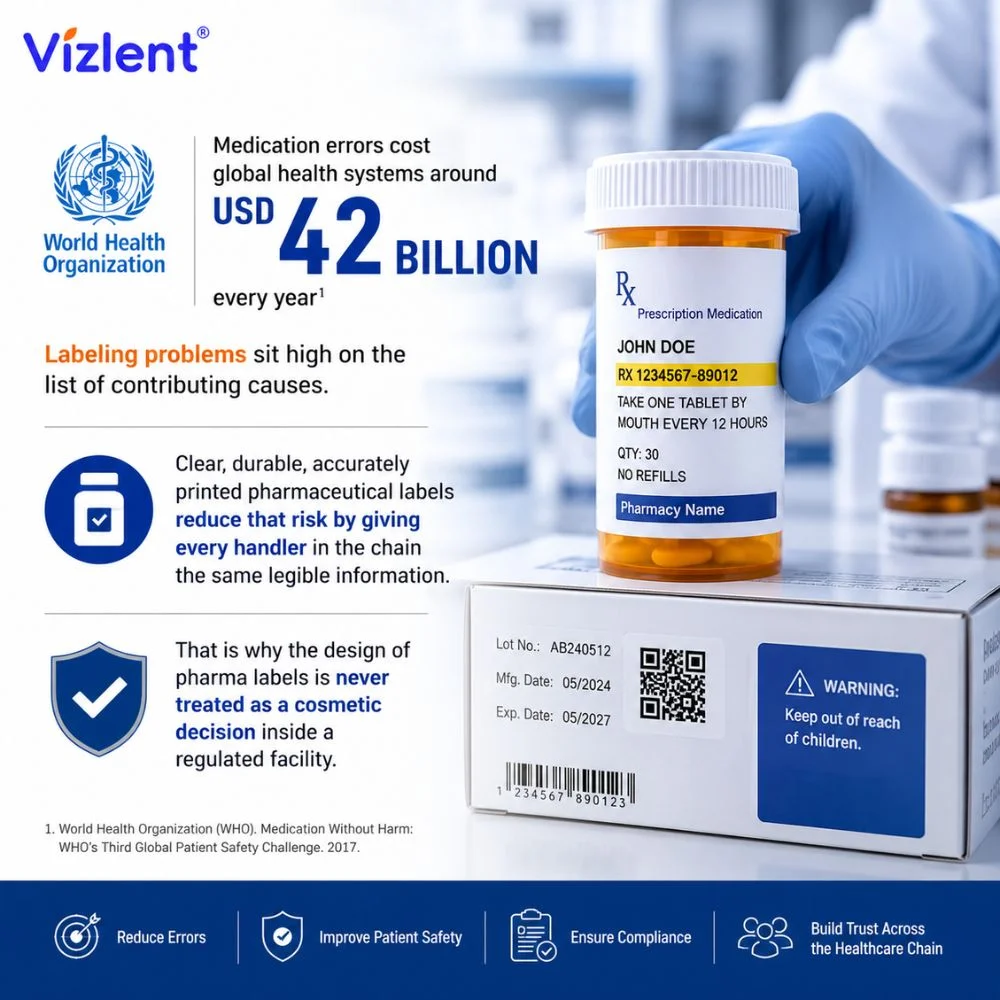
Pharmaceutical labels are the last line of defense between a manufacturer’s intent and a patient’s hand. Every prescription bottle, every vial, and every blister card carries data that nurses, pharmacists, and patients rely on to dose correctly. When that information fails, the consequences range from missed therapy to medication errors that send people to the emergency room.
The World Health Organization estimates that medication errors cost global health systems around USD 42 billion every year, and labeling problems sit high on the list of contributing causes. Clear, durable, accurately printed pharmaceutical labels reduce that risk by giving every handler in the chain the same legible information. That is why the design of pharma labels is never treated as a cosmetic decision inside a regulated facility.
A well-designed pharmaceutical label answers seven basic questions on a tiny piece of substrate:
- What is the drug, in both brand and generic name?
- What is the strength and the dosage form?
- Who manufactured it, and where?
- What is the lot number and the expiry date?
- What is the National Drug Code or equivalent identifier?
- What warnings apply to this specific medication?
- How should it be stored?
Regulatory Compliance and Pharmaceutical Labeling and Packaging
Pharmaceutical labeling and packaging are one of the most heavily regulated areas of consumer-facing print. In the United States, the Food and Drug Administration (FDA) enforces labeling content under 21 CFR Part 201, while traceability falls under the Drug Supply Chain Security Act (DSCSA). The European Union runs parallel rules under the Falsified Medicines Directive (FMD), which mandates a unique 2D DataMatrix code on every saleable unit of prescription medicine.
These frameworks do not just dictate what a label says. They also shape the physical performance demanded of the label substrate, since a label that delaminates inside a cold-chain shipper or a barcode that smears under isopropyl alcohol fails the rule even if the printed content is correct. That is why secure labels for pharmaceutical industry use are validated for sterilization, temperature swings, and solvent exposure long before they reach a converter’s press.
Key compliance touchpoints that label materials must support:
- DSCSA serialization with ISO/IEC 15415 Grade B or higher DataMatrix codes
- EU FMD anti-tamper sealing on every retail pack
- UDI marking for medical devices under 21 CFR Part 830
- ISO 11607 sterile barrier system compatibility
- 21 CFR 211 cGMP traceability for label inventory and reconciliation
Request a compliance-ready sample roll →
Types of Pharmaceutical Labels Used Across the Healthcare Supply Chain
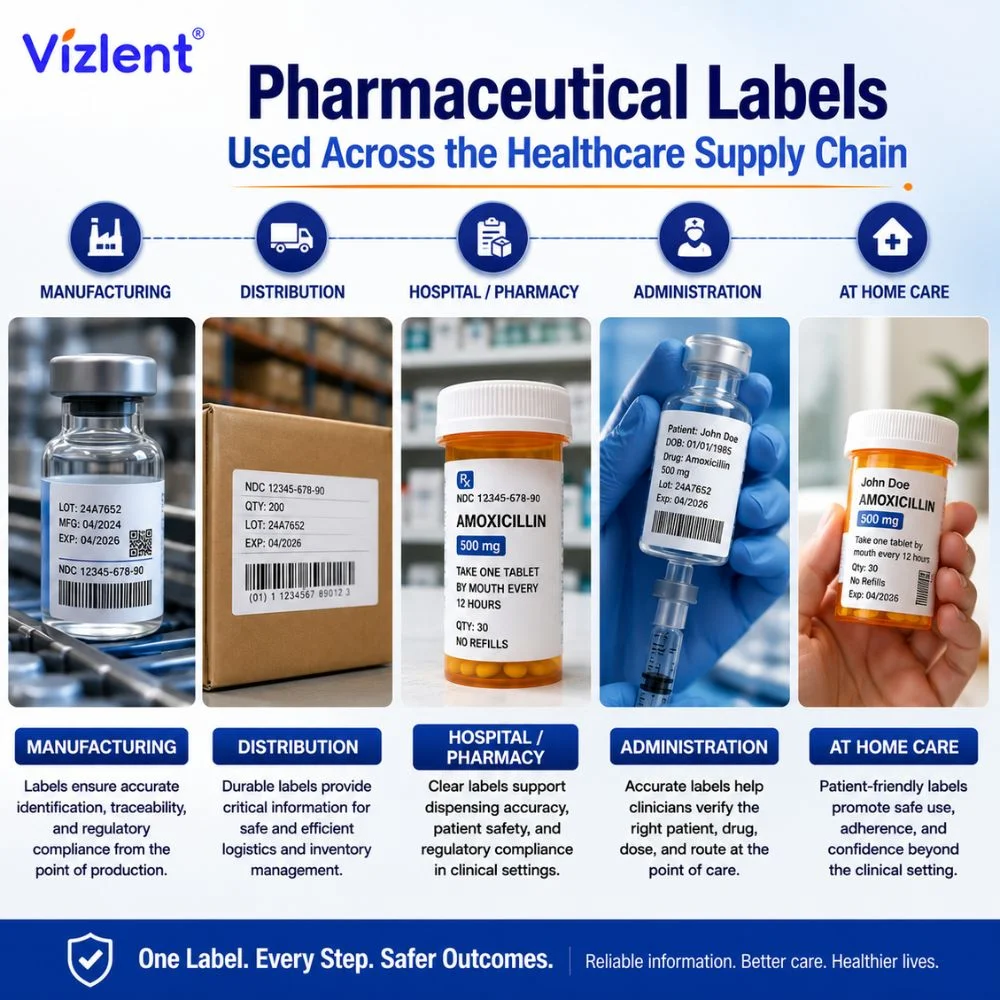
The phrase “pharmaceutical labels” covers a wide range of formats, each tuned to a different point in the drug lifecycle. From the pharma bottle label on a community pharmacy dispenser to the cryogenic vial label on a gene therapy specimen, the substrate, adhesive, and topcoat chemistry change with the application. Knowing the categories helps procurement teams brief converters without ambiguity.
When packaging engineers map types of pharmaceutical labels onto their bill of materials, they usually break the list down by where the label sits in relation to the drug product. Primary labels touch the immediate container. Secondary labels live on the outer carton. Tertiary labels handle the shipping case and the pallet, which is where logistics scanning and cold-chain telemetry intersect with pharma compliance.
Common label families used across the health industry:
- Pharmaceutical vial labels: thin polyester or BOPP face stock for small-diameter glass containers
- Medicine bottle labels for tablets and oral suspensions, often using semi-gloss coated paper
- Medicine box labels that carry serialization codes and tamper-evident seals
- Pharmaceutical product labels for blister packs, syringes, and IV bags
- Pharmaceutical warning labels flagging hazards such as controlled substances or photosensitivity
- Pharmaceutical auxiliary labels carrying patient instructions (“Take with food”, “May cause drowsiness”)
- Pharmaceutical waste labels for biohazard, sharps, and trace chemotherapy disposal
- Labels for prescription drugs dispensed at the pharmacy counter
- Labels for pills, capsules, and unit-dose strips inside hospital settings
- Labels for drugs in clinical trial and investigational use packaging
- Labels for pharmaceutical bottles in glass, HDPE, and PET formats
- Labels for pharmaceutical analysis used across QC labs and stability chambers
- Labels for pharmaceutical access programs, patient assistance kits, and sample packs
Pharmaceutical Warning Labels and Auxiliary Labels Explained
Pharmaceutical warning labels and auxiliary labels handle the medicine labels and instructions for use that do not fit on the main bottle face, but still have to reach the patient. The bright stickers on a dispensed prescription that say “Do Not Drink Alcohol” or “Refrigerate” are auxiliary labels. They sit alongside the primary dispensing label, and they exist because plain prose buried in a folded leaflet rarely gets read in real life.
Pharmacists rely on a defined library of these stickers, and most pharmacy management systems prompt for the right ones based on the drug being dispensed. The label material has to take an inkjet or thermal print at high speed, stick cleanly to round amber plastic, and survive months in a handbag without fading. That set of demands is harder than it sounds, which is why labels for medications often use synthetic film face stocks rather than basic paper.
Typical auxiliary content in U.S. and EU pharmacies includes:
- Photosensitivity warnings for tetracyclines, fluoroquinolones, and certain anti-inflammatories
- Sedation warnings for opioids, antihistamines, and benzodiazepines
- Refrigeration instructions for insulin, biologics, and reconstituted antibiotics
- Shake-well markers for suspensions and emulsions
- Controlled substance markers that comply with DEA labeling under 21 CFR 1304
- Patient counseling triggers for high-risk medications like anticoagulants
Pharma Bottle Label Design and Pharmacy Label Size Standards

Pharma bottle label design has matured into its own discipline within pharmaceutical packaging engineering. A good design balances regulatory data, brand identity, dispensing workflow, and substrate behavior on a curved surface. Get any of those four wrong and the label either fails an audit, looks unprofessional, or refuses to stick during cold storage.
Pharmacy label size is not random either. Most community pharmacy dispensing labels in the United States measure between 2.25 inches by 1 inch and 4 inches by 2.5 inches, sized to fit thermal printers like the Zebra GK420d and standard amber vials. European pharmacies often run slightly different metric sizes, typically in 50 mm by 25 mm or 70 mm by 36 mm formats. Hospital unit-dose packaging shrinks further, with some pharmaceutical vial labels printing legibly at 25 mm wide.
Frequently used dimensions across the industry:
| Application | Typical Size | Substrate Preference |
|---|---|---|
| Community pharmacy vial label | 2.25″ x 1″ to 3″ x 2″ | Semi-gloss thermal paper |
| Hospital IV bag label | 4″ x 2″ to 4″ x 6″ | Polyethylene or polypropylene |
| Cryogenic specimen label | 1.28″ x 0.5″ or smaller | Cryo-grade polyester |
| Outer carton label | 4″ x 2″ or larger | Coated paper with topcoat |
| Pharma bottle label, retail | Wraparound, varies | Clear BOPP or white BOPP |
Browse Vizlent’s medicine bottle label range →
Secure Labels for Pharmaceutical Industry Applications
Counterfeit medicines kill people, drain insurers, and damage brand trust, which is why secure labels for pharmaceutical industry packaging have moved from a nice-to-have to a procurement requirement. The U.S. Pharmacopeia and Interpol have both flagged falsified medicines as a growing global threat, and labels are one of the most cost-effective places to harden a package. A multi-layer label can carry overt, covert, and forensic features at the same time without adding bulk.
The technology stack used inside Vizlent’s security label range draws on materials that were originally developed for currency and passport printing. Tamper-evident face stocks like eggshell paper and VOID-release polyester give the package an instant visible signal if anyone tries to open it. Holographic overlaminates, UV-fluorescent inks, and serialized 2D codes layer on top, giving brand-protection teams forensic evidence that holds up in litigation.
Security features commonly applied to pharmaceutical product labels:
- Tamper-evident face stocks that fracture or leave a VOID pattern on removal
- Holographic OVDs that shift color under viewing angle changes
- Covert UV-fluorescent inks are readable only under specific wavelengths
- Microtext printing below the resolution of standard photocopiers
- Serialized 2D DataMatrix codes tied to a manufacturer’s serialization database
- Track-and-trace RFID inlays for high-value biologics and oncology drugs
How to Make a Label in Pharmacy
If you have ever wondered how to make labels in pharmacy operations, the answer is more procedural than improvised. Community pharmacies, hospital pharmacies, and compounding pharmacies all follow a structured cycle that starts when a prescription arrives and ends when the labeled product is verified by a pharmacist. The label is generated by software, not typed freehand, which is the only way to stay compliant with state board rules.
The standard sequence begins with prescription entry into a pharmacy management system such as PioneerRx, Liberty, or Epic Willow. Drug, strength, quantity, and patient instructions populate from the database. The system pulls auxiliary label triggers automatically, prints the dispensing label and any required warnings on a thermal printer, and logs the print event to the patient’s medication record for audit traceability.
A simplified workflow at a community or hospital pharmacy:
- Prescription intake. Electronic prescription or paper script enters the queue.
- Verification. Pharmacy technician confirms patient demographics and insurance.
- Drug selection. Software pulls National Drug Code (NDC), drug strength, and dosage form.
- Label generation. The pharmacy management system formats the dispensing label and any auxiliary labels.
- Print and apply. The thermal printer outputs to compatible label stock; the technician applies it to the amber vial.
- Pharmacist check. A licensed pharmacist verifies the drug, label, and instructions before the patient receives it.
- Documentation. The dispense event is logged for the state board and Drug Enforcement Administration (DEA) traceability.
Choosing a Reliable Pharmaceutical Labels Manufacturer
Pharmaceutical labels manufacturer selection is not a commodity decision. The supplier you choose dictates substrate consistency, audit readiness, lead-time stability, and the technical depth available when a converter hits a print or adhesion problem on press. Many converters search for “pharma labels corp” or similar phrases when they want a vendor that understands the regulatory side as much as the coating side.
What separates a serious label for pharmaceutical use supplier from a generic sticker shop is documented quality systems, free pre-production samples, and engineering support that does not vanish after the purchase order is signed. Vizlent operates a 10,000 sqm coating facility in Shenzhen with ISO 9001, FSC, and SGS certifications, and our team works directly with pharmaceutical packaging engineers on facestock, adhesive, and topcoat selection. We support both small trial orders and container-load production runs.
Questions worth asking before you commit to a supplier:
- Does the manufacturer hold ISO 9001, FSC, and SGS certifications?
- Can they provide sterilization validation data for your specific cycle?
- Are free samples available before bulk commitment?
- Do they support labels for pharmaceutical applications across the full temperature range, from cryogenic to autoclave?
- What is the standard lead time, and how is it protected during peak season?
- Will they sign a supplier quality agreement with change-notification clauses?
See Vizlent’s pharmaceutical-healthcare label material range →
Get Pharmaceutical-Grade Label Stock Built for the Health Industry
Pharmaceutical labels carry too much risk to be sourced on price alone. The end use shapes everything that follows. A retail medicine bottle label, a sterile fill-finish pharmaceutical vial label, and a hospital pharmaceutical auxiliary label all share one truth: the substrate behind the print matters as much as the artwork on top.
Vizlent supplies pressure-sensitive label stock to pharmaceutical converters, packaging engineers, and contract manufacturers in more than 50 countries. Our team will review your facestock, adhesive, sterilization cycle, and print system in one conversation, then send free samples sized to your converting line. Bulk orders typically ship within 7 to 15 business days, with full ISO 9001, FSC, and SGS documentation.
Request your pharmaceutical label sample roll →
Browse all pharmaceutical and healthcare label materials →
Frequently Asked Questions
What is the difference between primary, secondary, and auxiliary pharmaceutical labels?
Primary labels are applied directly to the immediate drug container, such as a vial, bottle, or blister pack, and carry the legally required drug identification. Secondary labels appear on the outer carton and add serialization plus tamper-evidence. Auxiliary labels are smaller stickers added by the dispensing pharmacy to flag specific warnings or instructions for the patient.
Why are pharmaceutical vial labels usually polyester instead of paper?
Pharmaceutical vial labels often sit on glass containers exposed to sterilization, cold storage, isopropyl alcohol wipe-downs, and frequent handling. Polyester face stocks resist tearing, solvent attack, and temperature shock far better than paper. They also hold barcode print fidelity through autoclave cycles, which paper substrates rarely survive without smearing or delaminating.
What pharmacy label size is standard for prescription bottles in the United States?
Most U.S. community pharmacies print dispensing labels between 2.25 inches by 1 inch and 4 inches by 2.5 inches. The exact format depends on the thermal printer model and the vial diameter being labeled. Larger labels are used when patient counseling text or auxiliary warnings need to fit alongside the main dispensing information.
Do pharmaceutical waste labels follow different rules than product labels?
Yes, pharmaceutical waste labels carry biohazard or chemotherapy waste markings governed by OSHA, EPA, and DOT regulations rather than FDA drug labeling rules. Color coding, hazard symbols, and accumulation-start-date fields are required. The label material itself must resist tearing, chemical contact, and the autoclave or incinerator handling involved in regulated medical waste disposal.
How does serialization affect medicine box labels and pharmaceutical product labels?
Under the U.S. DSCSA and EU FMD frameworks, every saleable unit of prescription medicine must carry a unique 2D DataMatrix code encoding product code, serial number, lot number, and expiry. This pushes label substrates and print systems toward semi-gloss or matte topcoats that hold ISO/IEC 15415 Grade B scan quality across the supply chain at small symbol sizes.
Where can I source secure labels for pharmaceutical industry applications?
Sourcing should focus on manufacturers with documented quality systems, sterilization validation data, and a full security label portfolio that covers tamper-evident face stocks, holographic overlaminates, and serialization-ready substrates. Vizlent’s pharmaceutical and healthcare label material range covers these requirements, with free sample rolls available before bulk commitment.






