If you’re wondering where is the lot number on a prescription bottle, you can find it on the standard prescription bottle, usually on manufacturer’s original label. It is usually located right below or next to the expiration date, close to the National Drug Code (NDC) or near the barcode.
Vizlent supplies the pressure-sensitive label stock used by pharmaceutical converters and pharmacy chains across more than 50 countries, which produces a working view of where lot codes get printed, why they sometimes seem missing, and how to read them on different bottle formats. The breakdown ahead walks through the location, the legal background, and what to do when the code is hard to spot.
Talk to a Vizlent label specialist →
What Is a Lot Number on a Prescription Bottle?
A lot number is a manufacturer’s traceability code. It identifies the specific production batch that a tablet, capsule, suspension, or liquid drug came from, including the raw materials, the date of manufacture, the equipment used, and the personnel on the line. If something goes wrong with that batch, the lot number is the thread that regulators pull to find every bottle, blister card, and unit-dose strip it touched.
The FDA requires the lot number under 21 CFR 211.130(c), which mandates batch identification on both the immediate container and the outer carton. European regulators follow a parallel rule under EU GMP Annex 13, and most pharmacy boards in the United States echo the requirement in state-level dispensing standards. No lot number, no compliant package.
A typical lot number string carries a few overlapping pieces of information:
- A batch or production ID (usually 4 to 8 alphanumeric characters)
- A manufacturing date code, sometimes embedded inside the lot string
- A facility or line identifier, common in larger pharma companies
- A revision or sequence marker for repeated runs of the same SKU
Where Is the Lot Number on a Prescription Bottle?
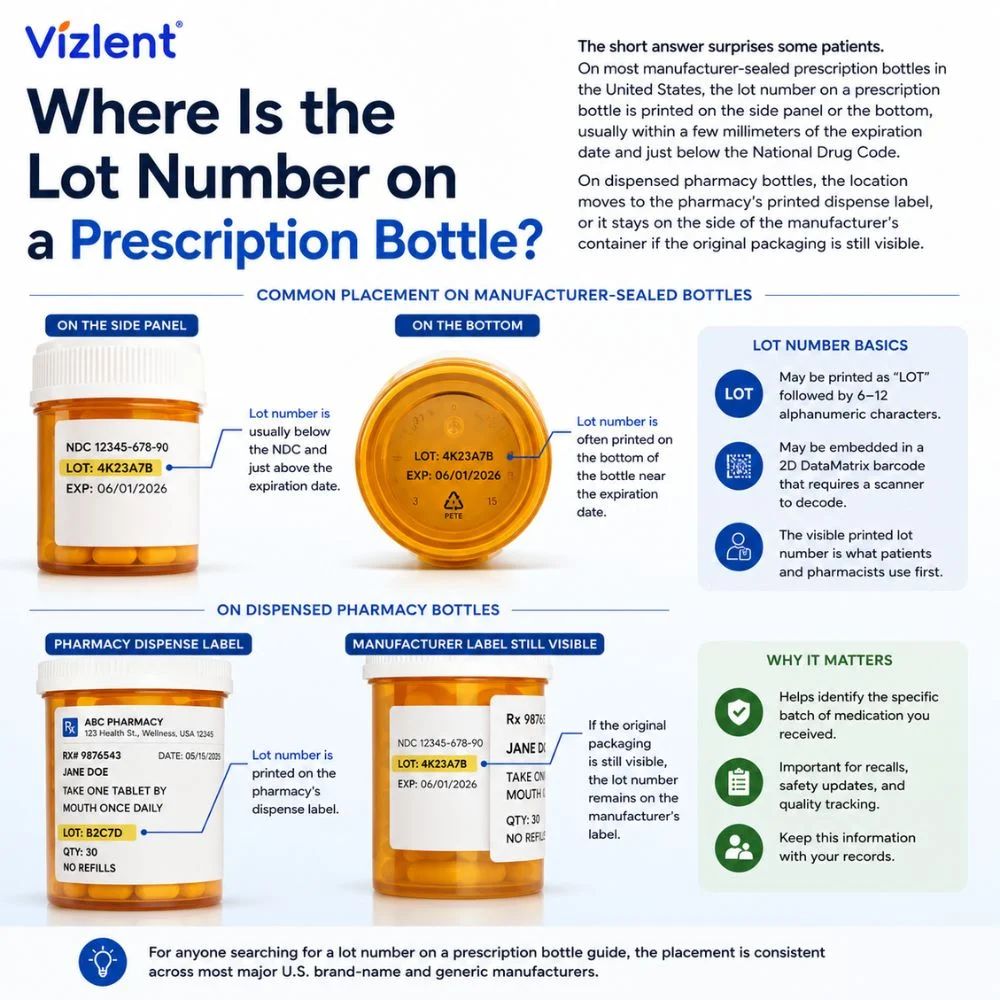
The short answer surprises some patients. On most manufacturer-sealed prescription bottles in the United States, the lot number on a prescription bottle is printed on the side panel or the bottom, usually within a few millimeters of the expiration date and just below the National Drug Code. On dispensed pharmacy bottles, the location moves to the pharmacy’s printed dispense label, or it stays on the side of the manufacturer’s container if the original packaging is still visible.
For anyone searching for a lot number on a prescription bottle guide, the placement is consistent across most major U.S. brand-name and generic manufacturers. Some prefer a clean horizontal “LOT” prefix followed by 6 to 12 alphanumeric characters, while others embed the same code inside a 2D DataMatrix barcode that requires a scanner to decode. The visible printed lot number is the version a patient or pharmacist will use first.
Common physical locations on a sealed bottle:
- Side panel of the bottle: most common for HDPE plastic and amber glass containers
- Bottom of the bottle: common for liquid suspensions and small unit-dose vials
- Carton flap: found on the outer secondary packaging of cartoned products
- Foil seal lip: printed near the tamper-evident induction seal
- DataMatrix barcode: scannable 2D code that encodes lot, expiry, and serial together
See pharmaceutical bottle label stock at Vizlent →
How to Find a Lot Number on a Prescription Bottle (Step by Step)
Finding the lot number on a prescription bottle is faster once the eye knows what to look for. The text is almost always printed in a small monospaced font, prefixed with the abbreviation LOT, LT, BN, or B/N, and located somewhere in the lower third of the bottle face or on the bottom. Bright natural light helps the most.
Pharmacy-dispensed bottles add another wrinkle, because the pharmacy applies its own dispense label that can cover the manufacturer’s printing entirely. In that case, the bottle has to be inspected after the dispense sticker is gently peeled back at one corner, or the patient can ask the pharmacist to read out the manufacturer’s lot from the original stock bottle. Both methods are routine in U.S. pharmacy practice.
A quick step-by-step on how to find a lot number on a prescription bottle:
- Hold the bottle in good natural light and rotate it slowly through 360 degrees
- Look for “LOT” or “BN” stamped near the expiration date field
- Check the bottom panel if the side wall is blank
- Scan the DataMatrix barcode if your pharmacy app supports it
- If the dispense label covers the manufacturer’s printing, ask the pharmacist to verify
- Document the code in writing or with a phone photo before disposing of any bottle that may be subject to a recall
Lot Number vs Batch Number on a Pill Bottle

The two terms get used almost interchangeably. In FDA documentation and most U.S. pharmacy practice, “lot number” and “batch number on a pill bottle” refer to the same identifier under 21 CFR 210.3(b)(10) and (11). In some European Pharmacopoeia contexts and ICH Q7 guidance, “batch” describes the full production run, while “lot” can refer to a portion of that batch released for distribution.
The practical impact for a patient or community pharmacist is essentially zero. Either code on a pill bottle lets a regulator trace the product back to its production conditions, and pharmacies in the United States treat the two phrases as synonyms when documenting an adverse event report or a return. When in doubt, write down both fields if both are printed.
Quick distinction summary:
- Batch: the complete production output from one continuous manufacturing run
- Lot: a quantity released into distribution from that batch (may equal the full batch)
- In U.S. retail pharmacy: treated as the same field for documentation purposes
- In ICH Q7 and EU GMP: technically distinct, with batch covering the full run
The Lot Number on a Prescription Bottle Expiration Date Pairing
Manufacturers almost always pair the lot number with the expiration date on the same printed line or in adjacent fields. The pairing is intentional because the expiration date is calculated from the manufacturing date encoded inside the lot number, and pulling one field without the other leaves the package half-traceable. On most U.S. retail prescription bottles, the format reads as “LOT ABC1234 EXP 06/2027” or a close variation.
The lot number on a prescription bottle expiration relationship has clinical importance, not just regulatory weight. If a stability problem affects a specific lot, the FDA may extend or shorten the expiry for that lot only, which is why both fields have to be captured during pharmacy intake and again at the patient counseling step. A photograph of both fields is the safest personal record for any patient on long-term therapy.
Why the lot number on a prescription bottle expiration date pairing matters in practice:
- A lot-specific recall can change the effective expiry for that one batch
- FDA stability reports key on lot, not just product
- Pharmacy management systems require both fields for adverse event filings
- Long-term medications often have multiple lots in the patient’s history
- DSCSA-compliant DataMatrix codes encode both together by design
Quick Tips to Find Lot Number on Prescription Bottle Packaging

A few small habits make the lot number on prescription bottle packaging easier to spot during the first 30 seconds after pickup. Patients on chronic therapy often build a routine of photographing the bottle face on the day of dispensing, which captures the lot number, the expiration date, and the National Drug Code in one image that lives inside their phone gallery for years. The habit pays off the first time a recall hits.
The same approach works for a batch number on pill bottle packaging, where the manufacturer uses “B/N” instead of “LOT” as the prefix. When the printed lot looks faint, or the dispense label sits on top, a phone flashlight held at an oblique angle highlights the ink against the bottle wall and lets a caregiver read the field without disturbing the foil seal or peeling the pharmacy sticker. Older eyes and bright pharmacies make a real difference.
Useful habits to build around lot number tracking:
- Photograph both the lot number and the expiration date together at dispense
- Use a phone flashlight at an oblique angle for faint or worn print
- Save photos in a labeled album for each long-term medication
- Cross-reference the lot against FDA recall notices at recalls.gov
- Bring the bottle, not just the pills, to every doctor or specialist visit
What If the Lot Number Is Not on Your Prescription Bottle?
It happens, though less often than patients assume. A pharmacy may have repackaged the medication into a vial without transferring the manufacturer’s lot, the dispense label may have covered it entirely, or, in very rare cases, a counterfeit bottle may have the field missing or formatted incorrectly. A lot number not on the prescription bottle packaging is not normal, and it warrants a phone call to the dispensing pharmacy before the next dose is taken.
The pharmacy retains the manufacturer’s lot information in its dispensing records under state board rules. A patient can request the original lot number tied to a specific fill date, and the pharmacist is required to provide it for traceability, recall response, or adverse event documentation purposes. The conversation usually takes only minutes.
Red flags that the missing field is more than a labeling oversight:
- The medication came from a non-licensed or online source outside FDA jurisdiction
- The packaging shows tampering signs (broken seal, damaged carton, smudged print)
- The bottle has no expiration date either
- The dispense label carries obvious printing errors or misspellings
- The pills inside do not match the prescribed strength, shape, or color
Why the Lot Number on a Medication Bottle Matters for Safety
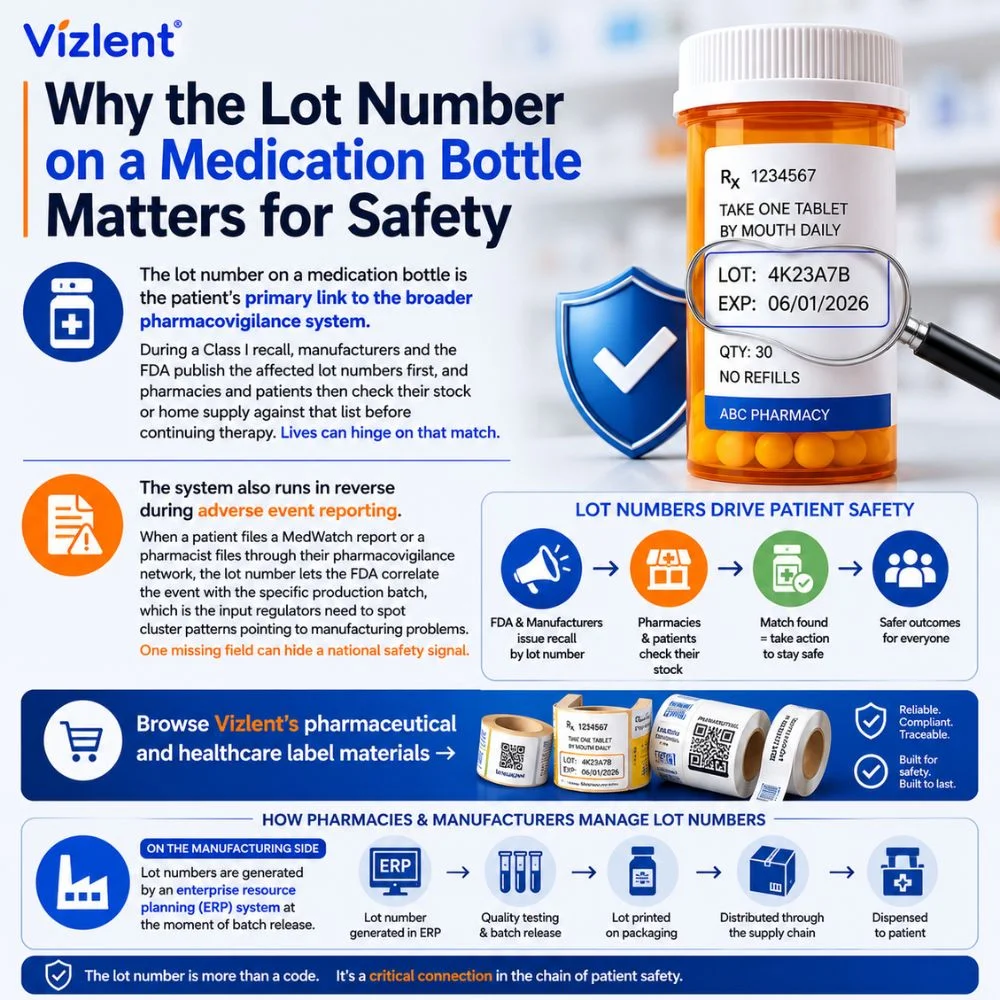
The lot number on a medication bottle is the patient’s primary link to the broader pharmacovigilance system. During a Class I recall, manufacturers and the FDA publish the affected lot numbers first, and pharmacies and patients then check their stock or home supply against that list before continuing therapy. Lives can hinge on that match.
The system also runs in reverse during adverse event reporting. When a patient files a MedWatch report or a pharmacist files through their pharmacovigilance network, the lot number lets the FDA correlate the event with the specific production batch, which is the input regulators need to spot cluster patterns pointing to manufacturing problems. One missing field can hide a national safety signal.
Browse Vizlent’s pharmaceutical and healthcare label materials →
How Pharmacies and Manufacturers Manage Lot Numbers
On the manufacturing side, lot numbers are generated by an enterprise resource planning system at the moment of batch release. The number is printed directly onto pharmaceutical labels through inkjet, thermal transfer, or laser coding equipment, and the same string is encoded into the DataMatrix barcode used for DSCSA serialization in the United States and EU FMD compliance in Europe. Every printed lot is auditable end-to-end.
On the pharmacy side, the lot number gets captured at the time of dispensing. Pharmacy management software such as PioneerRx, QS/1, or Epic Willow can scan the inbound stock bottle, link the manufacturer’s lot to the patient’s prescription record, and surface that information instantly if a recall notice or adverse event report needs the data later. Modern systems make the entire process almost invisible to staff.
Where to find lot number on medication bottle data across the supply chain:
- Manufacturer’s master batch record: the original system of record
- Carton and bottle print: the consumer-visible code
- DataMatrix barcode: scannable, machine-readable form
- Pharmacy management system: stored at the time of intake and dispensed
- Adverse event report: required field for FDA MedWatch submissions
Vizlent Supplies the Label Stock Behind Compliant Lot Number Printing
A lot number is small, but the audit trail behind it is anything but. Pharmaceutical converters, pharmacy chains, and contract manufacturers rely on label substrates that hold print fidelity through autoclave cycles, cold-chain transit, and isopropyl alcohol wipe-downs, which is the work Vizlent does every day for clients across more than 50 countries. If you are sourcing label stock for prescription bottle production, the team can match face stock, adhesive, and topcoat to your serialization workflow and your existing inkjet, thermal transfer, or laser coding equipment.
Free sample rolls ship before any bulk commitment, sized to your converting line. Bulk orders typically leave the Shenzhen facility within 7 to 15 business days, with full ISO 9001, FSC, and SGS documentation included.
Request your free pharmaceutical label sample roll →
See the full pharmaceutical and healthcare label range →
Frequently Asked Questions
What is a lot number on a prescription bottle?
A lot number on a prescription bottle is the manufacturer’s batch identification code that links the medication back to its specific production run, raw materials, and date of manufacture. The FDA requires the field under 21 CFR 211.130(c), and pharmacies retain it for recall response and adverse event reporting under state board pharmacy rules.
Where do you find a lot of numbers on a prescription bottle from a U.S. pharmacy?
On manufacturer-sealed bottles, the lot number is printed on the side or bottom panel, usually near the expiration date and below the National Drug Code. On pharmacy-dispensed bottles, the manufacturer’s lot may sit beneath the dispense label or in the pharmacy’s electronic dispensing record, which can be requested by the patient at any time.
How do I find a lot number on a prescription bottle if the dispense label covers it?
Gently peel back a corner of the dispense label to check the printed bottle face underneath, or call the dispensing pharmacy and request the manufacturer’s lot tied to your fill date. Pharmacies retain that information under state pharmacy board rules and can typically provide the original lot during a single phone call.
What does it mean if the lot number is not on a prescription bottle?
A missing lot number on a prescription bottle most often indicates the dispense label is covering the manufacturer’s printing, the medication was repackaged without transferring the lot, or, in rare cases, the product is counterfeit. Contact the dispensing pharmacy to confirm the original manufacturer’s lot and rule out a quality concern before the next dose.
Is the batch number on a pill bottle the same as the lot number?
For practical pharmacy and FDA documentation, the batch number on a pill bottle and the lot number refer to the same identifier under 21 CFR 210.3(b). Some European Pharmacopoeia contexts treat batch and lot as slightly distinct technical concepts, but in U.S. retail pharmacy practice, the two terms are used interchangeably for traceability purposes.
Where is the lot number on a pill bottle that has a peelable double label?
Many manufacturer-sealed pill bottles use peelable expanded content labels that hide a second printed layer underneath. The lot number is typically on the inner base label, near the expiration date and National Drug Code. Lift the corner of the outer ply gently to expose the base label without damaging the foil seal or the printed face.
Editorial disclosure: Regulatory references cited above (FDA 21 CFR 211.130, 21 CFR 210.3, DSCSA, EU FMD, EU GMP Annex 13, ICH Q7) are summarized for general educational purposes. Patients with concerns about a specific medication should contact their dispensing pharmacist or call the FDA MedWatch program directly. Pharmaceutical manufacturers and pharmacy operators should consult their regulatory affairs teams and the current published versions of each regulation before making documentation or labeling decisions.