
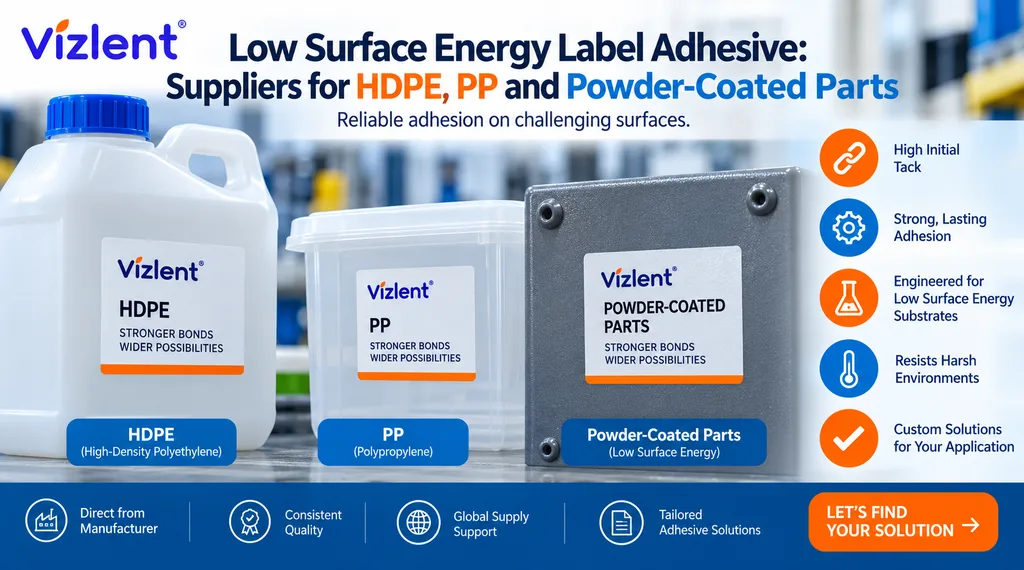
A low surface energy label adhesive uses modified acrylic or rubber-based chemistries to grip substrates that resist wetting by conventional pressure-sensitive adhesives. Materials like PE containers, PP automotive trim and powder-coated metal housings are difficult for standard permanent adhesives to wet adequately, making adhesive selection one of the most consequential decisions in any label specification. Matching the right adhesive to the right substrate prevents the edge-lift, flagging and outright label loss that drives returns, compliance failures and re-labeling costs across packaging, automotive and industrial markets.
What Is Low Surface Energy?
Surface energy, measured in dynes per centimeter (dynes/cm) or millijoules per square meter (mJ/m²), quantifies how strongly a material’s surface attracts liquids and adhesives. High surface energy substrates such as metals and glass pull an adhesive flat and allow it to spread, a behavior the industry calls wetting. Low surface energy generally describes substrates that are difficult for adhesives to wet; their surface molecules have weak intermolecular attraction, leaving the adhesive sitting on top of the surface rather than flowing into its micro-texture.
Values around 36 dynes/cm are often used as a practical reference point, but the threshold depends on the specific adhesive and application. Common self-adhesive material challenges arise with substrates such as polyethylene (approximately 31 dynes/cm), polypropylene (approximately 29 dynes/cm), PTFE (approximately 18 dynes/cm) and powder-coated metals that carry surface-modifying additives. Understanding what is low surface energy at the substrate level is the first step toward specifying an adhesive construction that will actually hold.
Why Standard Adhesives Fail on Low Surface Energy Substrates
Many general-purpose permanent acrylic PSAs are optimized for easier-to-wet surfaces and can show reduced adhesion on difficult LSE substrates. When applied to a polyethylene or polypropylene surface, those adhesives cannot achieve adequate wetting, which results in reduced initial tack and declining peel adhesion over time. The label may appear to stick at first, but within hours or days, edges begin to lift, and the bond can release entirely under mechanical stress, temperature cycling or humidity exposure.
This failure has real consequences in labeling workflows. A shipping label that peels from an HDPE drum during transit can cause mis-routing and, where the label carries regulatory content, may create a compliance exposure. An automotive label on a TPO bumper fascia that lifts after heat cycling fails both the brand and whatever information or function the label is intended to provide, which is why substrate adhesion testing before production is an industry best practice rather than an optional step.
How a Low Surface Energy Label Adhesive Works
High-tack LSE formulations are engineered to wet out more aggressively on difficult surfaces; formulation strategies can include tackifying resins, adjusted polymer rheology or surface-energy-matched chemistries that increase contact area between adhesive and substrate. The result is a stronger mechanical and chemical bond despite the substrate’s inherently weak surface attraction. This increased wetting is what separates a purpose-built LSE adhesive from a standard permanent PSA that relies on substrate cooperation.
The adhesive’s viscoelastic properties are tuned so that it remains aggressive enough to wet out on an LSE surface while maintaining cohesive strength under shear and temperature extremes. Vizlent Label’s super sticky low-energy label stock uses this principle across constructions rated for continuous service from -40°C to 120°C (Vizlent product data; confirm against the current technical data sheet). The specific formulation, whether acrylic or rubber-based, determines how the adhesive behaves under chemical exposure, UV aging and mechanical stress.
Acrylic-Based LSE Formulations
Modified acrylic adhesives are commonly selected for low surface energy labeling in demanding environments. These formulations use solvent-borne or hot-melt acrylic polymers blended with high-tack resins to increase surface wetting without sacrificing long-term aging stability. Acrylics generally offer superior UV resistance and chemical resistance compared to rubber-based alternatives, which makes them a practical choice for outdoor, automotive and chemical-drum applications.
Key characteristics of acrylic LSE adhesives include:
- High peel adhesion on PE, PP, ABS and TPO surfaces
- Resistance to plasticizer migration from flexible PVC substrates
- Aging stability that reduces the likelihood of yellowing or adhesive transfer over multi-year service
- Compatibility with durable label constructions using PET and polyimide facestocks
Acrylic formulations also offer broad solvent resistance, standing up to motor oils, brake fluids and many industrial cleaners when paired with an appropriate facestock. Some acrylic LSE formulations can show lower initial tack at cold application temperatures, which may require warming the substrate or the label before application in cold warehouse or field environments. Confirm the minimum application temperature with your adhesive supplier before specifying an acrylic LSE grade for cold-apply workflows.
Rubber-Based LSE Formulations
Rubber-based pressure-sensitive adhesives (often synthetic rubber or styrene-isoprene-styrene block copolymers) deliver exceptionally high initial tack, which makes them effective on very low-energy substrates where even modified acrylics struggle to wet out. The soft, aggressive nature of rubber adhesives allows them to conform rapidly to textured and irregular surfaces, including recycled plastics and blow-molded HDPE containers. This high tack comes at a trade-off: rubber adhesives age less gracefully than acrylics under prolonged UV exposure and can soften or flow at elevated service temperatures.
Rubber-based LSE adhesives are commonly selected for:
- Short-to-medium service life labels on PE and PP packaging
- Cold-applied labels in refrigerated or frozen-chain environments (confirm the specific formulation’s minimum application temperature)
- High-speed labeling lines where instant grab is critical to prevent flag or throw
- Indoor product labels where UV aging is not a primary concern
When specifying a rubber-based adhesive, confirm the expected service temperature range and chemical exposure with the adhesive manufacturer, as these formulations vary significantly in softening point and solvent resistance across suppliers. Rubber adhesives also tend to be more sensitive to plasticizer migration from flexible PVC facestocks. For applications combining LSE substrates with demanding chemical or thermal environments, a modified acrylic remains the more commonly selected option.
Low Surface Energy Label Adhesive Paper and Facestock Pairing
The facestock determines how a label performs structurally, while the adhesive determines whether it stays attached, but mismatches between the two create avoidable failures. LSE adhesive paper constructions use coated papers paired with aggressive PSAs, and they work adequately on mild LSE surfaces (around 32 to 36 dynes/cm) under controlled indoor conditions. For substrates below 30 dynes/cm, or for labels exposed to moisture, temperature extremes or chemical splash, a synthetic facestock is the more reliable choice.
Polyester (PET) label material paired with a solvent-acrylic LSE adhesive is one of the most robust combinations for industrial and outdoor labeling on low-energy substrates. BOPP label material offers a lighter-weight alternative with good moisture resistance and clarity for product branding on PP containers. Every LSE adhesive performs differently depending on the facestock it carries, so the pairing should be tested as a finished construction rather than evaluated from adhesive data alone.
Low Surface Energy Label Adhesive Tape and Transfer Films
LSE adhesive tape products use a carrier film (typically PET or closed-cell PE foam) coated on one or both sides with an LSE-rated PSA, providing structural reinforcement alongside adhesion. Transfer tapes remove the carrier entirely, leaving only a thin adhesive film between two surfaces, which makes them useful for bonding emblems, nameplates and trim components to LSE plastics. Both formats address applications where a traditional die-cut label is either too rigid or too thick for the assembly.
In electronics and consumer product assembly, heat-resistant label tape constructions bonded with LSE adhesive hold components to ABS and polycarbonate housings through thermal cycling and mechanical vibration. Die-cut labels remain the standard for identification, tracking and compliance marking because they combine a printable facestock with an LSE adhesive in a single construction. The choice between tape and label depends on whether the primary function is adhesive bonding (tape) or information transfer (label), though some applications require both.
What Is Low Surface Energy Label Adhesive 300LSE?
“300LSE” is a product designation for 3M’s Adhesive 300LSE, a high-performance acrylic PSA designed specifically for bonding to low surface energy plastics and powder-coated surfaces. 3M’s published data sheets describe 300LSE as a solvent-free acrylic adhesive available on transfer tapes (such as the 8132LE and 9453LE) and double-coated tapes (such as the 9475LE), with automotive label and electronics assembly among its primary applications. Buyers searching for an LSE adhesive in this performance class are generally looking for a high-tack acrylic with comparable published properties; “300LSE” is not a universal standard or classification, but a specific 3M product.
In label stock manufacturing, converters specify LSE adhesive grades that serve the same function as 300LSE: engineered to wet out on PE, PP and TPO surfaces and hold under thermal cycling. When evaluating any adhesive described as “300LSE-equivalent,” request the technical data sheet and compare the published 180-degree peel adhesion on stainless steel, HDPE and polypropylene, as well as the temperature service range. An LSE adhesive is only as reliable as the test data behind it, and any equivalence claim should be verified by testing on your actual production substrate.
Request a sample of Vizlent’s super sticky LSE label stock for your substrate testing.
Low Surface Energy Label Adhesive Spray and Liquid Coatings
Spray-applied adhesives coat large or irregular surfaces with a thin, even layer of LSE-rated adhesive and are used primarily in industrial assembly and graphic overlay applications rather than in pressure-sensitive label converting. An LSE adhesive spray delivers the adhesive from an aerosol or pneumatic system, which allows operators to treat surfaces that are too large, too curved or too numerous for pre-cut labels or tape. These spray adhesives are formulated with similar high-tack resins to their PSA counterparts, but they cure by solvent evaporation or contact bonding rather than by pressure application alone.
Spray adhesives carry safety and handling considerations that PSA labels and tapes do not, including requirements for proper ventilation, personal protective equipment and compliance with the adhesive’s safety data sheet (SDS). Overspray can contaminate adjacent surfaces and equipment, adding a cleanup step that pre-coated labels avoid entirely. For most labeling and marking applications, a pre-coated laminating film or die-cut self-adhesive label construction is a more controlled, less hazardous alternative to spray application.
How to Read a Low Surface Energy Label Adhesive SDS
When an LSE adhesive is classified as hazardous, its SDS follows the Globally Harmonized System (GHS) 16-section format. Under OSHA 29 CFR 1910.1200, Sections 1 through 11 and Section 16 are mandatory for hazardous chemicals; Sections 12 through 15 (ecological, disposal, transport and regulatory information) are included in the GHS format but are not enforced by OSHA. Section 2 (Hazard Identification) and Section 8 (Exposure Controls) are the most immediately relevant to label converters and end users, as they describe the adhesive’s chemical hazards, permissible exposure limits and recommended personal protective equipment.
For outdoor weather-resistant and industrial label applications, Section 9 (Physical and Chemical Properties) can include the adhesive’s softening point, flash point and solubility data, all of which affect storage, transport and application decisions. For adhesives classified as hazardous, a current SDS should be requested from your label stock supplier for every adhesive grade used in production (regulatory requirement: OSHA 29 CFR 1910.1200 Hazard Communication Standard requires employers to maintain accessible safety data sheets for hazardous chemicals). Keeping SDS records current protects both operators and the business from compliance exposure.
Surface Treatment Methods for Better Label Adhesion
When a substrate’s surface energy is too low for even a specialized LSE adhesive to achieve acceptable peel adhesion, surface treatment raises the dyne level by chemically or physically modifying the outermost molecular layer. The three methods commonly selected for label and packaging substrates are corona discharge treatment, atmospheric plasma treatment and flame treatment. Each method oxidizes the surface and introduces polar functional groups, increasing the substrate’s wetting tension so the adhesive can spread and bond.
- Corona treatment: Passes the substrate through an electrical discharge that oxidizes the surface; commonly selected for inline treatment of PE and PP films on converting and packaging lines.
- Plasma treatment: Uses ionized gas (air, nitrogen or oxygen) to modify the surface at a molecular level; offers more uniform treatment on complex three-dimensional parts than corona discharge.
- Flame treatment: Briefly exposes the substrate to an oxidizing flame; commonly selected for blow-molded HDPE and PP containers before label application.
Surface treatment effectiveness can decay over time due to molecular reorientation, migration of bulk additives to the surface, contamination and storage conditions, so labels should be applied as soon as practical after treatment. ASTM D2578 (industry standard) provides the standard test method for measuring wetting tension specifically on PE and PP films; dyne pen testing is widely used as a practical field check on other substrates, but that broader use falls outside the formal scope of D2578. For appliances and industrial applications where inline treatment is not feasible, specifying a higher-tack LSE adhesive grade may be more practical than adding a treatment step.
Testing and Qualifying Low Surface Energy Labels
Qualifying low surface energy labels for production requires controlled adhesion testing on the actual substrate, not on stainless steel test panels alone. ASTM D3330 (industry standard) provides the standard test method for measuring peel adhesion of pressure-sensitive tape, and results should be generated on samples of the production substrate at the expected application temperature and evaluated after a defined dwell time. An LSE adhesive that passes a 180-degree peel test on stainless steel can still fail on a polypropylene container, which is why substrate-specific testing is a screening condition rather than a guarantee of long-term service life.
Pair adhesion testing with print durability verification to confirm that the printed face withstands the same service conditions as the adhesive bond. Resin thermal transfer ribbons paired with a synthetic facestock deliver the chemical and abrasion resistance that demanding LSE applications require, while thermal transfer ribbon selection should match the facestock, print speed and application environment. Define written acceptance criteria before beginning qualification: minimum peel adhesion result, maximum edge lift, minimum barcode grade, no print transfer (author recommendation).
Low Surface Energy Sticker Applications by Industry
A low surface energy sticker must do more than adhere; it must survive the service conditions that define its industry, from chemical splash in petrochemical plants to UV degradation on outdoor signage. Automotive manufacturers apply LSE labels and stickers to PP and TPO interior trim, engine-compartment components and exterior emblems where surface energies routinely sit below 30 dynes/cm. Consumer electronics assemblers bond identification and regulatory stickers to ABS and polycarbonate housings that resist standard adhesives.
Key industries that depend on low surface energy sticker performance include:
- Automotive: Under-hood, under-dash and exterior labels on PP, TPO, nylon and powder-coated metal
- Petrochemical: GHS-compliant drum labels on HDPE and powder-coated steel (petrochemical drums applications)
- Consumer electronics: Regulatory, serial number and warranty stickers on ABS and polycarbonate
- Packaging: Product labels on PE and PP containers in food, beverage, household chemical and personal care segments
- Logistics: Shipping and tracking labels on stretch-wrapped pallets and shrink-film packaging (logistics and e-commerce solutions)
Each application has its own combination of substrate energy, application temperature, service temperature, chemical exposure and required service life. Specifying the wrong adhesive grade for even one of these variables leads to field failures that are far more expensive than a properly run qualification test. Request substrate-specific peel adhesion data from your label stock supplier before committing to a production order.
How to Choose the Right Low Surface Energy Label Adhesives
Surface energy is only one variable in adhesive selection; substrate texture, cleanliness, plasticizer content, application temperature and service environment all affect the bond. Selecting among LSE adhesive options starts with measuring or confirming the substrate’s surface energy, which can be done with dyne test pens (noting that formal ASTM D2578 scope covers PE and PP films specifically) or by requesting the substrate manufacturer’s published surface energy data. Next, define the application conditions: the temperature at which the label will be applied, the temperature range it must survive in service, and any chemical, moisture or UV exposure it will face.
Request technical data sheets for each candidate adhesive and compare published 180-degree peel adhesion on HDPE and polypropylene, initial tack, shear resistance and temperature service range. Where possible, test finished label constructions on production substrates under production conditions rather than relying on published figures alone (author recommendation). Vizlent offers free A4 sample sheets and sample rolls of its super sticky low-energy constructions, giving converters and brand owners the opportunity to qualify each LSE adhesive on their actual substrates before committing to volume (Vizlent product data; confirm current availability).
Five-Step Procurement Sequence
- Submit your specification: Provide substrate type, surface energy (if known), application temperature, service temperature range and chemical exposure to your label stock supplier.
- Receive a recommended construction: The supplier matches an LSE adhesive grade and facestock to your requirements.
- Request the technical data sheet: Review published peel adhesion, tack, shear and temperature data for the recommended construction.
- Test samples on your production substrate: Apply labels under production conditions and evaluate against your written acceptance criteria.
- Quote at volume: Once the construction passes qualification, request pricing for your production quantities.
Contact Vizlent to start your LSE label stock qualification.
Frequently Asked Questions
What is low surface energy, and why does it matter for labels?
Low surface energy generally describes substrates that are difficult for adhesives to wet, measured in dynes/cm. Values around 36 dynes/cm are often cited as a practical reference point, but the threshold depends on the adhesive and application; common LSE substrates include PE, PP, PTFE and powder-coated metals. Specifying an adhesive formulated for LSE substrates is the primary solution, though surface treatment can also raise the dyne level to improve adhesion.
What substrates are considered low surface energy?
Common LSE substrates include polyethylene (approximately 31 dynes/cm), polypropylene (approximately 29 dynes/cm), PTFE or Teflon (approximately 18 dynes/cm), silicone, TPO, powder-coated metals and some recycled plastics. Each substrate’s exact surface energy can vary with additives, processing conditions and surface contamination. A dyne pen test on a production sample is a practical way to estimate surface energy before selecting an adhesive; for PE and PP films specifically, ASTM D2578 provides the formal test method.
How is an LSE adhesive different from a standard PSA?
An LSE adhesive is engineered to wet out and bond on substrates where standard acrylic or rubber adhesives cannot achieve adequate peel adhesion; formulation strategies can include tackifying resins, adjusted polymer rheology or surface-energy-matched chemistries. The formulation may be acrylic-based (for UV and chemical resistance) or rubber-based (for maximum initial tack). Standard PSAs are optimized for easier-to-wet surfaces and may pass initial application but fail under thermal cycling or mechanical stress on LSE substrates.
Can I use corona or plasma treatment instead of an LSE adhesive?
Corona and plasma treatment raise a substrate’s surface energy by introducing polar functional groups, which can allow a standard adhesive to bond. However, the treatment effect decays over time, and treatment adds a process step, equipment cost and quality control requirement. For many applications, specifying an LSE adhesive eliminates the need for surface treatment entirely, though some very low-energy substrates (below 25 dynes/cm) may benefit from both treatment and an LSE adhesive.
What does 300LSE mean on a label adhesive product?
The term “300LSE” refers to 3M’s Adhesive 300LSE, a high-performance acrylic PSA designed for LSE substrates and widely used in transfer tapes and double-coated tapes. It has become an industry reference point, and many adhesive suppliers offer formulations described as “300LSE-equivalent.” When evaluating alternatives, compare published peel adhesion data on HDPE and PP, temperature service range and chemical resistance against the specific 3M technical data sheet.
Do I need a safety data sheet (SDS) for label adhesives?
For any adhesive classified as hazardous under OSHA 29 CFR 1910.1200, yes, an SDS is required. The SDS covers hazard classification, exposure limits, handling procedures, storage requirements and emergency measures. Even for adhesives not classified as hazardous, requesting the SDS or equivalent product safety information from your label stock or adhesive supplier is good practice; keep current copies accessible where the material is stored and applied.
What facestock works best with LSE adhesives?
Facestock selection depends on the label’s service environment. PET film is commonly selected for chemical, heat and UV resistance on industrial and outdoor weather-resistant applications. BOPP film is commonly selected for moisture-resistant product labels on PP containers. Coated paper can work on mild LSE surfaces indoors, but synthetic facestocks paired with resin thermal transfer printing deliver more consistent durability across temperature and chemical exposure.
How do I test whether an LSE adhesive will work on my substrate?
Provide your adhesive or label stock supplier with a sample of your production substrate, specify the application and service temperature range, and request peel adhesion test data on that material. ASTM D3330 (industry standard) provides the standard test method for measuring peel adhesion of pressure-sensitive tape. Define written acceptance criteria (minimum peel result, maximum edge lift, barcode grade) before testing, and treat the results as screening data rather than a guarantee of long-term performance.






