
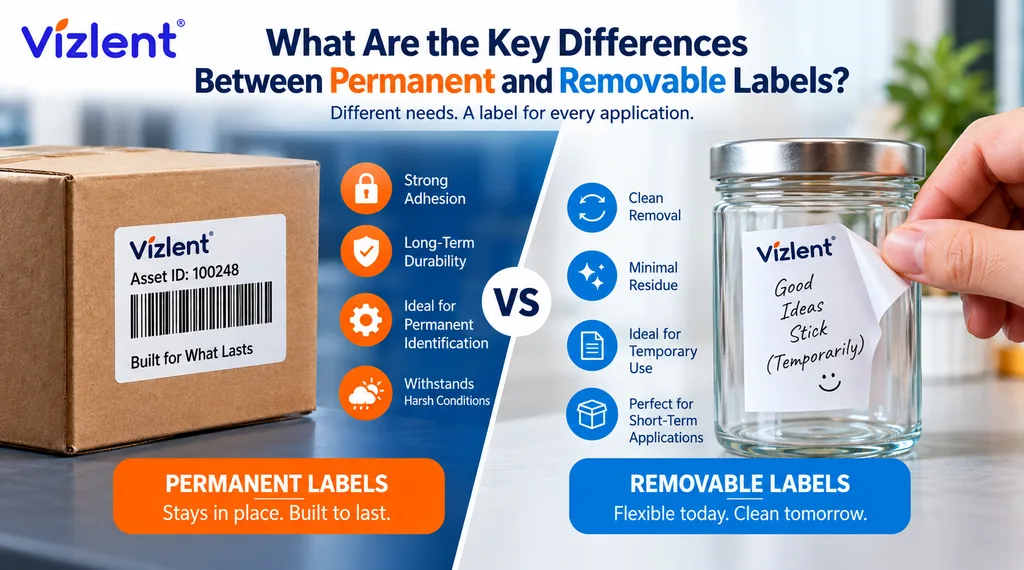
The differences between permanent and removable labels come down to adhesive design intent, peel adhesion characteristics and intended service conditions. A permanent label uses an adhesive designed to maintain a durable bond throughout the intended service life, while a removable label peels away cleanly when it is no longer needed. Choosing the wrong adhesive grade leads to either premature label failure or surface damage on removal.
What are the key differences between permanent and removable labels? The answer starts with adhesive design intent and ends with application-specific qualification testing. This post covers peel adhesion mechanics, adhesive formulations, testing standards and real-world selection criteria so that converters, brand owners and procurement teams can specify the right self-adhesive label materials for every substrate and service condition.
Understanding Permanent Label Adhesives
Permanent pressure-sensitive adhesives are formulated to create a bond that strengthens progressively after initial application. Most permanent adhesive labels use acrylic or rubber-based formulations that begin as tacky, flowable coatings and then build cohesive strength as the adhesive wets out into the substrate’s surface texture. Permanent adhesives are designed to resist removal and can require substantial force to separate from the substrate, with removal potentially damaging the label, substrate or adhesive bond depending on the construction.
This design intent makes permanent labels the standard choice for product identification, safety warnings and regulatory compliance markings. Barcode labels on finished goods, serialized pharmaceutical labels and certification marks all rely on permanent adhesive to remain legible and tamper-evident throughout the product’s service life. Any label that must survive shipping, handling and end-use conditions without lifting or curling at the edges requires a permanent-grade durable label construction.
How Permanent Adhesives Build Bond Strength Over Time
Some permanent constructions offer limited repositionability immediately after application, depending on adhesive formulation, but adhesion builds as the adhesive flows into microscopic valleys on the substrate surface. Converters and applicators should allow a minimum dwell time before testing peel adhesion, because adhesion at application and adhesion after bond development are measured under different dwell conditions. FINAT FTM 1 captures this by measuring peel adhesion after defined dwell periods, including 20 minutes and 24 hours after application on a standardized glass plate.
The rate of bond build depends on adhesive chemistry, substrate surface energy and ambient temperature. Smooth, high-energy surfaces such as glass and stainless steel allow rapid wet-out, while textured or low-energy plastics such as polyethylene and polypropylene require specially formulated high-tack or super-sticky adhesive grades. Vizlent supplies super-sticky adhesive constructions engineered for low surface energy substrates where standard permanent grades do not achieve adequate peel adhesion.
Understanding Removable Label Adhesives
Removable adhesive labels are engineered for temporary bonding, delivering enough tack for the label to stay in place during use while allowing clean separation from the surface afterward. Removable adhesives are formulated to provide sufficient initial adhesion while allowing removal under specified conditions. Adhesion can change with dwell time, temperature, substrate and environmental exposure, so the intended dwell period and service environment must be defined during adhesive selection.
Removable labels serve applications ranging from retail price tags and promotional stickers to warehouse inventory rotation and temporary compliance markings. Repositionable labels, typically designed as removable constructions, offer even lower initial tack so the label can be lifted and re-applied multiple times before a final placement. The growing demand for temporary labeling solutions in retail, food service and home organization has driven significant development in removable adhesive technology.
Clean Removal Without Surface Damage
The defining feature of a removable adhesive is its design intent: under specified conditions, the adhesive separates cleanly from the substrate rather than splitting cohesively or transferring to the surface. Adhesive formulation and viscoelastic properties influence how strongly the adhesive wets the substrate and how it releases during removal. The result is a bond that resists shear forces well enough to hold the label in place but releases under a deliberate peeling action within the designed service window.
Surface compatibility matters as much with removable labels as it does with permanent ones. A removable adhesive optimized for glass may leave residue on an uncoated cardboard surface because the adhesive penetrates the paper fibers. Always confirm clean removability by testing the specific label construction against the actual application substrate under realistic service conditions, including temperature, humidity and dwell time.
Removable vs Permanent Labels: A Side-by-Side Comparison
When evaluating removable vs permanent labels for a specific application, the comparison comes down to adhesive design intent, measurable adhesive properties and intended service conditions. Peel adhesion characteristics, measured under standardized test conditions, are one of the primary differentiators. The following list of permanent and temporary differences summarizes the core technical distinctions between these two adhesive categories.
| Property | Permanent | Removable |
| Bond objective | Long-term adhesion under specified conditions | Controlled removal under specified conditions |
| Design intent | Resist removal throughout service life | Allow clean separation when no longer needed |
| Peel adhesion | Formulated for higher peel forces | Formulated for lower, controlled peel forces |
| Dwell sensitivity | Bond strength can increase over hours to days | Depends on formulation and conditions |
| Removal behavior | Can damage label, substrate or bond on removal | Designed for clean, residue-free removal |
| Common applications | Product ID, asset tracking, compliance markings | Temporary ID, retail pricing, relabeling |
| Substrate sensitivity | Important for adhesion | Critical for both adhesion and clean removability |
| Testing approach | Application-specific qualification | Application-specific qualification |
Note: Permanent and removable adhesives do not have universal peel-force thresholds. Published values depend on adhesive formulation, facestock, substrate, dwell time, test method and test conditions. Both adhesive types are coated onto the same range of label stock materials, including paper, BOPP, PET and vinyl.
Converters should request technical data sheets for both adhesive types and compare published peel values measured under the same test standard and substrate conditions.
Need help determining whether your application requires permanent or removable adhesive? Contact Vizlent’s engineering team to discuss your substrate, service conditions and removal requirements.
Where Permanent and Removable Labels Are Used Across Industries
The difference between permanent and removable stickers becomes clearest when matched to specific industry applications. Permanent adhesive labels dominate product identification, asset tracking, safety markings and regulatory labeling because these labels must remain in place and legible throughout the product’s service life. Removable labels serve applications where the label itself has a defined end date or where the substrate must remain clean after the label is removed.
Industries that rely heavily on both adhesive types include food and beverage packaging, logistics and warehousing, retail and consumer electronics. A single product may carry both a permanent brand label and a removable promotional label, each requiring a different adhesive grade coated on a different facestock. Understanding which surfaces and service conditions each label will encounter is the starting point for adhesive selection.
Removable Labels for Plastic Containers and Storage Bins
Removable labels for plastic containers are widely used in food service, laboratory storage, household organization and retail repackaging. These labels must adhere reliably to polyethylene, polypropylene and polystyrene surfaces while peeling away without residue when the container is reused or relabeled. Select a removable adhesive specifically tested against the container’s resin type, because surface energy varies significantly across common packaging plastics.
Removable labels for storage bins serve a similar function in warehouse and distribution environments, where bin contents change with inventory rotation. A removable peel-and-stick label on a reusable tote or bin allows workers to swap identification and routing information without scraping adhesive residue or damaging the bin surface. Many warehouse management systems specify removable labels for reusable containers to reduce bin replacement costs and relabeling downtime.
How Adhesive Chemistry Determines Label Performance
Pressure-sensitive adhesives for labels are commonly categorized into three chemistry families for practical purposes: acrylic, rubber-based (natural or synthetic) and hot-melt. Each chemistry offers a different balance of tack, peel strength, shear resistance and aging stability, and each can be formulated for either permanent or removable performance. The choice of label adhesive types affects not only adhesion but also compatibility with printing systems, die-cutting and dispensing equipment.
Acrylic adhesives are commonly selected for durable label applications because they resist UV exposure, solvents and temperature extremes better than rubber-based alternatives. Rubber-based adhesives can provide higher initial tack on difficult surfaces but may yellow or lose cohesion with prolonged UV exposure. Vizlent formulates adhesive grades across multiple chemistry platforms, including emulsion acrylic, solvent acrylic and modified acrylic constructions, to serve both permanent and removable performance requirements.
Matching Adhesive Type to Substrate Surface Energy
Surface energy is one of the most important substrate properties to consider when selecting a pressure-sensitive adhesive. High-energy surfaces such as metals, glass and rigid PET accept most adhesive types readily, while low-energy surfaces such as polyethylene, polypropylene and silicone-treated materials resist wetting and require specially formulated adhesives. A permanent adhesive that performs well on glass may show significantly reduced adhesion on an untreated HDPE container.
When specifying adhesive labels for low-energy plastics, request peel adhesion data measured on the actual substrate material rather than standard stainless steel or glass test panels. Vizlent’s self-adhesive material product lines include constructions with adhesive grades engineered for low surface energy substrates, backed by substrate-specific peel test data available on request.
Testing Standards That Define Permanent and Removable Adhesive Performance
Peel adhesion testing is the primary method used to characterize and compare pressure-sensitive adhesive performance across the label industry. Several testing frameworks are widely referenced, including ASTM D3330, ASTM D6252 and the FINAT FTM series. These methods measure the force required to peel a strip of adhesive-coated material from a standard substrate at a controlled rate and angle.
No standard defines a universal numerical boundary between permanent and removable adhesives. The classification depends on the adhesive manufacturer’s design intent and published performance data for a specific construction. Converters should request test reports citing the applicable method, substrate and dwell time for every adhesive grade under consideration.
Key test methods:
- ASTM D3330: A standard test method for peel adhesion of pressure-sensitive tape. Method A measures peel at 180 degrees; Method F measures peel at 90 degrees. Tests use a 25 mm specimen width at 300 mm/min peel rate on a stainless steel substrate, conditioned at 23 degrees Celsius and 50% relative humidity. ASTM notes that peel results depend on factors including backing stiffness and adhesive rheology and do not necessarily provide direct design information.
- ASTM D6252/D6252M: A standard test method for peel adhesion of pressure-sensitive label stocks specifically, measuring 90-degree peel adhesion. This method is designed for label-stock constructions and may be more directly applicable than D3330 when evaluating label materials.
- FINAT FTM 1: A label-industry peel adhesion test at 180 degrees on a glass plate, measuring peel force in N/25 mm after defined dwell periods, including 20 minutes and 24 hours, to capture adhesion at different stages of bond development. Tack is measured separately under FINAT FTM 9 (loop tack).
- FINAT FTM 2: A 90-degree peel adhesion test at 300 mm/min, measuring adhesion under a different peel geometry than FTM 1.
Common Mistakes When Specifying Permanent or Removable Labels
Selecting the wrong adhesive category is one of the most expensive errors in label procurement because it usually surfaces after production, during application or at the point of use. These mistakes appear regularly in specifications submitted to label stock suppliers and converters.
Understanding these pitfalls helps converters and brand owners write more precise specifications from the outset. A clear specification reduces sample iterations, shortens qualification timelines and prevents costly production reruns. Most specification errors stem from treating “permanent” and “removable” as precise technical categories rather than broad descriptions of adhesive design intent.
Frequent specification errors include:
- Assuming all permanent adhesives perform identically across substrates: Peel adhesion values published on stainless steel do not predict performance on textured, coated or low-energy surfaces
- Expecting removable adhesives to remain removable indefinitely: Some removable constructions can show increased adhesion over time and may leave residue after extended dwell times, especially at elevated temperatures
- Overlooking the effect of facestock stiffness on peel behavior: A rigid PET facestock applies different peel forces than a conformable vinyl facestock, even with the same adhesive
- Specifying by adhesive category name alone: “Permanent” and “removable” are broad descriptions of design intent, not precise specifications; always request a construction-specific technical data sheet
- Ignoring application temperature versus service temperature: A removable adhesive that performs cleanly at room temperature can show different adhesion or removal characteristics when applied to warmer substrates
Build a written specification that names the substrate material, application temperature range, service temperature range, expected dwell time, required peel force range and removal cleanliness standard before requesting adhesive recommendations from your supplier.
Get the Right Adhesive Grade for Your Application
Selecting the right adhesive grade starts with a clear specification. Whether your application calls for permanent bond strength or clean removability, the construction must be matched to your substrate, temperature range and service conditions.
Vizlent Label Materials Co., Ltd. formulates self-adhesive label stock with eight adhesive grades (at the time of writing), including permanent, removable, freezer and wash-off constructions, across paper, BOPP, PET, PVC and specialty facestocks. Contact Vizlent’s engineering team to discuss your application requirements and request sample materials for qualification testing.
How to get started:
- Submit your specification: substrate material, application and service temperatures, required dwell time and removal requirements
- Receive a recommended construction from Vizlent’s engineering team, matched to your adhesive performance requirements
- Request the technical data sheet for the recommended construction, including published peel adhesion values and test conditions
- Test samples against your actual substrates under realistic conditions and document results against your written acceptance criteria
- Quote at volume once the construction passes your qualification testing
Contact Vizlent to request your specification review and sample materials.
Frequently Asked Questions
What are the key differences between permanent and removable labels?
Permanent labels use adhesives designed to build bond strength over time and resist removal, which can result in label tearing or adhesive residue on peel. Removable labels use controlled-tack adhesives formulated to maintain lower, more stable peel forces and separate cleanly from the substrate under specified conditions. The classification depends on the adhesive manufacturer’s design intent and published performance data for a specific construction, not on universal numerical thresholds.
Can a removable label become permanent over time?
Some removable adhesive formulations can show increased adhesion over time, especially on porous substrates or at elevated temperatures. Extended dwell times may cause the adhesive to penetrate the surface texture, making clean removal difficult. Always confirm the maximum recommended dwell time with the adhesive manufacturer’s technical data sheet.
Are removable labels suitable for outdoor use?
Standard removable adhesives are not designed for extended outdoor exposure because UV radiation and temperature cycling can alter the adhesive’s peel and removal characteristics. Outdoor-rated removable constructions exist but require UV-resistant facestock and adhesive formulations tested for the intended exposure period. Specify the expected outdoor service life when requesting constructions from your supplier.
What adhesive type works best for removable labels on plastic containers?
Removable labels for plastic containers require an adhesive formulated for the specific resin type, whether polyethylene, polypropylene or polystyrene. Surface energy varies across these plastics, and an adhesive that removes cleanly from PP may leave residue on PE. Request substrate-specific peel test data from your label stock supplier before committing to a construction.
How do I test whether a label is truly removable?
Apply the label to the actual substrate material under realistic conditions and allow it to dwell for the maximum expected period. Then peel the label at 180 degrees and inspect the substrate for adhesive residue, surface discoloration or fiber tear. Document the test conditions including temperature, humidity and dwell time, and define written acceptance criteria before starting.
Can I use permanent labels on surfaces I might need to relabel later?
Permanent labels are not designed for clean removal. If relabeling is expected, use a removable adhesive grade or consider a label holder system for reusable containers and storage bins. Using a permanent label on a surface that requires future relabeling typically results in adhesive residue that requires solvents or mechanical scraping to remove.
What is the difference between removable and repositionable adhesive?
Removable adhesives peel cleanly but may not re-adhere strongly after removal. Repositionable adhesives are typically designed as removable constructions that tolerate repeated lift-and-replace cycles with consistent tack. Repositionable labels are commonly used for price tags, shelf labels and promotional graphics where placement adjustments are expected.
Does facestock material affect whether a label is permanent or removable?
The adhesive coating determines whether a label is permanent or removable, not the facestock. However, facestock stiffness, thickness and surface treatment influence peel behavior because they change the angle and force distribution during removal. A rigid polyester facestock and a conformable vinyl facestock paired with the same removable adhesive will peel differently. Vizlent coats both permanent and removable adhesives onto BOPP, PET, paper, PVC and specialty facestocks.






