
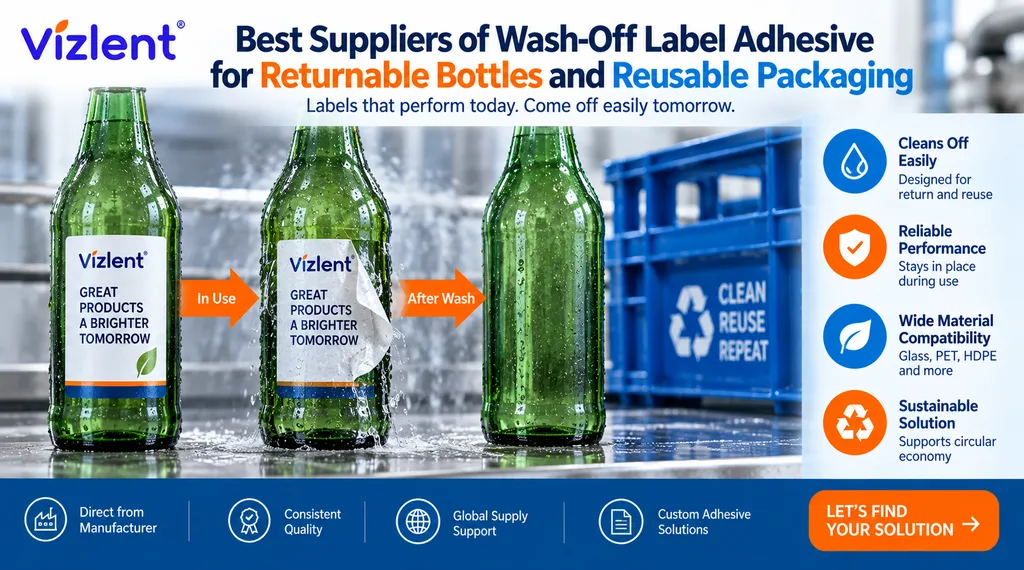
Established suppliers of wash-off label adhesive for returnable bottles and reusable containers include Vizlent Label, HERMA, Avery Dennison, Dow, Bostik, UPM Raflatac, and Beontag. Each offers pressure-sensitive adhesive formulations engineered to bond securely during product use and separate under specified washing conditions, with the goal of minimizing adhesive residue on the container surface. Your selection should prioritize wash-off performance data, third-party recyclability recognition, and compatibility with your specific container material and wash-line conditions.
Sourcing self-adhesive label stock with a properly matched wash-off adhesive is not a generic purchasing decision. The adhesive must perform under your exact wash-line parameters, including water temperature, caustic concentration, mechanical agitation, and dwell time. The sections below profile established Suppliers of Wash-Off Label Adhesive in this space, explain how different wash-off technologies work, and give converters and packaging buyers the evaluation criteria needed to qualify a wash-off adhesive before committing to volume orders.
What Is Wash-Off Label Adhesive?
Wash-off label adhesive is a category of pressure-sensitive adhesive (PSA) designed to lose its bond strength when exposed to specific conditions, which can include warm or hot water, alkaline cleaning agents, mechanical agitation, or combinations of these. Unlike permanent adhesives that resist removal throughout a product’s lifecycle, wash-off formulations are chemically engineered to swell, soften, or otherwise lose sufficient cohesive and adhesive strength to enable label separation under controlled washing parameters. A properly matched wash-off construction is designed to separate cleanly under specified washing conditions and minimize adhesive residue on the container surface.
The chemistry behind most wash-off adhesives falls into two main categories: water-based acrylic emulsions and hot-melt formulations tuned for wash sensitivity. [I] Water-based acrylic wash-off adhesives are commonly selected for beer and beverage labeling because they respond predictably to alkaline wash baths. Hot-melt wash-off adhesives, by contrast, tend to be used in cold-glue labeling applications on returnable glass where the wash-off trigger is temperature-dependent rather than alkali-dependent.
How Wash-Off Adhesive Works on Returnable Bottles and Containers
Wash-off mechanisms vary by formulation. Some adhesives are designed to release in warm water without additives, while others require alkaline conditions and elevated temperatures to trigger separation. Mechanical agitation assists label detachment during industrial washing. Once the adhesive loses sufficient cohesive strength, the label facestock separates from the container surface, and the wash water carries dispersed adhesive residue out through the filtration system.
Industrial wash conditions vary significantly by adhesive grade, facestock, container material, and washing system. Published supplier conditions range from water-only removal at lower temperatures (some Avery Dennison grades document wash-off capability from approximately 21 degrees Celsius) to hot alkaline washing around 80 degrees Celsius in 1% caustic soda (as documented by HERMA for specific grades). Before qualifying any supplier, request wash-off test data generated under conditions that mirror your actual production environment, including water temperature range, caustic concentration, dwell time, and rinse pressure.
What Removes the Sticky Residue from Stickers on Returnable Packaging?
The short answer to “what removes the sticky residue from stickers” in a commercial setting is a properly formulated wash-off adhesive paired with a compatible label facestock. When the adhesive is engineered for wash-off rather than permanent bonding, the adhesive is designed to soften, disperse, or lose sufficient bond strength during the wash cycle so that the container exits the wash line with a clean surface ready for relabeling. Residue performance depends on the match between the adhesive formulation, the facestock, the container material, and the actual wash conditions.
In cases where permanent adhesive residue is already present on a container, industrial cleaning protocols typically rely on alkaline soak solutions, solvent-based adhesive removers, or mechanical abrasion. Vizlent publishes a practical guide on how to remove sticky labels covering both consumer and industrial contexts. For any returnable packaging program, the most cost-effective approach is specifying a wash-off adhesive from the outset rather than investing in secondary residue-removal steps after the fact.
Key Features to Evaluate When Choosing a Wash-Off Label Adhesive Supplier
Not every wash-off adhesive supplier offers the same level of technical support, testing infrastructure, or product range. The following criteria separate a reliable supply partner from a catalog listing:
- Wash-off test data under documented conditions. Ask for peel adhesion values, residue rating, and wash-off time at a stated temperature, caustic concentration, and mechanical agitation level. A wash-off claim without test conditions is not a specification.
- Third-party recyclability validation. Products that have received APR Critical Guidance Recognition under protocol PET-CG-02, or that hold recyclability recognition from the cyclos-HTP institute, provide independent evidence that the tested label construction meets specified recyclability criteria under the applicable protocol.
- Facestock and liner compatibility range. Confirm whether the adhesive is validated on the BOPP label material, paper, or polyester label material you plan to use, and on the liner type your converting line requires.
- Food-contact compliance documentation. For beverage and food-contact applications, ask the supplier to identify the specific regulatory basis applicable to the adhesive and intended use. In the US, this may include FDA 21 CFR 175.105 or 175.125, depending on the adhesive type and application. In Europe, EU Regulation (EC) No 1935/2004 provides the general framework for food-contact materials. Request current compliance documentation for your specific end use and jurisdiction.
- MOQ flexibility and lead time. Trial quantities matter when qualifying a new adhesive. Ask whether the supplier can support sample rolls or small-batch orders before scaling to full production.
Evaluating these factors before your first purchase order protects your wash line from adhesive failures that result in residue buildup, label fragments in the wash water, or contaminated recycling output.
Established Wash-Off Adhesive Suppliers for Returnable Bottles and Reusable Packaging
The Suppliers of Wash-Off Label Adhesive below were selected for this profile based on three criteria: documented wash-off adhesive products published on the supplier’s own website, available technical information describing wash-off performance conditions, and relevance to returnable bottle, reusable container, or PET recycling applications. This list is not exhaustive and does not represent a market ranking. Other qualified suppliers may exist. The information in each entry is based on supplier-published product pages and press releases at the time of writing.
Supplier Comparison Overview
| Supplier | Example Grade(s) | Primary Application | Wash-Off Trigger | Key Qualification |
|---|---|---|---|---|
| Vizlent | Custom wash-off grades | OEM label stock | Grade-dependent | [V] Supplier testing |
| HERMA | 62P / 62Rpw / 72Hpw | Reusable crates, PET recycling | Water / alkaline | [S] cyclos-HTP recognition |
| Avery Dennison | WX6030 / WW2031 / WW4031 | Crates, glass, kegs | Grade-dependent | [S] Pooling-operator qualification |
| Dow | INVISU 7007 | PET film labels | Warm caustic wash | [S] APR Critical Guidance Recognition |
| Bostik | Flexcryl ClearCycle 1000 | PET bottles and trays | All-temperature wash-off | [S] APR Critical Guidance criteria |
| UPM Raflatac | RW85C | PET recycling | Wash-off | [S] Exceeds APR Critical Guidance |
| Beontag | PET Wash-Off | PET packaging | All-temperature wash-off | [S] APR Design for Recyclability Recognition |
1. Vizlent Label Materials Co., Ltd.
According to Vizlent’s published company and product information, the company is a Shenzhen-based self-adhesive label stock manufacturer operating since 2011, producing wash-off as one of its eight adhesive grade categories alongside permanent, removable, and freezer formulations. Vizlent coats wash-off adhesives onto paper, BOPP, PET, PVC, and vinyl facestocks in jumbo rolls and precision-slit rolls, with OEM and ODM production supported across custom widths. According to Vizlent’s published company information, its manufacturing operations are certified to ISO 9001, with FSC certification applicable to relevant forest-based materials and SGS-related testing or certification documentation for specified materials and properties.
Vizlent offers free sample rolls and A4 sheets that converters can use for adhesive, printing, converting, and application qualification trials before committing to bulk orders. Lead times run 7 to 15 business days on custom runs, with moisture-proof export packaging to over 50 countries. Verify current certifications, product availability, and technical specifications against the latest documentation before ordering. For specifications or sample requests, contact Vizlent directly.
2. HERMA Material
HERMA, headquartered in Filderstadt, Germany, produces a wash-off adhesive portfolio under grades including the 62P and 62Rpw lines. Their 62P adhesive is recommended by pooling system operators including IFCO and Europool for use on reusable crates and trays in fresh produce and plant logistics. HERMA’s wash-off products are engineered to adhere securely in cool, humid storage environments and release cleanly during high-pressure washing.
For PET bottle recycling applications, HERMA’s 72Hpw and 62Rpw adhesives are designed to wash off in caustic solutions at 80 degrees Celsius in 1% sodium hydroxide concentration. These products hold recyclability recognition from the cyclos-HTP institute in Germany. HERMA offers wash-off adhesive on both paper and film facestock rolls for thermal transfer and flexographic printing.
3. Avery Dennison
Avery Dennison offers multiple wash-off adhesive grades through its Label and Packaging Materials division, including the WX6030, WW2031, and WW4031 formulations. WX6030 is a paper wash-off adhesive designed for plastic HDPE crates, beer kegs, and steel surfaces, and it is qualified with Euro Pool Systems, Infinitum, Returpack, and IFCO. WW4031 targets returnable glass bottle programs for wine and spirits, washing off in an alkaline solution at 80 degrees Celsius.
Avery Dennison states that its wash-off adhesive range is NPEO-free and compliant with EU Framework Regulation (EC) No 1935/2004, EU Plastics Regulation (EU) No 2023/2006, and EU GMP Regulations (EU) No 10/2011. These regulatory references describe the applicable framework; specific end-use compliance depends on the label construction and intended food-contact application. Avery Dennison also offers CleanFlake S7000ER and S692N adhesives for filmic label constructions designed to float off during PET recycling.
4. Dow (INVISU Line)
Dow’s INVISU 7007 is a waterborne wash-off pressure-sensitive adhesive developed for polyolefin-based filmic labels on PET bottles. In 2023, INVISU 7007 received APR Critical Guidance Recognition for meeting or exceeding the Association of Plastic Recyclers’ protocol (PET-CG-02) for recycling clear PET articles with filmic labels and closures. APR Critical Guidance Recognition provides evidence that the tested label construction meets specified recyclability criteria under the applicable protocol.
Dow positions INVISU 7007 as a solution that performs comparably to high-performing general purpose filmic label adhesives while enabling better recycling outcomes. During testing, the adhesive allowed PE and PP filmic labels to separate during recycling in the washing step and produce pure flakes for new materials. Dow has stated a corporate target to enable 100% of its products sold into packaging applications to be reusable or recyclable by 2035.
5. Bostik (Arkema Group)
Bostik, a subsidiary of Arkema, offers the Flexcryl ClearCycle 1000, a wash-off adhesive formulated for PET bottles and trays. This adhesive has met APR Critical Guidance criteria, providing third-party evidence that the tested construction meets specified PET recyclability requirements. Bostik highlights all-temperature adhesion performance, allowing PET label applications requiring adhesion at 4.4°C (40°F) or lower to use wash-off technology.
Bostik’s ClearCycle 1000 targets clean label removal during PET recycling. The adhesive is formulated with intrinsic bond strength to BOPP facestock, which the company states eliminates the need for surface pretreatment. Bostik’s vertically integrated raw material supply chain supports consistent adhesive formulation for coaters and label producers.
6. UPM Raflatac
UPM Raflatac offers wash-off labeling solutions for PET package recycling under its RW85C adhesive grade. The label constructions feature clear, white, and metallized film facestocks paired with the RW85C wash-off adhesive and a PET liner made from 90% post-consumer recycled (PCR) content. UPM Raflatac states that these constructions exceed APR Critical Guidance requirements.
The company also offers paper wash-off labels designed to separate cleanly from PET and HDPE flakes during the recycling process. UPM Raflatac’s product range covers both single-use PET recycling and multi-use container applications. Their wash-off adhesive solutions are positioned as part of a broader sustainable labeling portfolio that includes biodegradable label alternatives and linerless constructions.
7. Beontag
Beontag, one of the world’s largest manufacturers of self-adhesive materials, announced in 2025 that its PET Wash-Off adhesive received APR Design for Recyclability Recognition. Beontag describes its PET Wash-Off adhesive as a pressure-sensitive solution engineered for PET packaging using BOPP facestocks, providing clean separation during recycling without requiring substrate pretreatment. Beontag states the product supports all-temperature performance.
The company positions its wash-off adhesive as enabling higher-quality post-consumer recycled (PCR) content production while helping brands meet recyclability targets. Beontag’s global manufacturing footprint allows the company to support converters and brand owners in multiple markets. This APR recognition adds Beontag to the growing list of adhesive suppliers with independent recyclability validation for PET packaging.
Industries That Depend on Wash-Off Labels for Reusable Packaging
Wash-off labels serve any operation where containers, crates, or bottles circulate through multiple fill-and-wash cycles. Common applications include:
- Beer and beverage bottling. Returnable glass bottle programs require labels that survive condensation, ice-water immersion, and handling during distribution but separate cleanly in the bottling plant’s wash system under the specified wash conditions.
- Fresh produce logistics. Reusable plastic crates (RPCs) from pooling operators like IFCO and Euro Pool System circulate through repeated distribution and washing cycles, and each cycle requires fresh identification labels designed to separate without residue during industrial washing.
- Dairy and food manufacturing. Returnable milk crates, kegs, and tote bins need wash-off labels that withstand cold and humid storage environments yet separate fully during cleaning for food safety compliance.
- Pharmaceutical and chemical containers. Reusable intermediate bulk containers (IBCs) and drums require wash-off identification that removes completely between product changeovers to prevent cross-contamination.
- Retail and consumer goods recycling. PET bottle recycling streams depend on wash-off or water-soluble label constructions to prevent adhesive contamination of the recycled flake output.
Each industry brings a distinct set of wash conditions, regulatory requirements, and container materials. Specify your industry and wash-line parameters when requesting adhesive recommendations from any supplier.
Facestock selection strongly affects wash-off and recycling performance. Paper and film facestocks behave differently during washing: in PET recycling systems specifically, paper can introduce fibre contamination, while floatable BOPP film facestocks are designed to separate from PET flakes during sink-float sorting. The complete label construction (adhesive, facestock, ink, and overlaminate) should be qualified for the intended wash or recycling process. Discuss both adhesive and facestock selection with your label stock supplier to ensure compatibility with your wash environment.
How to Evaluate and Test Wash-Off Adhesive Before You Order
Qualifying a wash-off adhesive should follow a structured test protocol rather than relying on a supplier’s published claims alone. Start by defining written acceptance criteria: maximum allowable residue on the container surface after washing, minimum adhesion during product use, acceptable wash-off time, and no label fragmentation in the wash water. Then request sample material and run trials under your actual wash-line conditions, not laboratory ideals.
Testing should simulate real-world variables including water temperature fluctuation, caustic solution age, container surface condition (scratched, worn, or new), and label age before washing. A label applied 24 hours ago may wash off differently than one that has been on a container for 90 days in cold storage. Your test protocol should also address:
- Number of wash cycles. If the container is reused, test whether residue accumulates over repeated labeling and washing cycles, not just a single pass.
- Label dwell time before testing. Qualify wash-off performance at multiple label ages to reflect actual logistics timelines.
- Residue scoring method. Establish a consistent visual and tactile scoring scale for residue, and document it with photographs at each grade.
- Label fragmentation assessment. Confirm that the label separates as a whole piece or in manageable segments, not as small fragments that clog filters.
- Container appearance after washing. Inspect for surface hazing, discoloration, or adhesive transfer that could affect relabeling or product presentation.
Document your results against the acceptance criteria you set, and ask the supplier for their technical data sheet (TDS) to compare your field results with their published performance ratings. Consider pairing your wash-off adhesive testing with print compatibility trials on laminating film or durable label constructions if your application requires overlamination for moisture or abrasion protection during use.
Start Sourcing Wash-Off Label Adhesive for Your Packaging Line
If your returnable bottle, reusable crate, or PET recycling operation requires wash-off label adhesive, follow this procurement sequence to reduce sourcing risk:
- Define your specification. Document your container material, wash-line type, water temperature range, caustic concentration, cycle time, label size, and print method.
- Request a recommended construction. Submit your specification to Vizlent’s engineering team or your preferred supplier and ask for a matched adhesive, facestock, and liner recommendation.
- Request the technical data sheet. Review published wash-off performance data, peel adhesion values, and any third-party recyclability recognitions.
- Test samples under your conditions. Run wash-off trials on your actual containers, at your actual wash-line settings, against your written acceptance criteria.
- Quote at volume. Once samples pass qualification, request pricing at your production volume and confirm lead times, MOQ, and export packaging.
Ready to test wash-off adhesive on your line? Vizlent supplies wash-off label stock in custom widths, with free samples and 7 to 15 day lead times on OEM orders. Submit your specification today.
Frequently Asked Questions
What is wash-off label adhesive used for?
Wash-off label adhesive is used on returnable bottles, reusable crates, and recyclable PET packaging where the label must bond securely during product use and then separate during industrial washing. It enables containers to be relabeled for the next fill cycle while minimizing adhesive residue buildup. This adhesive type is foundational to closed-loop packaging systems in the beer, beverage, fresh produce, and dairy industries.
How does wash-off adhesive differ from removable adhesive?
A removable adhesive allows manual peel-off at room temperature, while a wash-off adhesive requires exposure to water, heat, or an alkaline solution to release its bond. Removable adhesives prioritize clean hand removal. Wash-off adhesives prioritize automated removal in industrial wash lines, where manual peeling is not practical at production speeds.
What temperature and solution strength does wash-off adhesive need?
Wash-off temperature and caustic concentration depend on the specific adhesive formulation and the container material. Published supplier conditions range from water-only removal at lower temperatures for some crate applications to hot alkaline washing around 80 degrees Celsius in 1% caustic soda for glass bottle programs. Always confirm the required wash parameters against the supplier’s technical data sheet for the specific construction you intend to use.
Can wash-off labels be used on PET bottles for recycling?
Yes. Multiple suppliers now offer wash-off adhesives that have received APR Critical Guidance Recognition, providing evidence that the tested label construction meets specified recyclability criteria under the applicable protocol. When the complete label construction is designed and qualified for PET recycling, a compatible floatable film facestock can separate from PET flakes during washing and sink-float separation. Results depend on the specific label construction, facestock density, adhesive behaviour, shredding conditions, and flotation parameters.
Are wash-off adhesives food-safe?
Food-contact suitability depends on the specific adhesive formulation, the label construction, and the applicable regulatory framework. For U.S. food-contact applications, ask the supplier to identify the specific FDA regulatory basis applicable to the adhesive and intended use, such as 21 CFR 175.105 where applicable. In Europe, EU Regulation (EC) No 1935/2004 provides the general framework for food-contact materials. Request current compliance documentation from your supplier for your specific end use and market.
Who supplies wash-off adhesive for returnable bottles and reusable containers?
The best suppliers of wash-off label adhesive for returnable bottles and reusable packaging include Vizlent, HERMA, Avery Dennison, Dow, Bostik, UPM Raflatac, and Beontag. Each brings a different strength, from Vizlent’s OEM-ready custom adhesive coating to HERMA’s pooling-operator approvals and Dow’s APR-recognized waterborne technology. The best supplier for your operation is the one whose adhesive passes qualification testing under your specific wash-line conditions, container material, and regulatory requirements.
How do I request wash-off adhesive samples for testing?
Contact your prospective supplier with your container material, wash-line parameters, required facestock type, and label dimensions. A technically capable supplier will recommend a specific adhesive construction and provide sample rolls or sheets for your converting and wash-off trials. Vizlent offers free sample rolls and A4 sheets for peel strength, print compatibility, and wash-off testing. Browse the Vizlent Knowledge Center for more technical resources on adhesive selection.
Does wash-off adhesive leave residue on glass or plastic containers?
A properly formulated and correctly matched wash-off adhesive is designed to minimize visible and tactile residue on the container surface after washing. Residue problems typically indicate a mismatch between the adhesive grade and the wash-line parameters, such as water temperature too low, insufficient caustic concentration, or inadequate dwell time. If residue persists after adjusting wash conditions, consult the adhesive supplier for an alternative formulation suited to your setup.






