

The top requirements for chemical labels generally include a product identifier, signal word, hazard statements, precautionary statements, hazard pictograms, and supplier information. These elements help communicate hazards clearly and support the safe handling, storage, transport, and use of chemical products. While regulations vary by region, most chemical labeling systems follow the Globally Harmonized System (GHS), which provides a consistent framework for hazard communication.
Beyond the required content, labels must remain legible throughout the product’s lifecycle. Exposure to chemicals, moisture, abrasion, UV light, and temperature changes can quickly damage unsuitable labels. A compliant chemical label not only provides the right information but also keeps that information visible and readable in the environment where the product is used.
Chemical Labels OSHA Rules: Where the Requirements Come From
Chemical labels OSHA enforcement traces to one regulation: the Hazard Communication Standard (GHS), 29 CFR 1910.1200, which the agency aligned with the UN’s Globally Harmonized System. Manufacturers, importers, and distributors must label every container of hazardous chemicals that ships, and downstream employers must keep those labels intact and legible. The same GHS framework runs through most major economies, so an exported drum meets a familiar structure on arrival.
The standard is not frozen. OSHA finalized an update in 2024 that, among other changes, added labeling relief for very small containers where the full label physically cannot fit. The six core elements have not changed, which is why they remain the backbone of every compliant chemical label.
The Six Elements Chemical Labels Must Include
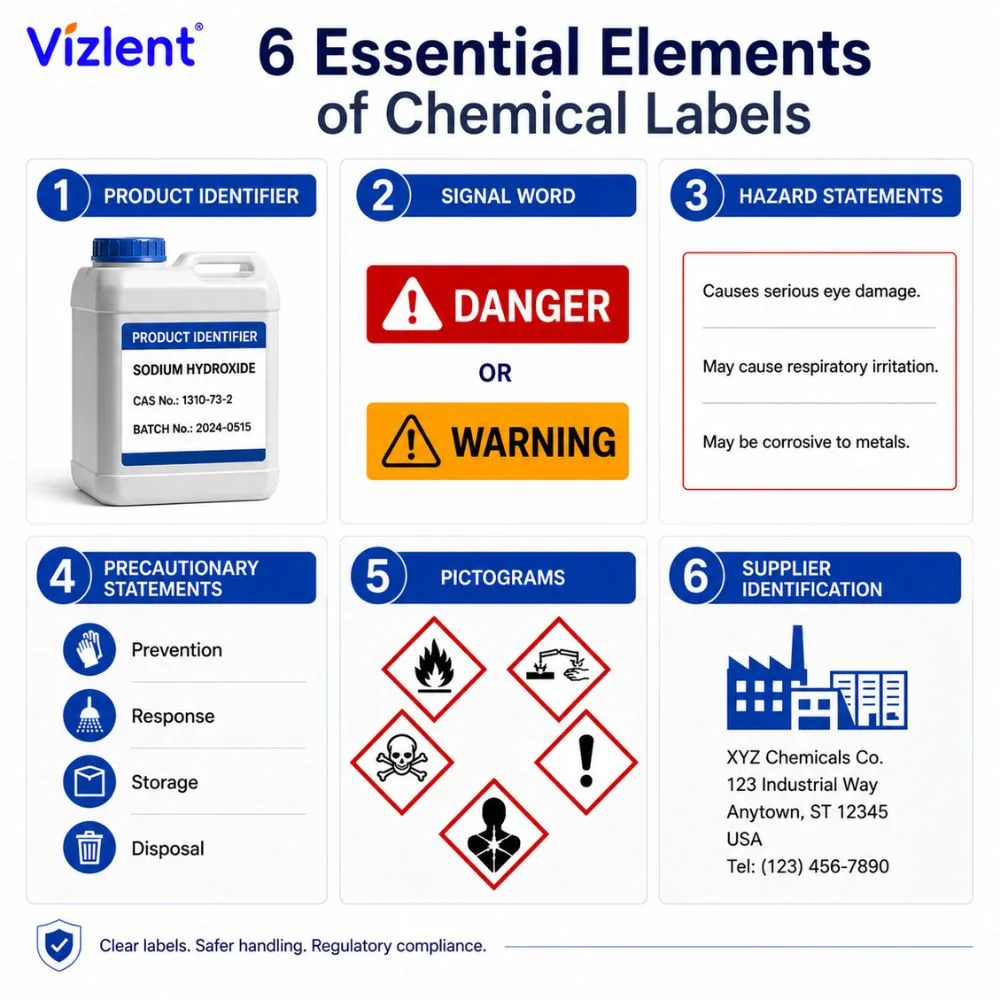
Chemical labels must include all six GHS elements on a shipped container, and each one answers a different question for the person holding the chemical. Anyone searching for what chemical labels must have the following list covers it completely. Miss one element and the container is misbranded, no matter how well the others are done.
- Product identifier: the chemical name, code, or batch number that matches the safety data sheet exactly.
- Signal word: either Danger for severe hazards or Warning for less severe ones, never both.
- Hazard statements: standardized phrases describing the nature and degree of each hazard, such as causing serious eye damage.
- Precautionary statements: the prevention, response, storage, and disposal measures that reduce exposure.
- Pictograms: the red diamond symbols that flag hazard classes at a glance.
- Supplier identification: the name, address, and telephone number of the manufacturer, importer, or responsible party.
The elements work as a set, not a menu. The signal word calibrates the severity, the statements give it words, the pictograms give it speed, and the identifier ties everything back to the safety data sheet. A worker who has never seen the chemical before should grasp the danger in seconds.
Pictograms and Signal Words: Reading the Label Fast
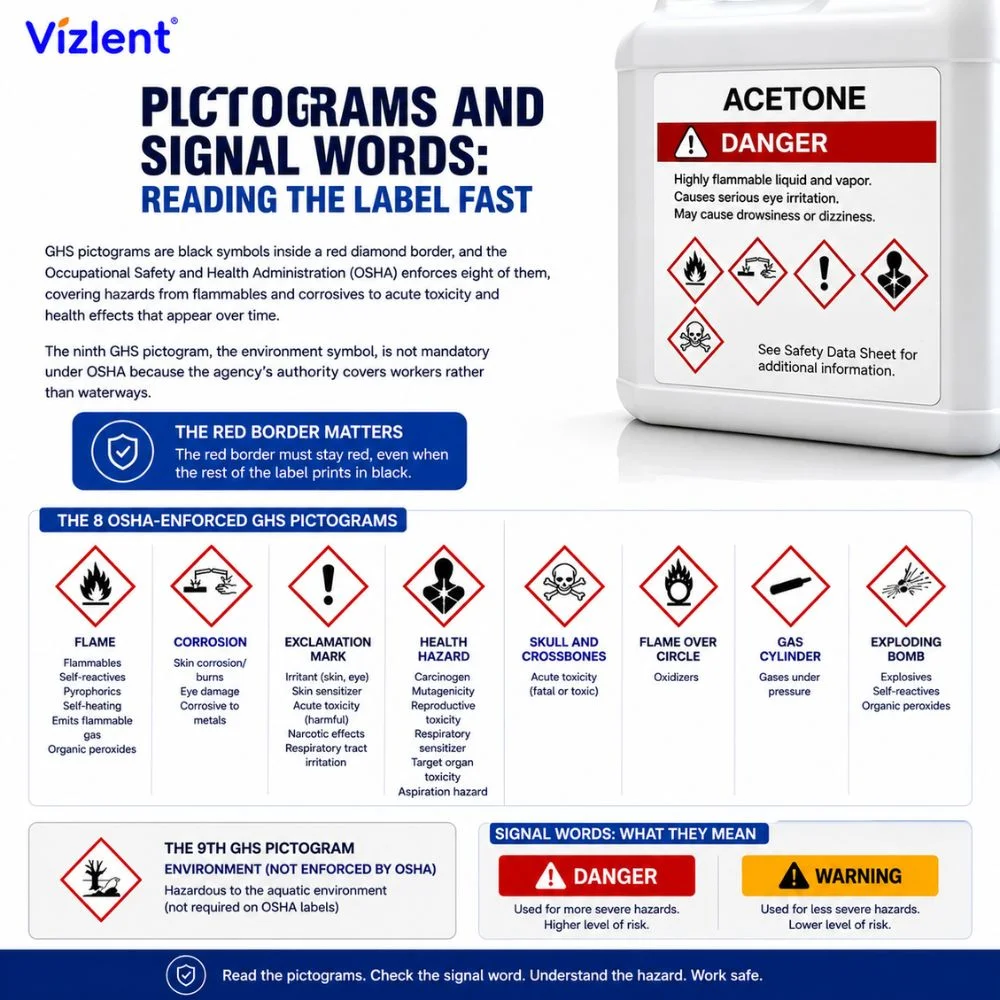
GHS pictograms are black symbols inside a red diamond border, and the Occupational Safety and Health Administration (OSHA) enforces eight of them, covering hazards from flammables and corrosives to acute toxicity and health effects that appear over time. The ninth GHS pictogram, the environment symbol, is not mandatory under OSHA because the agency’s authority covers workers rather than waterways. The red border must stay red, even when the rest of the label prints in black.
Signal words do one job: rank severity. Danger marks the more serious categories within a hazard class and Warning marks the lesser ones, and a label never carries both. That single word is often the fastest piece of hazard communication on the container, which is why print durability on it matters as much as the wording.
The Quiz Questions, Answered
Safety training generates a family of search phrases, and they deserve straight answers. Asking chemical labels must have which of the following items points back to the six elements above, no more and no less. And chemical labels will provide you with what type of information about a chemical has a clean answer too: the chemical’s identity, the nature and severity of its hazards, the precautions that reduce risk, and who to contact about it.
The trick questions run the other way. Quizzes phrased as chemical labels must contain all of the following information, except that chemical labels should include all of the following, except those items that the Global Harmonize System (GHS) does not require on the label: the chemical formula, the CAS number, the price, the fill date, and the safety data sheet itself. Those live in other documents. The label carries the warning, and the Safety Data Sheet (SDS) carries the depth.
Labeling Workplace Bottles and Secondary Containers
Rules loosen once a chemical is decanted inside a workplace, but they do not disappear. Chemical labels for bottles filled from a bulk drum must identify the product and convey its hazards, either by reproducing the shipped label or through an alternative system of words, pictures, and symbols that the workforce is trained on. The one true exemption is narrow: a portable container needs no label only when the person who filled it uses it up within their own shift.
Chemical labels for spray bottles are where most violations hide, because a trigger bottle of diluted degreaser feels too ordinary to regulate. It is not. Any spray bottle holding a hazardous chemical beyond immediate use needs its identity and hazard warning on it, and the label has to survive the very chemical it names, plus the overspray, drips, and constant gripping that wear print away.
The Durability Requirement: The Label Must Outlive the Chemical

OSHA requires labels to remain legible and attached, and that single sentence drives the entire materials specification. A drum of solvent attacks its own label through filling splatter and sweating, outdoor tank farm storage adds months of UV, and forklifts add abrasion, which is why petrochemical and drum label stock is built from solvent-resistant polyester faces rather than paper. For drums shipped by sea, BS5609 certification adds a salt-water immersion benchmark that many buyers treat as the floor.
The container material fights back, too. HDPE drums sit at a surface energy of roughly 31 to 35 millinewtons per meter, low enough that standard permanent acrylics manage weak peel strength and let go under chemical contact, so the construction needs an adhesive rated for low-energy surfaces. Large-format GHS labels, commonly 100 by 100 millimeters or more, must also conform to drum curvature without flagging at the corners. Compliance on paper means nothing if the diamond peels off in the yard.
Labeling drums, totes, or solvent containers? Request free chemical-resistant label samples from Vizlent and test them against your actual products.
Beyond OSHA: Transport and Certification Marks
GHS covers the hazard warning, but a chemical container in transit picks up further marking obligations. DOT hazmat labels follow their own diamond designs with defined color tolerances for road, rail, and air shipments, and they sit on the package alongside the GHS label rather than replacing it. International sea and air moves add the IMDG and IATA frameworks, which align with GHS in structure but enforce their own placarding details.
UN-rated packaging carries its own permanent certification marks proving the drum or tote passed performance testing. Those marks must stay legible for the packaging’s entire service life, which for a reconditioned drum can span years and many fill cycles, a tougher durability bar than a single-trip GHS label faces. Plan the GHS label, the transport marks, and the UN certification as three separate items that all have to survive together.
Choosing Adhesive Label Materials for Chemicals
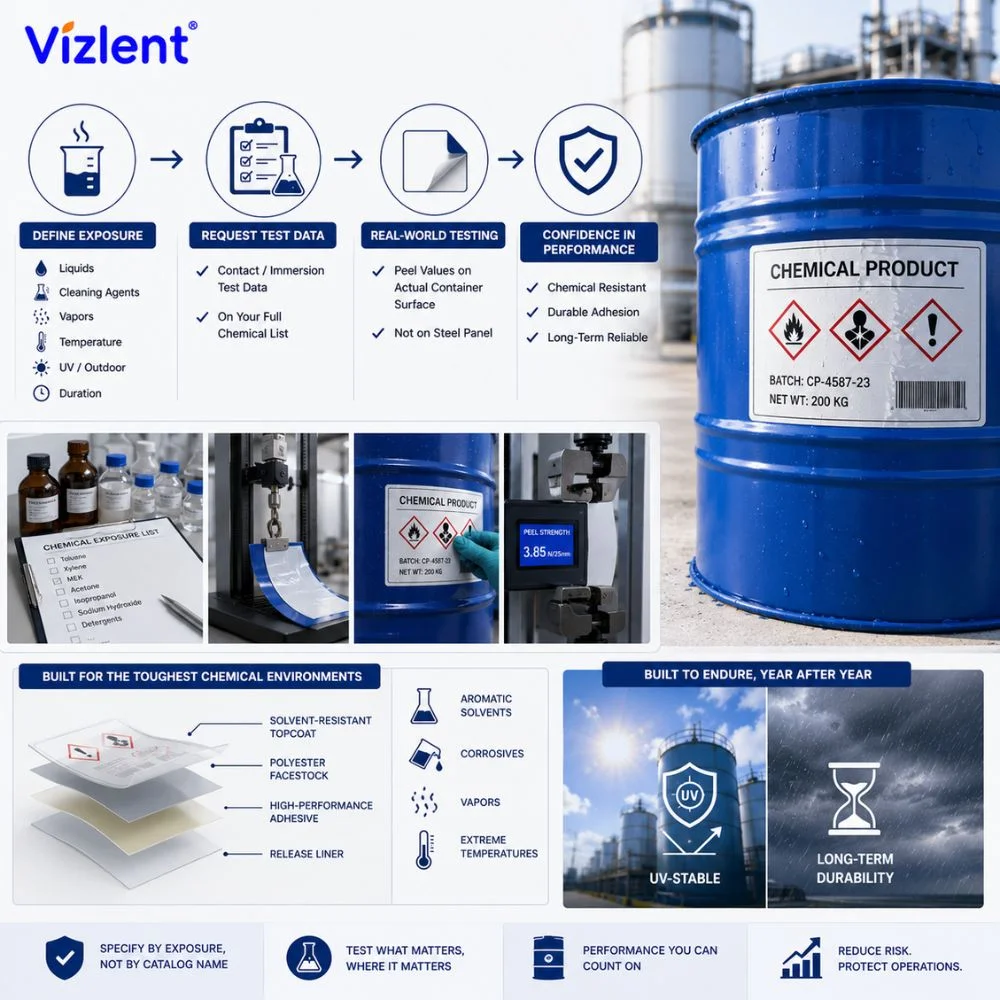
Buyers sourcing adhesive labels for chemicals in bulk should specify by exposure, not by catalog name. List every substance the label surface may meet, including cleaning agents and vapor, then ask the supplier for contact or immersion test data on that list, with peel values measured on the actual container surface rather than a steel panel. A polyester facestock with a solvent-resistant topcoat handles the broadest range of aromatic solvents, and UV-stable construction covers outdoor storage measured in years.
Adjacent industries inherit the same logic. Adhesive labels for chemicals and drugs must add the documentation and traceability that pharmaceutical labeling demands, while adhesive labels for chemicals and VOCs face solvent vapor that softens ordinary adhesives even without direct splash. The print method completes the system, since resin thermal transfer cures an image that survives the wipe-downs that erase lesser print.
Not sure which construction matches your chemical list? Send your exposure profile to a Vizlent engineer and get a matched specification with test data.
Source Compliant Chemical Label Materials From Vizlent
The requirements for chemical labels are split into two halves that only work together. The content half is fixed by regulation: six elements, red-bordered pictograms, one signal word, and workplace labeling for every bottle that outlives a shift. The durability half is fixed by physics: the label must resist the chemicals it names, the container it grips, and the weather it stores under, for the whole life of the hazard.
Vizlent manufactures chemical-grade label stock at its Shenzhen facility, pairing solvent-resistant polyester and vinyl faces with adhesives rated for HDPE, steel, and low-energy plastics, validated through peel, immersion, and weathering testing. As a direct manufacturer since 2011 with ISO 9001, FSC, and SGS certification, we customize facestock, adhesive, and format, supply jumbo rolls, slit rolls, and die-cut sheets, and back every order with free samples and a Technical Data Sheet. Reach out today and put GHS labels on your containers that stay compliant from the filling line to final disposal.
Contact Vizlent for a quote and free samples, and source chemical label materials built to hold their warning.
Frequently Asked Questions
What are the six required elements on a chemical label?
Every shipped container of hazardous chemicals must carry a product identifier, a signal word, hazard statements, precautionary statements, the applicable red-bordered pictograms, and the supplier’s name, address, and telephone number. The elements come from OSHA’s Hazard Communication Standard, which aligns with the UN’s GHS framework used worldwide.
Chemical labels will provide you with what type of information about a chemical?
A compliant label tells you four things: what the chemical is, what kind of hazard it presents and how severe that hazard is, what precautions reduce the risk, and who supplied it. Deeper detail, such as composition, first aid, and handling procedures, lives in the safety data sheet the label points to.
Do spray bottles need chemical labels?
Yes, with one narrow exception. A workplace spray bottle holding a hazardous chemical must carry the product identity and hazard information unless the person who filled it uses the contents within their own work shift. Diluted cleaning chemicals count, which makes unlabeled trigger bottles one of the most common hazard communication violations.
What is not required on a chemical label?
GHS does not require the chemical formula, the CAS number, the price, the fill or manufacture date, or an attached safety data sheet on the label itself. Quiz questions ending in except are usually pointing at one of these. The label is the warning layer, and the SDS carries the technical depth.
What is BS5609 and when does it apply?
BS5609 is a British standard for pressure-sensitive labels on drums shipped by sea, testing that the adhesive and printed image survive three months of salt-water immersion. It is required for the marine transport of dangerous goods in many supply chains and is treated as a durability benchmark for chemical drum labels generally.
Are workplace container labels different from shipped container labels?
Yes. Shipped containers need the full six-element GHS label, while workplace containers can use either that label or an alternative system of words, pictures, and symbols, as long as workers are trained on it and the chemical’s identity and hazards stay clear. The shipped label may never be removed or defaced while the chemical remains.
What label material resists solvents best?
Polyester facestock with a solvent-resistant topcoat outperforms vinyl and paper against aromatic solvents such as xylene and toluene, paired with an adhesive rated for the container surface. On HDPE drums that adhesive must be formulated for low-energy plastics, and resin thermal transfer print resists the smearing that solvent contact causes.






