
Durable pipe labels and identification help communicate what a pipe carries, how hazardous its contents may be, and which direction the material flows. They use a combination of colors, text, symbols, and placement conventions to make piping systems easier to understand and safer to operate. While specific requirements vary by country, industry, and facility, the goal remains the same: provide clear, consistent identification that helps workers quickly recognize pipe contents and associated hazards.
This guide explains the fundamentals of pipe labeling, including common color-coding practices, sizing and placement considerations, specialized labeling systems, and the materials used to ensure long-term durability. Understanding these principles makes piping networks easier to navigate, improves workplace safety, and reduces the risk of errors when operating, maintaining, or servicing equipment.
Why Durable Pipe Labels and Identification Matter
A facility ceiling can carry dozens of pipes running in every direction, and nothing about bare steel says what is inside. Labeled pipes tell maintenance crews what they are about to cut into, tell operators which line feeds which process, and tell everyone which way the contents flow. Unlabeled pipes turn every one of those moments into a guess.
Emergencies raise the stakes further. A responder hunting for the fire suppression line, or deciding how dangerous a leaking pipe is, needs the answer on the pipe itself in letters readable from the floor. Clear identification cuts response time exactly when seconds matter, which is why insurers and auditors look up before they look anywhere else.
Pipe Labeling Standards Around the World
Several standards govern pipe identification across different regions. ANSI/ASME A13.1 is widely used in the United States, while other countries and industries may follow their own requirements for colors, legends, symbols, and marker placement. Although the details vary, the objective remains the same: provide a clear and consistent way to identify pipe contents, hazards, and flow direction.
For manufacturers and facility operators, compliance starts with understanding the applicable local standard. For label suppliers, the focus is on providing durable materials and adhesives that can be converted into pipe markers that meet the performance requirements of the intended application, whether the labels are used in North America, Europe, Asia, or elsewhere.
Durable Pipe Labels and Identification: Pipe Color Codes at a Glance
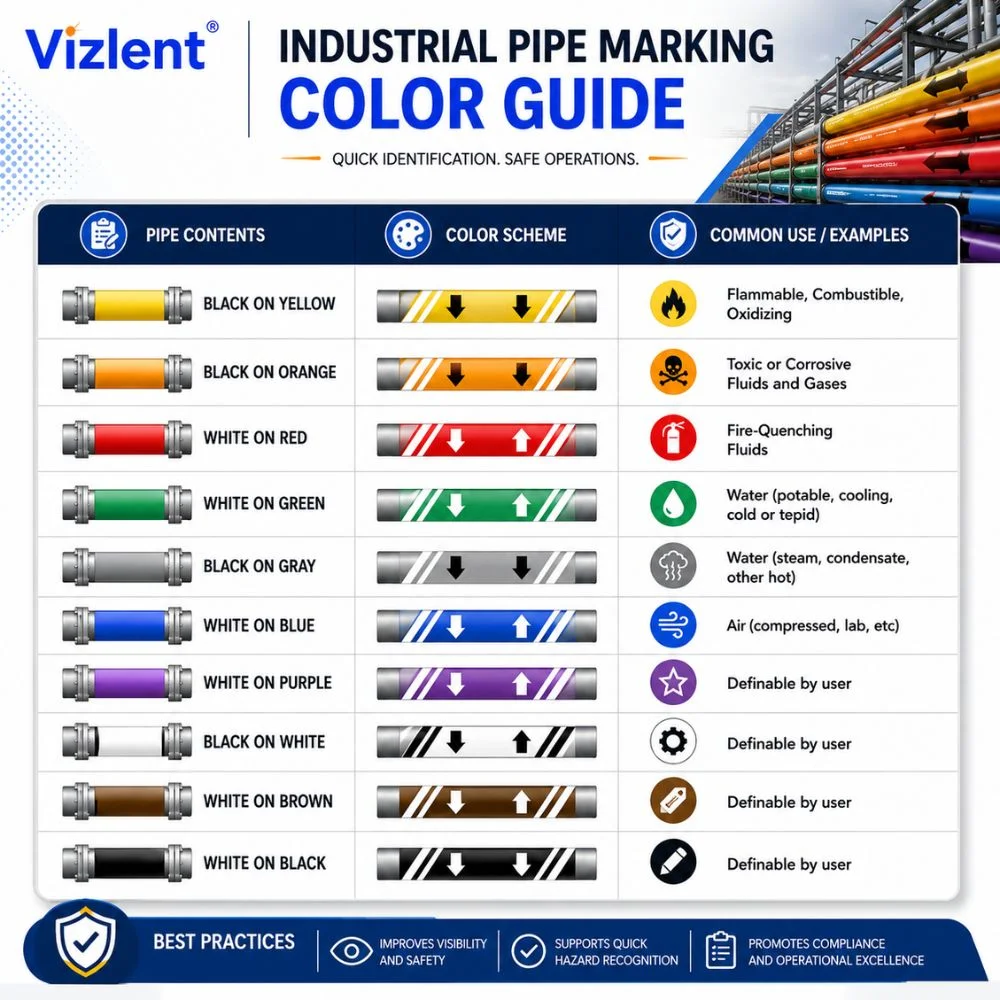
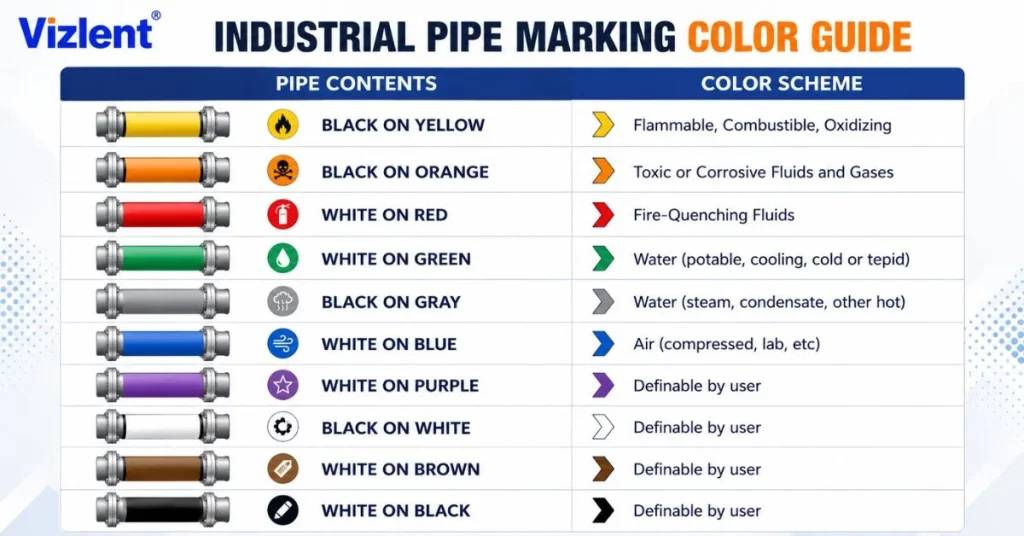
Color is the fast layer of the system, readable before the text is. A13.1 defines six color and text combinations for the major hazard families, and the answer to which color a pipe needs starts with what the contents would do if they escaped. Each pairing puts the legend in high contrast, so the label works at a distance.
- Yellow with black text: flammable, combustible, and oxidizing fluids, the highest-attention category in the scheme.
- Orange with black text: toxic and corrosive fluids that threaten anyone the contents touch.
- Red with white text: fire-quenching fluids such as sprinkler and suppression water.
- Green with white text: water in its non-firefighting roles, including potable, cooling, process, and boiler feed.
- Blue with white text: compressed air and other low-hazard gases.
- User-defined combinations: purple, brown, gray, white, and black pairings are reserved for site-specific services that a facility defines and documents itself.
The user-defined colors are not a loophole; they are an obligation. A site that assigns brown to thermal oil must define that meaning in its written program and train on it, because a color only protects people who know what it says. Consistency across the whole facility is the entire point.
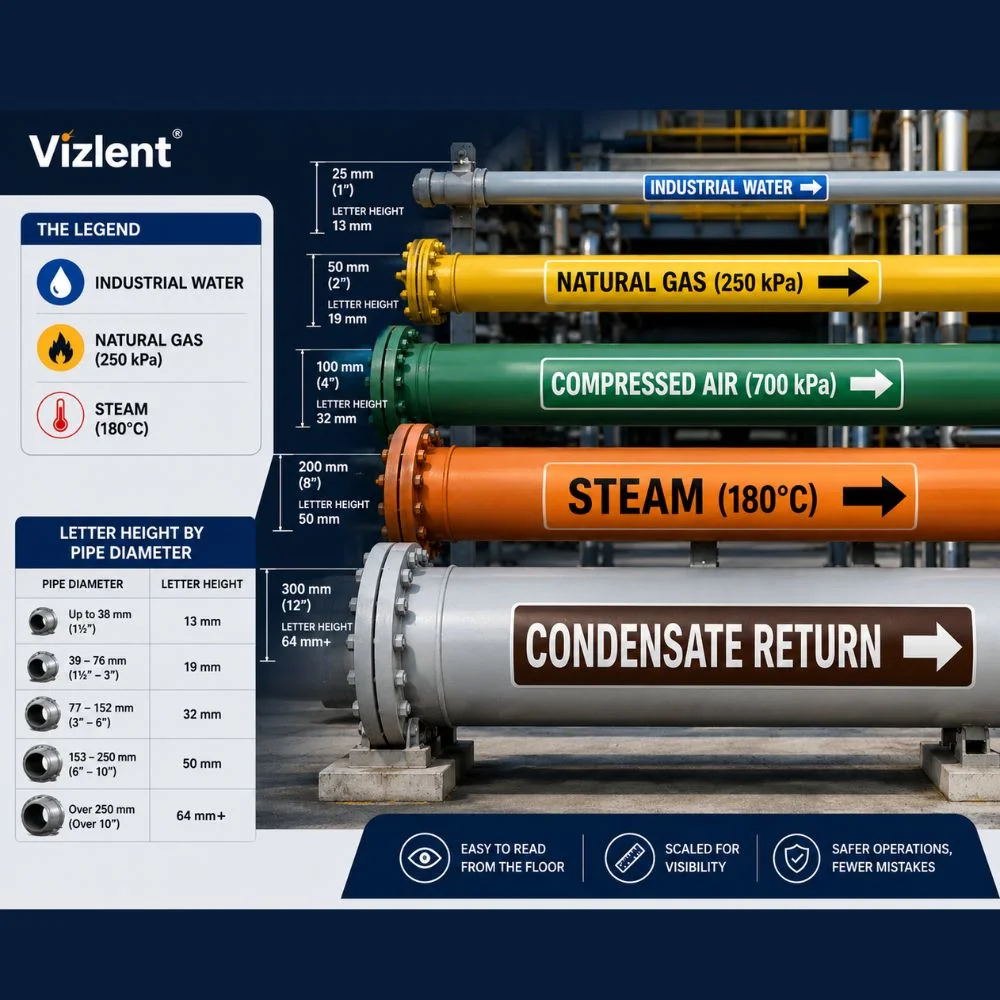
The legend is the text itself, and it should name the contents in plain words, such as INDUSTRIAL WATER or NATURAL GAS, with pressure or temperature added where that changes the hazard. A13.1 scales letter height to pipe diameter so the label stays readable from the floor: small-bore lines take roughly 13 mm letters, mid-size runs step up through 19 and 32 mm, and large pipes over 250 mm in diameter call for 64 mm characters or taller. Bigger pipe, bigger letters, longer label.
Flow direction completes the marker. An arrow at one or both ends of the legend shows which way the contents move, which matters every time someone isolates a section or traces a line to its source. A label without an arrow answers what but not where, and where is half the question.
Where Pipe Labels Go
Placement rules exist so a worker never has to walk a line hunting for its identity. Markers belong adjacent to every valve and flange, at every change of direction, at branches, and on both sides of any wall, floor, or ceiling the pipe passes through. Straight runs get markers at regular intervals, with common practice falling between every 8 and 15 meters, roughly 25 to 50 feet.
Visibility decides the angle. Place the label where it faces the normal line of approach, which means the lower quarters of overhead pipes and the upper quarters of pipes below eye level, never the hidden top of a line near the ceiling. A perfectly compliant label installed where nobody can see it protects nobody.
Special Systems With Their Own Rules
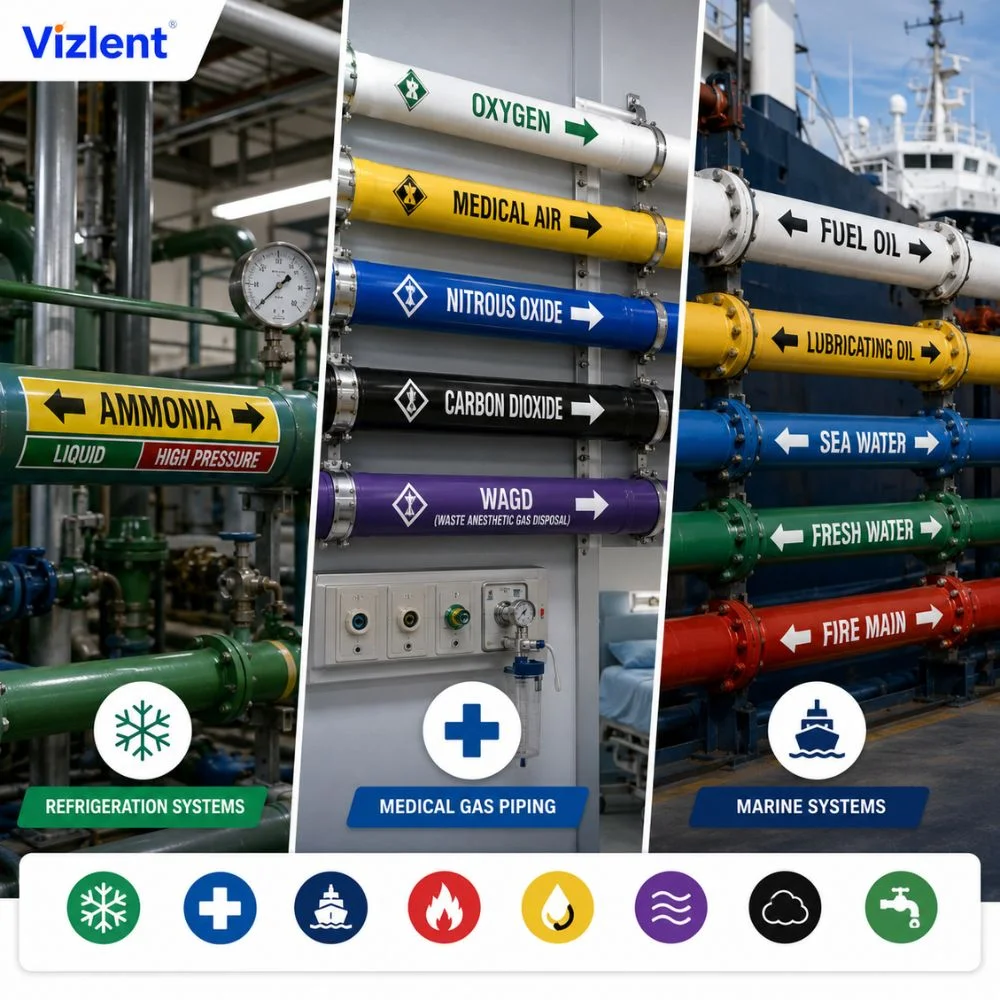
Some piping carries identification schemes beyond the general A13.1 colors. Ammonia refrigeration follows the IIAR marking system, which adds physical-state and pressure-level sections to the marker, and medical gas piping in healthcare facilities follows its own strict color and labeling requirements, where a mix-up is unthinkable. Marine installations carry their own conventions as well.
The lesson for a 101 reader is simple: identify the system before specifying the marker. A facility can hold general utility lines, an ammonia plant, and medical gas in one building, and each demands its own scheme applied correctly. The standards stack rather than substitute.
Choosing Pipe Marker Materials That Last
A pipe marker is a durable label doing hard service, so the material matters as much as the color. Plant conditions bring washdown, condensation, abrasion from passing equipment, and UV in outdoor pipe racks, which is why quality markers use weatherable vinyl with UV-stable inks rated for years of exposure. Vizlent’s INDUSTRIAL WATER roll form pipe marker, for example, prints the A13.1 green and white water scheme on self-adhesive vinyl rated from -30 to 80 degrees Celsius, with a typical outdoor life of 5 to 7 years.
Format is the practical decision. Roll-form markers cut to any length, so one roll covers every pipe diameter on a long run, while pre-cut markers suit small counts and snap-around carriers suit pipes too dirty or cold for adhesive. Hot lines near boilers and exhaust call for heat-resistant constructions, outdoor racks need UV-stable weatherproof stock, and the wider family of plant identification sits in Vizlent’s appliances and industrial labeling range.
Marking a full facility? Ask Vizlent about roll-form pipe markers across all A13.1 colors with custom legends and letter heights.
Three Ways to Source Pipe Markers
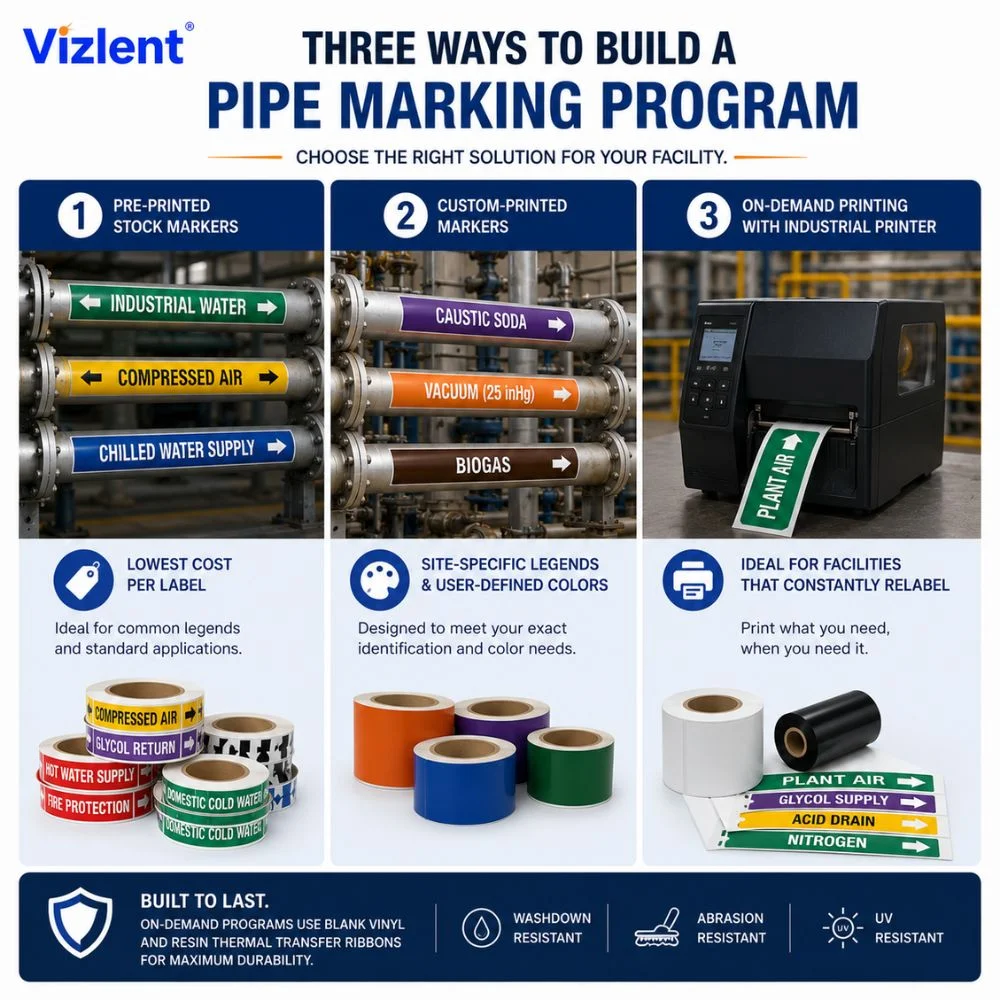
Facilities fill their marking programs through three routes, and scale usually picks the winner. Pre-printed stock markers cover common legends like INDUSTRIAL WATER or COMPRESSED AIR at the lowest cost per label, custom-printed markers handle site-specific legends and user-defined colors, and on-demand printing with an industrial label printer suits plants that constantly relabel. On-demand programs pair blank vinyl with resin thermal transfer ribbons so the printed legend resists the same washdown and abrasion the facestock does.
Most large facilities end up blending all three. Stock rolls carry the utility lines, custom orders cover the process-specific services, and the printer handles the changes that never stop coming. Whichever mix fits, hold every route to the same material standard, since a faded legend fails identically no matter how it was printed.
Installing and Auditing Pipe Labels
Installation quality decides how long the material rating actually holds. Wipe the pipe with isopropyl alcohol before application, since dust, oil film, and condensation block the adhesive from wetting out, and apply within the adhesive’s temperature window rather than onto a frosted or scalding line. Wrap roll-form markers with a slight overlap so the ends seal against washdown.
Then treat identification as a living system, not a one-time project. Audit the facility on a regular cycle, replacing faded, damaged, or outdated markers and adding labels wherever lines were rerouted or new services installed. A marker that no longer matches the pipe contents is worse than no marker at all.
Starting a labeling audit? Request free pipe marker samples from Vizlent and test adhesion on your actual pipe surfaces first.
Pipe Labels and Identification: The Terms and What They Mean
The vocabulary around this topic shifts depending on who is searching, but it all points at the same system. Pipe labels and identification markings, pipe labels and identification stickers, and labels for piping identification all describe the adhesive markers this guide covers, while pipe labels and identification codes usually signify the A13.1 color combinations themselves. Pipe labels and identification standards point back to A13.1 and the special-system schemes layered on top of it.
Trade-specific phrasings follow the same pattern. Identification labels for plumbing covers the same green, blue, and red markers applied to building water, air, and fire lines, pipe labeling requirements bundle the content, size, and placement rules into one phrase, and labels for piping identification and placement simply name the two halves of the job, what the marker says and where it goes. Use any term you like when specifying, as long as the marker underneath meets the standard.
Source Pipe Markers and Identification Labels From Vizlent
Pipe labels and identification come down to four rules working together: color the marker by hazard, write the legend in plain words at the letter height the diameter demands, place it where people actually look, and build it from material that outlives the conditions. A13.1 supplies the system. The facility supplies the discipline to apply it everywhere, every time.
Vizlent manufactures pipe markers and industrial identification labels at its Shenzhen facility, printing A13.1 color schemes on weatherable vinyl with UV-stable inks, permanent acrylic adhesives for painted steel, stainless, and insulated jacketing, and letter heights from 13 to 64 mm plus custom sizes. As a direct manufacturer since 2011 with ISO 9001, FSC, and SGS certification, we supply roll-form and pre-cut formats from a 10-roll minimum in 7 to 12 working days, with free stock samples before you commit. Reach out today and put identification on your lines that stays legible for the life of the plant.
Contact Vizlent for a quote and free samples and source pipe markers built for plant conditions.
Frequently Asked Questions
What is pipe identification marking?
Pipe identification marking is the system of labeling pipes with their contents, hazard color, and flow direction so anyone in the facility can read a line at a glance. Under ANSI/ASME A13.1 it combines a plain-language legend, a hazard-based color code, letter heights scaled to pipe diameter, and placement at valves, direction changes, and regular intervals.
What standard covers pipe labels and identification?
ANSI/ASME A13.1 is the consensus standard for pipe marking in the United States, last updated in 2020. It defines the color codes by hazard type, the legend text, letter heights scaled to pipe diameter, flow arrows, and placement rules, and it incorporates the ANSI Z535.1 safety colors and GHS classification framework.
What color are water pipe labels?
Water in non-firefighting service, including potable, cooling, process, and boiler feed water, takes a green label with white text under A13.1. Water dedicated to fire suppression is the exception and carries a red label with white text, so the two never get confused at a connection point.
How often should labels appear on a straight pipe run?
Common practice places markers every 8 to 15 meters, roughly 25 to 50 feet, along straight runs. Markers also belong next to every valve and flange, at each change of direction, at branches, and on both sides of every wall, floor, or ceiling penetration so the line stays identifiable along its whole path.
What size should the pipe label text be?
Letter height scales with pipe diameter, so the legend reads from the floor. Small-bore pipes take letters around 13 mm tall, mid-range diameters step up through 19 and 32 mm, and pipes over roughly 250 mm call for characters of 64 mm or more, with the label length growing alongside.
Do pipe labels need flow direction arrows?
Yes, an arrow showing flow direction is a core element of the A13.1 marking format, placed at one or both ends of the legend. Direction matters whenever a line is isolated, drained, or traced to its source, and a marker without it leaves half the identification job undone.
Are pipe labels legally required?
A13.1 itself is a voluntary consensus standard, but OSHA requires workplace hazards to be communicated, and unmarked hazardous lines invite citations under broader rules. Auditors, insurers, and fire authorities treat A13.1 as the expected benchmark, and specific systems such as ammonia refrigeration and medical gas carry marking requirements of their own.
What material works best for pipe markers?
Weatherable self-adhesive vinyl with UV-stable inks is the standard construction, typically lasting 5 to 7 years outdoors and longer indoors. Match the adhesive to the surface, use heat-resistant stock near boilers and exhaust, and wipe pipes with isopropyl alcohol before application so the bond reaches full strength.






