
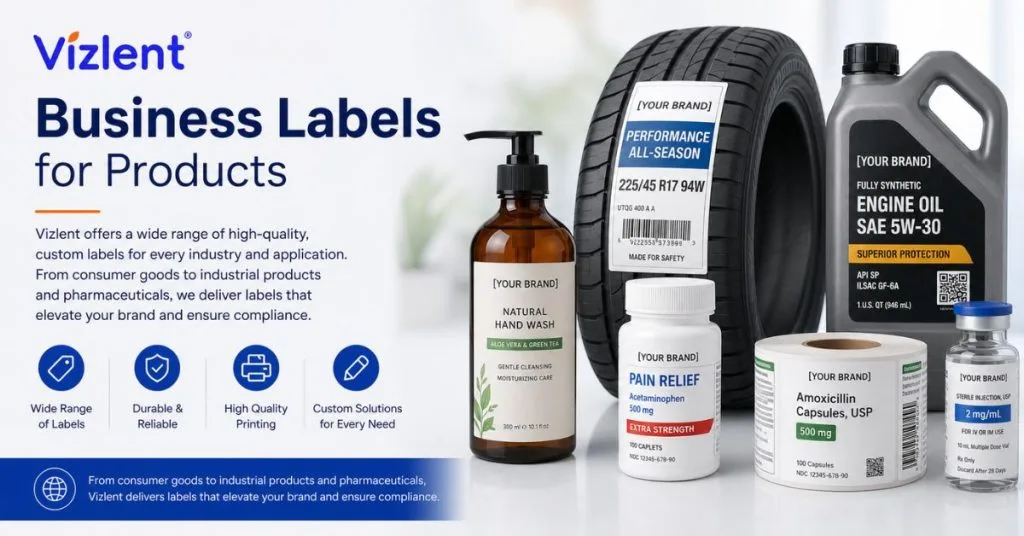
To create business labels for products, follow eight steps: design the layout around the actual container, check the surface, choose the facestock, match the adhesive to the package, size and shape, pick the print method, confirm compliance, and apply with validated samples first. Each step constrains the next, which is why a label specified in this order survives where a label chosen by looks alone fails. Get the sequence right, and the result stays flat, stuck, and legible from the packing line to the customer’s hands.
Business labels for products do two jobs at once: they identify the item for commerce and sell it at a glance. Most label failures, the lifted corners, fridge curl, and smudged batch codes trace back to one early decision made wrong. The sections below explain every decision and the reasoning behind it, so the finished label is specified rather than guessed.
1. Design: Create a Layout for Business Labels for Products
Product label design starts with the physical label, not the screen, because artwork built for a monitor fails quietly on a press. Add 2 to 3 mm of bleed past the die line, keep text and logos inside a safe zone of similar depth, and supply logos as vector art so curves stay sharp at any size. Work in CMYK (Cyan, Magenta, Yellow, and Key (Black), since on-screen RGB colors shift when printed.
Then reserve space for the content regulators and scanners’ demand. Food and cosmetic products need ingredient statements, net quantity, and business details at legible sizes, barcodes need their minimum dimensions and a clear quiet zone, and small containers punish overcrowded layouts fastest. Leaving a blank panel for batch codes lets you overprint dates in-house without reprinting the brand label.
2. Check the Product Surface to Create Business Labels for Products
The surface of business labels for products decides more than any other factor, and they are not all equal. Glass and PET bond readily because they are high-energy surfaces, cardboard accepts almost anything but can tear before the adhesive releases, and powder-coated metal sits somewhere in between. The friendly surfaces give you the widest material choice.
Polypropylene and polyethylene packaging is the trap. Squeeze bottles, tubs, and many cosmetic containers are low-energy plastics where standard adhesives slowly let go, and a label that gripped at packing can lift at the edges weeks later. Identify the resin before anything else. It is printed in the recycling triangle on the base.
3. Choose the Label Material for Business Labels for Products
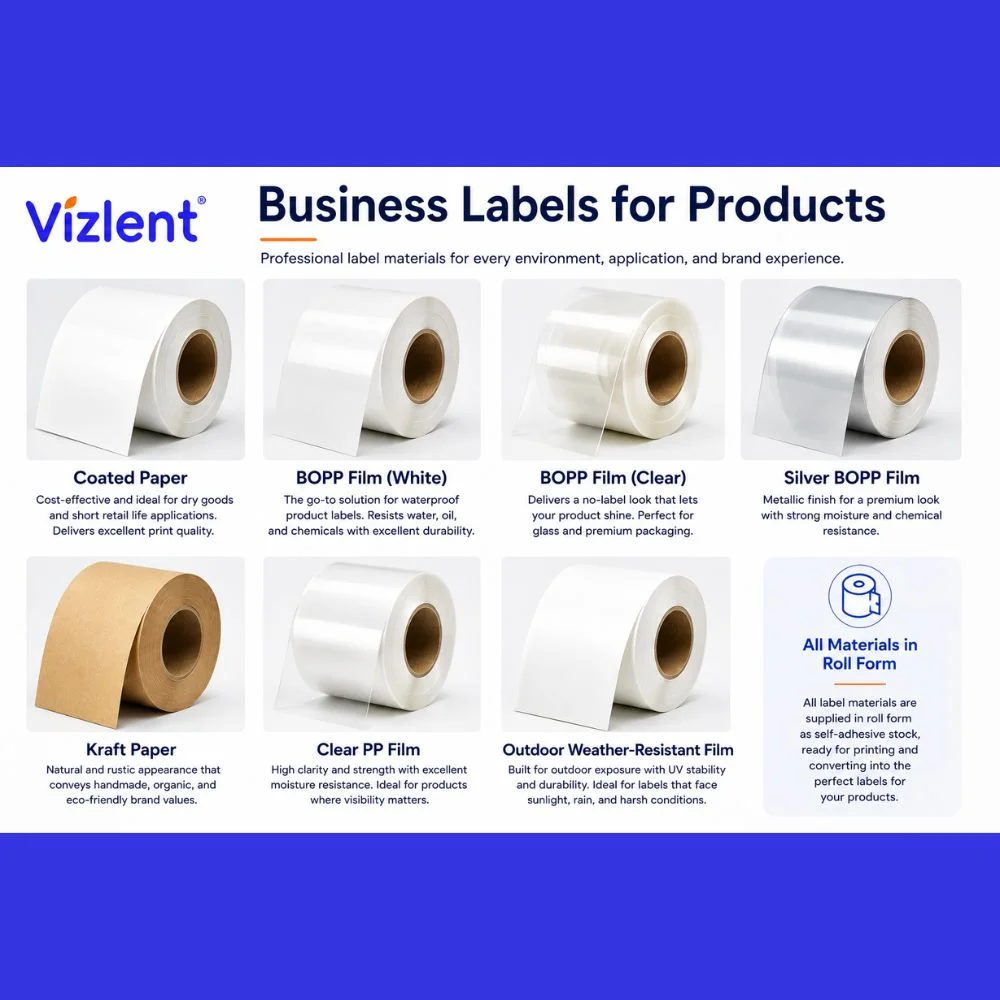
Facestock follows the product’s environment. Coated paper prints beautifully and costs the least, which suits dry goods and short retail lives, while film takes over the moment moisture, oil, or handling appear. BOPP film is the workhorse for waterproof product labels because it shrugs off water without the cost of polyester, and outdoor weather-resistant stock adds UV stability for products that live in sunlight.
Material also carries the brand. White film reads bold, clear film gives the no-label look premium brands favor on glass, and kraft paper signals handmade and natural. All of these begin as self-adhesive material in roll form, before a printer or converter turns it into finished labels.
Unsure between paper and film for your product? Request free sample sheets from Vizlent and test both on your actual packaging.
4. Match the Adhesive to the Job
Adhesive is where product labels quietly fail, because one glue does not cover every shelf. A permanent acrylic handles most ambient retail products, hot-fill jars need proven tack on warm glass, and anything refrigerated must hold through the condensation that forms on chilled packaging. Each condition is a different formulation, not a different promise.
Some products need the opposite of permanence. Returnable and reusable containers suit removable or wash-off grades that release without residue, and frozen goods call for low temperature label stock that keeps its grip where standard adhesives crystallize and quit. Specify the coldest and hottest moments of the product’s life, and let those two numbers pick the glue.
5. Size and Shape the Business Labels for Products for the Container
Containers are rarely flat, and label geometry has to respect that. Business labels for products that are too tall for a curved or tapered section, wrinkles, flags at the corners, and trap air bubbles that no applicator can chase out. Measure the straight panel of the container and design inside it.
- Wrap labels: a single label circling the container, efficient to apply but demanding a truly cylindrical panel.
- Front and back pairs: two smaller labels that tolerate curves and tapers better and leave packaging visible.
- Top, hang, and seal labels: lid labels, tags, and tamper seals that add branding and opening evidence in one piece.
Corner radius and die-cutting matter at scale too. Rounded corners resist edge lift far better than square ones on curved surfaces, and a clean die-cut with the right liner keeps an automatic applicator running without jams. These details cost nothing to specify and a production day to ignore.
6. Pick Printable Stock or Printed Labels of Business Labels for Products
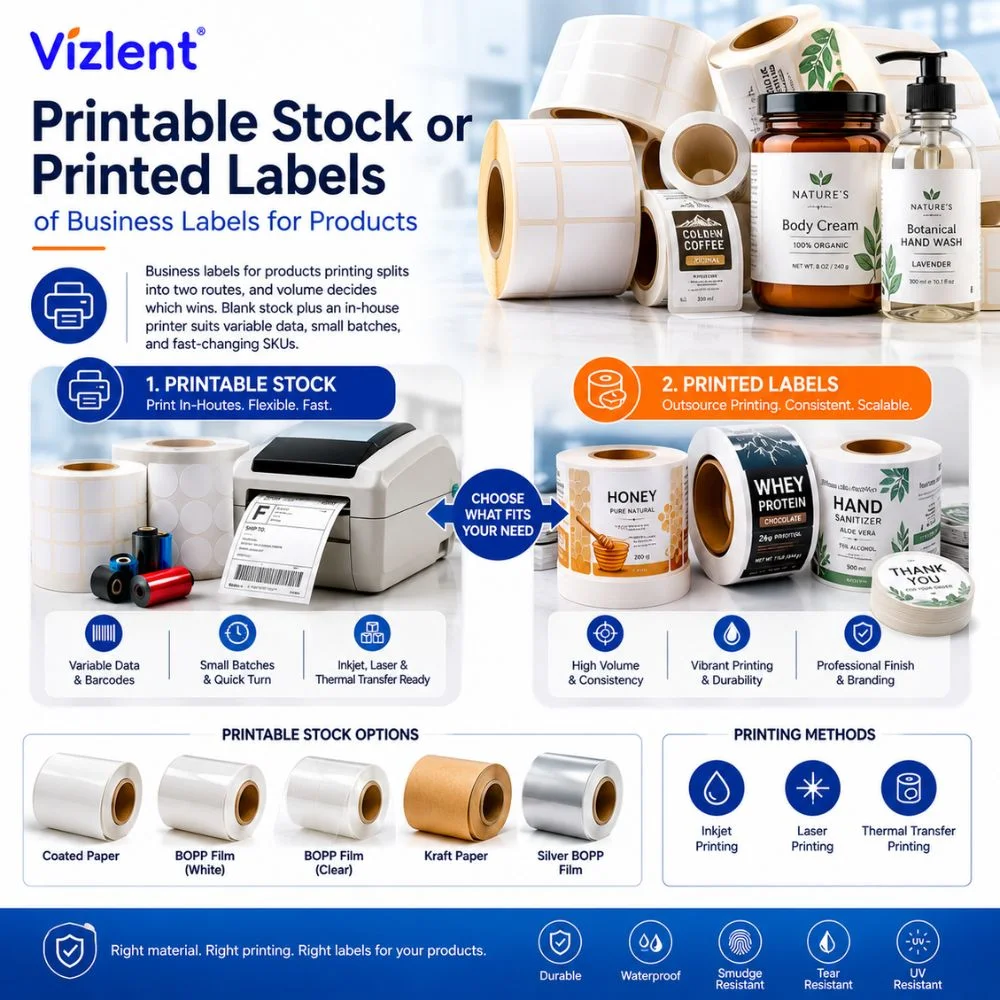
Business labels for products printing splits into two routes, and volume decides which wins. Blank stock plus an in-house printer suits variable data, small batches, and fast-changing SKUs, with inkjet label stock, laser printing labels, and thermal transfer each needing a facestock coated for that method.
Finished printing takes over at brand volume, where a converter delivers custom product labels in full color, die-cut to shape, on rolls ready for the applicator. Price the whole system rather than the unit, since a cheap blank that smudges or a coating mismatched to the printer costs more than it saves. Whichever route you take, the facestock coating and the print method must be specified together.
Printing in-house? Tell Vizlent your printer model and get stock coated and slit to match it.
7. Check Compliance and Finish of Your Business Labels for Products
Business product labels carry obligations that the artwork file never shows. Labels near food or cosmetics should be suitable for indirect contact so nothing migrates through the packaging, regulated categories add mandatory panels and warnings, and credible suppliers document compliance rather than assert it. Ask for the paperwork with the quote, not after the order.
Finish is the last design lever. Gloss laminate deepens color and wipes clean, matte reads premium and takes a handwritten date, and a varnish adds scuff resistance for products that travel. The right finish balances shelf appeal against the abuse the product will actually withstand.
8. Apply at Production Speed
Application is where good specifications prove themselves. Hand application works for market-stall volume, semi-automatic dispensers carry a growing brand to a few thousand units a week, and rotary or wrap-around applicators handle full production lines feeding from roll labels. Each step up demands more consistent rolls, tighter die-cut registration, and a liner that releases identically every time.
Condition the packaging as carefully as the labels. Surfaces should be clean, dry, and within the adhesive’s application temperature window, because labeling cold, sweating containers straight from a chiller is asking for lifted edges by morning. Hot-fill lines need the opposite check, an adhesive proven on warm packaging.
Who This Guide Is For: Businesses Buying Product Labels in Bulk
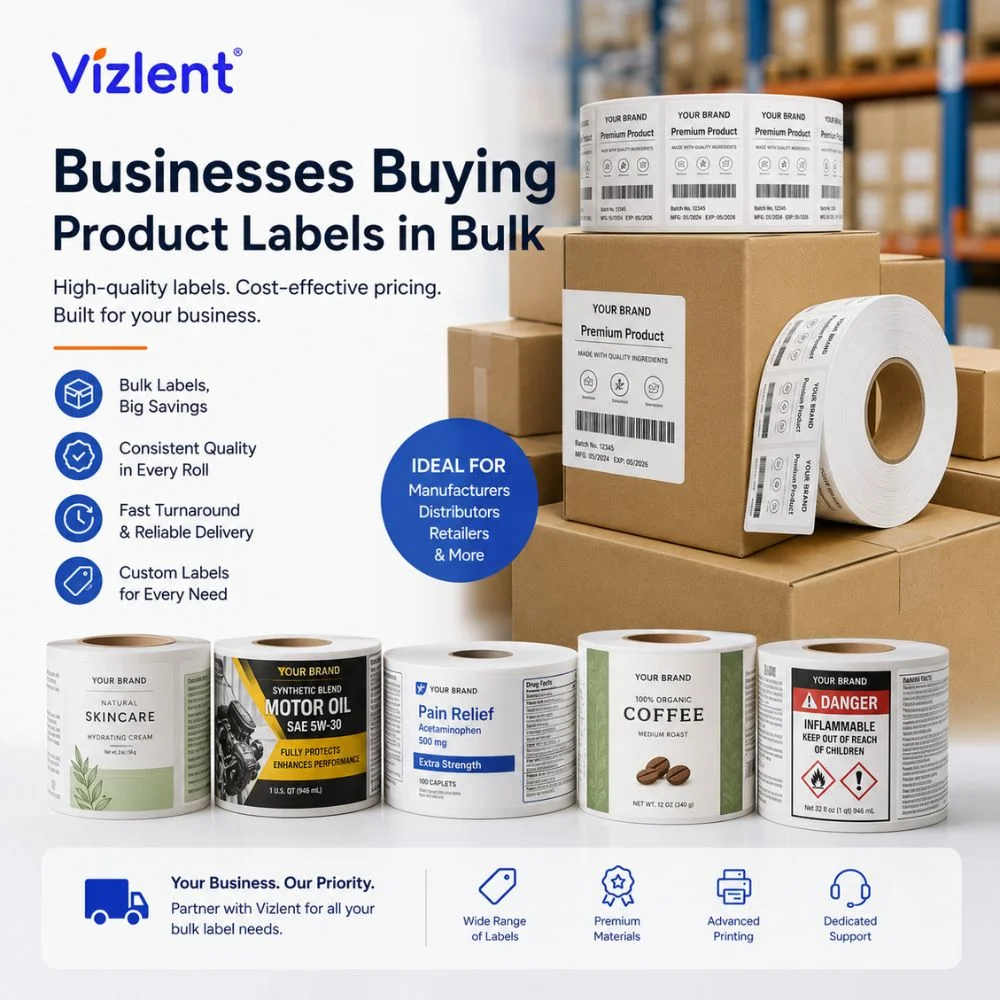
Everything above applies to a single unit, but the buyers this guide serves multiply it by thousands: food and beverage producers, cosmetics and candle brands, e-commerce sellers, co-packers, and the converters that supply them. Product labels for small business operations often start as printable sheets and personalized labels for business branding, then graduate to printed rolls as volume grows. At full scale, the question shifts from which label to which supply chain.
Brands order finished custom labels for business use from converters, while converters and high-volume operations buy label stock in jumbo or slit rolls and capture the printing margin themselves. Commercial details deserve the same scrutiny as the material: minimum order quantity, lead time, roll widths, and how far the supplier will customize the adhesive to your surfaces. For reference, a direct manufacturer like Vizlent slits from 30 mm to 1300 mm, runs custom orders in 7 to 15 days, and starts trial orders around a 1,000 square meter minimum with free samples first.
Pricing a bulk order? Get a factory-direct quote from Vizlent on jumbo rolls, slit rolls, or die-cut formats.
Source Your Business Labels for Products From Vizlent
Creating business labels for products is a sequence, not a single choice: design, surface, facestock, adhesive, geometry, print method, compliance, then validation on the real packaging in real conditions. Every failed product label traces back to a skipped step in that chain, usually an adhesive that never met the surface it was sold for. The sequence is also the specification sheet your supplier should be asking you about.
Vizlent manufactures self-adhesive label stock for product packaging at its Shenzhen facility, coating paper, BOPP (biaxially oriented polypropylene), PET, and vinyl faces with eight adhesive formulations spanning permanent, removable, freezer, and wash-off grades. As a direct manufacturer since 2011 with ISO 9001, FSC, and SGS certification, we slit to your width, coat for your print method, document food-contact suitability, and prove it all with free samples before you commit a container. Reach out today and put business labels on your products that stay exactly where you applied them.
Contact Vizlent for a bulk quote and free samples, and source product label materials built for your packaging.
Frequently Asked Questions
What are business labels for products?
Business labels for products are the printed self-adhesive labels a company applies to its goods, carrying the brand, product name, regulatory information, and barcodes. They are built from a facestock, an adhesive, and a release liner, and the construction is chosen to match the packaging surface and the conditions the product meets.
What is the best material for business product labels?
Coated paper offers the best print quality per dollar for dry goods, while BOPP film is the default for anything refrigerated, oily, or frequently handled. Waterproof product labels on film hold up where paper wrinkles, and clear BOPP gives the no-label look on glass. The product’s wettest, coldest moment picks the material.
How do small businesses usually start with product labels?
Most product labels for small business operations begin as printable sheets run through an office inkjet or laser printer, which suits low volume and frequent design changes. As orders grow, brands move to printed roll labels from a converter, then to bulk label stock once volume justifies in-house converting.
Is it better to print product labels in-house or buy them printed?
Volume and variability decide. In-house printing on blank coated stock suits variable data, short runs, and frequent SKU changes, while finished printed labels win at brand volume with full color and die-cut shapes ready for the applicator. Many operations run both printed brand labels plus in-house batch coding.
Why do product labels peel off in the fridge?
Condensation and cold are usually to blame together. Standard adhesives stiffen as the temperature falls and lose grip on the film of moisture that forms on chilled packaging. A cold-temperature or all-temperature adhesive paired with a moisture-resistant film facestock holds through refrigeration, where paper and general-purpose glue curl away.
What is the minimum order for bulk product label stock?
Minimums vary by supplier and material, with direct manufacturers typically quoting by area. Vizlent runs a general minimum of around 1,000 square meters, depending on the material, supports trial orders below full production volume, and ships custom slit rolls in 7 to 15 days, so a growing brand can scale in steps.
Can one label stock work across jars, bottles, and boxes?
Often, yes. A BOPP face with a general-purpose permanent acrylic covers most glass, PET, and cardboard packaging, which lets a line consolidate SKUs on one roll stock. The exceptions are low-energy plastics, frozen goods, and hot-fill lines, which each need their own adhesive grade validated separately.
How should product labels be tested before a bulk order?
Apply free samples to the actual packaging, filled and at real process temperatures, then run them through the conditions the product meets: refrigeration, washing, handling, and transport. Check edge lift, wrinkling, and print durability after at least a week. A label that survives the worst realistic case is ready for volume.






