
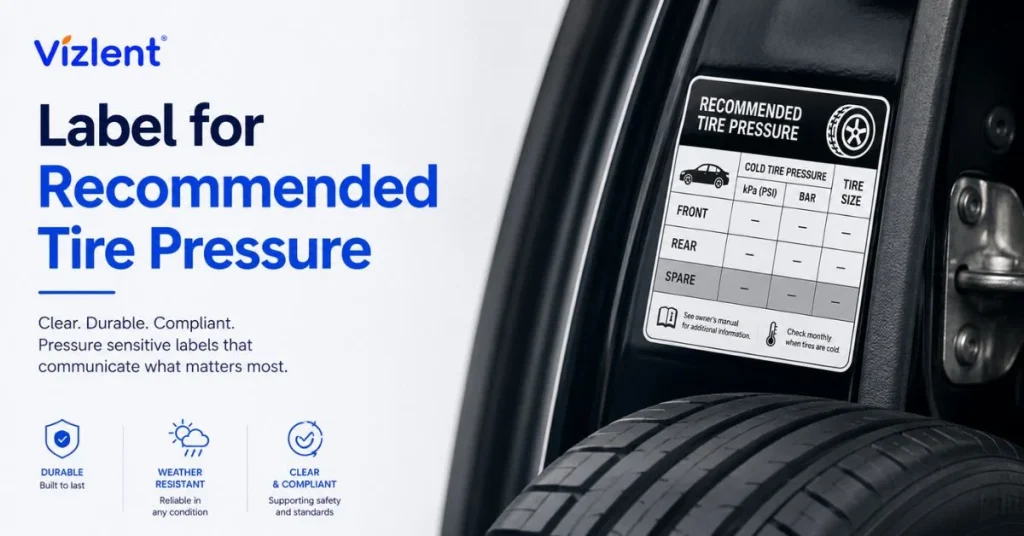
The label for recommended tire pressure sits on the driver’s side door jamb on nearly every modern vehicle, with the glove box door, fuel filler flap, and owner’s manual covering older models. Its figures are cold inflation pressures set by the vehicle maker, and they are the numbers a tire should actually run at. Every business in the tire chain works with this label daily, whether answering customer questions about it or producing it.
This guide is written for those businesses. Dealerships, tire retailers, fleet operators, upfitters, and tire plants all buy tire labels in bulk, from replacement placards to tread stickers to barcode labels that survive vulcanization. The sections below cover the placard knowledge your counter staff need and the material specifications your purchasing team needs.
Where Is the Tire Pressure Label on Most Vehicles?
Where is the tire pressure label is one of the most common questions service counters field, so the answer is worth standardizing across your staff. On almost any passenger vehicle built since the mid-2000s, it is the white or yellow Tire and Loading Information placard on the driver’s door jamb or B-pillar, placed there when US regulations standardized the location. Ten seconds with the door open finds it.
Older vehicles take a short hunt, which matters during fleet audits and pre-delivery inspections. Technicians checking incoming trade-ins or auction stock should know all the historical spots.
- Driver’s door jamb or B-pillar: the standard location on current vehicles, and always the first place to check.
- Glove box door or center console: common on models from the 1990s and early 2000s.
- Fuel filler door or trunk lid: used by some European and Asian manufacturers, occasionally alongside the door placard.
- Owner’s manual: always lists the recommended pressures, and serves as the reference when a placard is worn away.
What the Label Shows and Why Your Business Should Care
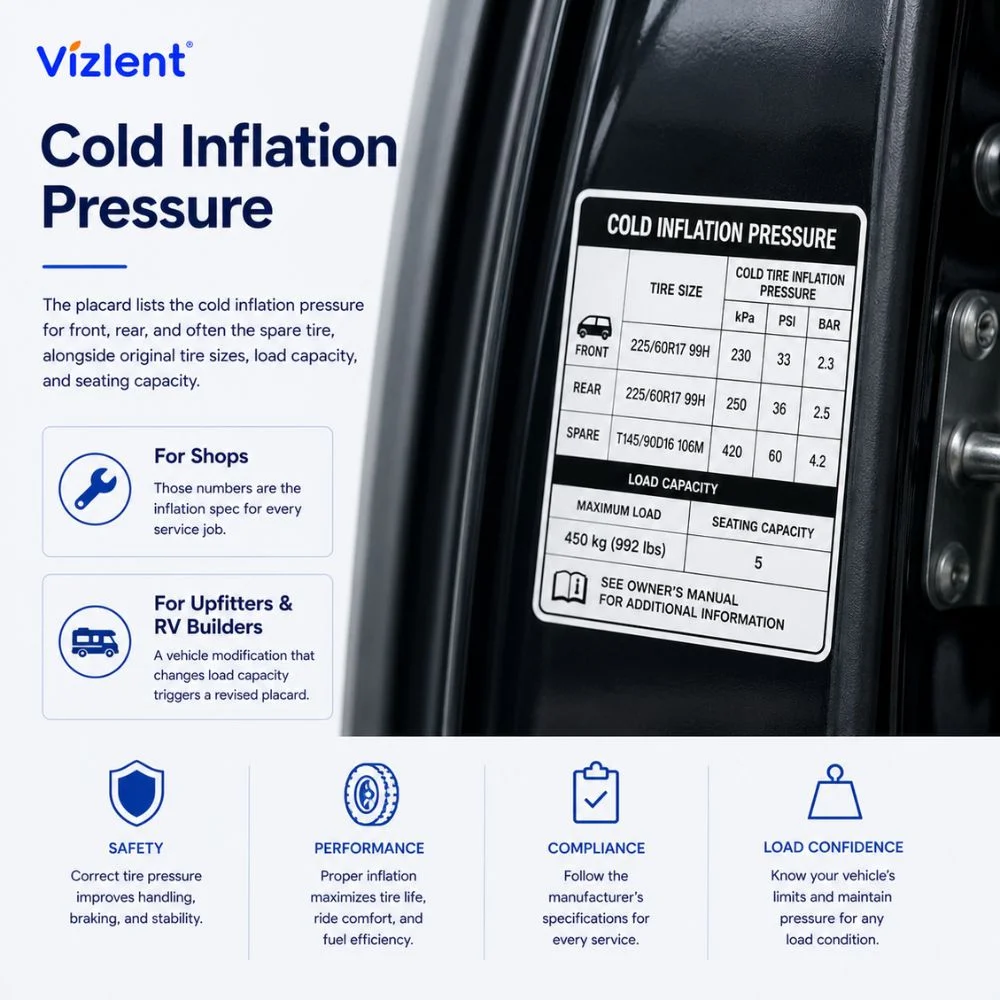
The placard lists the cold inflation pressure for front, rear, and often the spare tire, alongside original tire sizes, load capacity, and seating capacity. Front and rear values frequently differ. For shops, those numbers are the inflation spec for every service job, and for upfitters and RV builders, a vehicle modification that changes load capacity triggers a revised placard.
For anyone training staff on what is tire pressure label data based on, the answer is the vehicle, not the tire. Engineers set the pressures during development to balance handling, braking, wear, and fuel use for that model and load. Replacement tires in the placard size inherit the same numbers, which is why the door jamb spec survives every tire change your shop performs.
Are Tire Pressure Labels Cold Pressure Readings?
Yes, and your customers will keep asking. Are tire pressure labels cold pressure values is a daily counter question, and the answer is that every figure on the placard is a cold inflation pressure by definition. Cold means the tires hold no heat from driving, so the air inside sits at its resting pressure.
The practical rule your advisors can hand out: the vehicle has been parked about three hours or driven less than roughly one mile. A car that just arrived off the highway will gauge several psi high, so shops that set pressures on hot tires either compensate or recheck. Printing this rule on service hang tags is a cheap way to cut repeat complaints.
What Cold Actually Means on the Label
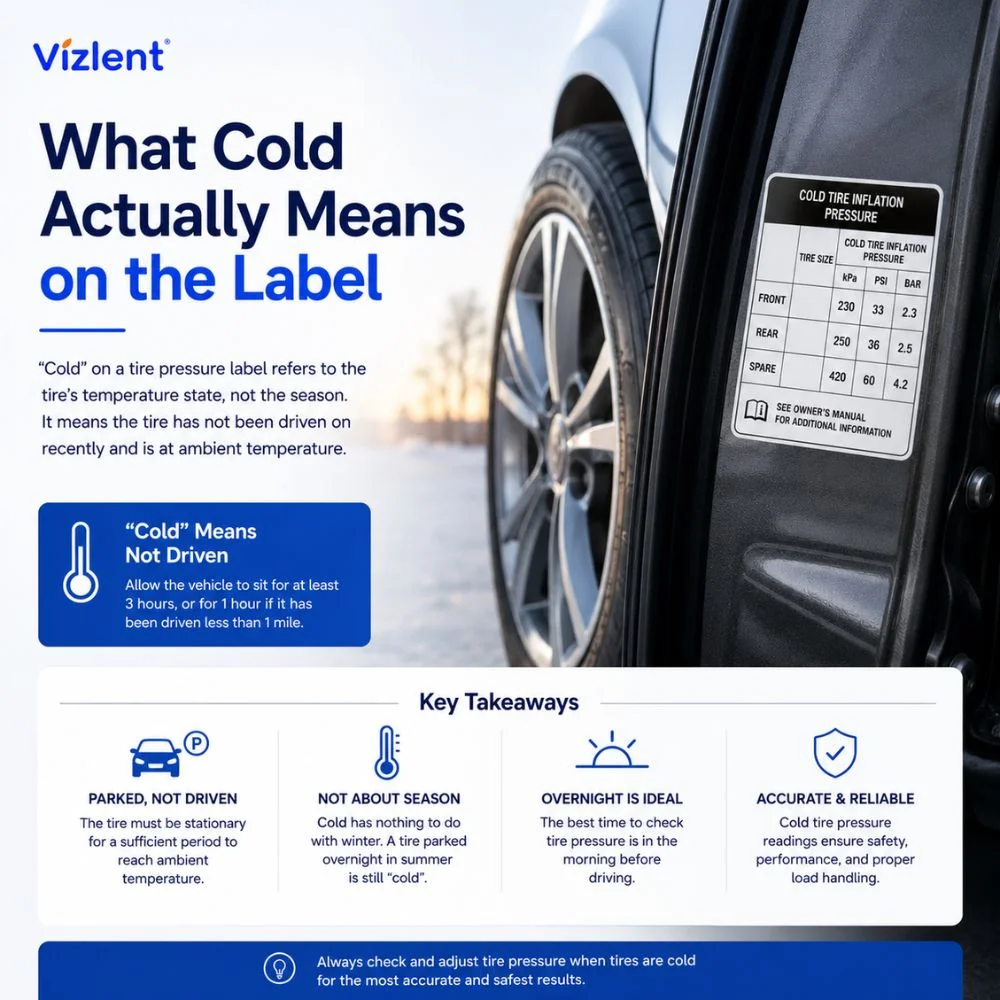
Customers also ask what is considered cold weather in tire pressure label terms, and the answer your staff should give is that the specification has nothing to do with winter. Cold refers to the tire’s temperature state, not the season. A tire parked overnight in summer gives a valid cold reading the next morning.
Weather enters through physics instead. Pressure drops roughly one psi for every ten degrees Fahrenheit the temperature falls, which is why TPMS lights flood service bays on the first frosty mornings of the year and why the dashboard warning typically waits until a tire sits about 25 percent under the placard. Seasonal pressure-check promotions turn that physics into traffic.
Placard Pressure vs the Sidewall Maximum
The sidewall also carries a pressure figure, and it causes more overinflated tires than any other number your technicians will meet. That sidewall value is the maximum the casing is rated to hold. It is a ceiling, not a target, and it can sit 10 to 20 psi above the placard.
The placard wins every time the two disagree, and a shop that inflates to the sidewall hands the customer a hard ride and early center-tread wear. Make the door jamb number the documented standard on every work order. It is the cheapest quality-control rule in the building.
Need placards, hang tags, or service labels printed in volume? Ask Vizlent about bulk automotive label stock matched to your print method.
Who Buys Tire Labels in Bulk
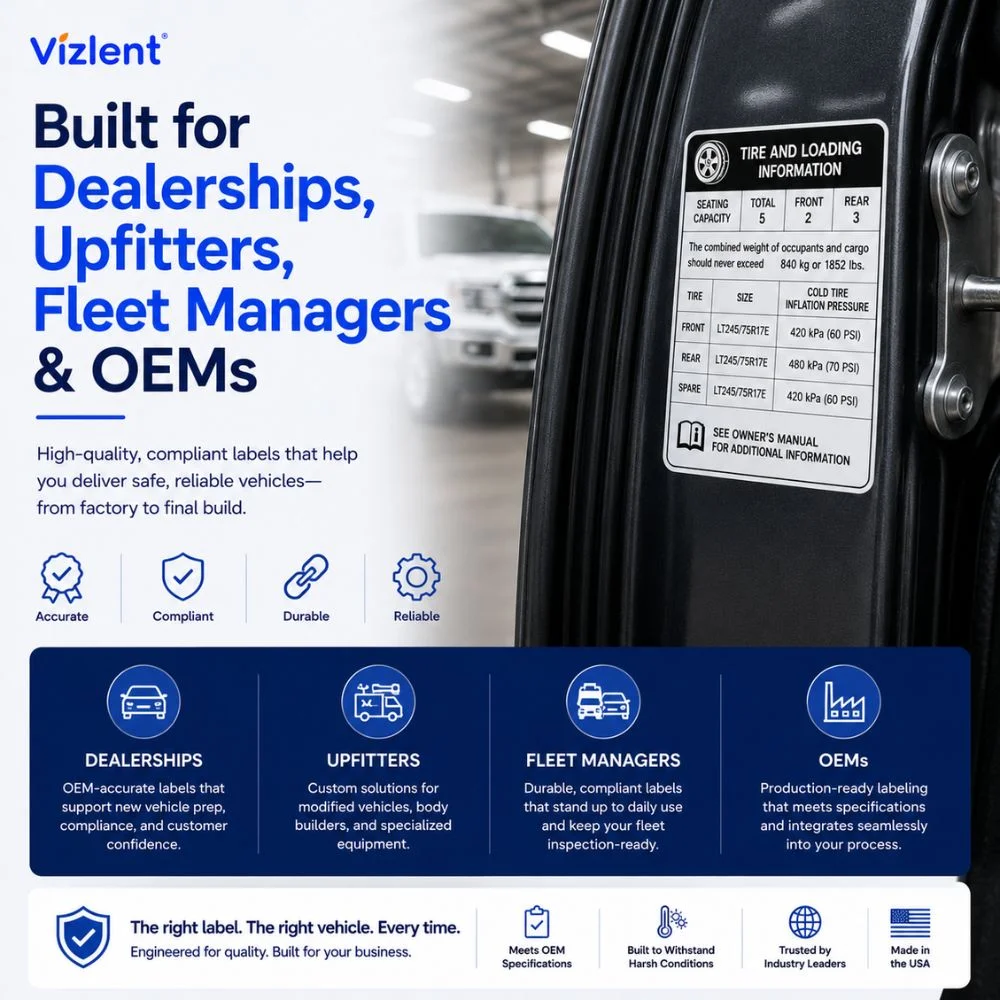
Tire labels are a bulk purchase across the whole chain, and each buyer needs a different construction. Dealers and compliance shops order replacement and revised placards, retailers and distributors order tread stickers by the tens of thousands, and fleets order inspection and rotation tags that survive wheel wells. Tire plants sit at the top of the volume pyramid with barcode labels on every unit produced.
- Dealerships and upfitters: replacement placards and revised load labels after modifications, in durable polyester constructions.
- Tire retailers and distributors: tread tire label stickers carrying brand, size, and grading data, with removable adhesive that peels cleanly at fitting.
- Fleet operators and retreaders: casing tracking labels and inspection tags that grip rubber and survive road grime.
- Tire manufacturers: vulcanization-grade barcode labels applied to green tires before curing.
Volume changes the buying math. At these quantities, the difference between a converted-label price and factory-direct material is real money, which is why high-volume buyers increasingly source label stock in jumbo or slit rolls and convert in house. The supplier’s minimum order, lead time, and customization range become as important as the unit price.
Why the Tire Pressure Label Has to Last
A door jamb is a hard place to be a sticker. The placard gets brushed by clothing, scrubbed during cleaning, soaked in rain, baked in summer, and frozen in winter, and US safety rules expect it to stay permanent and legible through all of it. That is why replacement placards are not paper but engineered constructions on automotive label stock built around the abuse.
The proven build pairs a polyester facestock that resists abrasion and cleaning chemicals with an aggressive acrylic adhesive matched to painted metal, plus UV-stable construction so print does not fade where sunlight reaches it. Businesses ordering these labels in bulk should ask suppliers for adhesion and legibility test data rather than durability claims, because a placard that fails in the field becomes the shop’s problem, not the printer’s.
Tire Barcode Labels in Manufacturing
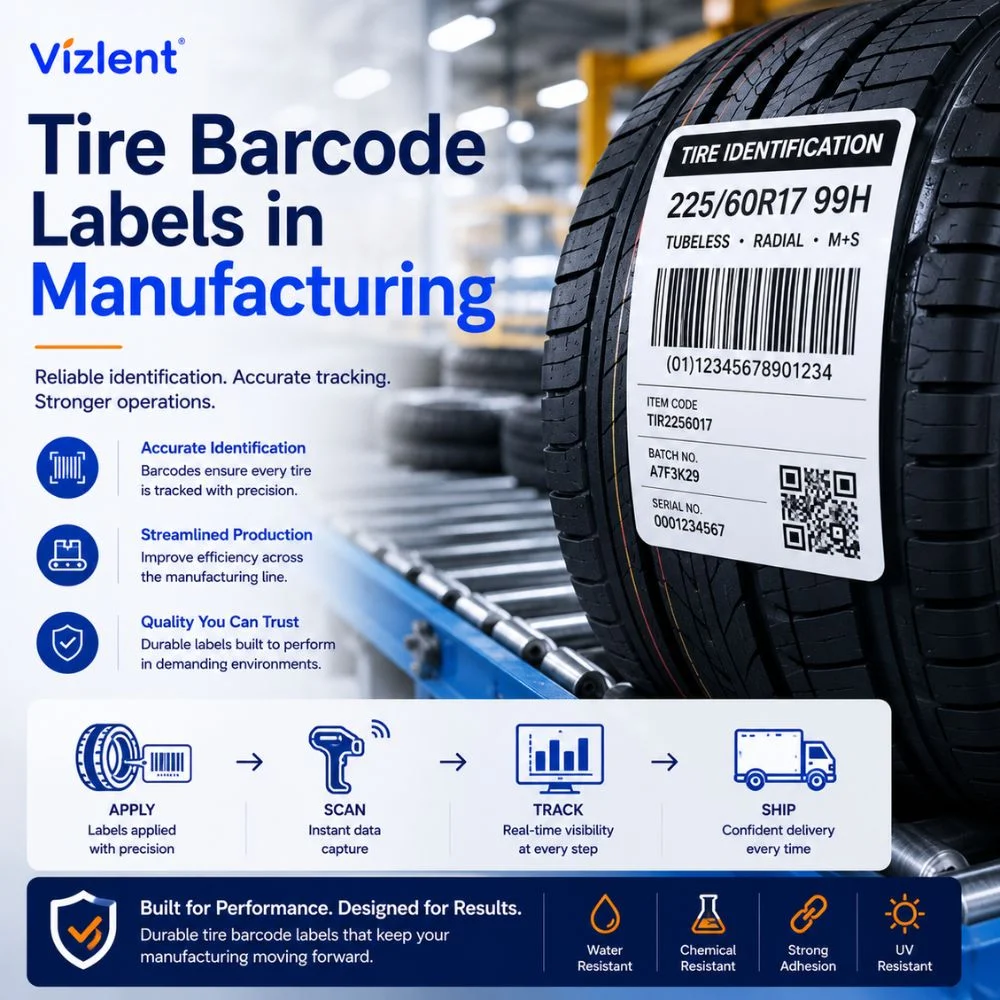
The hardest tire label job happens before the tire exists. Plants label a tire while it is still an uncured green casing, applying a tire barcode label that must then survive the vulcanizing press, where heat and pressure cure the rubber around it. Vulcanized labels are engineered for exactly this, bonding into the rubber during curing and emerging with the code still scannable.
That surviving code becomes the tire’s identity through its whole life. A tire barcode sticker links each unit to its production batch, DOT date code, and quality records, supporting the traceability that recalls and warranty claims depend on. Automotive serialization standards demand barcode grades that stay readable at every scan point, so plants qualify the label material as carefully as the rubber compound around it.
Running barcode labels through curing, heat, or harsh handling? Talk to a Vizlent engineer about vulcanized and high-temperature constructions validated for your process.
Buying Tire Labels in Bulk: What to Specify
A bulk tire label order lives or dies on the specification sheet. Define the surface first, since rubber, painted metal, and plastic trim each demand a different adhesive, and rubber in particular is a low-energy surface that defeats standard acrylics. Then set the durability profile: service temperature range, chemical exposure, UV, and the print method that will image the label.
Then test before committing the volume. Order free samples, run them on your printer or applicator, and check adhesion on the actual surface after heat and moisture, not on a steel test panel. A direct manufacturer that customizes facestock, adhesive, and roll format, documents performance in a Technical Data Sheet, and supports trial orders takes most of the risk out of a container-scale purchase.
Source Bulk Tire Labels From Vizlent Label Materials Co.
The label for recommended tire pressure is a ten-second find for a driver and a recurring line item for a tire business. Placards, hang tags, tread tire label stickers, fleet tags, and barcode labels all ride on the same fundamentals: a facestock matched to the surface, an adhesive matched to the conditions, and print that stays legible for the label’s whole working life.
Vizlent manufactures tire and automotive label stock at its Shenzhen facility, including polyester placard constructions, UV-stable outdoor grades, removable tread-sticker stock, and vulcanized rubber labels tested through curing conditions. As a direct manufacturer since 2011 with ISO 9001, FSC, and SGS certification, we supply jumbo rolls, precision-slit rolls, and die-cut formats at bulk volume, customize facestock and adhesive to your surfaces, and back every order with free samples and test data. Reach out today to specify tire labels that perform at the scale your business buys them.
Contact Vizlent for a bulk quote and free samples and source tire label materials built to endure.
Frequently Asked Questions
Where is the label for recommended tire pressure located?
On nearly all modern vehicles it is on the driver’s side door jamb or B-pillar, visible when the door is open. Older models may carry it on the glove box door, fuel filler flap, trunk lid, or center console, and the owner’s manual always lists the same recommended pressures as a reference.
Is the tire pressure on the label cold pressure?
Yes, every figure on the placard is a cold inflation pressure. Cold means the vehicle has been parked around three hours or driven less than about one mile, so the tires hold no heat from the road. Service work done on hot tires should compensate for the difference or be rechecked cold.
What counts as cold weather for tire pressure?
The label’s cold specification refers to tire temperature, not the season, so a summer morning reading is just as valid as a winter one. Weather matters through physics instead: pressure falls roughly one psi per ten degree Fahrenheit drop, which is why service bays see TPMS lights cluster each autumn.
Can a business order replacement tire pressure placards in bulk?
Yes. Dealerships, upfitters, and compliance shops order placard label stock in volume, typically a polyester facestock with permanent acrylic adhesive and UV-stable print that meets the permanence the regulations expect. A direct manufacturer can supply the material in rolls or die-cut formats matched to your printer.
What adhesive works for labels applied to tires themselves?
Rubber is a low-surface-energy material loaded with release agents, so standard adhesives lift quickly. Tread stickers use a removable grade engineered to peel cleanly at fitting, while tracking and inspection labels use aggressive formulations built for rubber. Always test samples on the actual compound before a bulk order.
What is a tire barcode label used for?
A tire barcode label identifies an individual tire through manufacturing and distribution, linking it to its production batch, DOT date code, and quality records. Plants apply it before vulcanization, so the material must survive the curing press with the code still scannable. That traceability supports recalls, warranty claims, and fleet records.
Why do new tires have stickers on the tread?
Tread tire label stickers carry the brand, model, size, and regulated grading or efficiency information shoppers compare at retail. Retailers and distributors buy them in bulk with a removable adhesive intended to survive shipping and display, then peel away cleanly once the tire is mounted.






