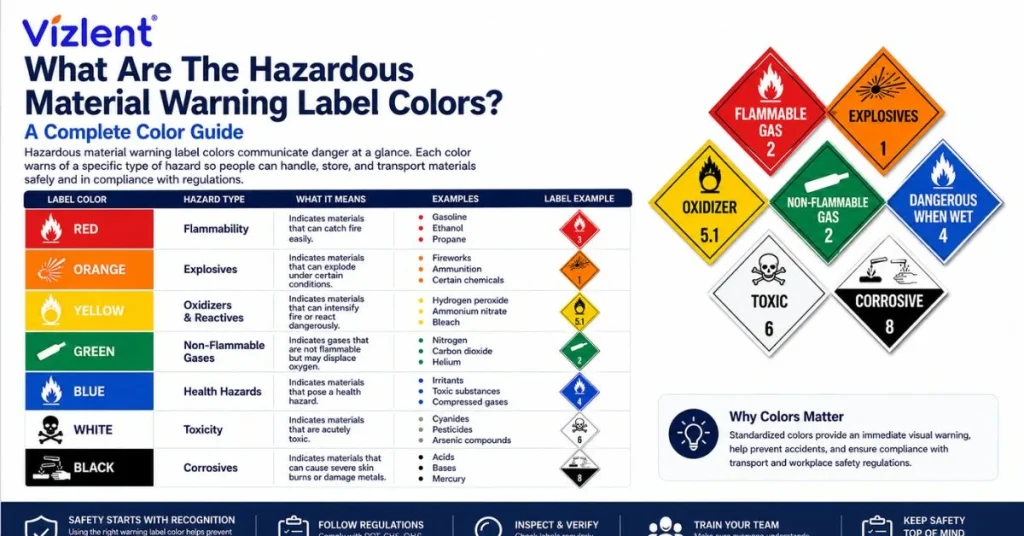
Hazardous material warning label colors are fixed colors set by regulation, with each color tied to a specific type of danger. Under the DOT system, red means flammable, green means non-flammable gas, yellow means oxidizer, white means poison or infectious, blue means dangerous when wet, orange means explosive, and black and white together mean corrosive. These colors are not decorative choices, since they let workers and first responders read the hazard at a glance, even from a distance or in another language.
Need durable, compliant hazmat labels that hold their color in harsh conditions? Request a factory-direct quote from Vizlent for chemical-resistant label stock built to spec.
Why Color Matters on Hazardous Material Warning Labels
To answer what colors are hazardous material warning labels at the most basic level, color is a coded language. Each regulated color maps to a category of risk, so the eye can identify the danger before reading any text. This matters most in emergencies, when responders need to assess a spill or fire in seconds.
The colors are standardized by law rather than chosen by the manufacturer. In the United States, the Department of Transportation sets the transport colors, while the Occupational Safety and Health Administration (OSHA) and the National Fire Protection Association (NFPA) govern workplace and storage markings. Because the system is consistent, a red flammable label means the same thing on a truck in Texas as it does in a warehouse in Ohio.
This consistency also crosses language barriers, which is part of the design goal. A worker who cannot read the text can still recognize the color and symbol and respond correctly. That speed of recognition is exactly why regulators lock the colors in place rather than leaving them to preference.
The Hazardous Material Warning Label Colors

A complete hazardous material warning labels list pairs each color with the danger it represents. Reading the list once makes every package, sign, and placard easier to interpret in the field. The colors below cover the core hazard categories you will encounter most often.
- Red: Flammable liquids and other fire risks
- Green: Non-flammable, non-toxic compressed gases
- Yellow: Oxidizers that intensify fire
- White: Poison, toxic, and infectious substances
- Blue: Materials that are dangerous when wet
- Orange: Explosives
- Black and white: Corrosive materials
- Fluorescent orange: Biohazards and infectious medical waste
Some categories combine two colors to signal a layered hazard. Organic peroxides use red over yellow, and radioactive materials use yellow over white. Learning the single-color entries first makes these combined labels simple to decode.
DOT Hazardous Material Warning Labels and Their Colors
The dot hazardous material warning labels follow nine hazard classes, each with assigned colors and symbols. These diamond-shaped labels are required under 49 CFR Part 172 for packages offered for transport. The color, the class number, and the pictogram work together so the hazard is unmistakable.
This hazardous materials warning label chart summarizes the main class colors:
| Class | Hazard | Primary Color(s) |
|---|---|---|
| 1 | Explosives | Orange |
| 2 | Gases | Red (flammable), green (non-flammable), white (poison gas) |
| 3 | Flammable liquids | Red |
| 4 | Flammable solids and reactive | Red-white stripes, white-red, blue (when wet) |
| 5 | Oxidizers and organic peroxides | Yellow; red-and-yellow for peroxides |
| 6 | Poison and infectious | White |
| 7 | Radioactive | Yellow-and-white or white |
| 8 | Corrosive | Black and white |
| 9 | Miscellaneous | White with black vertical stripes on top |
Some materials carry more than one color when they pose multiple hazards. A label may show white on top for a health hazard and yellow on the bottom for oxidizing properties. The class number always appears in the lower corner, so the category stays clear even on a combined label.
Class 3 Flammable Liquids and the Color Red
Red is the most recognized color in the system, and it signals fire risk. The class 3 dot hazardous material warning label applies to flammable liquids such as gasoline, alcohol, and many solvents. It shows a red background with a white or black flame symbol and the number 3 in the bottom corner.
Red appears across several flammable categories, with small design changes for each. Flammable solids use red and white vertical stripes to set them apart from flammable liquids, which are solid red. Spontaneously combustible materials use white on top and red on the bottom, keeping red as the shared signal for ignition risk.
The flame symbol reinforces the color so the message survives poor lighting or partial damage. A faded label can still warn correctly if the flame and the number 3 remain visible. This redundancy between color, symbol, and number is built into the standard on purpose.
Shipping flammable or corrosive goods that demand weatherproof labels? See Vizlent chemical-resistant label stock engineered to stay legible through transport stress.
Hazardous Material Warning Symbols and Label Meanings

Color is only one part of the message, since hazardous material warning symbols carry equal weight. A flame means flammable, a skull and crossbones means toxic, and a corroding hand means corrosive. Together, color and symbol give the hazardous material label meanings that workers learn to read instantly.
Two other systems add detail beyond DOT transport labels. The GHS system used on containers and Safety Data Sheets uses black symbols on a white background framed by a red diamond border. The NFPA 704 fire diamond uses four colors for on-site storage, and its layout is worth knowing:
- Blue (left): Health hazard, rated 0 to 4
- Red (top): Flammability hazard, rated 0 to 4
- Yellow (right): Instability or reactivity, rated 0 to 4
- White (bottom): Special hazards such as W for water-reactive or OX for oxidizer
The two systems serve different moments in a material’s life. GHS pictograms travel with the product on container labels and Safety Data Sheets, while the NFPA diamond is posted on rooms, tanks, and doors for emergency response. Using each in its proper place keeps both shippers and on-site responders informed.
| System | Where Used | Color Approach |
|---|---|---|
| DOT labels | Transport packages | Nine class colors on a diamond |
| GHS | Containers and SDS | Black symbol, white field, red border |
| NFPA 704 | On-site storage areas | Blue, red, yellow, white quadrants |
| OSHA biohazard | Medical and lab containers | Fluorescent orange, black symbol |
What Color Are Biohazard Warning Labels?
Biohazard labels use a distinct color that sits outside the DOT class palette. Under OSHA’s Bloodborne Pathogens Standard, biohazard labels must use a fluorescent orange or orange-red background. The biohazard trefoil symbol and the word BIOHAZARD appear in a contrasting color, most often black.
This color rule is strict and specific for a reason. OSHA does not allow a solid red or yellow background for these labels, since the fluorescent orange is what makes them stand out. These labels mark containers of blood, regulated medical waste, and other potentially infectious materials so exposure can be avoided.
Durability is part of biohazard compliance, not just color. Labels must stay legible through moisture, routine cleaning, and disinfectants, which is why material choice matters. A faded or peeling biohazard label fails its purpose, so permanent, chemical-resistant stock is the safe choice.
Hazardous Substances, Waste Labels, and Placement Rules

Beyond transport, hazardous substances warning labels appear on containers throughout a facility. Hazardous waste warning labels and hazardous waste material warning labels follow the same color logic, with added text for waste status and accumulation dates. The goal is the same: to communicate the danger clearly from point of use to final disposal.
Placement is regulated as carefully as color. Hazardous waste material warning labels are placed on containers to identify contents, warn of risk, and support safe handling and tracking. These rules guide where and how the labels go on:
- Never on the bottom of a package, where the label cannot be seen
- On the same side as shipping information when space allows
- Hazardous material safety labels must be placed on all containers containing chemicals, including secondary and transfer containers
- Duplicated on two sides for large packages and all radioactive materials
Special Cases: Limited Quantity, Propane, and Domestic Markings
Not every shipment uses a full-color diamond label, and the exceptions matter. The dot hazardous material warning labels permitted for limited quantities use a black-and-white square-on-point mark rather than a colored class label. This limited quantity mark shows the package qualifies for reduced regulation under the hazardous materials rules.
Other special cases have their own clear requirements. The hazardous material warning labels on propane cylinders must contain a flammable gas marking, since propane is a flammable gas under Class 2. For mail and domestic shipping, the domestic hazardous materials warning labels and markings are summarized in USPS Poster 298, which acts as a quick visual reference.
Poster 298 domestic hazardous materials warning labels and markings help shippers match the right label to each item. It covers the marks and labels used for mailable hazardous materials and restricted items. Using the correct mark prevents rejected shipments and keeps handlers safe along the route.
Labels, Signs, and Placards: Knowing the Difference
Hazardous material warning signs, labels, and placards are related but not identical. Labels go on individual packages, hazardous material warning signs are posted in fixed locations, and placards go on vehicles and bulk containers. All three use the same color code so the message stays consistent across every format.
Knowing which one you need keeps a shipment compliant. Hazardous materials warning labels and placards share designs, but placards are larger and required on transport vehicles. A complete program often uses all three so the hazard is clear on the package, in storage, and on the road.
Size is the most visible difference between a label and a placard. A DOT label measures at least 3.9 inches per side, while a placard runs at least 9.84 inches so it reads from a distance. The matching color code means a responder sees the same warning up close on a box or from a distance on a truck.
Why Label Material Matters as Much as Color
A correct color means nothing if the label fails before the hazard is gone. DOT rules require labels to survive 30 days of worst-case transport exposure without a substantial change in color. Sun fades printing, moisture weakens adhesives, and abrasion damages edges, so the substrate has to be tough.
Matching the material to the environment keeps a label compliant for its full service life. Chemical splash, extreme cold, and outdoor storage each call for a different face stock and adhesive. These pairings cover the most common demanding conditions:
- Chemical and solvent exposure: chemical-resistant label stock that resists smear and lifting
- Deep-cold and cryogenic storage: cryogenic label stock rated for ultra-low temperatures
- Custom printable hazard labels: adhesive sticker paper matched to your printer and finish
Testing the label on the actual container is the final safeguard. Adhesion and color retention can vary between metal drums, plastic totes, and coated surfaces. A manufacturer that supplies samples lets you confirm durability before a full production run.
Get Compliant Hazardous Material Labels Built to Last
Knowing the colors is the first step, and using durable, compliant labels is the next. Vizlent manufactures chemical-resistant and durable label stock that holds color and adhesion through heat, moisture, and rough handling. Share your hazard class, surface, and conditions, and the right label material gets matched to the job.
Talk to the Vizlent team about hazmat labels or browse chemical-resistant label stock to get started today.
Frequently Asked Questions
What colors are hazardous material warning labels?
Hazardous material warning labels use regulation-set colors tied to specific hazards. Red means flammable, green means non-flammable gas, yellow means oxidizer, white means poison or infectious, blue means dangerous when wet, orange means explosive, and black with white means corrosive. Each color maps to a DOT hazard class for instant recognition.
What does the color red mean on a hazmat label?
Red signals fire risk on hazmat labels. It is the background color for Class 3 flammable liquids like gasoline and solvents, shown with a flame symbol and the number 3. Red also appears in striped or split form for flammable solids and spontaneously combustible materials.
What color are biohazard warning labels?
Biohazard warning labels use a fluorescent orange or orange-red background under OSHA’s Bloodborne Pathogens Standard. The biohazard trefoil symbol and the word BIOHAZARD appear in a contrasting color, usually black. Solid red or yellow backgrounds are not compliant for biohazard labeling.
What is a hazardous materials warning label chart?
A hazardous materials warning label chart maps each DOT hazard class to its color, symbol, and class number. It lets shippers and workers quickly match a material to the correct label. DOT Chart 15 and Chart 17 from PHMSA are the official references for these designs.
What are DOT hazardous material warning labels permitted for limited quantity?
Limited quantity shipments use a black-and-white square-on-point mark instead of a full-color hazard class label. This mark shows the package qualifies for reduced regulation under DOT rules. It applies to small quantities packaged within set limits.
What must the hazardous material warning labels on propane cylinders contain?
Propane cylinders must carry a flammable gas marking, since propane is a Class 2 flammable gas. The label includes the flammable gas symbol and class information. Cylinders also require proper identification of contents for safe handling and transport.
What is Poster 298?
Poster 298 is the USPS reference for domestic hazardous materials warning labels and markings. It shows the marks and labels used for mailable hazardous and restricted materials. Shippers use it as a quick visual guide to label items correctly for mail.
Where must hazardous material safety labels be placed?
Hazardous material safety labels must be placed on all containers containing chemicals, including secondary and transfer containers. Labels should never go on the bottom of a package and should sit near the shipping information. Large and radioactive packages require labels on at least two sides.