
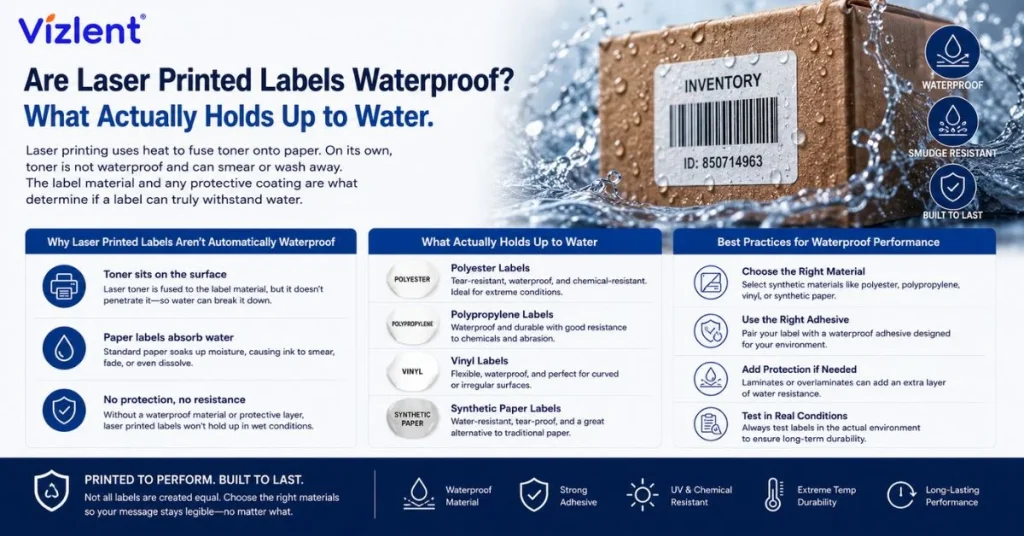
Laser printed labels are water-resistant but not waterproof. This depends far more on the label material than on the laser printer itself. Laser toner, for instance, is a plastic powder fused onto the surface by heat, so the printed image resists water well, yet a standard paper label underneath will still soak, wrinkle, and fail when wet. For a truly waterproof result, you need a synthetic facestock such as polyester or polypropylene, often finished with a laminate or protective topcoat.
Need labels that survive moisture, washdown, or outdoor exposure? Request a factory-direct quote from Vizlent for waterproof synthetic label stock matched to your printer.
Laser Printer Labels Waterproof Claims: The Real Answer
The honest answer to are laser printed labels waterproof is that it depends on the stock, not the printer. People search for laser printer labels waterproof and assume the machine does the work, but laser toner bonds to the surface as a fused plastic layer that gives the printed text strong resistance to water and smudging. The weak point is the label material itself, since ordinary paper labels absorb water and break down even when the print stays intact.
This distinction between print durability and material durability matters most in wet settings. A laser-printed paper label may shrug off a quick splash, then fail completely after soaking or repeated moisture. To get a waterproof label, the facestock and adhesive have to be built for water from the start.
There is also a useful middle ground worth naming clearly. Water-resistant means a label tolerates brief or occasional moisture, while waterproof means it survives soaking, immersion, or constant damp. Knowing which level your application needs prevents both label failure and overspending on more protection than the job requires.
Why Laser Toner Resists Water but Paper Does Not
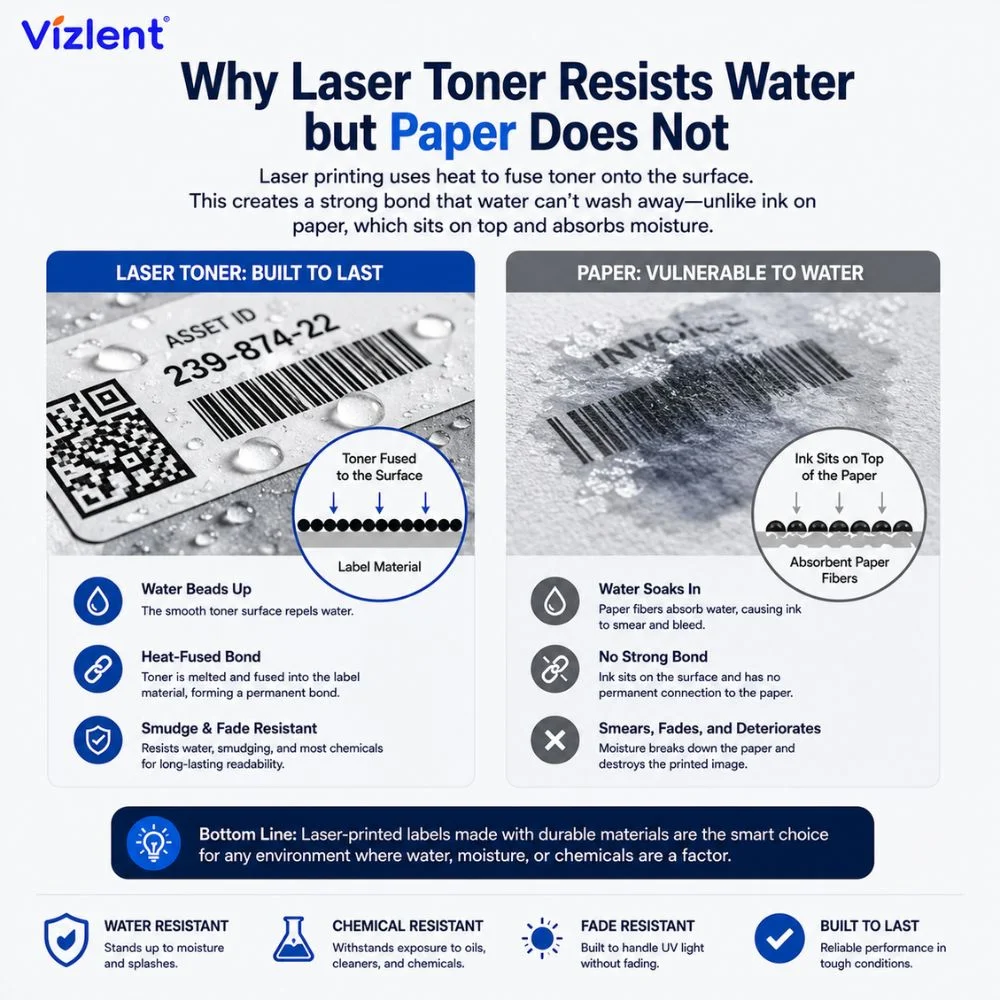
Understanding the print process explains the limits clearly. A laser printer melts fine toner powder and fuses it onto the label with a heated roller, forming a thin, durable plastic film of image. That fused layer does not dissolve in water, which is why laser print holds up better than water-based inkjet ink in damp conditions.
The problem is everything beneath that toner layer. Standard label paper is porous, so it wicks moisture, swells, and separates from its adhesive once saturated. The toner image can survive while the paper carrying it falls apart, which is the core reason a laser-printed paper label is not waterproof:
- Toner: water-resistant, since it is a fused plastic layer
- Paper facestock: absorbs water, wrinkles, and tears when wet
- Standard adhesive: can loosen as the paper swells and lifts
- Result: print stays readable, but the label itself fails
This is why the question is really about the whole label, not the ink. Toner quality is rarely the issue, since the fused image is the most durable part of a laser-printed paper label. Shifting focus from the print to the facestock is the single most useful step in choosing a label that lasts in water.
What Actually Makes a Label Waterproof
A waterproof label starts with a synthetic facestock instead of paper. Polyester (PET), polypropylene (BOPP), and vinyl films do not absorb water, so they keep their shape and strength when soaked. These materials are the foundation of any label expected to survive moisture, immersion, or outdoor weather.
Material is the first layer of protection, and finish plus adhesive complete it. Many waterproof labels add a laminate or topcoat over the print, and all of them use an adhesive rated for wet or cold surfaces. These elements work together to create a label that stays put and stays legible:
- Synthetic facestock: PET, BOPP, or vinyl from durable label stock that will not absorb water
- Protective finish: a thermal lamination film or topcoat that shields the toner from abrasion and moisture
- Waterproof adhesive: a permanent or wet-surface acrylic that grips when damp or cold
- Printer match: a laser-rated synthetic that tolerates fuser heat without warping
Each synthetic facestock has its own strengths for water exposure. Choosing among them depends on cost, clarity, flexibility, and the conditions the label will face. This quick comparison helps match the material to the job:
| Facestock | Water Behavior | Best For |
|---|---|---|
| Polyester (PET) | Waterproof, very durable | Assets, outdoor, high heat |
| Polypropylene (BOPP) | Waterproof, flexible | Bottles, packaging, retail |
| Vinyl | Waterproof, conformable | Curved surfaces, drums |
| Coated paper | Water-resistant only | Short-term, light moisture |
Sourcing waterproof stock for bottles, drums, or outdoor assets? See Vizlent outdoor weather-resistant label stock built to hold print and adhesion in tough conditions.
Choosing Laser Printer Labels for Everyday Use
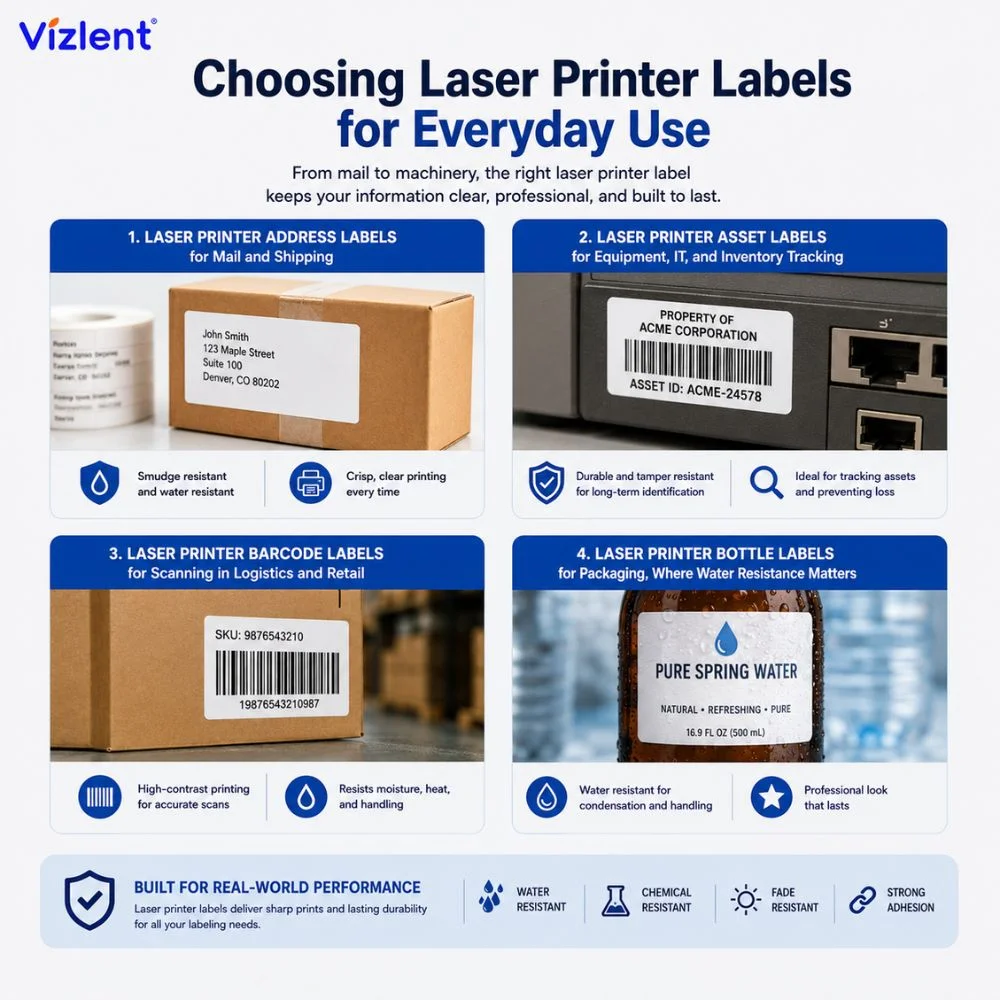
Most laser printer labels are designed for clean, dry indoor use, and they perform well there. Laser printer address labels, return labels, and shipping labels run fast and print sharp on standard sheets. These laser printer adhesive labels suit offices, mailrooms, and warehouses where water exposure is not a concern.
The label you choose should match the job and the surface it lands on. Many buyers use laser printer address labels for mail, then need a tougher stock for product or asset use. Common categories include the following:
- Laser printer address labels and laser printer return address labels for mail and shipping
- Laser printer asset labels for equipment, IT, and inventory tracking
- Laser printer barcode labels for scanning in logistics and retail
- Laser printer bottle labels for packaging, where water resistance often matters
Speed and print quality are the main draws for laser sheets in the office. When you laser print address labels in bulk, the fused toner gives sharp, smudge-free text that scans and reads cleanly. For anything that will meet water, though, the paper facestock under that crisp print becomes the limiting factor.
Avery, Brother, and Brand Compatibility
Brand and printer pairing is a frequent question for office buyers. Avery laser printer address labels are made for laser heat and run reliably on most laser machines. If you use a Brother laser printer, Avery labels rated for laser printing will feed and print correctly, since the rating is about heat tolerance, not brand.
The rule is to match the label rating to the printer type, not the brand name. Any laser-rated sheet, including Avery laser printer address labels and Brother laser printer Avery labels, is built to handle fuser heat without curling or releasing adhesive. For waterproof needs, look beyond standard paper sheets to a synthetic laser-rated stock, since most brand-name address labels are paper.
Compatibility confusion usually comes from mixing up brand and printer type. A Brother laser printer needs laser-rated labels, and Brother laser printer Avery labels work fine when that rating is present. The same logic applies to any maker, so always read the box for the laser rating before loading a sheet.
Laser Printer Bottle Labels and Water Exposure
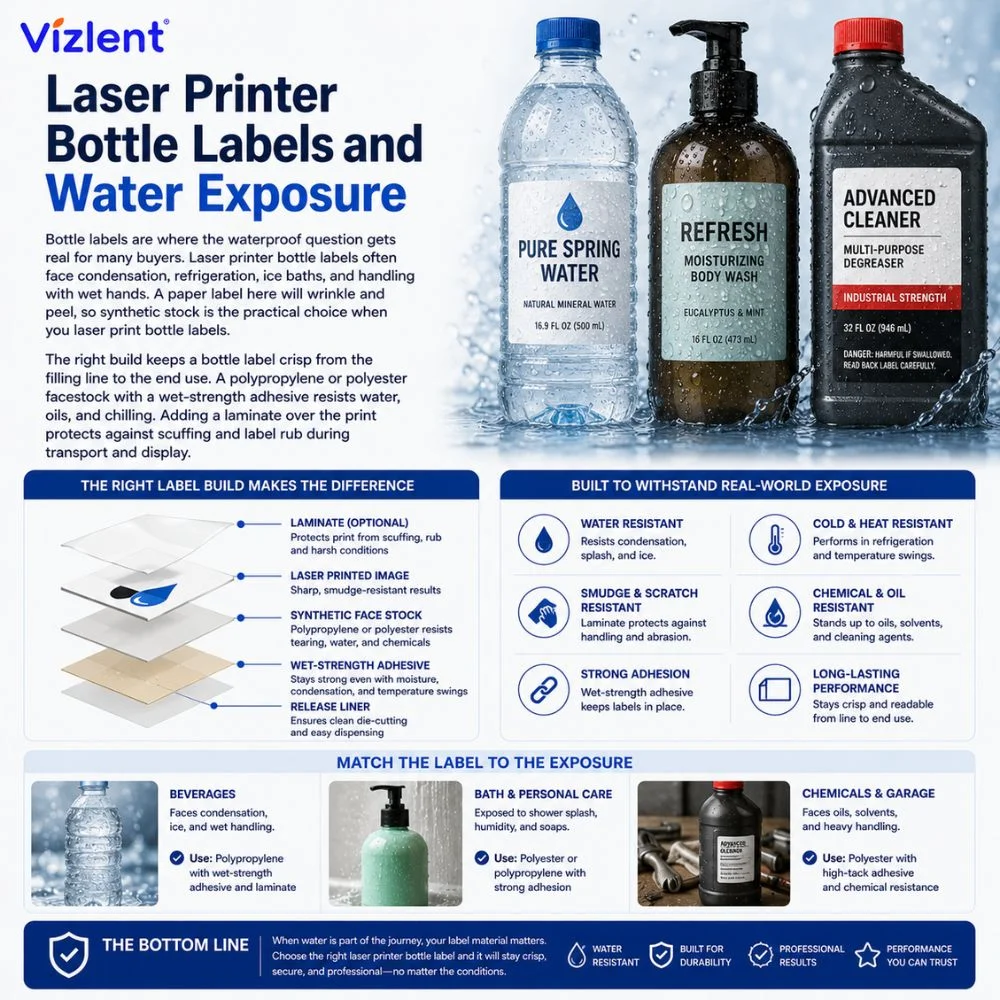
Bottle labels are where the waterproof question gets real for many buyers. Laser printer bottle labels often face condensation, refrigeration, ice baths, and handling with wet hands. A paper label here will wrinkle and peel, so synthetic stock is the practical choice when you laser print bottle labels.
The right build keeps a bottle label crisp from the filling line to the end use. A polypropylene or polyester facestock with a wet-strength adhesive resists water, oils, and chilling. Adding a laminate over the print protects against scuffing and label rub during transport and display.
Different bottle products face different kinds of water exposure. A drink bottle sees condensation and ice, a bath product sees shower splash, and a garage chemical sees solvent and handling. Matching the facestock and adhesive to that specific exposure is what keeps the label looking right at the point of sale.
Laser Versus Inkjet for Water-Resistant Labels
The print method changes how a label behaves once it gets wet. Laser toner is inherently water-resistant, while standard inkjet ink is water-based and can run unless it is pigment ink on coated stock. This gives the laser an edge for damp environments, though the facestock still decides true waterproofing.
The table below compares the two methods for water exposure. Use it to match your printer and stock to the conditions the label will face. Either method can produce a waterproof label on the right synthetic material:
| Factor | Laser Printing | Inkjet Printing |
|---|---|---|
| Print water resistance | High, fused toner | Varies, depends on ink |
| On paper stock | Print survives, paper fails | Ink may run, paper fails |
| On synthetic stock | Waterproof when laser-rated | Waterproof with pigment ink |
| Best wet-use match | Laser-rated PET or BOPP | Inkjet-coated waterproof film |
Inkjet still has a place for waterproof labels in the right setup. A pigment-ink inkjet on a coated waterproof film can match laser for water resistance, and it handles full-colour artwork well. For plain text, barcodes, and fast office runs, laser remains the simpler route to a water-resistant print.
Where to Find Waterproof Laser Printer Labels
Sourcing depends on if you need a few sheets or bulk volume. Searching for laser printer labels nearby works for a one-off office pack from a local supplier. For waterproof labels at scale, sourcing direct from a manufacturer gives better material options, pricing, and consistency.
Local shops mostly stock paper laser sheets, which are not waterproof. A label manufacturer can supply laser-rated synthetic facestock, the right adhesive, and an optional laminate as a matched system. That control is what turns a standard laser label into one that truly survives water.
How to Test if a Label Is Truly Waterproof
A quick test tells you more than a product description. Print a sample, apply it to the real surface, and expose it to the conditions it will face in use. Checking both the print and the material under realistic exposure prevents surprises after a full run.
Watch for a few clear signs of failure during the test. Look at the print, the facestock, and the adhesive separately, since they can fail at different points:
- Print: rub the toner under water to confirm it does not lift or smear
- Facestock: soak the label to check for wrinkling, swelling, or tearing
- Adhesive: test edges for lifting after the surface gets wet or cold
- Scanning: confirm any barcode still reads cleanly after exposure
Real-world testing matters because conditions vary widely. A label that survives tap water may still fail against solvents, salt, or prolonged sun. Testing against your actual exposure is the only reliable way to confirm performance.
Common Mistakes When Choosing Water-Resistant Labels
Most label failures trace back to a few avoidable errors. Buyers often assume laser print alone makes a label waterproof, or they choose paper stock for a wet application to save money. Each mistake comes from focusing on the printer rather than the material and finish.
Knowing the common traps makes the right choice easier. Keep these points in mind before you order labels for any damp or outdoor use:
- Assuming the printer, not the facestock, determines waterproofing
- Using paper labels where condensation or immersion is expected
- Skipping a laminate on labels that face abrasion plus moisture
- Overlooking the adhesive rating for wet or cold surfaces on self-adhesive material
- Not testing the label against its actual exposure before a full run
Get Waterproof Laser Labels Built for Your Application
The print is rarely the problem, since the material decides if a label survives water. Vizlent manufactures laser-rated synthetic label stock with waterproof facestocks, wet-surface adhesives, and optional laminates for bottles, assets, and outdoor use. Share your printer, surface, and exposure conditions, and the right waterproof stock gets matched to the job.
Talk to the Vizlent team about waterproof labels or browse laser printing label stock to get started today.
Frequently Asked Questions
Are laser printed labels waterproof on standard paper?
No, laser printed labels on standard paper are not waterproof. The fused toner resists water, but the paper facestock absorbs moisture, wrinkles, and fails. For a waterproof label, you need a synthetic facestock such as polyester or polypropylene rather than paper.
Does laser toner smear or run when wet?
Laser toner does not run when wet, since it is a plastic powder fused onto the surface by heat. This makes laser print more water-resistant than standard water-based inkjet ink. The limiting factor is the label material under the toner, not the print itself.
What label material is best for waterproof laser printing?
Polyester (PET) and polypropylene (BOPP) films are the best materials for waterproof laser printing. They resist water, hold their shape, and tolerate fuser heat when laser-rated. Adding a laminate or topcoat further protects the printed image from moisture and abrasion.
Can I use Avery laser printer address labels in a Brother laser printer?
Yes, Avery laser printer address labels work in a Brother laser printer as long as they are rated for laser printing. Compatibility depends on heat tolerance, not the printer brand. Note that most standard address labels are paper and are not waterproof.
Are laser printer bottle labels waterproof?
Laser printer bottle labels are waterproof only when printed on synthetic facestock with a wet-strength adhesive. Paper bottle labels wrinkle and peel under condensation and refrigeration. A polypropylene or polyester label with an optional laminate handles bottle moisture reliably.
Do laser printer asset labels resist water and wear?
Laser printer asset labels resist water and wear when made from synthetic stock such as polyester. These labels keep barcodes and serial numbers legible through handling, cleaning, and outdoor exposure. Paper asset labels are suitable only for clean, dry indoor use.
How can I make laser labels more waterproof?
To make laser labels more waterproof, switch to a synthetic facestock and add a laminate or protective topcoat over the print. Pair this with a waterproof adhesive rated for wet or cold surfaces. The printer matters less than the material and finish you choose.
Are laser printer barcode labels durable enough for scanning after exposure?
Laser printer barcode labels stay scannable after exposure when printed on durable synthetic stock with a protective finish. The fused toner keeps the barcode sharp, and the synthetic facestock prevents smearing or warping. This combination supports reliable scanning in logistics and storage.






