
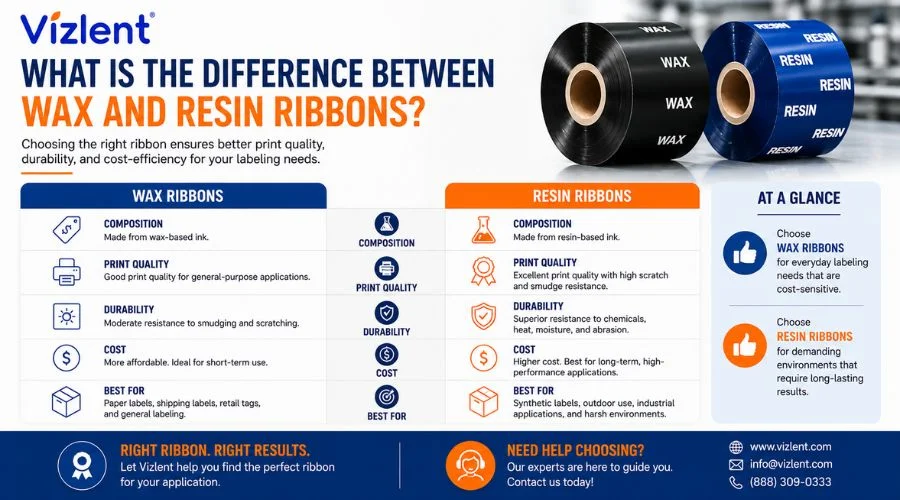
The difference between wax and resin ribbons comes down to coating chemistry and print durability. Wax ribbons use a wax-based coating designed for fast, low-cost printing on paper labels that only need short-term readability. Resin ribbons use a resin-based coating engineered for long-term durability on synthetic films, standing up to heat, chemicals, and abrasion that would smear or scratch a wax print.
Understanding the difference between wax and resin thermal transfer ribbons matters before you commit to a print method, because the wrong ribbon choice leads to faded barcodes, smudged text, and reprints that slow down a production line. Composition, use cases, pricing, and buying guidance below help converters, warehouse managers, and label buyers match the right ribbon to the right application. For sourcing questions on any thermal transfer ribbon type, our engineering team is available to review your print specifications.
What Is a Wax Ribbon?
A wax ribbon is a thermal transfer ribbon coated with a wax-based ink formulation that melts at low temperatures and bonds to paper facestocks. The coating sits on a thin polyester film backing, and the printhead applies heat through the film to transfer the wax image onto the label surface. Wax thermal transfer ribbons are the most widely used ribbon category because they print quickly, cost less per roll, and work well on uncoated and semi-coated paper labels.
Print quality from a wax ribbon holds up fine for labels that will not face moisture, sunlight, or heavy handling, such as shipping labels, price tags, and short-term inventory tags. A wax ribbon black cartridge is the standard configuration most barcode printers ship with, since black ink provides the contrast needed for reliable barcode scanning. This is one of the clearest angles on the difference between wax and resin ribbons, since the soft wax coating is prone to smearing under friction, keeping wax ribbon uses limited to indoor, short-lifespan labeling rather than outdoor or industrial-duty applications.
- Lower cost per roll compared to resin alternatives
- Fast melt point for high-speed print runs
- Best suited to paper labels, not synthetic film
- Prone to scratching, smudging, and fading over time
What Is a Resin Ribbon?
A resin ribbon is a thermal transfer ribbon coated with a resin-based formulation that bonds tightly to synthetic facestocks such as polyester, polypropylene, and vinyl. The resin coating requires more heat to transfer than wax, and once fused to the label surface, it resists chemical exposure, extreme temperatures, and physical abrasion far better than a wax coating. This makes a resin ribbon printer the standard choice for labels that need to survive harsh environments over months or years.
Resin ribbons are the default option for asset tags, automotive under-hood labels, chemical drum labels, and any application where the printed barcode must remain scannable after exposure to solvents, oils, or outdoor weather. A resin ribbon roll typically costs more than a wax roll of the same length, but the added durability reduces reprints and relabeling costs over the life of the asset. This environmental resilience sits at the core of the difference between wax and resin ribbons, and it makes resin the more reliable long-term investment for labels combining synthetic facestock with demanding conditions.
- Higher heat resistance and chemical resistance than wax
- Bonds securely to polyester, polypropylene, and vinyl films
- Suited to outdoor, industrial, and long-term asset labels
- Higher cost per roll than wax ribbon options
Wax vs Resin Ribbon: Core Differences
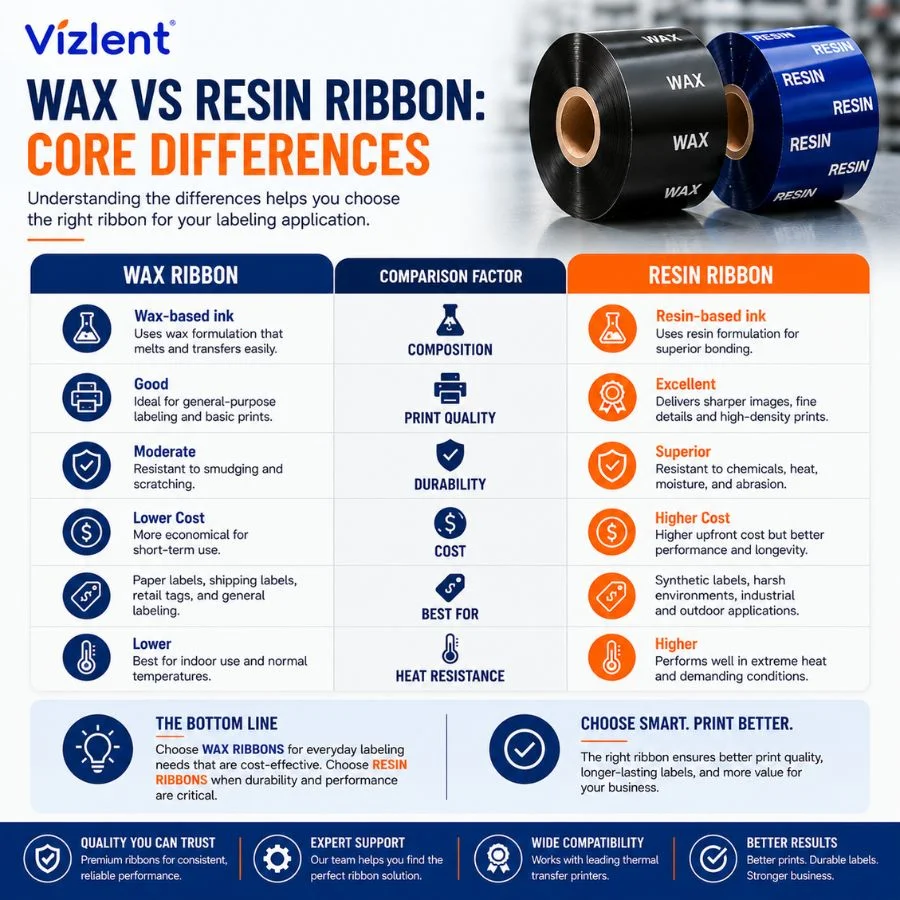
The wax vs resin ribbon comparison, or more broadly the difference between wax and resin ribbons, ultimately comes down to three factors: facestock compatibility, environmental durability, and cost per label. Wax performs best on paper facestocks in controlled indoor settings, while resin performs best on synthetic facestocks exposed to friction, chemicals, or weather. Print speed also differs, since wax ribbons transfer at lower temperatures and generally support faster print speeds than resin.
| Factor | Wax Ribbon | Resin Ribbon |
| Facestock | Paper, uncoated or semi-coated | Polyester, polypropylene, vinyl |
| Durability | Short-term, indoor use | Long-term, harsh environments |
| Chemical resistance | Low | High |
| Cost per roll | Lower | Higher |
| Print speed | Faster | Moderate |
Comparing wax vs resin ribbons side by side helps label buyers avoid a mismatch between facestock and ribbon coating, which is one of the most common causes of premature label failure. A converter printing on synthetic film with a wax ribbon will see poor ink adhesion almost immediately, while a converter using resin on plain paper is paying for durability the application does not need. Matching ribbon chemistry to facestock and end-use environment is the single most important decision in the thermal transfer print process.
Wax Resin Ribbon vs Resin Ribbon: The Hybrid Middle Ground
A wax resin ribbon blends both coating types into a single formulation, giving converters a middle ground between the low cost of wax and the durability of resin. The wax resin ribbon vs resin ribbon comparison generally favors the hybrid option when a label needs moderate scratch and smudge resistance but does not face chemical exposure or extreme heat. Hybrid ribbons sit squarely inside the difference between wax and resin ribbons spectrum, printing at speeds closer to wax while offering print durability closer to resin on select synthetic facestocks.
The wax ribbon vs wax resin ribbon decision usually comes down to budget and risk tolerance for the specific application. Pure wax remains the cheaper option for paper labels with no durability requirement, while wax resin ribbon formulations suit synthetic labels that need better smudge resistance without the full cost of pure resin. For applications where scanning accuracy after light handling matters but full chemical resistance does not, a hybrid ribbon often delivers the best balance of cost and performance.
- Wax resin ribbons work on coated paper and some synthetic films
- Better smudge and scratch resistance than pure wax
- Lower cost than pure resin, though pricier than pure wax
- Not rated for heavy chemical or extreme heat exposure
Wax Ribbon Uses and Barcode Printing Applications
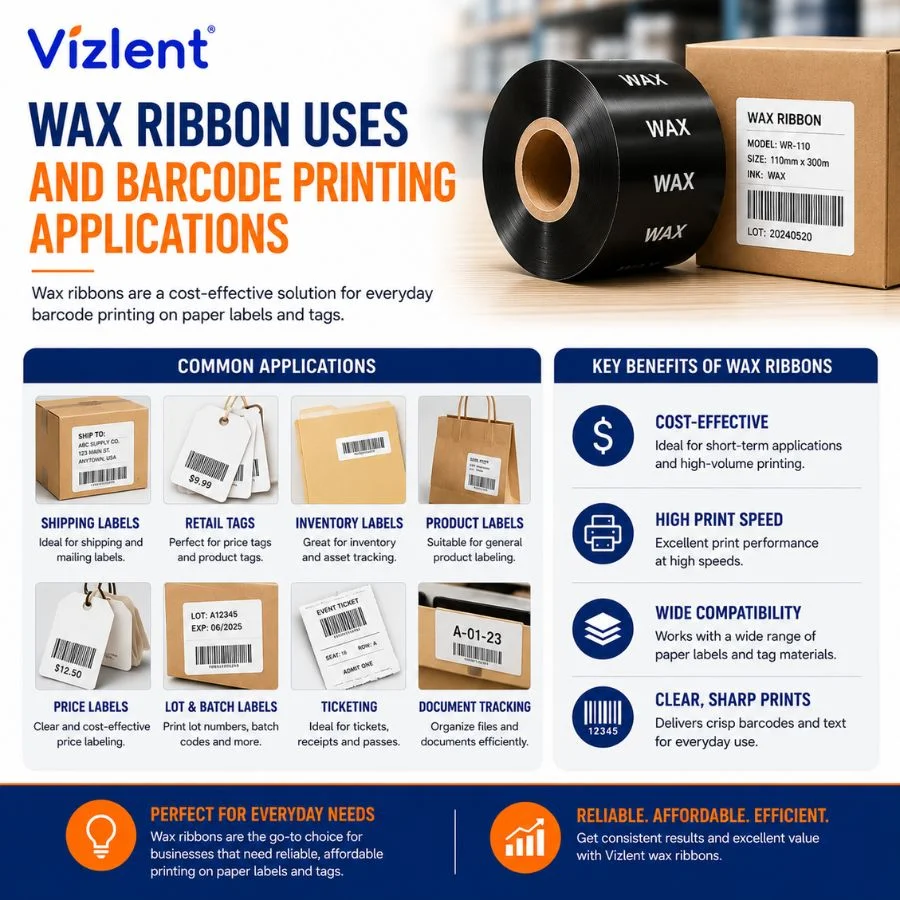
Wax ribbon centers on high-volume, cost-sensitive printing where labels only need to remain legible for days or weeks. Retail price tags, shipping labels, receipt-style tags, and general warehouse labeling all run efficiently on wax ribbon barcode printers because print speed and cost per label matter more than long-term durability. A wax ribbon barcode print job on a paper facestock produces sharp, scannable code density suitable for logistics and point-of-sale environments.
Ribbon wax barcode label setups are common in distribution centers processing thousands of shipping labels per shift, where the label’s job ends once the package reaches its destination. Businesses searching for a wax ribbon for barcode printers near me are typically running standard desktop or industrial printers that accept 25mm to 110mm ribbon widths on paper labels. For bulk sourcing rather than local retail purchase, factory-direct supply offers better pricing and consistent wax ribbon quality across large order volumes.
- Retail and point-of-sale price tags
- Shipping and logistics labels
- Warehouse inventory tags with short shelf life
- General office and administrative barcode labels
Resin Ribbon Uses and Industrial Applications
Resin ribbon applications concentrate on labels that must survive months or years of exposure to chemicals, heat, moisture, or abrasion. Asset tags on machinery, wire and cable identification, automotive VIN labels, and chemical drum labels all rely on resin because the coating bonds permanently to synthetic film and resists smearing under friction. A resin ribbon printer configuration is standard equipment in manufacturing plants, laboratories, and automotive assembly lines where barcode integrity cannot fail.
Pharmaceutical and medical device labeling also depends on resin ribbons, since printed barcodes must remain scannable after sterilization cycles, alcohol wipe-downs, and cold storage. Facilities running near edge ribbon printers for high-speed production lines typically pair the equipment with resin formulations to maintain print quality at faster throughput speeds. Selecting the correct resin grade for the specific facestock and environmental exposure prevents costly relabeling downstream.
- Asset tags and equipment identification
- Automotive and under-hood labeling
- Chemical drum and hazmat labels
- Medical device and pharmaceutical labels
Wax Paper Ribbon and Facestock Compatibility
A wax paper ribbon pairing refers to the most common thermal transfer combination in the industry: a wax-coated ribbon printing onto an uncoated or semi-coated paper facestock. This pairing produces reliable, cost-effective results for any application where the label will be read and then discarded or replaced within a short timeframe. The soft wax coating melts easily onto the paper fibers, producing dense black print with minimal printer maintenance.
Attempting to use a wax paper ribbon setup on synthetic film facestocks like polyester or vinyl typically fails, since wax does not bond well to non-porous surfaces. Ribbons and wax coatings depend on facestock porosity for proper ink transfer, which is why matching coating type to facestock material remains a foundational step in the label specification process. A waxy ribbon that performs well on paper will underperform significantly once applied to a synthetic film it was never designed for.
Wax Ribbon Blueprint: Choosing the Right Configuration
Building a wax ribbon blueprint for a new print application starts with three questions: what facestock is being printed on, how long the label needs to remain legible, and what environmental conditions the label will face. Printer compatibility also matters, since ribbon width and core size must match the specific printer model being used across a production line. Getting this specification right the first time avoids wasted trial runs and inconsistent print quality across batches.
Because the difference between wax and resin ribbons often comes down to facestock alone, a general-purpose wax formulation on paper facestock covers most standard barcode and price tag needs without added cost. For any application involving synthetic film, moisture, or physical handling beyond light use, the specification should shift toward resin or wax resin ribbon options instead. Working directly with a ribbon manufacturer on facestock, adhesive, and coating compatibility helps converters avoid the guesswork that leads to failed print runs.
Resin Ribbon Price and Purchasing Considerations
Resin ribbon price varies based on roll length, ribbon width, and the specific resin formulation required for the target facestock. A standard resin ribbon roll generally costs more per meter than wax or wax resin alternatives, reflecting the added raw material cost and the manufacturing precision needed for consistent resin coating thickness. Buyers evaluating resin ribbon price should factor in total cost per scannable label over the asset’s lifespan, not just the sticker price per roll.
Bulk purchasing from a factory-direct manufacturer typically brings resin ribbon price down significantly compared to small-batch retail purchases, particularly for converters ordering container-load volumes. Requesting free samples before committing to a bulk order lets label buyers verify print density, scan accuracy, and chemical resistance on their actual facestock and printer combination. Reach out through our contact page for a custom resin ribbon quotation based on your roll width, core size, and order volume.
Choosing correctly between wax and resin, or the hybrid wax resin option in between, protects print quality, reduces reprint costs, and keeps barcodes scannable for the life of the label. Our engineering team reviews facestock, adhesive, and environmental requirements for every ribbon inquiry to recommend the correct coating and width for your printer. Send your inquiry today for a factory-direct quotation on wax, resin, or wax resin thermal transfer ribbons.
For converters and distributors evaluating a full labeling program rather than ribbons alone, explore our complete range of thermal transfer ribbons and resin ribbon options built for industrial-duty applications. Free samples are available to test print density, scan accuracy, and durability on your own printer before committing to a bulk order. Contact our team to request samples or discuss custom ribbon specifications for your production line.
Frequently Asked Questions
What is the difference between wax and resin ribbons?
The difference between wax and resin ribbons is coating chemistry and durability. Wax ribbons use a low-melt wax coating suited to paper labels with short-term readability needs, while resin ribbons use a higher-melt resin coating built to survive heat, chemicals, and abrasion on synthetic facestocks. Wax costs less per roll and prints faster, while resin costs more but lasts significantly longer in demanding environments.
Which is better, wax or resin ribbon?
Neither option is universally better in the difference between wax and resin ribbons debate, since the right choice depends entirely on the facestock and end-use environment. Wax suits paper labels that only need to stay legible for days or weeks, such as shipping labels and price tags. Resin suits synthetic labels that must remain scannable for months or years under chemical, heat, or friction exposure.
Can I use a wax ribbon on synthetic film labels?
Wax ribbons generally perform poorly on synthetic facestocks like polyester or vinyl because the coating does not bond well to non-porous surfaces. Print quality on film labels tends to smear or scratch off quickly when using wax instead of resin. For any synthetic film application, resin or wax resin ribbon formulations produce far more reliable results.
What is a wax resin ribbon used for?
A wax resin ribbon is a hybrid formulation used when a label needs better durability than pure wax but does not require the full chemical and heat resistance of pure resin. It works well on coated paper and select synthetic films that face light handling or moderate smudge risk. Common applications include retail apparel tags and mid-durability inventory labels.
How do I know which ribbon width to order?
Ribbon width should match or slightly exceed the width of the label facestock being printed, and it must fit the specific printer model’s ribbon spindle and core size. Checking the printer manual or the original ribbon packaging confirms the correct width and core diameter. Ordering the wrong width causes wrinkling, poor print quality, or ribbon jams inside the printer mechanism.
Why does resin ribbon cost more than wax ribbon?
Resin ribbon price is higher because the coating formulation requires more raw material precision and higher transfer temperatures to bond correctly to synthetic facestocks. The added durability that resin provides against chemicals, heat, and abrasion also reflects added manufacturing complexity compared to standard wax coatings. Despite the higher upfront cost, resin often reduces total cost through fewer reprints and relabeling incidents.
Do wax and resin ribbons work in the same printer?
Most thermal transfer printers support both wax and resin ribbons as long as the printer allows temperature and print speed adjustments for each ribbon type. Printer settings typically need reconfiguration when switching between ribbon types to match the correct melt temperature for the coating being used. Checking printer specifications before ordering ribbons prevents compatibility issues during production.
What industries rely most heavily on resin ribbons?
Automotive, pharmaceutical, chemical manufacturing, and logistics industries rely most heavily on resin ribbons because their labels face chemical exposure, sterilization, outdoor weather, or heavy physical handling. Asset tracking and equipment identification programs also depend on resin for long-term barcode legibility. Any industry where a label failure creates compliance or safety risk typically defaults to resin over wax.






