
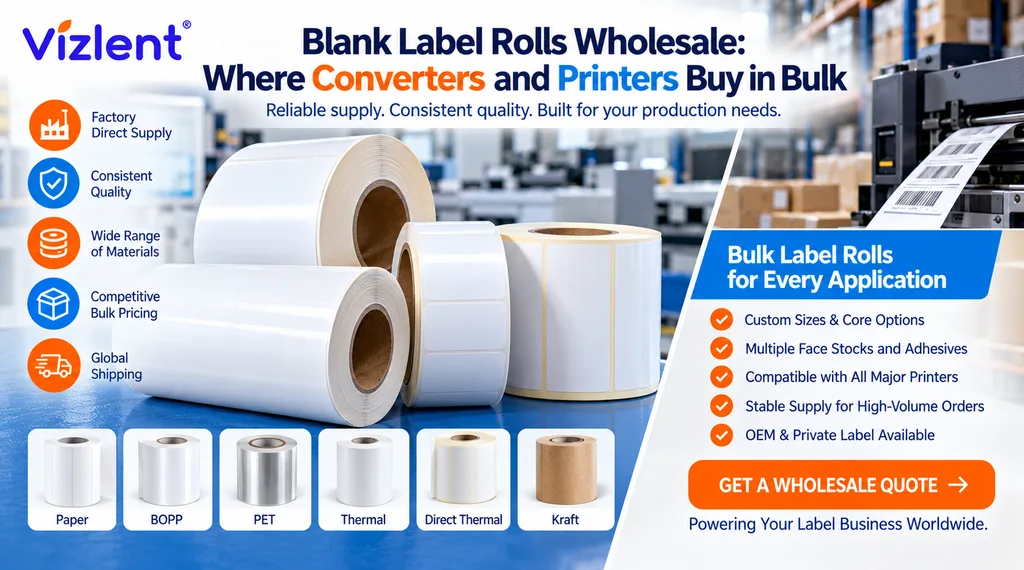
Blank label rolls wholesale is the bulk purchase of unprinted pressure-sensitive label stock, supplied as jumbo rolls or precision-slit rolls, by converters, printers, and distributors like Vizlent Label who print and die-cut the material themselves. The rolls carry no artwork and often no die-cut shape. What the buyer pays for is a coated web of facestock, adhesive, and release liner, wound to a specified width, core, and diameter.
That distinction matters more than most buyers expect. A finished label is bought on artwork and unit price, while unprinted stock is bought on caliper tolerance, adhesive coat weight, release force, and roll geometry. Those variables strongly influence whether the roll runs consistently on your press.
What You Are Actually Buying When You Order Blank Label Rolls Wholesale
Conventional pressure-sensitive label stock consists of three primary components, and each is priced separately. The facestock is the printable top web, the pressure-sensitive adhesive bonds it to the application surface, and the siliconised release liner protects the adhesive until dispensing. Vizlent’s published durable label construction data gives a typical adhesive coat weight of 17 to 25 g/m² and a liner of 75 to 80 µm, varying by substrate and service requirement.
Those numbers are where wholesale label rolls stop being a commodity. Coat weight drives tack and shear, liner caliper drives dispensing speed and matrix stripping, and facestock caliper drives die-cut consistency. A buyer who specifies only “white paper, 100mm wide” has handed every performance variable to the supplier’s default.
- Facestock: semi-gloss paper, woodfree, thermal top-coat, BOPP, PET, PVC, vinyl, polyimide
- Adhesive: permanent acrylic, removable, freezer grade, wash-off, hot-melt rubber-based
- Liner: glassine, clay-coated kraft, or PET for high-speed automatic application
- Format: jumbo master roll, precision-slit roll, or sheeted stock
Vizlent’s raw material label stock range covers all three formats from one coating line.
Who Buys in Bulk, and What Each Buyer Optimises For
Buyer profile shapes the specification more than industry does. Converters buy jumbo or wide-slit rolls because they run their own slitters, so they optimize for splice-free length, tension consistency, and coat weight uniformity. Print service providers buy slit rolls at press width, so they optimize for core size, unwind direction, and roll outside diameter.
Distributors occupy a third position, buying blank label rolls wholesale and retail on the same purchase order and splitting volume across trade accounts and walk-in customers. Their constraint is inventory turn rather than press compatibility, which pushes them toward a narrow range of high-velocity constructions. A blank label rolls wholesale business built on twelve SKUs turns faster than one built on eighty.
| Buyer type | Typical format | Primary specification driver |
|---|---|---|
| Label converter | Jumbo or master roll | Slit width, roll length, coat weight uniformity |
| Print service provider | Slit roll at press width | Core ID, unwind position, roll OD |
| Distributor or reseller | Mixed slit widths | Inventory turn, stocked range |
| In-plant or brand owner | Printer-specific slit roll | Printer compatibility, barcode grade |
Formats are indicative. Confirm against the supplier’s technical data sheet before ordering.
Ready to spec a roll? Send your facestock, adhesive, and roll dimensions to Vizlent’s engineering team and request free samples before committing to bulk.
The Four Channels for Blank Label Rolls Wholesale Supply
Coating mills sell the wholesale label stock they manufacture, which gives the buyer direct access to formulation, coat weight, and liner choice. Master distributors buy from mills, warehouse regionally, and slit to order, converting long lead times into next-day availability at a margin. Many converters use a combination of mill-direct and distributor sourcing depending on volume, lead time, and inventory requirements.
The remaining two are situational. Converter-to-converter sales move overrun stock at attractive pricing with no guarantee of repeat availability, which rules them out for a qualified production construction. Marketplaces list blank label rolls for sale at published prices, useful for trials but rarely supplying the technical data sheet qualification requires.
- Coating mill direct: potentially lower unit cost at volume, full spec control, higher MOQ, longer lead time
- Master distributor: fast, small quantities, limited range, distributor margin
- Converter overrun: opportunistic pricing, no repeat supply guarantee
- Marketplace: convenient for trials, thin technical documentation
Vizlent operates as the first of these, positioning its model as factory-direct so buyers source from its own coating and slitting operations.
Facestock, Adhesive, and Liner: The Three Specs That Move Your Price
Facestock sets both the material cost and the performance ceiling of bulk label rolls. Coated paper gives the best print quality per dollar for dry goods and shipping, while film facestocks such as BOPP and polyester hold up where paper wrinkles or absorbs moisture. Vizlent publishes 12+ facestocks paired with 8 adhesive grades at the time of writing, covering permanent, removable, freezer, and wash-off systems.
Adhesive selection is where most blank label rolls wholesale orders go wrong, because buyers name the surface without naming the condition. The same permanent acrylic that performs on clean room-temperature corrugated can fail on a chilled HDPE drum or a low-surface-energy recycled board. Application temperature, surface energy, and dwell time before service all belong on the specification sheet.
- Ask for coat weight in g/m², not “strong” or “standard”
- Ask for release force, which governs dispensing speed on automatic applicators
- Ask for the liner substrate and caliper, since glassine and PET behave differently at speed
- Ask for the application temperature window separately from the service temperature range
Vizlent specifies its low temperature, heat resistant, and outdoor weather resistant ranges as distinct constructions rather than variants of one stock.
Roll Format: Widths, Cores, Diameters, and Unwind Direction
Roll geometry is frequently left to the supplier and can cause rejected deliveries when the finished roll does not match the press or applicator. Vizlent publishes roll widths from 30mm to 1300mm, with jumbo rolls up to 1200mm splice-free at the time of writing. Precision slitting from the same lines produces custom slit label rolls sized to your press rather than to a catalogue width.
Core inside diameter, roll outside diameter, and unwind position complete the format. Core ID must match the press mandrel or air shaft, outside diameter is limited by unwind station clearance, and unwind position sets which way the label faces as it leaves the roll. Many label suppliers use an eight-position unwind diagram, though the numbering is not universal, so confirm the convention rather than quoting a number.
| Format variable | What to specify | Why it matters |
|---|---|---|
| Slit width | Exact mm plus tolerance | Registration and die-cut alignment |
| Core ID | mm or inches | Physical fit on mandrel or air shaft |
| Roll OD | Maximum mm | Unwind station clearance |
| Unwind | Position, with a sketch | Label orientation and feed direction |
| Splices | Maximum permitted per roll | Press stoppages and waste |
Confirm all figures against the supplier’s current technical data sheet and your press manual.
Working to a tight slit tolerance? Explore Vizlent’s self-adhesive material range and send your press width, core, and unwind requirements.
Print Method Compatibility Is a System Property, Not a Roll Property
Whether a blank roll prints well depends on the complete print system, not the facestock alone. Blank thermal label rolls in direct thermal construction need a heat-sensitive top coat and print without a ribbon, which suits short-life shipping and receipt work. Thermal transfer stock needs a ribbon chemistry matched to the facestock, with wax commonly used on paper, resin on films and harsh environments, and wax-resin between them.
Digital and conventional methods place their own demands on the surface. Inkjet needs a receptive top coat, laser needs dimensional stability through the fuser, and flexo needs consistent surface energy. Vizlent maintains dedicated inkjet printing and laser printing ranges alongside its thermal transfer ribbon line.
- Ribbon width is set by the printer, printhead, and printable area per the manufacturer, not by label width alone
- Barcode print quality is assessed under ISO/IEC 15416:2025 for linear symbols and ISO/IEC 15415:2024 for two-dimensional symbols
- Those standards define measurement and grading methods; they do not set an acceptance threshold for your application, so set your own minimum grade before sample testing
Automotive Programmes: Where Durability Changes the Order
Automotive labelling is a major end use for blank stock, and the specification bar sits well above general packaging. Automotive buyers typically need under-hood, VIN, or component identification stock that survives oils, solvents, and sustained heat. Vizlent’s published automotive positioning cites AIAG B-10 and SAE J2681 with continuous service temperatures up to 150°C on high-temperature constructions.
The aftermarket buys differently. An automotive aftermarket programme is usually a barcode and bin-location application on thermal transfer, where scan reliability matters more than chemical resistance. A dealership network or dealer group parts department orders at branch level in small slit widths, which normally routes through a distributor rather than a mill.
- Under-hood and powertrain: polyimide or high-temperature PET with resin ribbon
- VIN and safety labels: destructible or tamper-evident constructions
- Parts bins and racking: blank barcode label stock on paper or synthetic thermal transfer
- Tyre and rubber marking: vulcanisation-resistant constructions
Vizlent’s automotive label and durable label ranges cover these, and its resin ribbon line pairs with the high-temperature facestocks.
What “Near Me” Actually Buys You
Searches for blank labels near me almost always resolve to a distributor’s stocked range rather than to a manufacturer. Local sourcing of blank shipping label rolls buys speed, small minimums, and the ability to inspect a roll before committing, which is genuinely valuable during a press trial or an emergency reorder. It does not buy formulation control, coat weight specification, or a custom construction at volume.
The trade-off shows up on repeat orders. A distributor’s stocked construction can change without notice when its own supply shifts, which is manageable for ad hoc work and disruptive for a qualified production line. Record the construction code on every order so you can detect a substitution before it reaches the press.
Author recommendation: run local distribution for trials and urgent gaps, and mill-direct for any construction qualified into production.
Import, Customs, and Landed Cost
Bulk stock bought direct from a coating mill usually crosses a border, which puts customs classification inside the buying decision. Under the Harmonized System, paper-based pressure-sensitive stock may fall under heading 4811.41 for gummed or adhesive paper, while plastic-based self-adhesive flat products can fall under heading 3919, subject to the product’s characteristics and the applicable tariff schedule. These are classification references, and the binding classification depends on the product, the destination tariff schedule, and your broker’s determination.
Landed cost is where blank label rolls wholesale bulk pricing is won or lost. Unit price, freight mode, duty rate, Incoterms allocation, and inventory carrying cost all move together, and a low ex-works price on stock that ties up six months of working capital is not a saving. Vizlent’s published export practice covers moisture-proof wrapping, palletised export packing, and shipment to more than 50 countries at the time of writing.
- Confirm classification with a licensed broker before the first shipment
- Agree Incoterms explicitly, since they allocate freight, insurance, and customs responsibility
- Price the full landed cost per square metre, not the roll price
Qualifying a Blank Label Rolls Wholesale Supplier Before the First Container
Qualifying a blank label rolls wholesale supplier is a documentation exercise before it is a price negotiation. Ask whether the supplier coats its own material or works through affiliated factories, since a pure trading company and a mill answer technical questions very differently. Then ask for quality credentials in writing. Vizlent publishes manufacture under ISO 9001 quality-management processes, FSC certification for applicable forest-based materials, and SGS testing or certification documentation for specified products.
Sample testing separates a qualified supplier from a quoted one. Vizlent’s published programme provides free A4 sheets and sample rolls across paper, film, and thermal materials so buyers can check ink receptivity, peel performance, and die-cutting on their own equipment. Treat short sample trials as screening conditions rather than proof of long-term service life.
- Define written acceptance criteria first: edge lift limit, minimum barcode grade, no delamination, no print transfer, minimum peel result
- Request the technical data sheet, not a web page, for every construction considered
- Run samples on your own press, at your own speed and tension settings
- Ask for current compliance documentation for your intended use and jurisdiction
- Quote at volume only after the construction passes, recording the construction code on the purchase order
Peel adhesion is commonly measured under ASTM D3330/D3330M-04(2025), a test method for pressure-sensitive tape whose own significance section notes that peel results usually bear no direct relationship to a functional requirement. It compares constructions; it is not a pass mark for a finished label.
Regulatory Exposure Sits With the Printed Label, Not the Blank Roll
A blank roll carries no regulatory content, but the construction decides whether the finished label can meet its obligations. For food applications in the United States, depending on the construction and intended food-contact use, applicable FDA provisions can include 21 CFR 175.105 for adhesives used as components of packaging and, where relevant, 21 CFR 175.125. Citing a CFR section does not by itself establish compliance for your product.
Industrial applications carry their own durability expectations. OSHA’s Hazard Communication standard at 29 CFR 1910.1200 establishes requirements for labels and warnings on hazardous chemicals, so the finished construction should be selected to remain legible and attached for the conditions the applicable labelling system requires. Requirements vary by market, product category, and intended use.
Sourcing for a regulated application? Review Vizlent’s pharmaceutical and healthcare range or the logistics and e-commerce range, then send your specification.
Start With a Specification, Not a Price Request
Buyers who get consistent stock send a specification first and ask for a price second. A blank label rolls wholesale programme built on a documented construction, a qualified sample run, and a recorded construction code survives supplier changes, staff changes, and press changes. One built on a verbal description of “the usual white paper” does not.
Vizlent has coated and slit label jumbo rolls and finished self-adhesive label rolls since 2011, supplying converters, printers, and distributors in more than 50 countries with stock manufactured under ISO 9001 quality-management processes, FSC certification for applicable materials, and SGS testing documentation for specified products. The engineering team reviews incoming specifications and recommends constructions rather than quoting from a catalogue.
Your next five steps:
- Submit your specification: facestock, adhesive requirement, roll dimensions, core, unwind, and print method
- Receive a recommended construction from the engineering team
- Request the technical data sheet for that construction
- Test free samples on your own press against written acceptance criteria
- Quote at volume once the construction passes
Send your specification to Vizlent now and request free sample rolls. Compare constructions in the durable label range, the laminating film range, or the technical knowledge base.
Frequently Asked Questions
What is the minimum order for blank label rolls wholesale?
Minimums vary by supplier type and material, with mills setting higher floors than distributors. Vizlent publishes a general 1,000 sqm minimum at the time of writing, varying by material, with trial-order support. Distributors typically sell single rolls at a higher unit price, which makes them the practical route for press trials.
What is the difference between jumbo rolls and slit rolls?
A jumbo roll is the full-width master roll straight off the coating line; a slit roll has been cut to a finished width for a specific press. Converters with their own slitting lines buy jumbo to lower cost per square metre. Printers without slitting capability buy precision-slit rolls at press width.
Can one supplier serve both wholesale and retail buyers?
Some suppliers serve both channels, though terms usually differ. Manufacturers optimize for container-scale orders with custom constructions, while distributors optimize for stocked ranges and small quantities. Buyers running both a trade and a walk-in business often keep one supplier for each.
How do I know which adhesive grade I need?
Specify the application surface, the application temperature, the service temperature range, and whether the label must be removable. Those four inputs narrow the adhesive family faster than any product name, and the supplier’s engineering team can then recommend a construction. Confirm the choice with sample testing on your actual substrate.
Do blank label rolls expire?
Pressure-sensitive materials have a recommended shelf life, and adhesive and liner performance can change under extended or poorly controlled storage. Suppliers typically publish storage conditions covering temperature and relative humidity, which form part of the specification. Ask for that guidance in writing when you qualify a construction.
Is buying blank label rolls wholesale cheaper than buying pre-printed labels?
Unprinted stock generally has a lower material cost per square metre than a finished printed label. The total economics depend on your printing, converting, labour, waste, and equipment costs, all of which move onto your side of the ledger. Buyers without in-house converting often find finished labels cheaper on a fully costed basis.
What documentation should come with a bulk shipment?
Expect a technical data sheet per construction, a batch or lot identifier, and the quality certifications relevant to your application. For regulated end uses, request current compliance documentation for your intended use and jurisdiction rather than a generic certificate. Record the construction code on the purchase order so reorders match.
How long does a custom order take?
Custom constructions require formulation, coating, curing, slitting, and inspection, so lead times run longer than stocked distributor items. Vizlent publishes 7 to 15 days for custom OEM/ODM production at the time of writing, with export transit on top. Build both figures into your reorder point.






