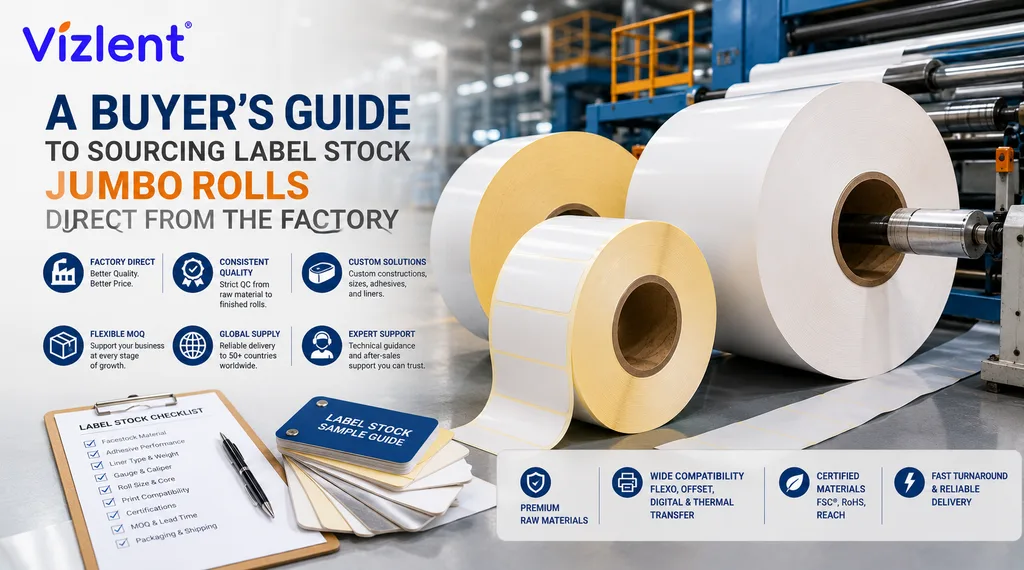
Sourcing Label Stock Jumbo Rolls means purchasing wide, unslit master rolls of pressure-sensitive label laminate directly from a coating factory for conversion into finished label reels. Roll widths vary by coating line and construction, with many commercial jumbo rolls produced around 1,000 to 1,300 mm wide. Factory-direct sourcing can reduce distributor layers while giving converters clearer visibility into the facestock, adhesive, liner, coating, and roll specifications before placing an order.
I have spent fifteen years on the manufacturing side. Converters get burned by the same three things: a coat weight nobody documented, a liner too light for their die station, and a quote that looked cheap until freight landed. What follows is the checklist I give buyers sourcing direct for the first time.
What to Specify When Requesting a Jumbo-Roll Quote
Most quoting delays come from incomplete inquiries rather than slow suppliers. A coater cannot price a construction it cannot picture, so a vague request produces a vague number that changes later. Sending a complete specification on the first email usually cuts a week off the quoting cycle.
Treat the list below as the minimum inquiry package. Anything you leave blank becomes an assumption the supplier makes on your behalf. Where you genuinely do not know a value, say so and ask for a recommendation rather than omitting the line.
Include every one of these in your first inquiry:
- Facestock material and grade
- Facestock caliper
- Adhesive chemistry
- Adhesive coat weight
- Minimum application temperature
- Service temperature range
- Liner material
- Liner caliper
- Roll width
- Roll outside diameter
- Core inside diameter
- Core width
- Winding direction
- Maximum roll weight your equipment accepts
- Quantity and expected annual volume
- Required certifications and documentation
- Intended converting and printing process
What Jumbo Roll Label Stock Actually Is
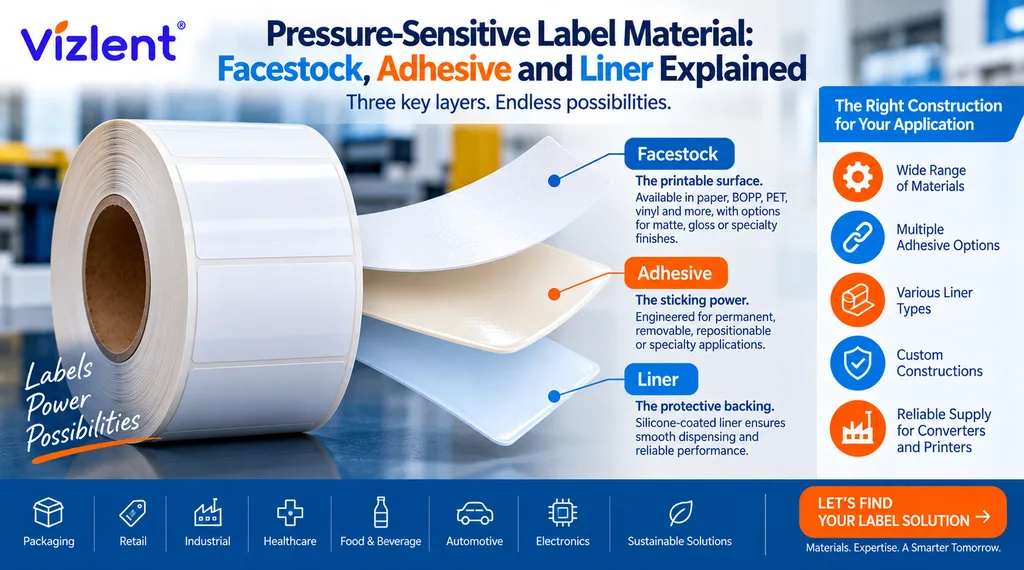
A jumbo or master roll is a wide roll of coated labelstock that is typically slit into narrower finished reels. The laminate is built as a single construction: facestock on top, adhesive in the middle, silicone coated release liner underneath. Everything downstream is a subdivision of that web.
Buyers sometimes search for label stock jumbo rollstock, the trade term for the same product described as continuous web rather than as a roll. Both point to unslit, full width self-adhesive label material sold by weight or linear meter. Suppliers use the words interchangeably, which is shorthand rather than a red flag.
The three layers you are buying:
- Facestock: paper, PET, BOPP, PVC, or specialty film, setting printability and temperature range
- Adhesive: acrylic, hot melt rubber, or silicone, specified by coat weight in gsm
- Release liner: glassine, PET, or kraft, with release value measured in grams per 25 mm
Why “Label Stock Jumbo Rolls Bath Tissue” Pulls Up the Wrong Product
Searching label stock jumbo rolls and bath tissue collides two unrelated industries. Tissue converters also buy jumbo rolls, but theirs are parent rolls of tissue paper headed for bath and towel lines, with no adhesive and no liner. The categories share a phrase and nothing else.
This matters because tissue mills and label coaters surface in the same marketplace categories. A buyer can waste a week emailing the wrong factories. Scan the product page for “adhesive,” “release liner,” and “silicone” before sending an inquiry.
Why Factory Direct Changes Your Cost Structure
Every intermediary adds handling, storage, financing, logistics, and margin, and none of them add adhesive performance. A distributor buys the same jumbo roll you would, slits it, warehouses it, and resells it, so the delivered price can be materially higher than factory-direct pricing. That difference buys real convenience, which is why distribution makes sense at low volume and short lead times.
At volume the calculation shifts. Once you consume full pallets of Label Stock Jumbo Rolls monthly, carrying your own inventory often costs less than paying for someone else to carry it. You also gain what distribution cannot sell, which is direct access to the formulation team when a job fails.
What direct sourcing gets you:
- A named adhesive formulation with published coat weight, not just “permanent acrylic”
- Certificates of analysis tied to a specific production lot
- Roll widths cut to your slitter, not a distributor’s standard program
- A factory-direct raw material program priced against committed volume
What Actually Drives Label Stock Jumbo Roll Cost
Label stock jumbo roll cost is driven by chemistry far more than by roll size. A paper faced permanent acrylic and a PET faced high temperature construction can differ substantially per square meter. Diameter and width move handling and freight, not the base rate.
Three variables carry most of the number, and each is negotiable separately. Facestock grade sets the floor, adhesive chemistry and coat weight set the middle, liner choice adds the rest. Ask for pricing broken out along those lines, because that is the only honest way to compare quotes.
Pricing a construction? Send your facestock, adhesive, and liner requirements to the Vizlent technical team and request a per square meter breakdown rather than a bundled figure.
The Specification Sheet to Demand Before Any Quote
A serious supplier sends a technical data sheet before you ask twice. It should state facestock type and caliper, adhesive type and coat weight, liner type and basis weight, total caliper, and service temperature range. Missing any of those five makes a quote uncomparable.
Then ask for the numbers that predict press and field behavior. Peel adhesion, loop tack, and shear resistance are three widely used adhesive-performance measurements. They are assessed against published methods rather than house methods, which is what lets you score two suppliers on one scale.
Methods worth naming in your inquiry:
- FINAT FTM 1: 180 degree peel adhesion, which FINAT specifies at 300 mm per minute, published by the Federation of European Manufacturers of Self-Adhesive Labels and Labelstock
- FINAT FTM 9: loop tack, measuring initial grab under the method’s stated conditions
- ASTM D6195: a North American loop tack test method
- UL 969: adhesion and legibility criteria for marking and labeling systems
- BS 5609: marine immersion and printed-label durability requirements used for certain dangerous-goods labels intended for marine transport
Roll Geometry, Cores, and the Label Stock Jumbo Rolls Holder Question
Geometry is where a good price becomes a bad delivery. Confirm outside diameter, core inside diameter, core wall thickness, roll weight, and winding direction before production starts. A wide roll at full diameter can weigh several hundred kilograms, making it a forklift question rather than a purchasing one.
Buyers researching a label stock jumbo rolls holder are specifying the unwind stand, shaft, and chuck assembly that carries the roll. Core sizes vary by roll dimensions and converting equipment, though 3 inch cores are common in many jumbo-roll applications while 1 inch and 76 mm cores appear on slit reels. Core mismatch is a preventable reason a delivered roll can sit unused for weeks.
Matching Facestock to the Application
Facestock selection starts from the failure mode you are avoiding, not from price. Paper faces are the lower cost option and print well, but they tear, absorb moisture, and can yellow under UV exposure. Films generally provide better resistance to moisture, tearing, and dimensional change than comparable paper constructions.
The practical split is narrower than most catalogs suggest. Paper covers retail, shipping, and short life work. Film constructions are often selected where the application demands greater resistance to moisture, chemicals, temperature, abrasion, or long-term handling, with the specific film chosen for the specific exposure.
Common jumbo facestock choices:
- BOPP film: water and oil resistant, in clear, white opaque, matte, or metallized finishes
- PET polyester: dimensionally stable and suited to elevated temperatures, common on rating plates
- PVC vinyl: conformable, often specified for curved surfaces and pipe marking
- Specialty films: polyimide, flame retardant, and heat-resistant constructions rated to their own documented limits
Adhesive Selection Is Where Sourcing Goes Wrong
Adhesive is the layer nobody inspects visually and everybody blames after a failure. Permanent, removable, freezer grade, and wash off describe adhesive functions, but they do not replace construction-specific performance specifications. What you actually need is chemistry, coat weight, minimum application temperature, and service range.
Low surface energy substrates deserve separate attention. Polyethylene, polypropylene, powder coated metals, and textured plastics can present challenging surfaces for standard adhesive constructions. If your customers label those surfaces, ask for a high tack construction and supporting test data rather than assuming a permanent adhesive holds.
Put these questions in writing:
- Coat weight in gsm, and the tolerance that applies
- Minimum application temperature against service temperature range
- Water based, solvent based, or hot melt chemistry
- The 24 hour peel value alongside the 20 minute value
- Whether a freezer grade version exists on the same facestock
Unsure which adhesive fits your substrate? Describe the surface and temperature window, and Vizlent will recommend a construction and send sample rolls for press trials.
Release Liner Choices Affect Your Press
The liner is what buyers ignore and pressrooms complain about. It carries the web through die cutting, matrix stripping, and dispensing without breaking or stretching. A liner that runs fine slowly can fail at speed.
Glassine is the economical default and suits a wide range of paper and BOPP work. PET liners can provide higher tensile strength and dimensional stability, which can benefit demanding die-cutting and high-speed converting. Kraft appears on heavier industrial constructions where strength matters more than appearance.
Liner decision points:
- Caliper: thinner liners fit more meters per roll and cut freight per label
- Tensile strength: PET generally outperforms glassine on fast lines and small die shapes
- Release value: grams per 25 mm, controlling dispensing behavior
- Recyclability: glassine and PET follow different end of life pathways
How to Audit a Factory Before You Commit
Auditing a coater does not require a plane ticket. Start with documentation, because a factory that cannot produce a certificate on request is a factory that does not keep records. Ask for ISO 9001, FSC chain of custody if you need certified paper, and a recent third party test report.
Then test the sample process, which reveals more than any certificate. Request three sample rolls in your working width, on your core, with your specified adhesive. A supplier who delivers the right construction on the right core within the promised window has production planning that works.
A qualification sequence that works remotely:
- Define the failure mode, then work backward to facestock and adhesive
- Verify paperwork: check ISO 9001 and FSC chain of custody numbers against the issuing body’s database, and review the manufacturing background for continuity
- Request a lot specific certificate of analysis, not a template
- Send a substrate sample and ask for a written adhesive recommendation
- Order paid samples, then run press and application trials at production speed
- Place a small first order to confirm packaging, documentation, and lead time
Buying Label Stock Jumbo Rolls Bulk Without Overcommitting
Suppliers quote label stock jumbo rolls bulk pricing against annual or quarterly volume, and the temptation is to commit high for the better tier. That trade only works if consumption is stable and storage is controlled. Shelf life varies by construction and manufacturer, and adhesive performance can drift when material is stored outside the supplier’s stated conditions.
Structure the commitment so tier pricing does not become dead inventory. A blanket order with scheduled releases gives you the price while the supplier holds the material. Most direct manufacturers will agree to this once a few shipments have gone well.
Storage terms worth writing into the agreement:
- Storage under the supplier’s specified temperature and relative humidity conditions, in a controlled indoor environment
- Rolls suspended on shafts or stored on end, never resting on the outer wrap
- First in, first out rotation with visible lot dating and the supplier’s stated shelf-life period on file
Freight, Packaging, and Landed Cost
The quoted price is not the price. Jumbo rolls are heavy, awkward, and easily damaged at the edges, so packaging and freight can shift landed cost meaningfully. Ask for a landed estimate under the Incoterm you actually use.
Damage prevention belongs in the purchase order explicitly. Edge damage can propagate through the slit reels produced from that roll, turning a scuff into scrap. Specify how rolls are packed and how they are loaded.
Label stock jumbo roll packaging requirements:
- Individual rolls wrapped in moisture barrier film
- Rigid edge protectors on both faces
- Rolls shipped on end or suspended, never stacked horizontally unsupported
- Pallets stretch wrapped with corner boards
- Roll identification showing lot, width, length, and construction on the outer wrap
Red Flags in Marketplace Listings
Listings advertising label stock jumbo rolls for sale range from legitimate mill offers to brokered surplus of unknown provenance. Surplus is not automatically bad, and buying overruns can be genuinely economical. The problem is that surplus often arrives without a lot of traceability.
Treat any listing without a technical data sheet as unknown material regardless of price. Ask for the original construction code and the production date first. If neither is available, price the material on the assumption that some of it will not run.
Warning signs:
- No data sheet, or one listing no coat weight
- “Permanent adhesive” with no chemistry named
- No production date or lot number
- Unwilling to send a paid sample roll
Applications That Justify Buying at Jumbo Level
Not every converter should buy at jumbo level, and the answer depends on your slitting capacity and utilization. If you operate a slitter rewinder and consume substantial volumes of a stable construction, jumbo sourcing can become economically attractive. If you do not slit in house, buying slit reels direct from the manufacturer still removes a layer.
The applications that justify jumbo buying share one trait, which is steady volume on a construction that does not change often. Label stock jumbo roll stickers for retail and promotional work, logistics labels, drum labels, and beverage labels all tend to fit. Specialty and low volume work is usually better served by slit reels.
Where it tends to pay off first:
- Logistics and e-commerce: predictable annual draw on logistics labeling materials
- Industrial and chemical: PET and vinyl durable label constructions with documented performance data
- Security and tamper evident: VOID and destructible stock where formulation control matters
- Print and overlaminate programs: base stock matched to laminating film and the correct thermal transfer ribbon from one source
Start With Samples, Not a Container
Sourcing Label Stock Jumbo Rolls direct rewards buyers who treat specification as their own responsibility rather than the supplier’s sales pitch. Get the data sheet, run the press trial, confirm the core, then discuss annual volume. The suppliers worth keeping welcome that order of operations.
Vizlent has coated and slit pressure sensitive label materials since 2011, supplying converters and brand owners with ISO 9001 certified constructions across paper, PET, BOPP, PVC, and specialty films. If you are evaluating a new construction or a new supplier, the fastest first step is a sample roll in your working width.
Request a sample roll and technical data sheet from Vizlent, listing your facestock, adhesive, and liner requirements, and ask for pricing broken out by layer.
Frequently Asked Questions
What is the standard width of a label stock jumbo roll?
There is no single industry standard, because jumbo width is set by the coating line and the construction. Many commercial jumbo rolls run somewhere around 1,000 to 1,300 mm, and Vizlent lists custom widths from 30 mm up to roughly 1,300 mm depending on the construction ordered. The practical ceiling is usually your slitter rather than the coater, so confirm maximum unwind width and roll weight first.
How much cheaper are Label Stock Jumbo Rolls than slit reels?
Jumbo material can offer a lower material cost per square meter than slit reels, because you absorb the slitting, waste, and handling yourself. The realized saving depends on slitting yield, freight, labor, waste, and order volume, so it varies considerably between converters. Ask both suppliers to quote the same construction in both formats and run the comparison against your own yield figures.
What is the shelf life of pressure sensitive label stock?
Shelf life varies by construction and manufacturer, so use the supplier’s stated shelf-life period rather than a general rule. Adhesive performance, not facestock, is usually the limiting factor, and storage conditions affect how quickly it drifts. Store under the supplier’s specified temperature and relative humidity conditions and rotate stock first in, first out.
Can I get FSC certified paper label stock in jumbo format?
Yes, and FSC certified materials are increasingly requested by brand owners seeking documented responsible-sourcing claims. FSC certification applies to the paper facestock and travels through chain of custody documentation held by parties in the supply chain. If you intend to make an FSC claim on finished labels, confirm the applicable chain-of-custody requirements for your role and supply chain before promising anything to a customer.
What minimum order quantity should I expect from a direct manufacturer?
Minimums generally follow coating run length, so they are quoted in linear meters or kilograms per construction rather than per roll. Standard constructions tend to carry lower minimums than custom adhesive formulations, which need a dedicated coating pass. Ask whether the supplier stocks standard constructions, since stocked items often carry far lower minimums.
How do I compare two quotes that look similar?
Break both into facestock, adhesive, and liner, then compare each line at the same coat weight and caliper. Two quotes that look close often turn out to be different constructions once normalized. Request FINAT FTM 1 peel and FTM 9 loop tack figures from both suppliers so you compare measured performance rather than description.
Do I need special equipment to handle jumbo rolls?
You need an unwind stand rated for the roll weight, a shaft matching the core inside diameter, and a safe way to lift the roll onto it. A wide roll at large diameter can exceed several hundred kilograms, well beyond manual handling. Confirm unwind capacity, shaft diameter, and lifting equipment before your first order.
Is buying direct from an overseas factory practical for smaller converters?
It becomes practical once annual consumption justifies the freight, inventory, and lead-time tradeoffs of direct international purchasing. Smaller converters often start with slit reels from the same manufacturer, then move to jumbo format as volume grows. The technical relationship carries over, which is the real argument for starting direct early.